Stress Management for Leaders: An Operational Playbook
A practical stress management for leaders playbook covering assessment, engineered routines, delegation systems, and bio-optimization built for busy executives.
Jan Kutschera
Your calendar is full, your inbox has developed opinions, and every “quick question” seems to arrive just as you’ve managed to focus. You tell yourself you’ll catch your breath after the launch, the hiring decision, or the next board meeting. But the next urgent thing keeps appearing, and the pressure follows you home.
That pattern isn’t proof you need more grit. Stress management for leaders starts with the way work is designed: how many decisions land on you, how responsibilities are assigned, and whether your routine leaves room to recover. For ADHD and other neurodivergent minds, those design choices matter even more. The answer isn’t to become a different person. It’s to build an operating system that works with the person leading it.
Table of Contents
- Why Smart Leaders Stay Burned Out
- The 10-Minute Leader Stress Audit
- Engineered Routines and Dopamine Design
- Strategic Delegation as a Stress Intervention
- Bio-Optimization the Operating System Runs On
- Measurement That Survives Reality
- Your 30-Day Rollout and a Real Founder Case
Why Smart Leaders Stay Burned Out
Leaders often treat chronic stress as a private weakness: a resilience deficit to fix with better self-talk, another meditation app, or a weekend away. Those tools can help, but they can’t permanently offset a job that keeps producing the same overload. When the inbox, team, and decision flow stay unchanged, relief tends to be temporary.
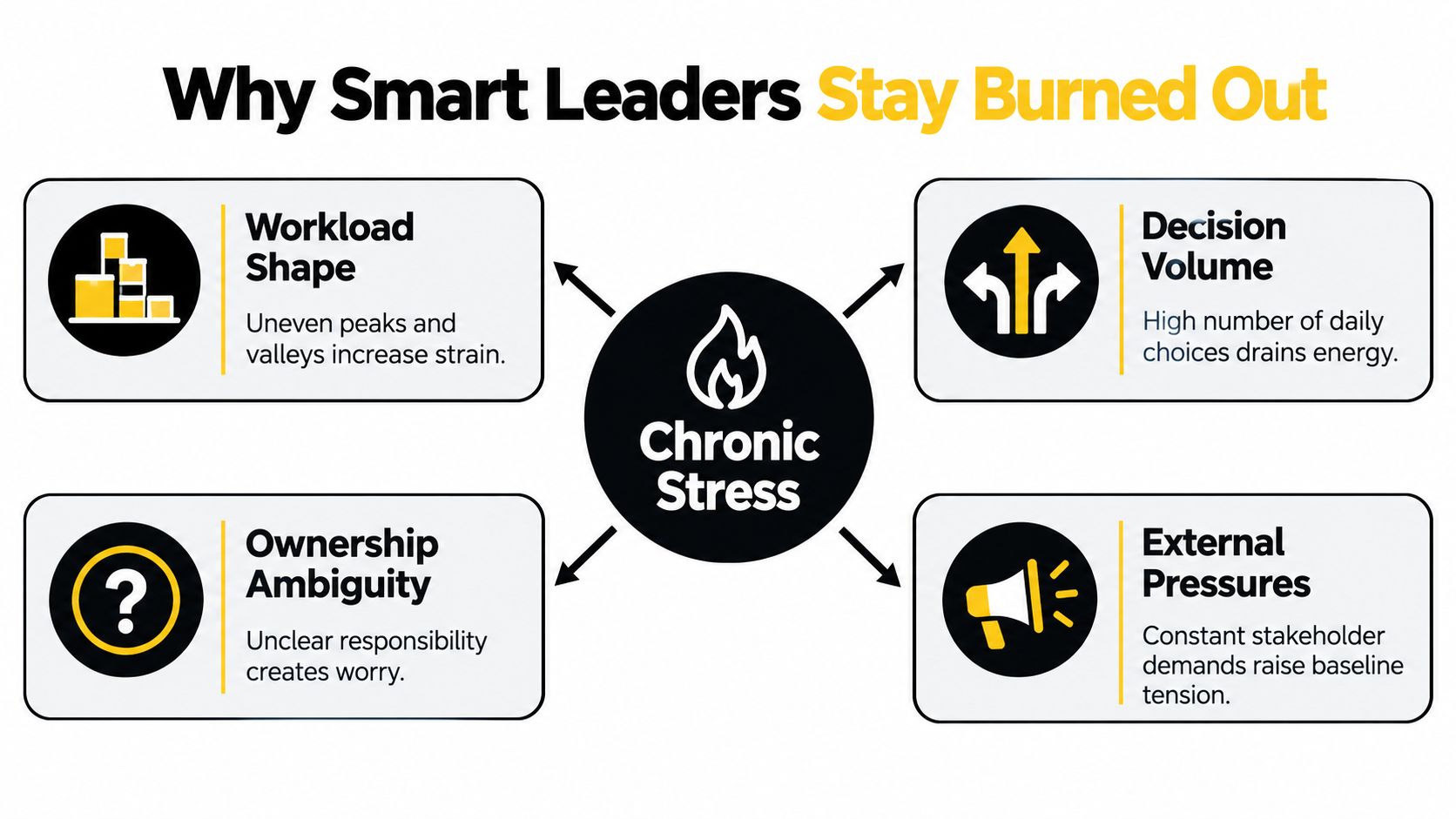
Four sources commonly keep the pressure running. Workload shape matters as much as task count: lurching between quiet stretches and urgent peaks makes it difficult to plan or recover. Decision volume drains attention, especially when small choices crowd out work that requires sustained thought. Ownership ambiguity leaves leaders wondering who will act, whether a handoff is safe, and what might fall through. External pressures, from stakeholder requests to market demands, raise the baseline tension.
Stress is an operating signal
The World Health Organization and International Labour Organization estimated that depression and anxiety cause the loss of approximately 12 billion working days each year worldwide, representing nearly US$1 trillion in lost productivity (WHO workplace mental health guidance). The estimate isn’t a measurement of executive burnout, but it makes clear that workplace mental health has organizational consequences. WHO guidance also points to harmful working conditions and organizational interventions, not only individual self-care.
That’s why a useful response has several parts: assess where pressure comes from, engineer routines that reduce unnecessary switching, delegate work with clear decision rights, and protect the recovery that supports sound judgment. If stress has become difficult to manage alone, therapy for workplace stress can offer a supportive resource alongside changes to the work itself.
Neurodivergence changes the design requirements
ADHD can make time feel slippery, interruptions unusually costly, and repetitive tasks hard to start. Novelty-seeking can drive creative work, while unclear ownership can leave too many open loops competing for attention. Those aren’t character flaws to overcome through sheer discipline. They’re design constraints to account for with visible priorities, fewer handoffs that live only in memory, and reliable ways to decide what happens next.
Practical rule: Don’t ask only how to feel calmer during the next crisis. Ask what change will prevent the next recurring source of crisis.
Stress is not random, and responding to it doesn’t require a personality transplant. When leaders identify the conditions that keep regenerating pressure, they can redesign those conditions instead of repeatedly blaming themselves for reacting to them.
The 10-Minute Leader Stress Audit
Before changing your schedule, establish what’s happening now. A quick audit doesn’t need to diagnose you or generate a beautiful spreadsheet. Its job is to turn “I’m fried” into a few useful signals that point toward a structural change.
Set a timer and answer each prompt in plain language. If you prefer a rating, use the same simple scale for each question: 0 means no strain, and 10 means the most strain you can imagine. The number itself isn’t a clinical measure. It’s a consistent way to notice whether the pattern shifts after you change the work.
Ask what the workday is doing to you
Start with four prompts:
- Stress: “How activated or overwhelmed do I feel during a typical workday?”
- Sleep: “Do I wake rested enough to think clearly, or do I carry fatigue into the morning?”
- Decisions: “Which decisions did only I make this week, and which could someone else have made?”
- Delegation: “What work am I still monitoring because I haven’t made ownership or escalation rules clear?”
Then scan your calendar and task flow. Note whether meetings are crowding out focused work, how often your attention gets broken into fragments, and whether your week contains any protected time to recover. Don’t invent a universal target. The useful comparison is with your own baseline and the demands of your role.
Founders who enjoy pressure can underrate it. If urgency gives you energy, ask what happens afterward: Can you shift into focused work without a deadline looming? Do ordinary tasks stall until they become emergencies? Does a day off leave you restored, or merely behind?
Record signals without turning into a tracking project
If available, add a few objective observations, such as sleep duration or resting heart rate, and record them consistently. Treat them as context, not a verdict. The point is to see whether your experience and the signals you can observe move together, not to chase a perfect score.
A randomized trial involving 174 managers measured perceived stress, mental health, leadership behavior, and nocturnal heart-rate variability before and after a stress-management intervention (trial of manager stress-management training). That kind of measurement makes a useful distinction: feeling better matters, but it can be informative to examine recovery and leadership behavior as well.
Finish by circling the answer that suggests a change to the work itself. If decision load is the problem, a breathing exercise won’t clarify who has authority. If fragmented attention is the problem, better intentions won’t protect focus from a calendar without boundaries. Use the audit to choose a lever, not to build a new job tracking your stress.
Engineered Routines and Dopamine Design
A routine built around adrenaline can look productive from the outside. Work waits until urgency makes it interesting; a looming deadline supplies focus; then exhaustion arrives after the sprint. The problem isn’t that the leader lacks ambition. The problem is that the system makes crisis the most reliable way to start.
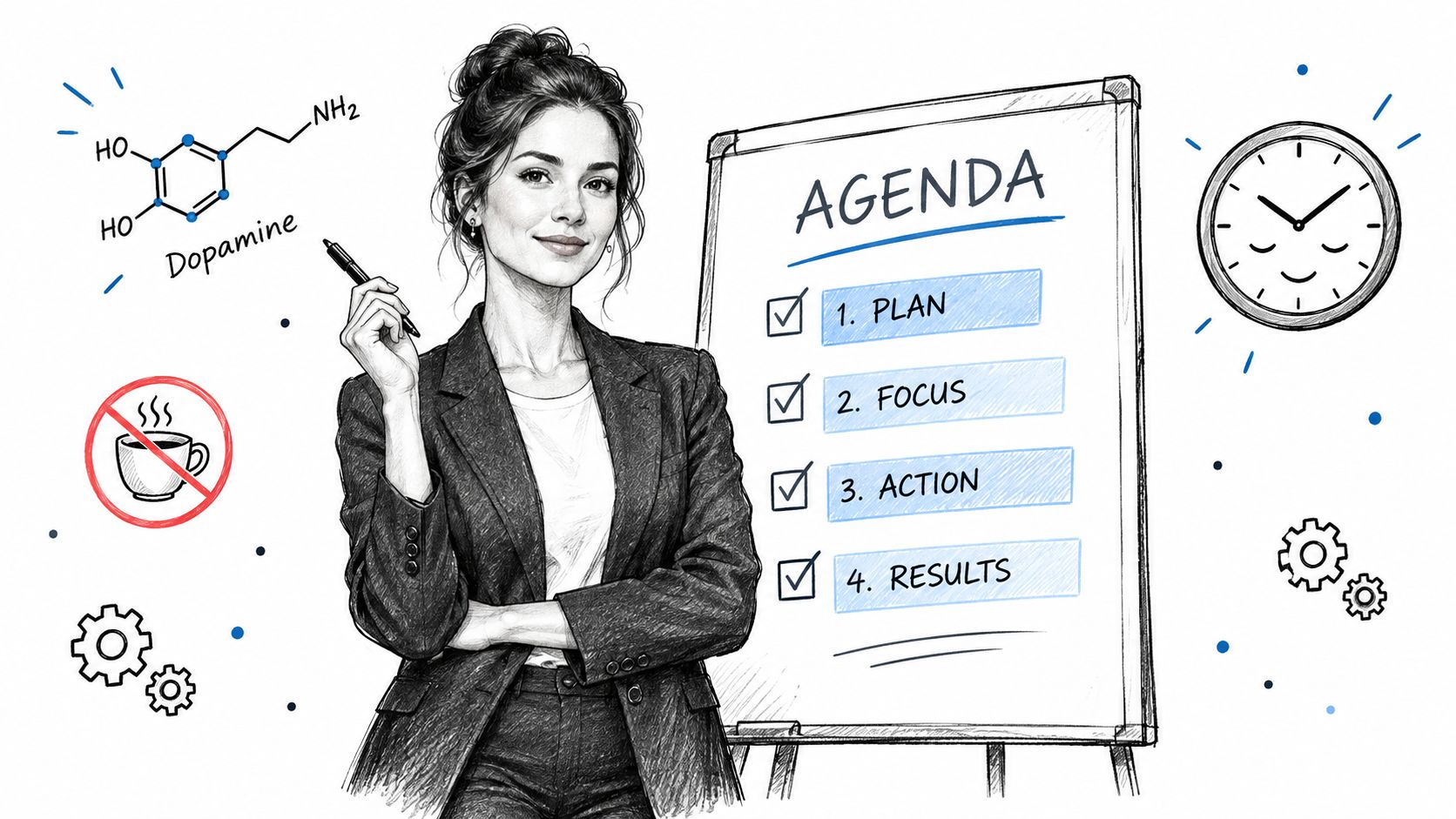
Cognitive architecture replaces the need to keep every task, decision, and reminder in working memory. Put the agenda where you can see it. Use a reusable template for recurring decisions. Time-box focused work, and write down the next physical action before you switch tasks. These structures don’t restrict creative thinking. They save it for problems that require it.
Reward completion, not emergency
For ADHD minds, interest and challenge can make a task easier to enter. Design routines that include those ingredients without waiting for a fire. Turn a vague project into a visible finish line, introduce variety in the order of routine tasks, or make progress tangible with a simple checklist. The aim is to connect reward to completion rather than last-minute rescue.
For example, “work on hiring” is an invitation to drift. “Review the shortlisted candidates and send the next-step decisions” gives the mind a defined outcome. A daily agenda can include one must-ship result, meeting windows, and a recovery appointment. If a habit needs a nudge, tools with guided plans, such as a HYROX training app with smart routines, can help make movement more structured rather than another decision to remember.
A brittle hustle routine says, “I’ll do the important work when I have a clear day.” An engineered routine gives important work a visible place before the calendar fills. That distinction is especially useful when transitions and task initiation take effort. For more on building structure that supports ADHD rather than fighting it, see ADHD and routines.
Make the next useful action obvious before your attention moves elsewhere.
This isn’t about scheduling every minute or turning a founder into a human project-management board. It’s about reducing the small frictions that make the day depend on mood, memory, and panic. External structure creates a dependable starting point; meaningful progress gives the brain a reason to return.
Strategic Delegation as a Stress Intervention
Delegation controls what reaches the leader’s attention. It isn’t a reward for having a quiet week or a way to push unwanted tasks onto a colleague. Done well, it reduces recurring decisions while giving another person genuine ownership.
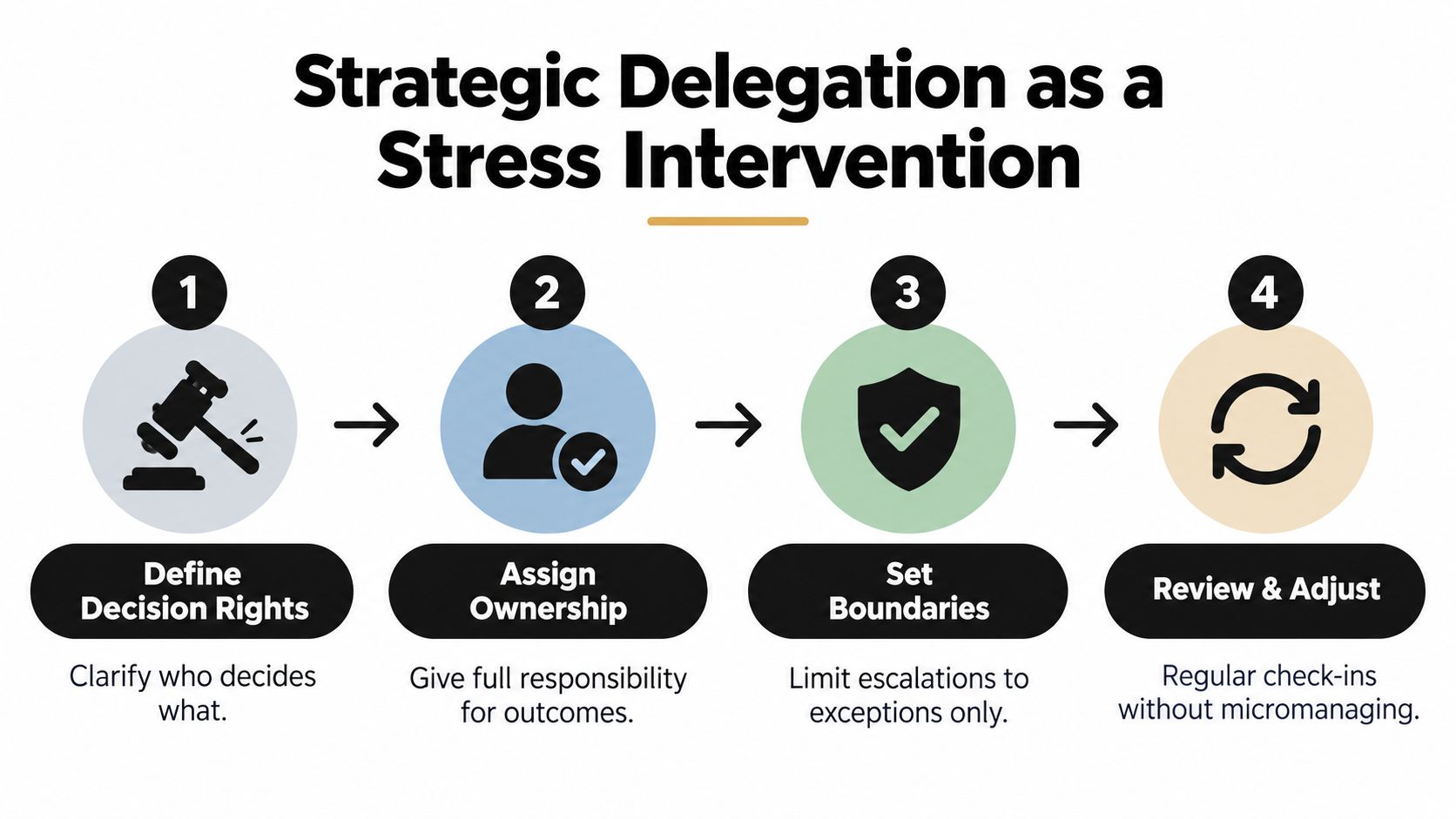
A common failure looks like delegation but feels like surveillance: “You own this, but check with me before every move.” The leader still carries the decision burden, and the teammate adds another layer of questions. The cure is to define what the person can decide, what outcome they own, and which exceptions need escalation.
Hand off work with decision rights attached
Begin with tasks that are reversible, repeatable, low-context, or low-stakes. A teammate can often make a routine choice without the leader reviewing every detail, provided the desired outcome and boundaries are clear. For a handoff, write a short responsibility brief that answers:
- Outcome: What does finished look like?
- Authority: What can the owner decide independently?
- Boundaries: What must they avoid or check first?
- Escalation: Which specific exceptions should come back to you?
- Review: When will you check progress together?
Recent global leadership data found that 71% of leaders experienced a significant increase in stress after entering their current role, while 40% of highly stressed leaders considered leaving leadership to protect their well-being (DDI leadership burnout data). Those figures don’t prove delegation alone will resolve stress, but they underline why leaders should examine the work and support surrounding the role, rather than treating strain as a private stamina test.
Set check-ins in advance and use them to review outcomes and exceptions, not to request a running commentary. Make status updates asynchronous where possible. In meetings, put the decision needed at the top of the agenda, and record who owns the next action. That reduces the familiar cycle in which a meeting creates questions that require yet another meeting.
Here’s a short explanation of the handoff principle in practice:
Delegation fails when the leader transfers the task but keeps the anxiety, by hovering over every step. A good handoff makes control visible in the rules, so the leader doesn’t need to recreate it through constant monitoring. This guide to delegating tasks effectively can help turn that principle into a repeatable practice.
Bio-Optimization the Operating System Runs On
Sleep, movement, and food are often treated as personal perks that leaders can postpone until work calms down. That gets the order backward. The body is where attention, emotional regulation, memory, and judgment have to operate. When recovery is neglected, the work system has less capacity to absorb friction.

Protect the basics that support clear decisions
Start with a consistent wake time you can maintain, and build a short wind-down routine that signals the end of work. Morning light can help mark the start of the day. The aim isn’t to create a perfect sleep ritual; it’s to stop treating every night as an improvised extension of the workday.
Food matters for practical reasons, too. A leader who reaches the afternoon under-fueled may find it harder to manage competing demands, especially when attention already requires deliberate support. Keep meals predictable enough that eating doesn’t become another task that disappears beneath meetings. Notice which choices leave you steady and which leave you foggy, without turning meals into a moral scorecard.
Movement doesn’t need an elaborate training plan to earn a place in the operating system. A walk after a demanding stretch of decisions can create a boundary between work blocks and give your attention a change of pace. Choose something you can repeat, such as a walk, mobility work, or a brief workout, and attach it to an existing cue in the day.
Track just enough to learn
A simple note about sleep, movement, and post-meal energy can reveal patterns without creating a new administrative burden. If you consistently notice low energy after a particular routine, adjust that routine and observe what changes. Don’t build a dashboard so intricate that monitoring your body becomes another high-stakes deliverable.
This is a leadership decision, not a reward for finishing the inbox. The calendar will keep presenting work that feels more urgent than recovery. Leaders have to give the basics a place before that work claims every open space. The minimum viable routine is the one you can keep when the week gets complicated.
Measurement That Survives Reality
A tracking system should answer a practical question: Is the way we work becoming more sustainable without making leadership less effective? Self-report can show how pressure feels, while a recovery signal or team outcome can reveal what’s happening beyond the leader’s impression. Neither a single number nor a crowded spreadsheet can answer everything.
The evidence supports modest expectations. A meta-analysis of 25 studies and 2,466 participants found that the pooled effect of leader stress interventions wasn’t significant before sensitivity analysis. After influential outliers were removed, the effect was significant but small; domain-specific results were larger for mental health and work outcomes (meta-analysis of leader stress interventions). The practical lesson is to pick a clear outcome, use a suitable measure, and keep an eye on whether the work conditions are recreating the stress you’re trying to reduce.
| Layer | What to Track | Cadence | Example Metric |
|---|---|---|---|
| Stress response | Perceived strain and reactivity | Weekly | Stress rating on a 0–10 scale |
| Recovery | Sleep continuity or another consistent recovery signal | Daily, reviewed weekly | Rested on waking, yes or no |
| Leadership output | A team outcome connected to the change | Weekly | Escalations waiting for a decision |
Choose a signal you’ll actually use
A weekly stress rating can help you spot direction. Pair it with a simple recovery check and one work outcome, such as whether decisions are waiting on you. If mood patterns are difficult to recall consistently, adult mood charts can offer a structured way to capture observations over time.
Avoid tracking every meeting, meal, mood, and message. More data doesn’t automatically produce better choices. Decide in advance what you’ll do if the signal stays flat: revisit the handoff, reduce a recurring demand, or protect a recovery block more firmly.
Measurement earns its place when it changes a decision.
Review the dashboard on a predictable schedule, then make a plain-language call: keep the system, adjust it, or remove what isn’t helping. Don’t treat a single good week as proof that the underlying design has changed. Look for a pattern that holds while real work is still happening.
Your 30-Day Rollout and a Real Founder Case
The most ambitious reset often collapses under its own complexity. A calendar overhaul, new tracking app, exercise plan, and delegation campaign can all become more work than the leader can sustain. Start smaller. Change the conditions that repeatedly create stress, then add another layer only when the first one has become usable.
Make the rollout fit a working week
Week one: Baseline and quick wins. Complete the stress audit, mark the recurring interruptions, and choose one source of unnecessary pressure to reduce. For example, write down the decisions that keep returning to you and identify one that can move to a teammate with clear boundaries.
Week two: Routine architecture. Create a visible daily agenda, reserve a block for the work that matters most, and prepare a template for a recurring task that currently starts from scratch. Keep the system simple enough to use on a busy day, not just on an optimistic Monday.
Week three: Delegation. Pick an appropriate responsibility, write the outcome and decision rights, and agree on a review point. Then let the owner work within those boundaries rather than checking each step as it happens.
Week four: Recovery and review. Put a repeatable sleep wind-down, movement cue, or other realistic recovery practice on the calendar. Review your stress, recovery, and team-output signals together, and decide what to keep or revise.
Treat examples honestly
I can’t present the founder turnaround described in some leadership advice as a real case: no verified case details or outcome figures are provided here. So here’s a hypothetical example, not a report of actual results. A founder notices that every project update becomes a new decision, handoffs arrive without a clear owner, and focused work is repeatedly displaced by urgent messages. They begin by documenting the recurring decisions, assign one category with explicit escalation rules, and protect a regular block for their highest-priority work. Their review asks whether decisions are still bottlenecked and whether stress feels different, rather than promising a particular change in hours or output.
Remote work deserves the same operational scrutiny. A global study covering more than 10,000 leaders reported lower stress among remote and hybrid leaders than onsite leaders, but higher burnout rates among remote and hybrid leaders (2025 leadership study coverage). Flexibility alone doesn’t guarantee recovery. Written decisions, clear response-time expectations, and deliberate team connection can help make boundaries workable.
Start this week by identifying one recurring decision, one unclear handoff, and one recovery block worth protecting. If you can change the system around those pressure points, stress management becomes part of how the business runs, not another personal improvement project to squeeze into an already overloaded day.
Jan Kutschera helps founders with ADHD replace burnout-driven hustle with practical operating systems built around cognitive architecture, strategic delegation, and sustainable routines. If you want support redesigning the way you work so clarity and recovery can coexist with ambition, visit Jan Kutschera.
Jan Kutschera
German founder, diagnosed with ADHD at 51. Built 4 agencies, now building systems for neurodivergent entrepreneurs. German engineering for the ADHD brain.
Connect on LinkedInRelated Articles
Hold Me Accountable: A Practical ADHD Founder Guide
Hold me accountable without surveillance or shame: a step-by-step ADHD founder playbook for partners, cadences, reminders and reliable follow-through.
Burnout Recovery Strategies: 8 Systems That Actually Work
Burnout recovery strategies for founders who run on adrenaline: eight evidence-based routines for sleep, focus, delegation and sustainable energy.
How to Manage Multiple Projects with ADHD
Learn how to manage multiple projects with ADHD: set boundaries, build external systems, delegate and batch your week without burning out.