Executive Function Explained: The Brain's Air Traffic Crew
Executive function explained without jargon: the three core skills, why ADHD makes them state-dependent, and the external scaffolds that replace willpower.
Jan Kutschera
Executive function is a three-part management layer, mapped in a widely used 2000 model as inhibitory control, working-memory updating, and cognitive flexibility. Those three skills are what turn a plan you already understand into action while Slack, fatigue, and a competing reward all fight for the same hour.
You’re probably in the middle of that fight right now. A half-written email sits in one window, a ping lands in another, and the thing that was supposed to leave at nine is still a draft. Intelligence isn’t the problem. Motivation isn’t either. The control tower just lost a plane because the crew on duty changed.
Executive function explained this way is staffing, not a score. The same brain can clear a launch at 2 a.m. and drop routine follow-through on a Tuesday. What follows is a map of the crew, the conditions that empty the tower, and the external instruments that still work when willpower has gone home.
Table of Contents
- The Three-Person Crew Running Your Brain’s Control Tower
- What Each Executive Function Does and How It Fails
- Why Your Executive Function Works Brilliantly at 2 a.m. and Vanishes on Tuesday
- A Week Inside an Unstaffed Control Tower
- How to Build External Scaffolding That Holds on Your Worst Day
- Brain Training, Willpower and Cold Plunges Against Real Reliability
- Pick One Failure and Scaffold It This Week
The Three-Person Crew Running Your Brain’s Control Tower
It’s 9:40 a.m. Forty tabs are open, a client email is half written, and Slack just asked whether the proposal went out. It was due at nine. You knew the deadline yesterday. Nothing about your IQ changed overnight.
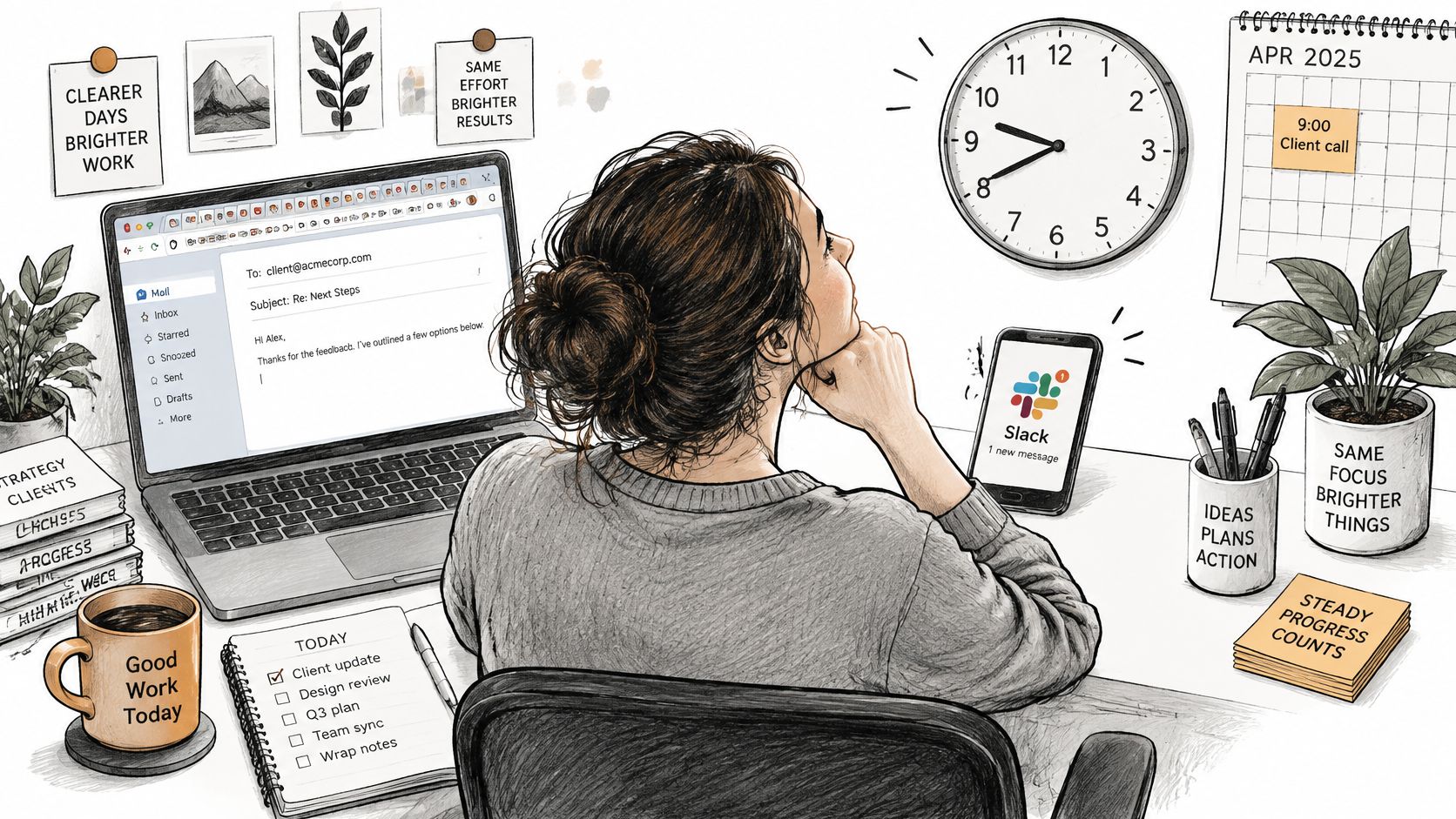
Executive function is the management layer that directs attention, holds and updates information, brakes impulses, and switches plans when reality changes. It is distinct from knowledge, talent, and raw intelligence. You can know the proposal cold and still fail to send it.
A scientific model introduced by Miyake and colleagues in 2000 treats three related but distinguishable processes as the backbone most studies still use.
Working memory is the radar screen. It keeps live flights visible and swaps out what is stale, like shifting priorities halfway through a meeting. Inhibitory control is the hand that stops a takeoff clearance mid-sentence, the pause before an angry email leaves the building. Cognitive flexibility reroutes when a runway closes, dropping a plan that stopped working.
Executive function is not knowing what to do. It is doing it while everything else competes.
Researchers sometimes add planning, emotional regulation, or getting started at all. Those extras matter in a real workday, and reviews also tie this layer to problem-solving, resisting temptation, sustained focus, and novel problems. The 2000 trio is still the spine.
The three don’t operate as isolated staff. Stress, fatigue, distraction, or a shinier reward can knock out inhibition, updating, or shifting even when the goal is obvious. Productivity for founders isn’t a motivation speech. It depends on regulating behavior in real time, which is why reminders, checklists, clear handoffs, and written decision rules shrink what the tower has to hold internally.
This is an explainer, not a diagnostic tool. A bad Tuesday doesn’t assign you a disorder, and a brilliant all-nighter doesn’t prove the tower is fully staffed.
What Each Executive Function Does and How It Fails
Find the failure people can see, then look at the substitute that carries the load. Trying harder is not a column in this table.
The three core executive functions at a glance
| Core function | Job in plain language | Normal workday example | Failure signature | External substitute |
|---|---|---|---|---|
| Working memory updating | Hold live information and swap out what is stale | Track three changing priorities across a client call | Lose your thread mid-sentence, re-read the same paragraph four times, forget why you opened the laptop | One visible capture list plus written meeting notes and a single next-action line per project |
| Inhibitory control | Pause before the automatic response fires | Sit with an angry email for ten minutes before replying | Send the hot reply, say yes to scope creep, open a new tab mid-task | Predefined decision rules, a draft-only rule for emotional replies, a 24-hour hold on new commitments |
| Cognitive flexibility | Switch task, rule, or strategy when the plan stops working | Drop the rejected concept and start plan B without losing the day | Restart paralysis after interruption, hyperfocus past the next meeting, stuck on a dead approach | Written if-then fallbacks, timed transition alarms, a pre-agreed stopping rule per task |
Working memory is a small whiteboard
Someone speaks and the board gets wiped. You walk into the kitchen for a charger and leave with a glass of water, then open the laptop and can’t say why. In a pitch you lose the thread of your own sentence while the slide is still correct.
The job isn’t storage. It’s updating. Old priorities have to leave so the live ones fit. If you want a practical way to process information more efficiently, shrink the live set to one capture inbox and one next action, instead of trusting the whiteboard to survive a interruption.
Inhibition is the delay, not the virtue
The impulse is already loaded. Reply in ninety seconds. Buy the domain at midnight. Say yes to a project that eats the quarter. Inhibitory control is the gap between that firing and the send button.
A crisis can make the gap look huge, because the stakes buy the pause for you. A boring status call doesn’t. That’s why a person can look disciplined under fire and porous the moment a client asks, live, for “just one more thing.”
Flexibility is the cost of changing rules mid-flight
The client rejects the concept at 1:10. The whole afternoon evaporates, not because the new brief is hard, but because the old plan won’t release. The mirror image is hyperfocus that keeps you in the doc after the meeting has started.
Spiky profiles, double failures
The three are correlated and still separable. Excellent inhibition in a crisis can sit next to terrible updating on a routine call. Most real misses involve two at once. A hot reply is inhibition, and the missing next step afterward is working memory.
Read the table from the loudest signature toward the substitute column. Relief lives there. A score on an executive function performance test can hint at a pattern. It can’t staff Tuesday.
Why Your Executive Function Works Brilliantly at 2 a.m. and Vanishes on Tuesday
You shipped a flawless launch under deadline pressure. Three weeks later the invoices are still unsent. Same person, same job, opposite reputation.
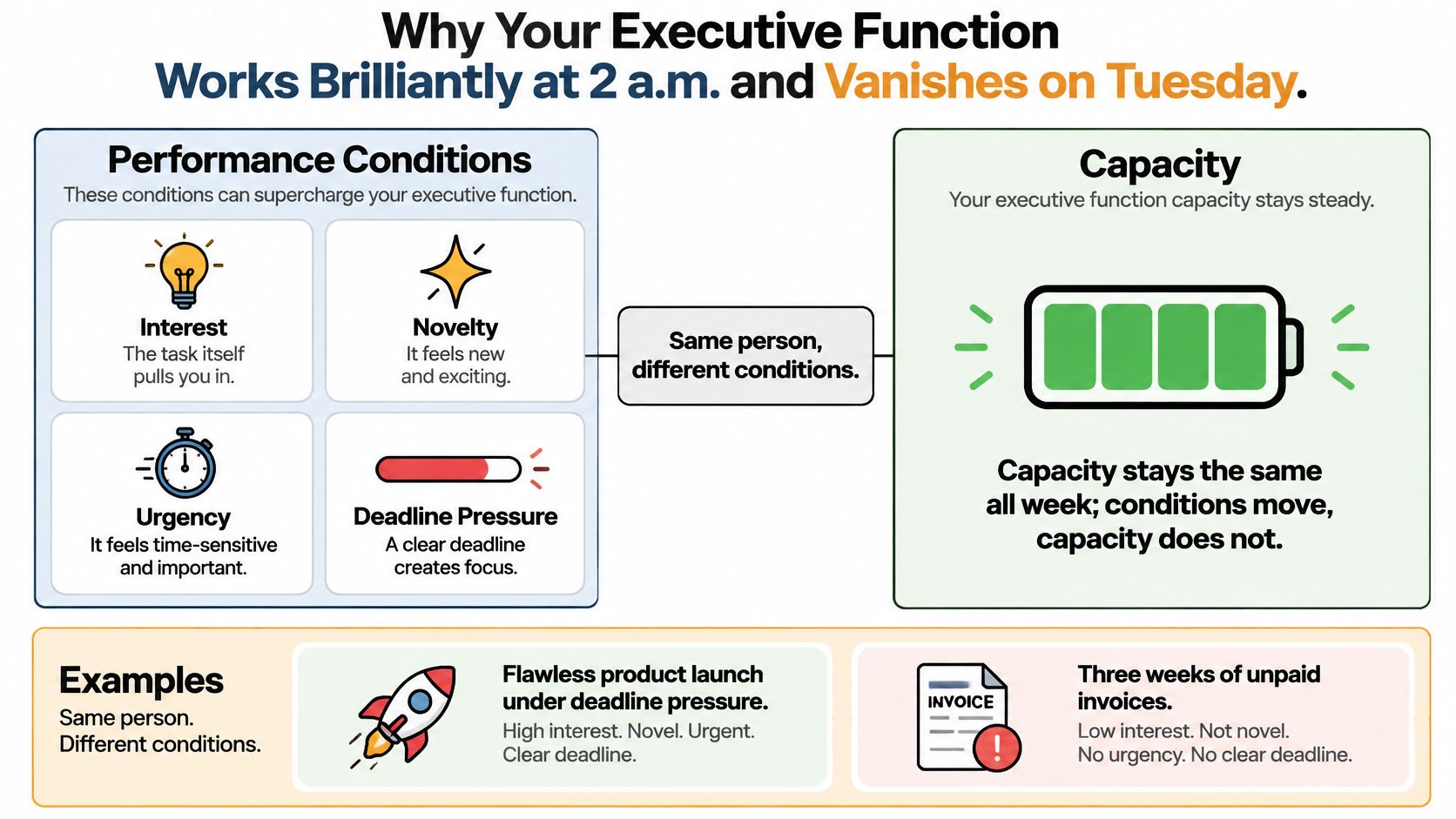
Conditions move, capacity doesn’t announce itself
Interest, novelty, urgency, and personal stakes temporarily raise available regulation. Routine, ambiguity, and low reward drop it. The launch had a countdown and an audience. Invoicing has neither. That isn’t proof the skill vanished. It’s proof performance conditions changed.
People often call the gap time blindness, and practical ADHD time blindness strategies help when hours disappear inside an interesting task. The deeper point is state. Urgency borrows regulation you don’t have on a quiet Tuesday.
What adult ADHD research actually shows
A tidy story says weak executive function equals ADHD. A meta-analysis of adults with ADHD in Psychological Medicine found medium-sized group differences in inhibition, verbal fluency, and set shifting, and also in non-executive measures including response consistency and basic reading and color-naming performance. The authors concluded the difficulties aren’t confined to executive function, and that current tests have limited diagnostic specificity.
Two consequences follow.
A score isn’t a person. An executive-function number doesn’t describe capability across a week.
The same missed deadline has many parents. ADHD, sleep debt, anxiety, depression, learning differences, and environmental overload can all produce disorganization or an impulsive reply. Comorbidity, diagnosis, mechanisms, and treatment are still open research problems, so a one-line explanation is ahead of the evidence.
Inconsistency across trials is part of the picture, not a character witness for laziness. Variable response is one of the non-executive differences that meta-analysis picked up.
Demands keep rising after the skills “should” be done
Harvard’s Center on the Developing Child reports that these skills begin shortly after birth, grow especially fast between ages 3 and 5, and keep developing through adolescence and early adulthood. United States Centers for Disease Control and Prevention figures from a 2022 national parent survey estimate that 7.0 million children aged 3–17, 11.4% of that population, had ever received an ADHD diagnosis. Separate 2023 CDC data estimate 15.5 million U.S. adults, 6.0%, had a current ADHD diagnosis, with about half diagnosed at 18 or later.
Those figures don’t make ADHD identical to an executive-function problem, and they don’t give everyone the same profile. They do show why supports have to last into leadership, money, and family load. School demands don’t shrink when the job title grows. Routines that only work on a good morning won’t carry that load, which is why ADHD and routines belong next to the paradox, not instead of it.
Stop asking whether you “have” the skill. Ask under which conditions it shows up.
A Week Inside an Unstaffed Control Tower
Maya runs an eight-person agency. She was diagnosed at 44. The work is good. The tower is staffed entirely by her memory.
Monday, the productive detour. She opens the CRM to update one deal, spots a broken filter, and rebuilds the pipeline view until lunch. Flexibility dropped the ball. Cost: a morning, and a designer waiting on a brief that never arrived.
Tuesday, the live yes. A client changes scope on a call. She agrees to all of it because the pause never arrives. Inhibition dropped the ball. Cost: a rebilled project and a sour Wednesday.
Wednesday, the brilliant orphan. She writes a sharp strategy doc and never turns it into tasks. The team waits. Working memory failed the handoff, not the thinking. Cost: a day of idle production and a retainer conversation that slips.
Thursday, the proof. A hard deadline appears. She delivers twelve hours of exceptional work. Capacity is intact when urgency staffs the tower. Cost of relying on that: she can’t schedule a crisis on purpose.
Friday, the invoice block. She can’t start the boring billing window, rereads the same email six times, and calls herself lazy. Initiation plus a dead updating loop. Cost: a missed retainer renewal.
Maya’s problem isn’t effort. Every safeguard still lives inside her head.
Affection matters here. She isn’t careless. She’s running air traffic with no radar backup, then grading herself as if the backup had been installed. The next move is instruments, not a sterner self-talk script.
How to Build External Scaffolding That Holds on Your Worst Day
A scaffold counts only if it still works when you’re underslept, unmotivated, and mildly annoyed. ADHD isn’t a superpower and isn’t a curse. It’s a different operating system that crashes if it isn’t maintained. Our method uses four pillars for that maintenance: Cognitive Architecture, Dopamine Engineering, Strategic Delegation, and Bio-Optimization. Architecture is the part you can build this week.
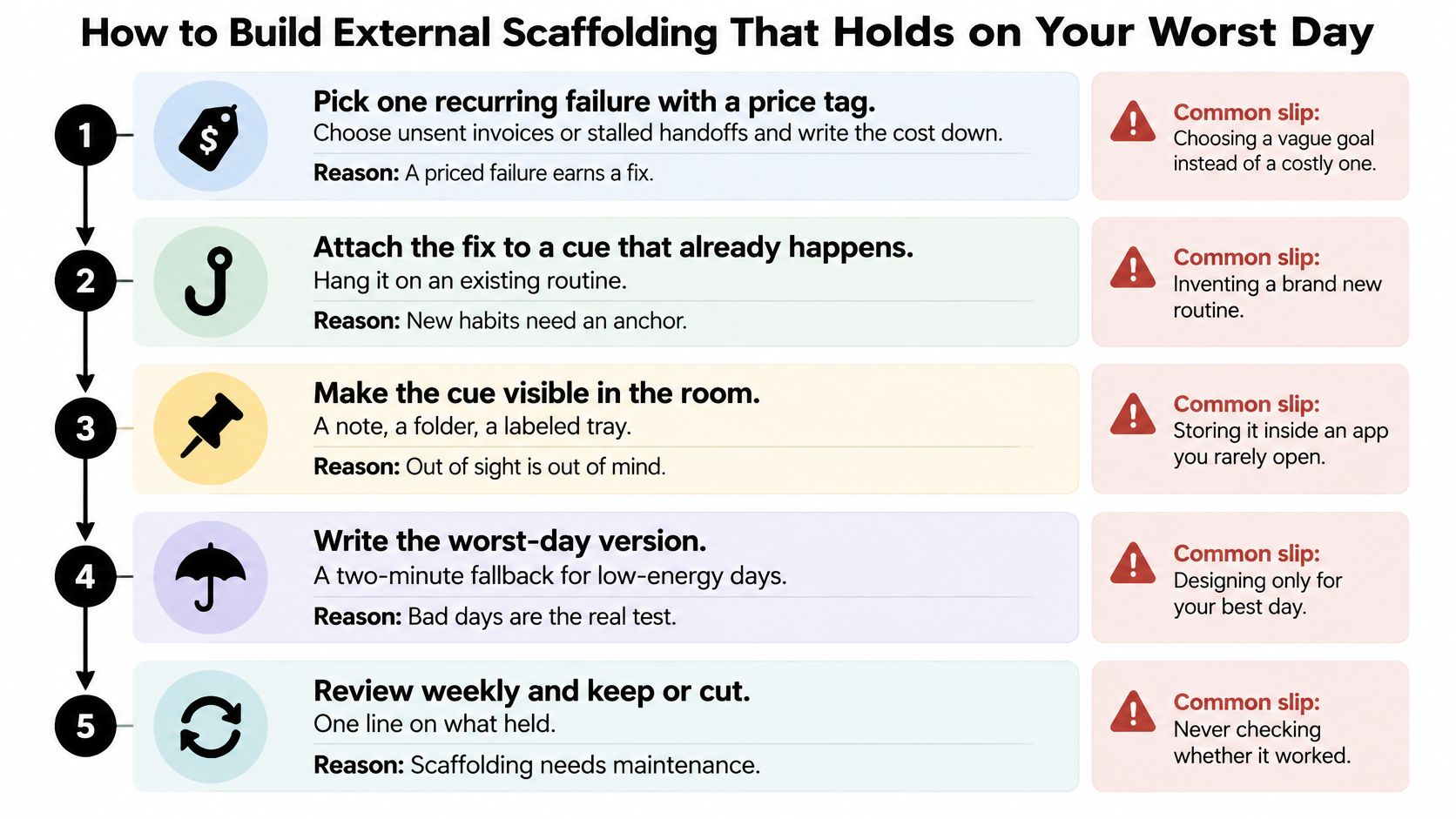
The picture is the overview. The build below is the version you can put on a desk.
The seven builds
-
Price one failure. Pick a recurring miss with a number you can say out loud, unsent invoices or a stalled handoff, and write the cost down. A priced failure earns a fix. The slip is a vague goal like “be more organized,” which builds a pretty system for a problem you don’t have.
-
Externalize the whiteboard. One capture inbox. One visible next-action line per project. Delete the four competing apps. The slip is parallel lists, because then updating has to happen in your head again.
-
Write the pause. If a client asks for extra scope on a call, then you say you’ll confirm tomorrow. Emotional replies stay in draft until the next block. The slip is a rule you admire and don’t put on the call script.
-
Install the switch. A timer five minutes before every transition, a written stopping rule per task, and a two-line parking note that says where you left off. The slip is trusting hyperfocus to notice the meeting.
-
Design the handoff, not the intention. Every delegation leaves with an owner, a deadline, a definition of done, and a named check-in. Nothing depends on Maya remembering Wednesday’s doc. The slip is “they know what I mean.”
-
Pay on completion, not on panic. A visible streak, a short walk, or a small purchase budget released when the block ships. Dopamine engineering means the reward arrives for the boring finish, not for the 2 a.m. rescue. The slip is waiting to feel motivated first.
-
Repair on a fifteen-minute weekly pass. Whichever scaffold broke gets one fix. The slip is redesigning the whole system because Friday was messy.
A longer treatment of ADHD executive function strategies sits beside this sequence if you want the delegation pieces in more detail. If you’re tempted to read another habit book before you build step 1, a reading-time estimate from Quotabl is a useful reality check on how long that detour takes.
The short video below walks through why the management layer fails in ordinary tasks, which is the reason step 5 exists.
Practical rule: if the scaffold needs you to remember it, it isn’t a scaffold yet.
Brain Training, Willpower and Cold Plunges Against Real Reliability
The outcome that matters is a sent invoice, a clean handoff, and a recovery after overload. A better score on a lab task is a different sport.
What each approach improves and where it stops
| Approach | What it targets | Evidence in adults with ADHD | Transfers to daily execution? |
|---|---|---|---|
| Single session of aerobic exercise | Inhibitory control, acute state | Moderate immediate effect, Hedges’ g = 0.55; core symptoms g = 0.23 (2026 review) | Partly, as a state reset before hard blocks, not as a system |
| Longer-term exercise programme | Core symptoms, mood, sleep | Mixed and inconsistent in the 2026 review | Indirect, via sleep and energy rather than direct skill gain |
| Commercial brain-training games | Trained task performance | Gains mostly task-specific; much training research runs in children or lab conditions | Rarely, little evidence of improved planning or follow-through |
| Calendars, timers, and to-do apps alone | Cool functions, external reminders | Useful as components, weak as a complete answer | Only if paired with decision rules, handoffs, and reward design |
| Sleep, nutrition, and movement as strategy | Available regulation capacity | Consistent practical lever; effects vary by person | Yes, raises the floor under every other scaffold |
| Medication and clinical care | Core symptoms and regulation | Established clinical route, individual response varies | Yes for many, but still needs external structure; prescriber territory |
A 2026 systematic review of exercise in adults with ADHD found a moderate immediate benefit for inhibitory control (Hedges’ g = 0.55) and only a small benefit for core symptoms (g = 0.23), with mixed evidence for longer-term exercise. That gap is the whole argument. A run can reset state before a hard block. It doesn’t mail the invoices next month.
Why the game doesn’t reach the calendar
Commercial brain training mostly improves the game you practiced. Much of the promising training literature is in children or tightly controlled conditions, so claims about adult leadership, delegation, and burnout prevention are thin. Acute state regulation and a durable operating system are different products. Cognitive improvement and shipped work are different again.
Cool functions and hot functions
Working memory, inhibition, and flexibility are the cool side. Reward sensitivity and emotional regulation are the hot side. Advice built only on calendars and timers covers half the system and then blames you for the other half. Emerging work is moving toward both, and those studies are still developing.
Be fair about the clinical lane. Medication and competent care are legitimate routes, decided with a prescriber, not a productivity thread. Sleep is the cheapest lever with the widest reach, because it raises the floor under every scaffold you already built. Cold plunges and willpower slogans don’t replace that floor.
Hype has a smell.
- Cure language: anything that promises the tower is permanently staffed.
- Single-app salvation: one subscription standing in for handoffs and decision rules.
- Motivation as a prerequisite: a fix that works only after you feel like starting.
Judge the row by what left the building, not by how sharp you felt at the keyboard.
Pick One Failure and Scaffold It This Week
Don’t rebuild the company. Staff one gate.
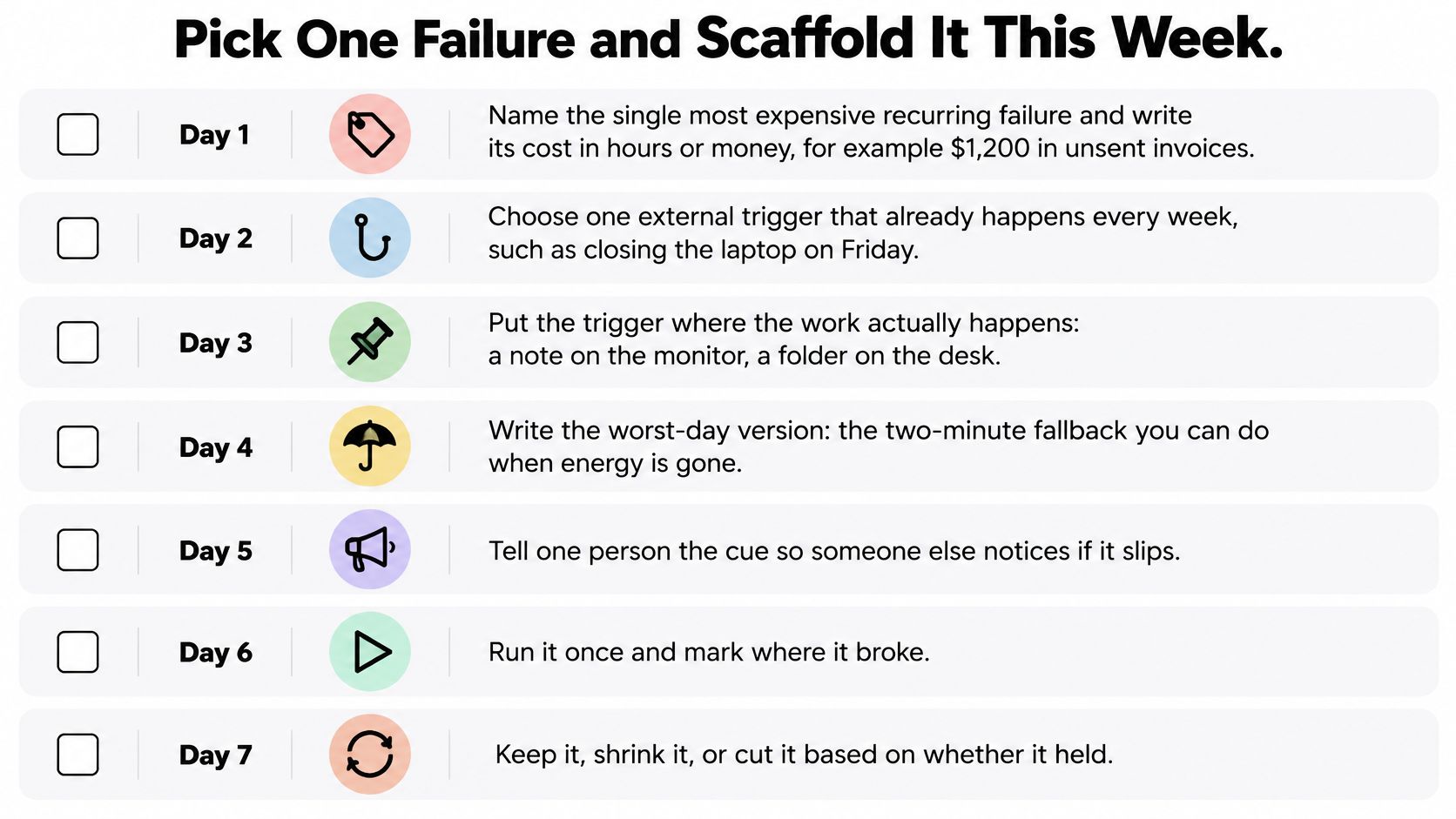
Day 1. Name the single most expensive recurring failure and write its cost in hours or money. A missed retainer or an idle designer is specific enough.
Days 2 and 3. Put only the capture inbox you already have, plus one if-then rule, into live use. No new app.
Days 4 and 5. Rewrite one real delegation with owner, deadline, definition of done, and a named check-in.
Day 6. Attach the completion reward so it pays when the block ships, not when panic does.
Day 7. Repair only the piece that broke.
A scaffold that survives a bad night beats five abandoned apps. That is the rule of one.
Where self-help stops
See a clinician when the pattern has been there since childhood, when it impairs both work and home, or when mood, sleep, or substance use is getting worse and hiding the picture. A quiz is not an assessment. A Brain Map, quiz result, or tool score is not a clinical assessment either.
Jan Kutschera offers engineering support beside that care, not instead of it. The Starter Kit and Brain Map include mapping, a personal blueprint, training, and the toolkit described in the offer. Free tools such as the Dopamine ROI Calculator, Wall of Awful, Survival Kit, Morning Blueprint, Weekly Build Filter, Execution Audit, quizzes, and webinars are for experimenting with scaffolds, not for diagnosing anyone.
You aren’t repairing a broken character. You’re staffing a control tower with instruments that stay on duty after you get tired.
Jan Kutschera helps founders with ADHD replace panic productivity with operating systems built for their wiring, including Cognitive Architecture that carries executive function when the tower is short-staffed. If the unpaid invoices and the brilliant orphan documents are running your week, start with the systems rather than another willpower push. Visit Jan Kutschera and pick the scaffold that still works on your worst Tuesday.
Jan Kutschera
German founder, diagnosed with ADHD at 51. Built 4 agencies, now building systems for neurodivergent entrepreneurs. German engineering for the ADHD brain.
Connect on LinkedInRelated Articles

Can't Get Started? a Founder's Playbook for Momentum
When you can't get started, it's a systems failure, not a moral one. Get a step-by-step playbook for ADHD founders to beat inertia with real-world systems.

How to Be Productive with ADHD: A Founder's System
Learn how to be productive with ADHD using a proven system for founders. Ditch the burnout and build sustainable workflows with our step-by-step guide.
Time Management for Entrepreneurs Without the Panic
Time management for entrepreneurs with ADHD: a weekly split, capacity calendar, batching, and delegation specs that replace panic productivity.