Time Management for Entrepreneurs Without the Panic
Time management for entrepreneurs with ADHD: a weekly split, capacity calendar, batching, and delegation specs that replace panic productivity.
Jan Kutschera
The most popular time-management advice for entrepreneurs is to wake up earlier, build a stricter routine, and squeeze more into the day. That’s a fine way to become exceptionally punctual at exhausting yourself. If your business needs your attention everywhere, extending your availability won’t fix the operating model.
Good time management for entrepreneurs means deciding what deserves founder attention, protecting the capacity to do it, and giving everything else a different route. For founders with ADHD, consistency means returning to a few dependable operating behaviors on uneven days, not producing identical output regardless of sleep, attention, or workload.
Table of Contents
- Where Founder Hours Actually Disappear
- How to Protect the Agenda for Thirteen Weeks
- Calendar Rules for High and Low Capacity Days
- Delegation Specs That Stop the Boomerang
- Start With One Protected Week
Where Founder Hours Actually Disappear
A longer week is not a system. It’s extra room in which to repeat the same mistakes.
The hours gap is substantial: Eurostat figures cited in a longitudinal study of small-business owners show that, in 2024, 7.6% of salaried employees worked at least 48 hours weekly, compared with 36.2% of solo self-employed workers and 61.9% of entrepreneurs with employees. The study also found that weekly hours alone weren’t significantly associated with burnout, while sleep duration, mental health, and workplace loneliness were relevant predictors.
That distinction matters. Don’t reduce burnout to arithmetic, then assume that trimming your calendar will solve everything. A shorter day spent firefighting, eating at your keyboard, and carrying every unresolved decision home can still be a miserable day.
Availability isn’t the same as ownership
Consider an agency founder who approves every proposal, joins every client call, and checks every invoice. Each intervention looks responsible in isolation. Together, they establish a rule nobody wrote down: work isn’t finished until the founder touches it.
The founder then complains about interruptions while maintaining the approval structure that produces them. That’s not a character flaw. It’s an operating-design problem, and buying a nicer planner won’t change it.
Boundaries deserve more than motivational-poster status: a 2025 study of American entrepreneurs, described in Fortune’s report on entrepreneur well-being, found 45% of respondents who maintained work-life boundaries reported low burnout, compared with 6% of those who struggled to maintain them. The survey doesn’t establish that boundaries caused the difference, but it gives founders a strong reason to stop treating unrestricted availability as a professional virtue.
Operating rule: A boundary needs an owner, an exception policy, and somewhere for the work to go. Otherwise, it’s a wish with a calendar reminder.
Give the week a job before other people do
Use the following as a hypothetical starting allocation, not a research-derived ideal. The percentages are planning recommendations to test against your business, not claims about what successful founders do.
Target founder week versus the availability trap
| Block | Share of week | Belongs here | Keep out |
|---|---|---|---|
| Strategic outcomes | 25% | Three quarterly bets, offers, pricing, irreversible calls | Status meetings and inbox drips |
| Key relationships | 15% | Priority clients, hires, partners | Cold admin and FYI calls |
| Batched operations | 20% | Inbox, invoices, content, supplies in set windows | All-day reactive drip |
| Reactive buffer | 10% | True escalations with a named backup owner | Every ping treated as urgent |
| Recovery | 15% | Sleep protection, movement, a hard shutdown | Hero late nights and weekend catch-up |
| Delegate or delete | 15% | Removing or transferring repeatable admin and coordination | Founder as the default owner |
Treat this as an allocation of your weekly planning envelope, not a suggestion that sleep belongs inside billable working hours. The recovery row protects breaks and the edge of the workday; adequate sleep still sits outside it. The delegate-or-delete row is time spent removing future obligations, not another admin bucket.
An early-stage founder may need more sales time. An agency facing a delivery problem may temporarily need more operational capacity. Make that trade consciously, with an end condition, rather than sacrificing strategy whenever somebody types urgent.
Make boundaries visible in the workflow
Start with concrete rules your team can follow:
- Name the shutdown. Put the stop time on your shared calendar and leave a written first task for tomorrow. Closing the laptop shouldn’t require remembering everything still open.
- Batch messages. Try a late-morning communication window and another in the late afternoon. Publish the response expectation so clients aren’t left guessing.
- Keep operations together. Process invoices, scheduling, and routine approvals in a dedicated batch instead of grazing through them between important tasks.
- Separate strategy from delivery. Reserve a different day or clearly separated session for pricing and offer decisions. Don’t expect clean thinking while supervising a live client deadline.
- Protect basic maintenance. Eat away from the inbox, move your body, and keep work from swallowing your sleep opportunity. These are operating requirements, not prizes for clearing the task list.
The waste isn’t imaginary: in a 2025 survey of 2,000 U.S. small-business owners commissioned by Slack and conducted by Talker Research, respondents reported an average of 1 hour and 36 minutes daily on unproductive tasks, according to Bitdefender’s coverage.
Before changing next week, sketch last week from memory. Then compare that story with your calendar and messages. For founders who struggle to perceive elapsed time, practical time-blindness tools can make work boundaries visible instead of leaving them inside your head.
Judge the week by whether strategic work happened in its intended place and whether shutdown remained credible. Being impressively busy doesn’t earn a passing grade.
How to Protect the Agenda for Thirteen Weeks
Say you finish the week with a packed calendar and an untouched offer rewrite. You attended the meetings, answered the questions, and rescued the delivery. You also postponed the decision that might improve what you sell.
Use a thirteen-week agenda-protection cycle to expose that mismatch. The protocol below turns intention into something you can inspect.
Audit without prosecuting yourself
-
Capture a sample week. Record work in 15-minute increments, using a spreadsheet, Toggl, or a paper grid. Write what happened, not what should have happened. Don’t tidy the record to protect your self-image.
-
Tag each block. Use strategic, relational, operational, or reactive. A scheduled meeting isn’t automatically strategic, and an unexpected client conversation isn’t automatically waste. Classify its actual purpose.
-
Write the quarterly outcomes. Give each outcome a clear finish condition: publish the revised offer, appoint a delivery owner, or validate a new acquisition channel. A vague ambition such as improve marketing can justify almost any meeting.
-
Compare the record with the agenda. The CEO benchmark summarized by Stealth Agents’ executive-delegation review tracked 27 Fortune 500 CEOs across nearly 60,000 hours, finding that 43% of their time advanced their stated agendas and approximately 36% was reactive. These aren’t targets for your startup; they’re a warning that a demanding role and a full calendar don’t guarantee alignment.
A full calendar can still be strategically empty.
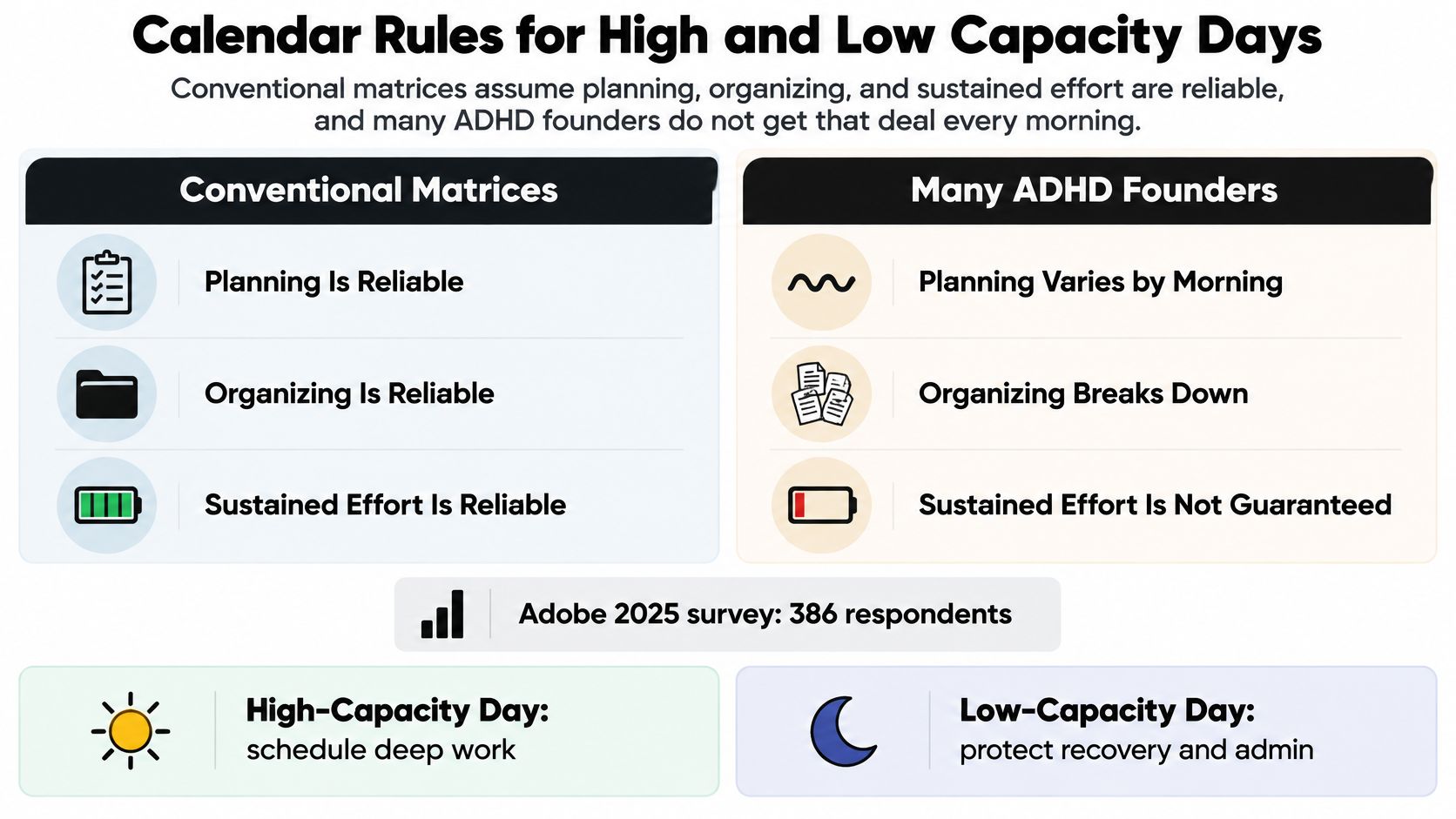
Capacity also affects whether a protected block is usable. This comparison captures why rigid scheduling assumptions can fail ADHD founders.
Give someone permission to defend the plan
-
Reserve recurring outcome blocks ahead of demand. Schedule them before accepting optional meetings. Name the deliverable in the event title, such as draft pricing alternatives, rather than writing focus time and hoping inspiration attends.
-
Transfer calendar authority. Give your assistant or operations lead written permission to reject attendance requests, shorten discussions, and reroute status updates. If every refusal still requires your approval, you’ve delegated the clicking, not the decision. For the scheduling mechanics, TiedSiren’s guide to time blocking that survives interruptions is a useful companion.
-
Review variance every Friday. Compare intended blocks with completed work. Identify what displaced the agenda, who accepted that trade, and what routing rule needs changing. Track the share of scheduled time used for priority outcomes and the unplanned work you managed to displace, not just total hours logged.
For an ADHD founder, the external record is especially useful because you don’t have to notice every drift while it’s happening. You can inspect the pattern afterward and change the environment.
Use the video as a prompt for reviewing your scheduling habits, then make the actual edits in your calendar.
Calendar Rules for High and Low Capacity Days
Conventional prioritization matrices can help you sort work. They can’t guarantee that you’ll have the planning, organizing, and sustained attention needed to execute it that morning. For many ADHD founders, that’s the missing assumption.
Use capacity modes instead of pretending every available hour offers the same kind of work. The windows below are suggested starting settings, not clinical prescriptions or research-established optimal durations.
What to schedule on high, medium, and low capacity days
| Mode | Minimum viable output | Put on the calendar | Do not do |
|---|---|---|---|
| High focus | One deep build or irreversible decision | A suggested 90-to-120-minute first window, before messages | Meetings in the first window |
| Medium | One relationship plus one operations batch | Two suggested 45-minute blocks | Starting a new strategic project |
| Low | Shutdown list and one prewritten admin batch | A suggested 60-to-90-minute minimum viable work window, then reassess or stop | Pretending it is a normal full day |
Match the task to the available capacity
Choose the mode by observing yourself, not negotiating with your guilt. Can you hold the problem in mind, start without repeatedly escaping, and evaluate alternatives? Or are you rereading the same paragraph while opening unrelated tabs?
The difficulty isn’t wanting success badly enough. Psychology Today’s discussion of ADHD and productivity describes difficulties with planning, organizing, and sustaining effort, the very abilities standard productivity advice often assumes are dependable.
On a high-focus day, build the proposal architecture or make the pricing decision before opening messages. On a medium day, advance an existing commitment and clear a defined operations batch. On a low day, preserve continuity: flag anything time-sensitive, send the necessary handoff, complete the prepared admin list, and stop bargaining for a heroic comeback.
Low capacity doesn’t cancel customer obligations. It changes how you meet them. Use a backup owner, renegotiate a deadline early, or reduce scope rather than disappearing and calling it recovery.
Remove the need to invent the day
Put the first task where you’ll see it. Open the relevant document before shutdown, leave a physical note on the keyboard, and use a visible timer when you begin. A short, chosen reward after the protected block can provide a reason to start that a distant quarterly objective doesn’t offer.
For calendar implementation, Dial Milo’s Google Calendar setup steps can help you turn these modes into usable events. Pair that setup with an ADHD-friendly daily schedule so the plan remains readable when your attention is thin.
Capacity check: Choose the day you can actually execute, not the day you’d like to announce.
After an intense hyperfocus session, leave recovery space that same day. Don’t spend every available ounce of concentration and then schedule the next morning as though nothing happened.
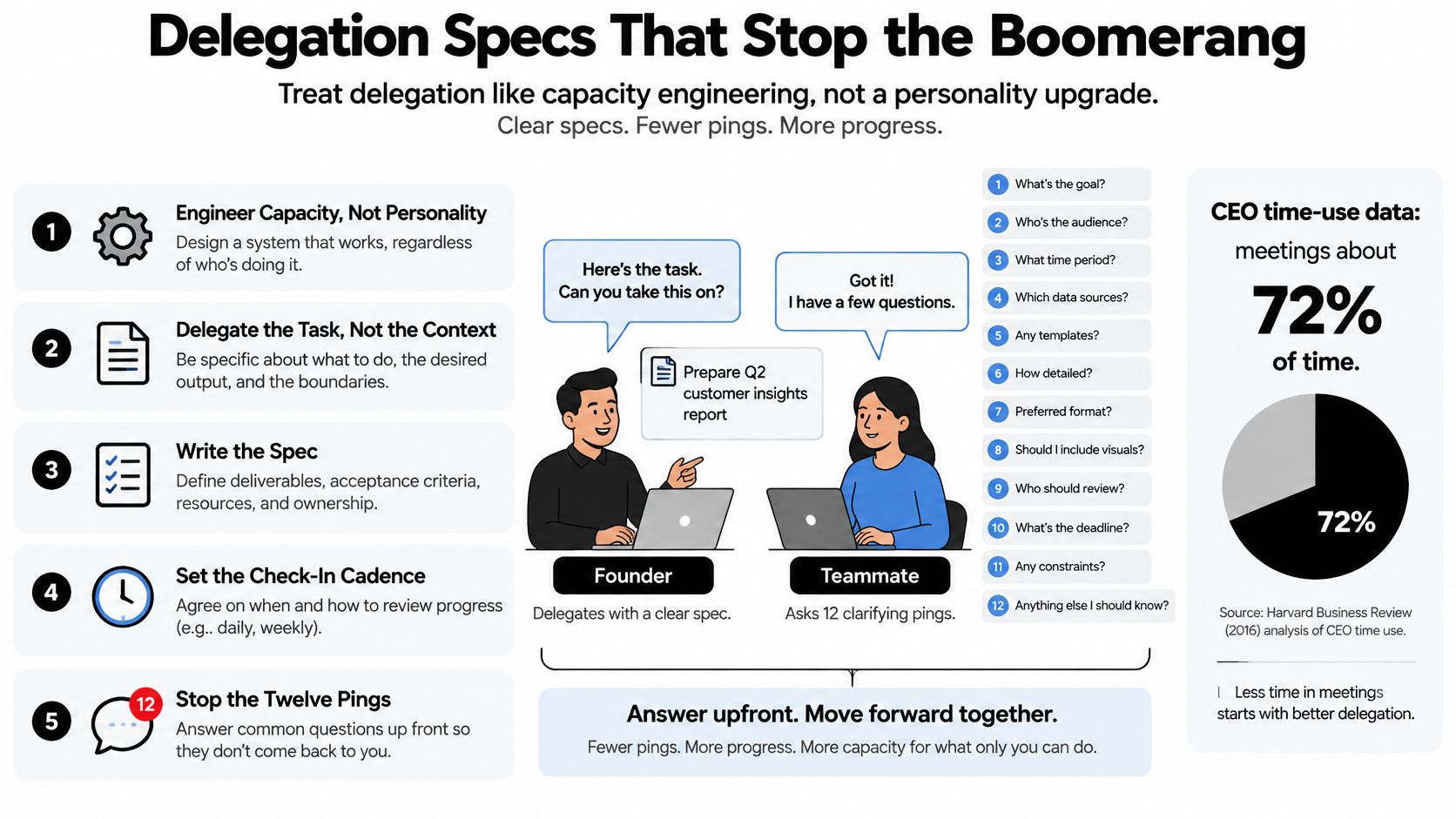
Reliable handoffs make these capacity choices possible. This visual captures the delegation discipline that keeps a reduced-capacity day from becoming a team-wide interruption festival.
Consistency means returning to the mode check, the priority outcomes, and the shutdown. On Monday morning, ask: Which mode is honest today, and which row will I follow?
Delegation Specs That Stop the Boomerang
Delegation fails when the task moves but the decisions stay with you. Hand off invoicing, then answer questions about payment terms, exceptions, client details, and approval limits all morning, and you have added a messaging interface to your old job.
The goal is decision bandwidth: fewer recurring decisions landing on your desk, not an instantly empty calendar. Executive time-use findings summarized by Delegation Assistant put meetings at about 72% of an average 62.5-hour CEO workweek. That makes coordination worth examining before assigning miscellaneous tasks to someone else.
Delegate decisions within boundaries
Sort work by decision complexity, the consequence of error, and where your judgment matters. Keep strategy, high-stakes relationships, and irreversible calls that depend on your judgment. Transfer repeatable administration and coordination first. Ambiguous work is a poor first handoff because the delegate cannot act without repeatedly asking you to define the task.
There is also routine work worth reviewing. A 2025 Time etc survey of 251 U.S.-based entrepreneurs found respondents spent 36% of their workweek on administrative tasks such as invoicing, data entry, and ordering supplies, according to Upwork’s account of small-business owners’ time use.
Choose a recurring task only when the likely time saved justifies the setup and supervision. Repetition, teachability, and manageable error costs are stronger reasons to delegate than a crowded calendar. A task that happens once, changes every time, and carries serious consequences may be cheaper to keep.
Write the spec before sending the task
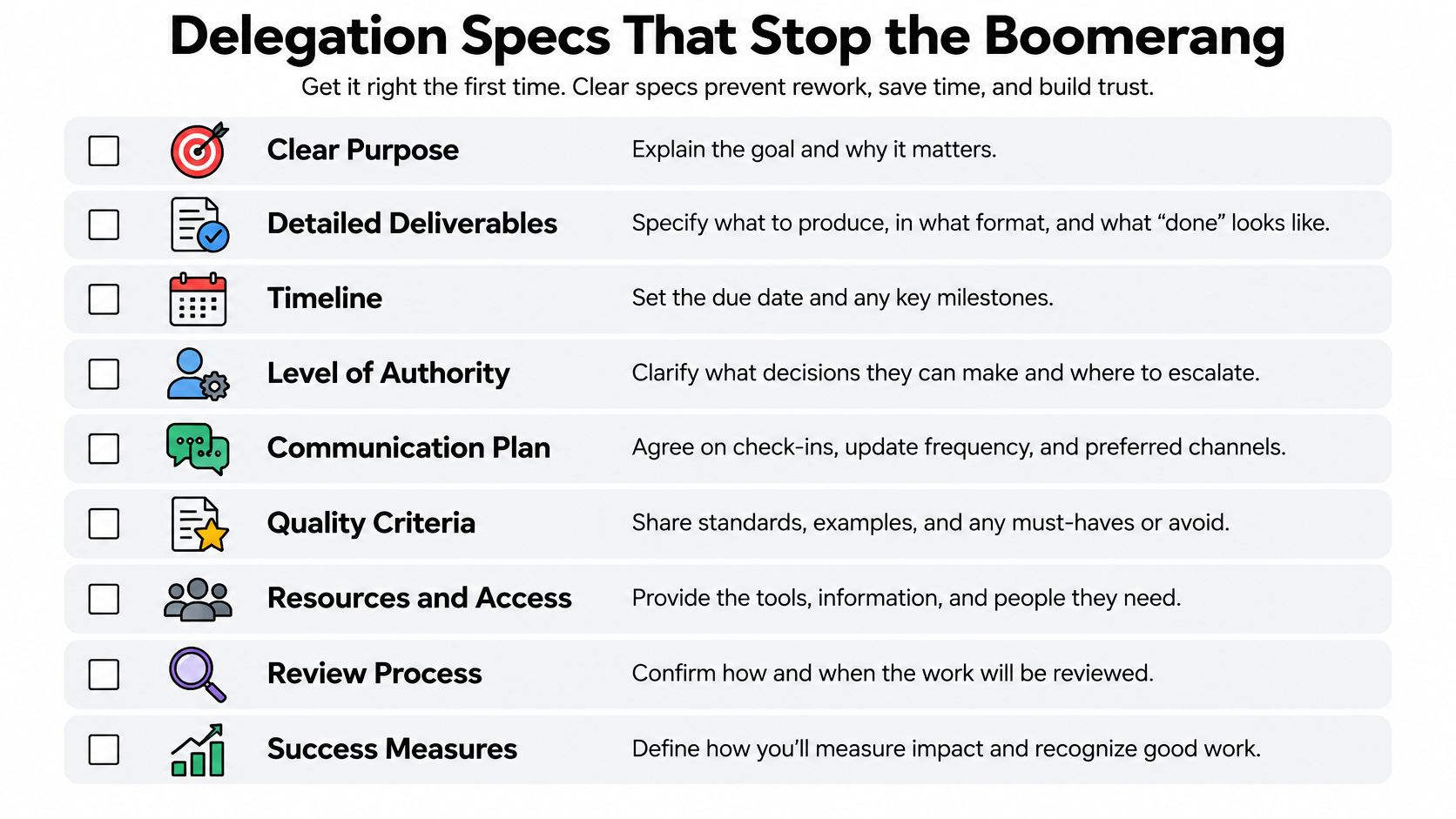
A handoff needs enough detail for someone to act without turning every exception into a fresh founder decision. Keep the specification short, but cover the decisions that would otherwise bounce back:
- Outcome and quality. Describe the finished result and show acceptable examples. For invoicing, include a normal invoice and a permitted exception.
- Decision rights. State what the delegate can approve, what requires review, and what must never be changed.
- Constraints. Name relevant terms, deadlines, approved tools, and access limits.
- Escalation triggers. Specify when to involve you, such as a disputed amount or a request outside agreed commercial terms.
- Review cadence. Set checkpoints for questions and quality checks instead of allowing continuous commentary.
Use these elements of delegation to make the handoff more precise. If inbound calls keep interrupting the person doing the work, consider systems for handling inbound calls while working. The point is to protect the task’s focus, not to create another channel for routine decisions.
Transfer execution, then inspect the result
Use a two-cycle handoff. First, have the delegate complete the task while you observe and capture missing context. Then let them execute independently, with your involvement limited to the checkpoints in the spec.
Expect the first cycle to take longer. Documenting your judgment requires effort, and the delegate needs room to learn without you taking over whenever their method differs from yours. Returning to the task at every small variation trains the team to wait for permission.
Track founder time recovered, errors against the specification, and escalations per task. Some early questions are useful. Constant escalation points to unclear authority; no escalation at all can hide mistakes.
Before calling the handoff complete, check that the outcome, decision rights, constraints, escalation triggers, and review cadence are written down. Use this checklist as the final test.
For an ADHD founder, a vague handoff can create more context switching than doing the work personally. Judge success by a reliable result and fewer recurring questions, not by how quickly you assigned the task.
Start With One Protected Week
You don’t need a personality overhaul. You need a week in which your priorities are visible, your calendar has boundaries, and other people know what they can decide without you.
Don’t rebuild every workflow at once. That’s an attractive avoidance project, especially when choosing software feels easier than making the uncomfortable decision about what you’ll stop doing.
Put the commitments where people can see them
Use this installation checklist before the week begins:
- Write the outcomes. Put your quarterly finish conditions somewhere you and your team already look. Don’t bury them in a planning document nobody opens.
- Place the strategic window. Protect the first useful work session before messages and invitations fill it. Attach the relevant document to the event.
- Choose the daily mode. Make the capacity decision before promising the day’s output. Adjust scope and communicate changes while there’s still time to respond.
- Specify the noisy handoff. Choose the recurring admin task that interrupts you most. Write its outcome, authority boundaries, constraints, quality examples, escalation triggers, and review arrangement.
- Publish the shutdown. Put the stop time on a shared calendar and name the backup for genuine emergencies.
Treat this as an installation test, not a moral examination. If you miss a commitment, identify the failure precisely: unclear task, unrealistic capacity, missing backup, or an exception that became the default.
Fix the failure instead of extending the day
If the week collapses into heroics, don’t automatically add evening hours. Ask what you can change before tomorrow begins. Perhaps the strategic task needs a smaller deliverable, the delegate needs clearer authority, or the customer needs an honest deadline rather than another silent rescue.
Our method uses Cognitive Architecture, Dopamine Engineering, Strategic Delegation, and Bio-Optimization. In practical terms, that means external structure, sustainable reward loops, cleaner handoffs, and treating sleep, nutrition, and movement as business concerns rather than optional maintenance.
That design matters more than owning the perfect planner. You should be able to see what matters, start the appropriate task, transfer work without constant supervision, and stop without leaving the business unattended.
Before Monday, put the strategic block and the shutdown on a calendar other people can see. Tell the relevant people what will change, including where urgent work goes when you’re unavailable. Ambition stays; constant crisis doesn’t have to.
We offer free resources including the Morning Blueprint and Execution Audit, alongside the ADHD Founder System Sprint with an individual consulting session and the preparation, follow-up materials, and support stated in the offer. Visit Jan Kutschera to choose a practical starting point for a founder operating system built around your attention, handoffs, and recovery, rather than another promise to work harder.
Jan Kutschera
German founder, diagnosed with ADHD at 51. Built 4 agencies, now building systems for neurodivergent entrepreneurs. German engineering for the ADHD brain.
Connect on LinkedInRelated Articles

How to Manage Multiple Projects with ADHD
Learn how to manage multiple projects with ADHD: set boundaries, build external systems, delegate and batch your week without burning out.

How to Run Effective Meetings for ADHD Founders
How to run effective meetings with timeboxes, roles, agendas, and follow-up built for neurodivergent founders who want decisions, not more calls.

ADHD Paralysis Symptoms and How to Restart
ADHD paralysis symptoms explained with freeze patterns, likely drivers, and a first move that restarts the stuck task.