ADHD-Friendly: How to Delegate Tasks Effectively
Learn how to delegate tasks effectively with an ADHD-friendly system. Replace burnout with clear handoffs, motivating feedback, and boost team momentum.
Jan Kutschera
Most delegation advice is useless for ADHD founders because it assumes your problem is mindset. It isn’t. You don’t need another lecture about “letting go.” You need a system that survives time blindness, working memory gaps, novelty chasing, and the weird urge to ignore a task until it becomes a fire.
That’s why how to delegate tasks effectively has to be built differently for your brain. The fix isn’t more willpower. The fix is dopamine-engineered delegation and Cognitive Architecture: external systems that carry the load your executive function drops.
Table of Contents
- Why Standard Delegation Advice Fails Your ADHD Brain
- The Delegation Triage How to Decide What to Offload
- Building Your Handoff Playbook with Cognitive Architecture
- Dopamine Engineering for Feedback and Follow-Up
- Minimalist Tooling and Measuring What Matters
- Your System for Compounding Team Momentum
Why Standard Delegation Advice Fails Your ADHD Brain
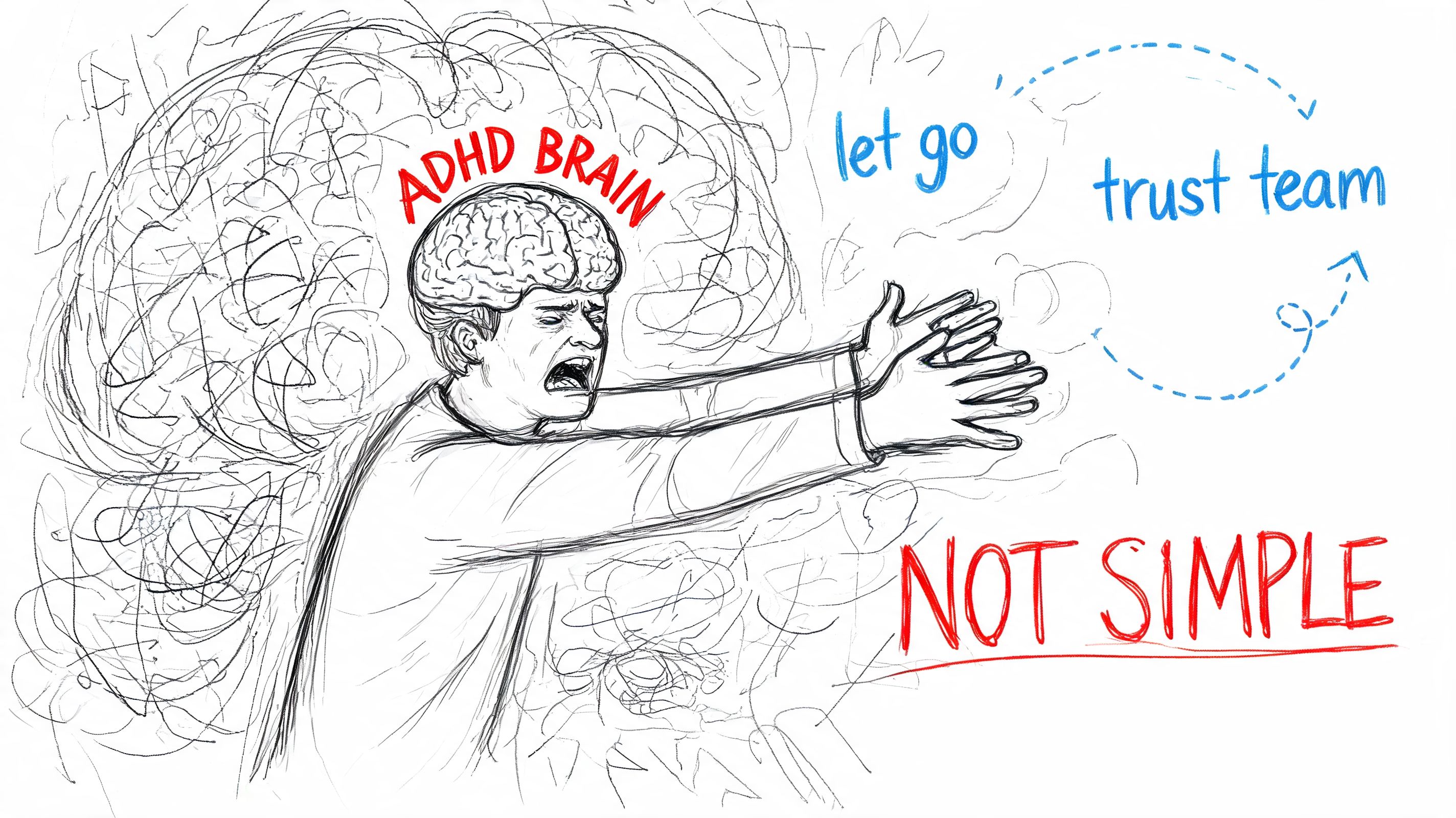
Generic advice says: trust your team, hand things off, don’t micromanage. Fine. But that advice skips the part where your brain loses track of delegated work the second it leaves your visual field, then panics later and barges back in with ten “quick checks.”
That isn’t poor character. It’s poor system design.
Your brain is not a bad manager
For ADHD founders, delegation often fails because the handoff itself creates anxiety. One verified neurodivergent angle puts it bluntly: neurodivergent leaders are 2.5x more likely to burn out from delegation failures due to poor task externalization, and emerging post-2025 tools can reduce handoff anxiety by 40% through async video primers, which standard frameworks rarely address (goalsandprogress.com on delegation for ADHD minds).
So when somebody tells you to “just trust more,” ignore them. Trust is not the first job. Externalization is the first job.
If your delegated tasks live in memory, they don’t exist. If expectations live in your head, they mutate. If follow-up depends on mood, it won’t happen consistently.
Practical rule: If a handoff requires you to remember details later, you haven’t delegated it. You’ve postponed your own stress.
A lot of founders also confuse executive dysfunction with laziness. Wrong. If you need more support around improving executive function with ADHD, build that support into your delegation process instead of trying to become “more disciplined.”
For a plain-English breakdown of why this keeps happening, this explainer on ADHD executive dysfunction in founders is worth reading.
The real problem is invisible work
Standard delegation advice assumes you can do these things reliably:
- Hold context in your head while someone else executes
- Estimate time cleanly without time blindness wrecking the plan
- Give neutral feedback without rejection sensitivity distorting tone
- Check in consistently before a task turns into a rescue mission
That is a neurotypical fantasy.
ADHD founders need dopamine-engineered handoffs. That means visible systems, tiny milestones, concrete deliverables, and predictable check-ins. You’re not trying to become chill. You’re trying to make delegation boring enough that your nervous system stops treating it like a threat.
The Delegation Triage How to Decide What to Offload
Most founders stall at the same point. They know they should delegate, but every task feels either too important, too annoying to explain, or too easy to justify keeping. That indecision is expensive.
A cleaner approach is to sort tasks by urgency, complexity, and ROI, then delegate low-expertise, high-volume work first while protecting your genius-zone work. Done well, delegation can free 25 to 35% of a leader’s capacity for strategic work and reduce panic productivity by 40% in startups. Micromanaging does the opposite and can drop productivity by 20% (Asana’s delegation guide).
Start with a ruthless task dump
Open a doc, a Notion page, Apple Notes, whatever you use. Dump every recurring task from the last two weeks.
Do not sort while listing. Just extract. Your brain lies when it sorts in real time.
Then mark each task with one of four labels:
- Genius Zone. Work only you should do. Vision, key relationships, strategic calls, creative direction that depends on your pattern recognition.
- Competence Zone. You’re good at it, but it drains you. Client reporting, inbox cleanup, project coordination, proposal formatting.
- Repetitive Admin. Necessary, repeatable, boring. Calendar wrangling, data entry, CRM updates, status chasing.
- Growth Opportunity. Work someone else should own because it stretches them in the right direction.
Use the triage matrix
Here’s the simple version I recommend.
| Task Category | Description | Action | Example |
|---|---|---|---|
| Genius Zone | High-value work tied to strategy, vision, or unique judgment | Keep | Final positioning call for a new offer |
| Competence Zone | You can do it well, but it costs energy and attention | Delegate soon | Weekly client recap drafts |
| Repetitive/Admin | Repeatable operational work with clear steps | Delegate first | Scheduling, invoicing follow-ups, CRM hygiene |
| Growth Opportunity | Work that develops team capability while moving the business forward | Delegate with support | First-draft research for a campaign strategy |
Delegate the task that steals focus most often, not the one that annoys you most loudly.
That distinction matters. ADHD brains overreact to irritation and underweight cognitive leakage. A fifteen-minute interruption can wreck an entire afternoon if it snaps you out of deep work.
What to delegate first
Use these decision criteria, in this order:
- High volume beats high drama. Repeated work creates the biggest payoff.
- Low expertise beats high stakes. Start where mistakes are survivable.
- Energy drain beats competence. Stop keeping tasks just because you’re fast at them.
- Visible outputs beat fuzzy projects. Delegate work that can be checked clearly.
If you want another perspective on practical handoffs, Fluidwave’s guide on effective delegation is useful because it stays focused on execution instead of leadership theater.
One more hard truth. If you keep “helping” after you delegate, you didn’t delegate. You split ownership. That creates confusion, not advantage.
Building Your Handoff Playbook with Cognitive Architecture
Bad delegation usually sounds casual. “Can you handle this?” “Take a pass?” “Just run with it.” That language feels efficient. It is not efficient. It’s lazy ambiguity dressed up as trust.
ADHD founders need a handoff playbook because memory is unstable and verbal instructions evaporate.
Stop handing off vibes
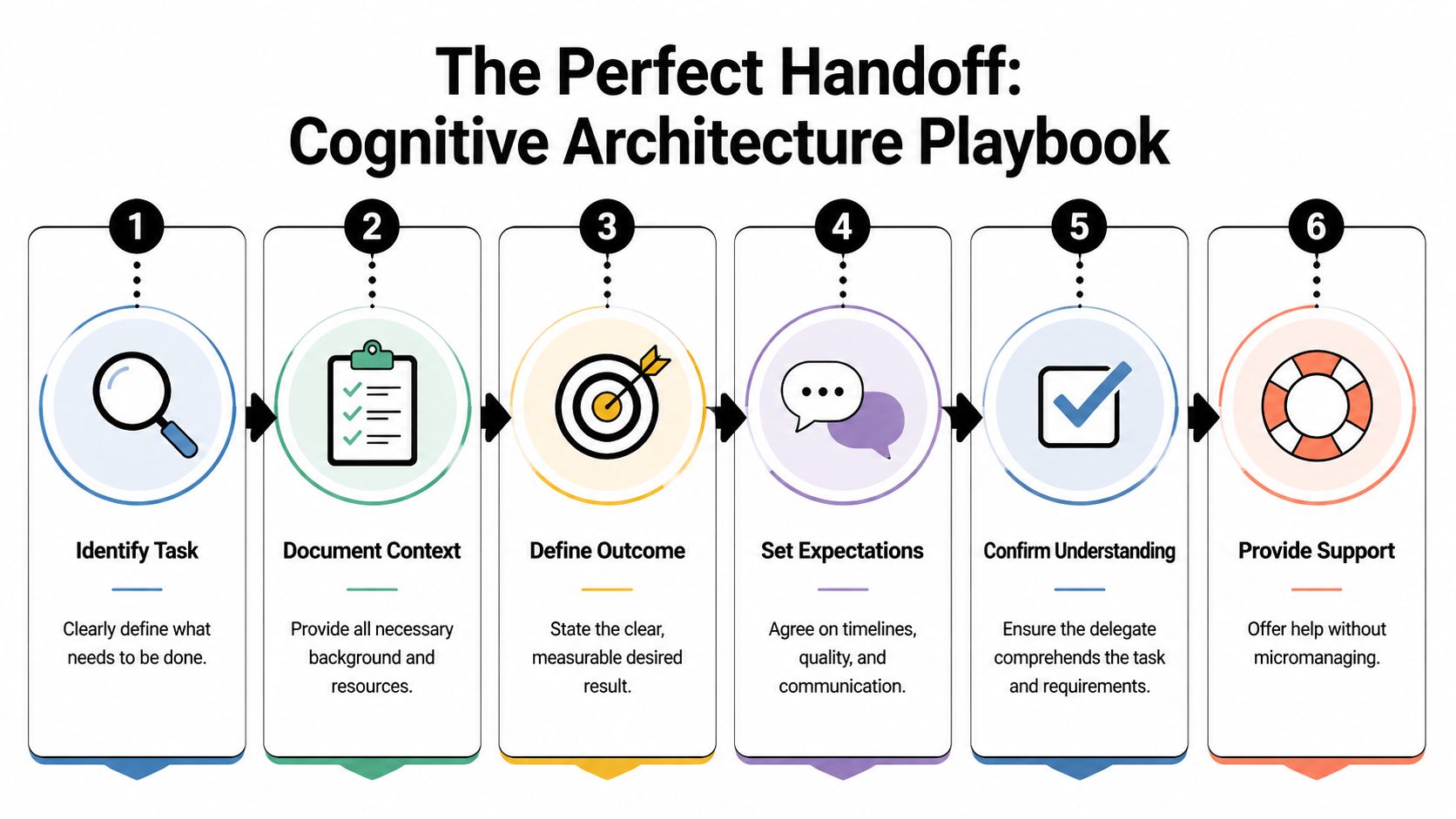
A proper handoff focuses on outcomes, not methods. The cleanest structure here is 5W2H: What, Why, Who, When, How, How Much. Combined with an I do, we do, you do training model, this approach boosts delegation success by 40%. Teams with clear authority and resources hit 92% on-time delivery versus 65% for vague delegations (Harvard Business School Online on delegation).
That gap is massive, and it makes sense. People don’t fail because they’re incompetent. They fail because the assignment was mush.
Your delegation brief template
Use this as a standard brief in Notion, Google Docs, ClickUp, Asana, or a plain email if you must.
1. What
State the outcome in one sentence.
Example: “Deliver a clean first draft of the weekly pipeline report with clear risks, wins, and next actions.”
2. Why
Explain the business reason.
Example: “This report helps us spot stalled deals early and keeps client delivery from drifting.”
3. Who
List stakeholders and reviewers.
Example: “Prepared by Ops, reviewed by me, shared with sales and account leads.”
4. When
Set milestones, not just a deadline.
- Draft checkpoint: when rough structure is ready
- Midpoint review: when core content exists
- Final delivery: when it’s ready to ship
5. How
Define authority level.
- Can they decide alone?
- Do they need approval for changes?
- Can they contact the client directly?
- Can they revise the format without asking?
6. How Much
State budget, time cap, or resource limits.
Example: “Use existing data only. Don’t commission new research. Keep prep time inside current weekly ops allocation.”
Clarity feels slower for five minutes and faster for five months.
Use training wheels on purpose
Don’t throw somebody into “ownership” because you’re overwhelmed. That isn’t true support. That’s abandonment.
Use a progression:
- I do. You show the task once and narrate your thinking.
- We do. You complete it together and refine the checklist.
- You do. They own execution while you review against the brief.
This is Cognitive Architecture in practice. You’re converting your private judgment into a visible operating system.
Add one more element most founders skip: a Definition of Done checklist.
| Item | Done means |
|---|---|
| Format | Matches the agreed template |
| Quality | Meets the examples you shared |
| Scope | Covers all requested components |
| Communication | Delivered in the right channel |
| Escalations | Flags raised before delivery, not after |
If “done” isn’t defined, your team will guess. Then you’ll call it underperformance when it was an unclear brief.
Dopamine Engineering for Feedback and Follow-Up
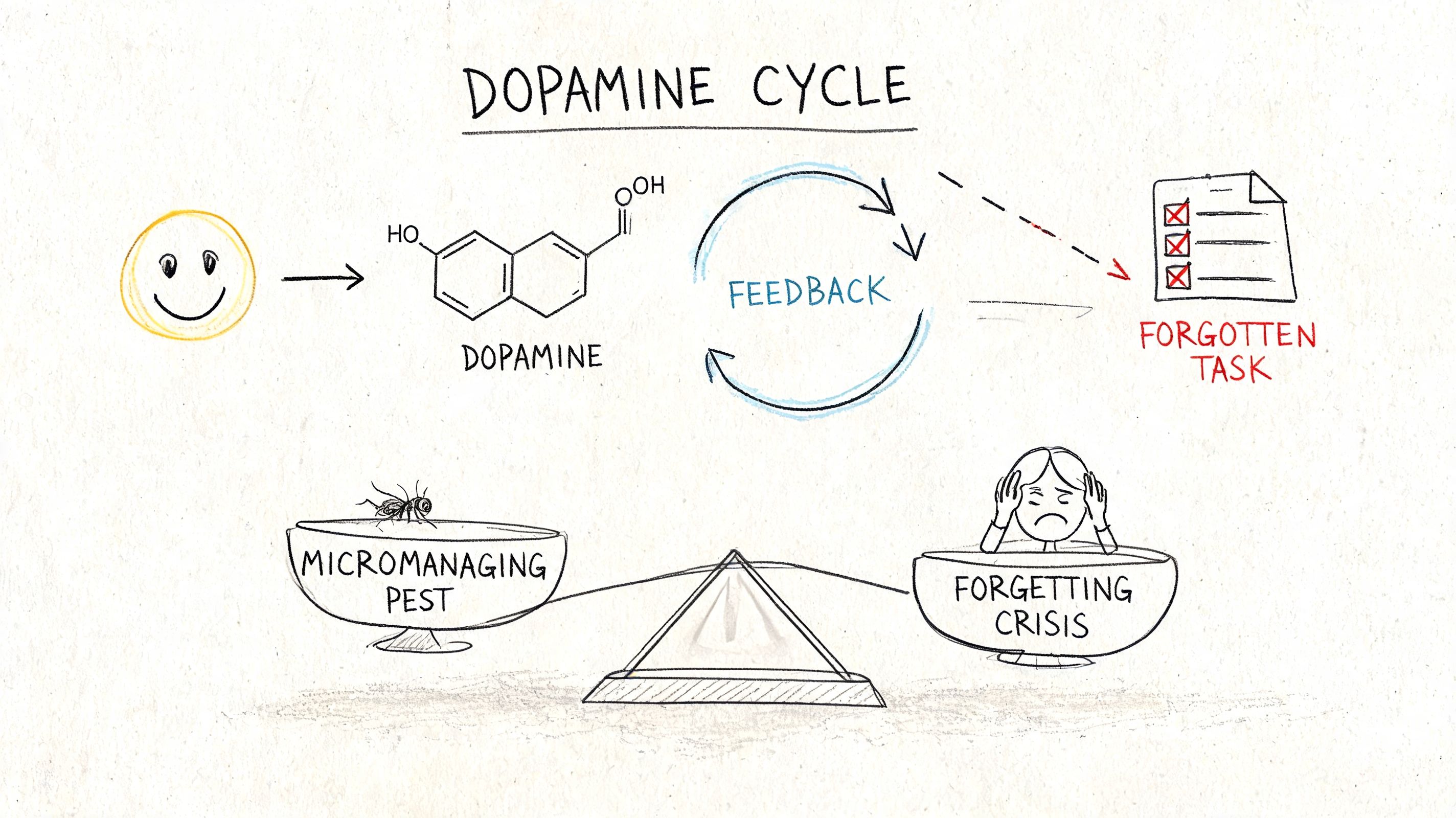
Delegation doesn’t break at the handoff. It breaks in the dead space after the handoff, when you forget the task exists until something slips and your nervous system screams, “See, this is why I do everything myself.”
That cycle is optional if you build follow-up into the system.
Follow-up needs a rhythm, not heroics
You do not need constant visibility. You need predictable visibility.
Set one recurring check-in for each important delegated stream. Same day. Same time. Same format. A Tuesday fifteen-minute sync works because it exists outside your memory. The calendar holds it for you.
This matters for your team too. Research shows that a high degree of task delegation is strongly associated with job satisfaction, and leaders can delegate even highly complex tasks without harming motivation when task variation is maintained. Delegation works as a development mechanism because much learning comes from doing (PMC research on delegation and staff satisfaction).
That means your check-ins shouldn’t feel like surveillance. They should feel like support plus growth.
A practical way to keep momentum is to tie follow-up to visible wins. If you want a useful way to think about that, this article on an ADHD reward system for business momentum connects the brain chemistry piece to actual execution.
Give feedback that lands
ADHD founders often avoid feedback because they hate receiving it themselves. Then they overcorrect and become vague. That helps nobody.
Use this script:
- State the win first. “The structure is clearer than last week.”
- Name the gap without drama. “The risk section is still too soft.”
- Give one concrete fix. “Call out the blocked items in plain language.”
- Reconfirm ownership. “You’ve got this. Bring me the revised draft by the next checkpoint.”
Good feedback reduces ambiguity. It does not perform kindness by hiding the problem.
And stop dumping a list of ten improvements at once. Your team can’t act on that. Give the next most important correction, not the whole museum archive of your opinions.
Here’s a solid explainer to reinforce the habit before the next team review:
Use delegation to grow people
If someone can only handle simple tasks forever, the bottleneck is usually the leader’s handoff quality, not the employee’s ceiling.
Use delegated work to build capability:
- Stretch carefully. Give tasks slightly above current comfort, not wildly above it.
- Preserve variation. Don’t turn one person into a machine for repetitive scraps.
- Review patterns. Ask what they’re learning, not just what they finished.
The best teams don’t just take work off your plate. They start solving problems before you notice them. That only happens when follow-up creates confidence instead of fear.
Minimalist Tooling and Measuring What Matters
ADHD founders love tools for the same reason we love whiteboards, notebooks, and random tab explosions. Tools feel like progress before progress has happened.
Resist that urge.
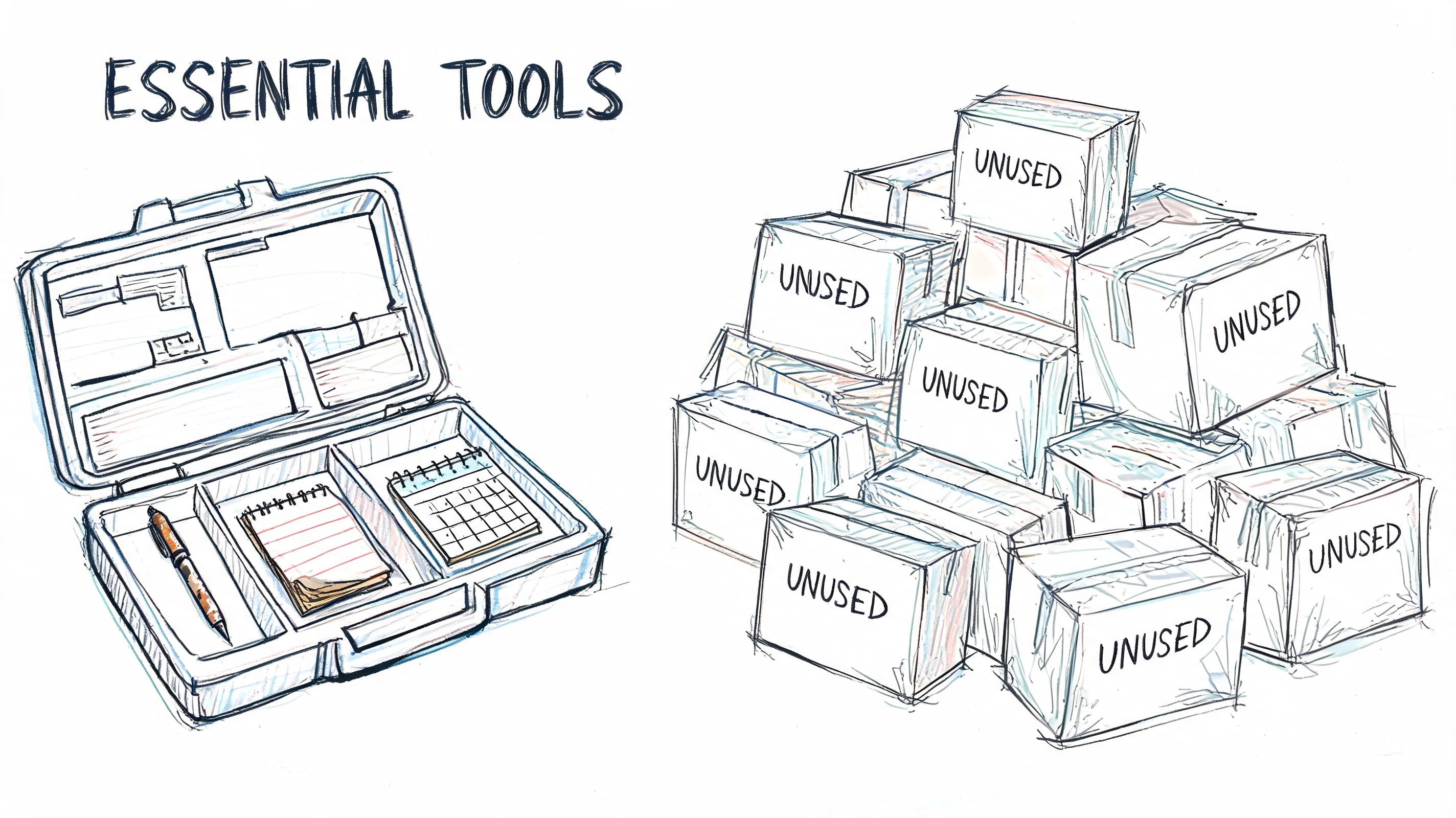
Effective delegation has real business upside. Leaders who delegate well achieve an average 33% increase in revenue while maintaining lower employee turnover, and one reliable way to get there is to apply the 80/20 Rule: protect the 20% of tasks that create the highest impact and systematically hand off the remaining 80% (CEO Review on the business impact of delegation).
Use fewer tools than you want
You do not need a sprawling software stack to delegate well. You need a tiny system your team will maintain.
My recommendation:
- One task board. Trello, Asana, ClickUp, or a shared spreadsheet.
- One documentation home. Notion, Google Docs, or Confluence.
- One communication channel. Slack channel, Teams thread, or email alias for delegated work.
That’s enough.
If your timing is messy, add one simple external cue. A tool like a multiple timer app for ADHD workflows can help you run check-ins and review windows without relying on spontaneous recall.
Your delegation dashboard
Make one lightweight view with these columns:
| Task | Owner | Status | Next milestone | Blocker | Needs founder input |
|---|
That’s it. Not seventeen custom fields. Not a dashboard with charts nobody reads.
The point is instant visibility. When you open the board, you should know in seconds:
- What is moving
- What is stuck
- What needs your decision
- What no longer belongs on your plate
Track proof, not activity
Most founders measure delegation badly. They count assigned tasks and call that progress. Wrong metric.
Track these instead:
- Time reclaimed for genius-zone work
- Tasks completed without rescue
- Areas of growing team ownership
- Recurring bottlenecks in briefs or approvals
If a tool needs a tutorial every time you open it, it is stealing focus, not creating leverage.
You’re not trying to build a perfect operating environment. You’re trying to build a stable one. Minimal tools force sharper thinking. That’s good for ADHD brains because complexity feels stimulating right up until it becomes unmaintainable.
Your System for Compounding Team Momentum
Delegation is not a kindness to yourself. It is infrastructure.
When you triage tasks properly, hand off with a real brief, follow up on a fixed rhythm, and keep the tooling lean, something important changes. The business stops depending on your panic response. You no longer need urgency to create movement.
This is how you stop being the bottleneck
Most ADHD founders become the center of every workflow by accident. You keep context in your head, solve problems in motion, and patch gaps fast enough that people assume the system works.
It doesn’t work. You work.
That’s the trap.
A better system looks like this:
- You keep the work only you can do
- Your team gets visible ownership
- Checklists hold the details
- Milestones surface drift early
- Feedback builds confidence instead of dread
That is how to delegate tasks effectively when your brain loves ideas and hates loose ends.
The operating system in one page
If you want the shortest possible version, use this:
- List recurring tasks.
- Protect genius-zone work.
- Delegate repetitive and draining work first.
- Use a written 5W2H brief for every meaningful handoff.
- Train with I do, we do, you do.
- Run recurring check-ins on a fixed cadence.
- Track visible progress in one simple dashboard.
- Refine the system when something breaks. Don’t blame memory.
You are not trying to become less ADHD. You are building a company that doesn’t require a neurotypical brain to operate cleanly.
Do that long enough and the gains start stacking. The team gets stronger. Handoffs get cleaner. Your calendar stops looking like a hostage situation. You get your strategic attention back, which is where you were always most valuable anyway.
If you’re done improvising and want a system built for an ADHD founder’s actual wiring, Jan Kutschera helps entrepreneurs replace burnout, chaos, and panic productivity with practical operating systems that create steady momentum.
Jan Kutschera
German founder, diagnosed with ADHD at 51. Built 4 agencies, now building systems for neurodivergent entrepreneurs. German engineering for the ADHD brain.
Connect on LinkedInRelated Articles

ADHD Prioritization for Founders: Why Everything Feels Urgent
ADHD prioritization fails when every task feels equally urgent. Here is the framework ADHD founders use to pick one thing and actually start it.

Managing a Team With ADHD: What Actually Works for Founders
Managing a team with ADHD means you are the wildcard. Here is what actually works when your brain is the unpredictable part of the equation.

Low Dopamine ADHD: Why Your Brain Runs Out of Fuel
Low dopamine ADHD crashes explain why founders hit walls mid-project. Learn the signs, triggers, and the Dopamine Refill Stack to get moving again.