Engineer Caffeine and Carbs for ADHD Focus
Tired of the caffeine and carbs rollercoaster? Engineer this combo for sustained focus and end the panic-productivity cycle. Guide for ADHD founders.
Jan Kutschera
You open your laptop with a plan. One hard problem. One clean work block. Then the brain fog shows up, so you do what works fast: coffee and something sweet. A cappuccino and a croissant. A cola and a protein bar that’s really candy with branding. For an hour, maybe two, you feel brilliant. Tabs close. Decisions sharpen. Slack gets answered. The impossible thing suddenly looks solvable.
Then your nervous system sends the invoice.
By early afternoon, the lift turns into static. You reread the same paragraph five times. You want more stimulation, but not because you’re lazy or undisciplined. You’re running a volatile fuel mix through an ADHD brain that loves quick reward and hates unstable energy. The caffeine and carbs combo isn’t random. It’s one of the most common default strategies people use to manage energy. In the U.S., coffee provides about 65 to 70% of caffeine intake, soft drinks add 10 to 15.4%, and 69% of people consume at least one caffeinated beverage daily, according to U.S. caffeinated beverage intake data.
For founders with ADHD, that habit can feel less like a preference and more like a survival tool.
The good news is that this isn’t a morality problem. It’s an engineering problem. If your mornings feel productive but your afternoons collapse, you don’t need more self-criticism. You need a better system than grabbing stimulation on autopilot. If your current ADHD morning routine for entrepreneurs starts with emergency fuel, it’s time to fix the wiring.
Table of Contents
- The 10 AM Liftoff and the 1 PM Crash
- Why Your ADHD Brain Craves This Double-Edged Sword
- The Metabolic Collision That Fuels Brain Fog and Burnout
- You Have an Energy Production Problem Not a Caffeine Problem
- Dopamine Engineering An Actionable Framework
- Sample Protocols for the ADHD Founder
- From Volatile Fuel to a Reliable Engine
The 10 AM Liftoff and the 1 PM Crash
A lot of ADHD founders live inside the same sequence.
You wake up under-recovered, skip a real breakfast, then reach for the fastest available upgrade. Coffee hits first. Sugar lands right behind it. Your brain lights up. You stop doom-scrolling and start shipping. It feels like a personal breakthrough, so you repeat it the next day.
By lunch, the system gets weird.
You’re not exactly sleepy. You’re flat, irritable, distractible, and hungry for something that feels urgent. Founders often mistake that state for lack of discipline. It’s usually a predictable reaction to using caffeine and carbs as a blunt instrument instead of a controlled input.
When the combo becomes panic productivity
The dangerous part isn’t that it works. The dangerous part is that it works fast.
Fast relief teaches the brain a simple lesson: when focus drops, escalate stimulation. That’s how a useful tool turns into a loop. One coffee becomes two. A pastry becomes a “reward.” A soda becomes an afternoon rescue mission.
You’re not failing at focus. You’re getting exactly the output your fuel strategy produces.
For an ADHD brain, that lift can feel almost medicinal. You finally get traction, so of course you protect the ritual. But if the ritual creates output only by borrowing stability from later in the day, it’s not a productivity system. It’s a loan.
The real problem isn’t the morning burst
I’m not anti-coffee. I’m anti-chaos.
Used deliberately, caffeine and carbs can help you start, recover, or bridge a rough patch. Used reflexively, they create a cycle where your best thinking happens in short bursts and your schedule gets built around avoiding the next crash. That’s why some founders feel “on” only in emergencies. Their biology has been trained to perform under stimulation spikes, not under stable conditions.
The aim isn’t to remove every stimulant. The aim is to stop letting convenience design your nervous system.
Why Your ADHD Brain Craves This Double-Edged Sword
The craving makes sense. That matters, because shame leads to bad experiments.
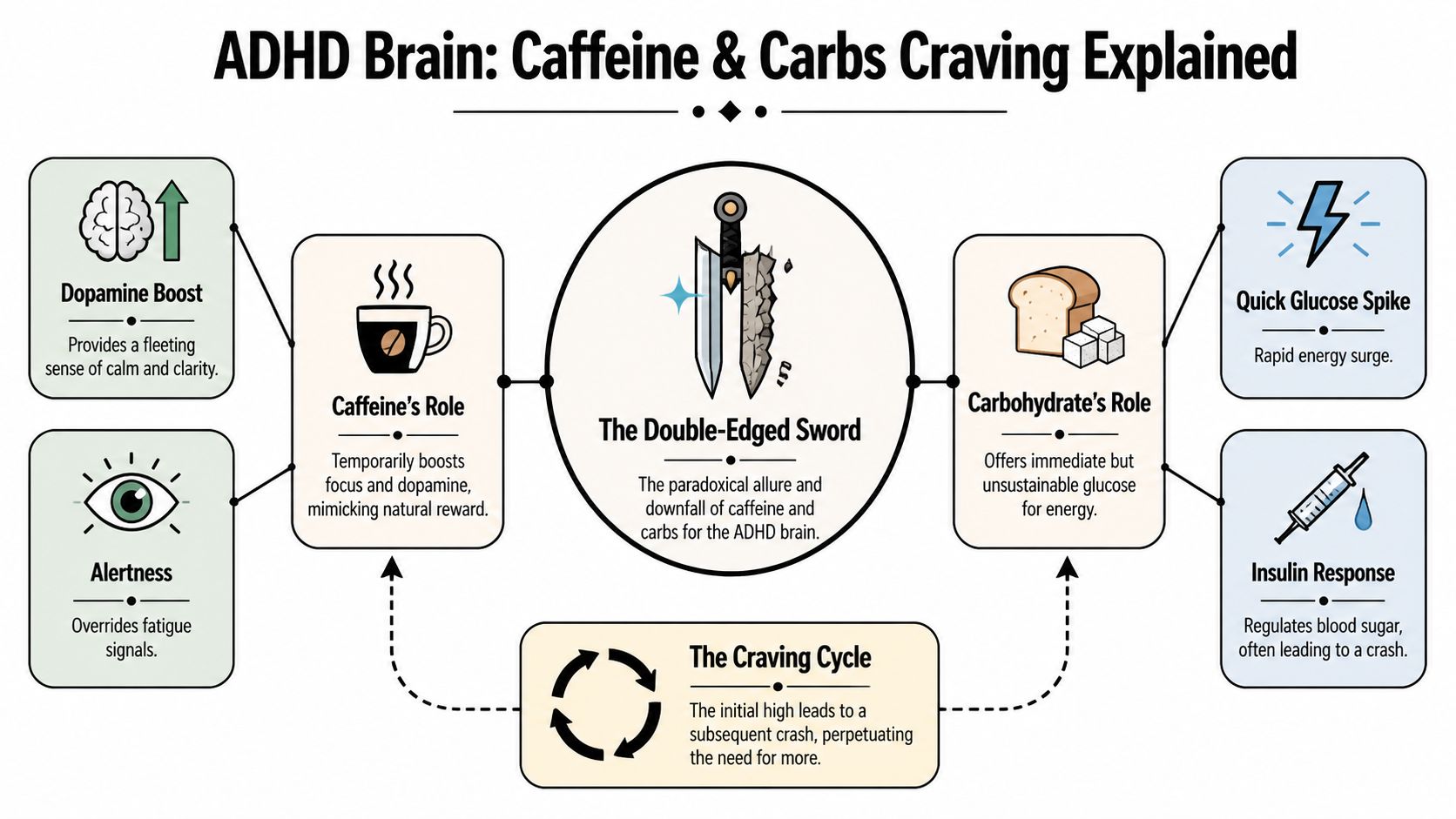
For many people with ADHD, caffeine and carbs don’t feel like indulgences. They feel like tools. The ADHD brain often seeks stimulation, clarity, and emotional grounding during brain fog, and that pull is tied to dopamine-seeking and brain-gut signaling, as described in Tiimo’s explanation of ADHD cravings for carbs and caffeine.
Why the combo feels so good
Think of caffeine and carbs as two different parts of a launch sequence.
Caffeine is the ignition key. It pushes back against fatigue signals and can create that sharp, switched-on feeling you’ve probably used to start sales calls, writing sprints, or a gnarly strategy session. Carbs are the quick-burning fuel. They’re easy to reach for because they’re fast, familiar, and emotionally convincing when your brain feels underpowered.
Together, they can feel like rocket fuel.
That’s why the combo is seductive on founder days. You’re not just looking for energy. You’re looking for friction reduction. You want your brain to stop fighting startup tasks that require initiation, prioritization, and follow-through.
Here’s how it usually plays out:
- Caffeine reduces drag: You feel more alert and less buried under sleep pressure.
- Carbs create immediate momentum: Something sweet or starchy gives you quick mental relief.
- The combination lowers resistance: Tasks that felt impossible feel merely annoying, which is a huge improvement when ADHD has you stuck.
The ADHD caffeine paradox
For some ADHD adults, caffeine doesn’t feel stimulating in the stereotypical way. It can feel calming, narrowing, even organizing. That’s where a lot of generic nutrition advice misses the point. It assumes everyone experiences caffeine as a clean accelerator.
Many ADHD founders don’t.
Practical rule: If caffeine sometimes makes you feel calmer instead of more hyped, that doesn’t mean you’re imagining it. It means your response doesn’t fit the standard script.
This is why caffeine and carbs can become emotionally sticky. The combo doesn’t just wake you up. It can briefly create relief from scattered thinking, under-arousal, and the internal friction of starting. That relief is real. But relief isn’t the same thing as stability, and once you understand that difference, you stop designing your day around rescue missions.
The Metabolic Collision That Fuels Brain Fog and Burnout
The crash isn’t just “too much coffee” or “too much sugar.” It’s what happens when two systems compete.
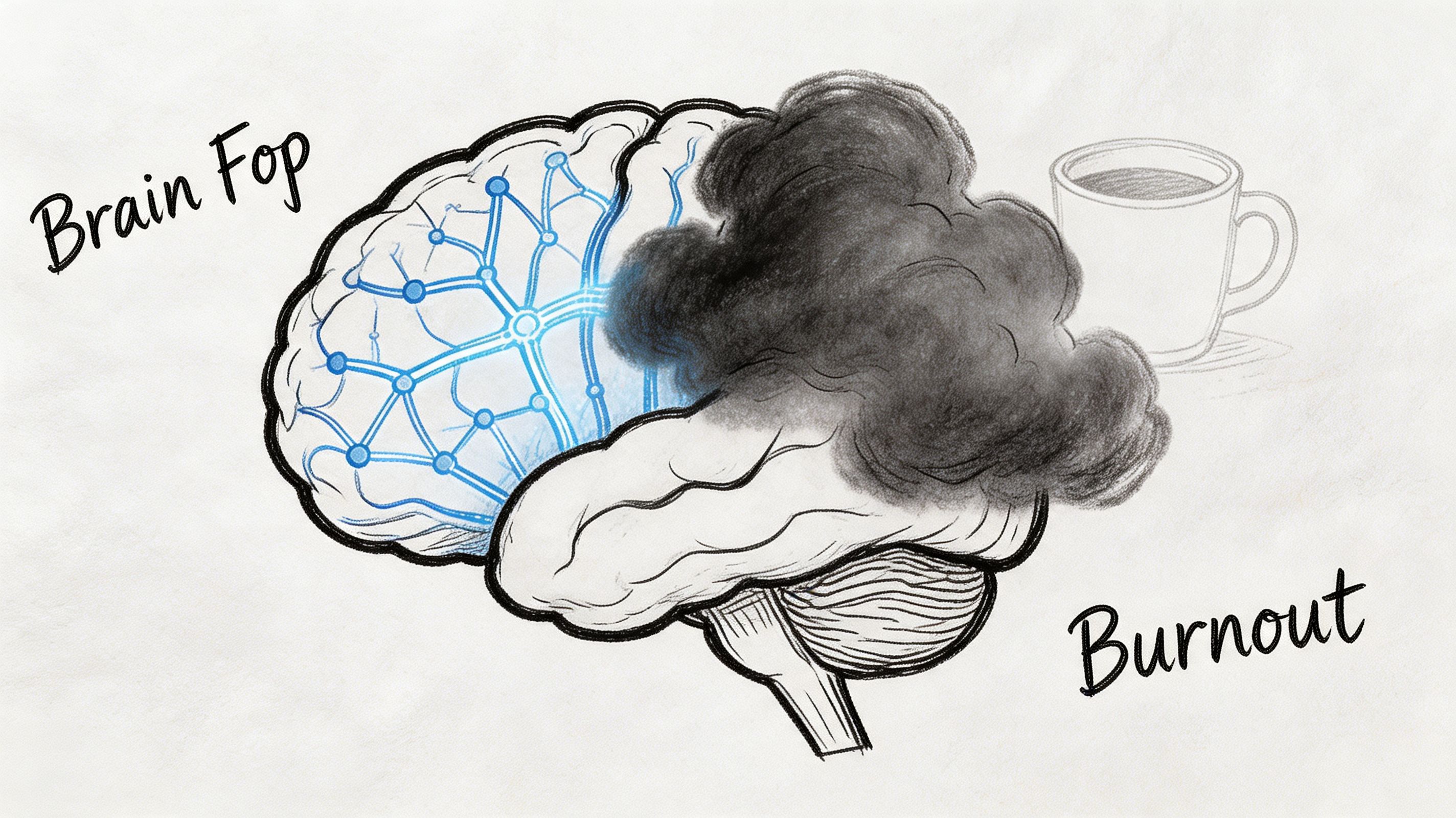
A high-carbohydrate meal can blunt caffeine’s fat-oxidation effect because the insulin response suppresses the rise in free fatty acids that caffeine would otherwise trigger, according to research on caffeine and carbohydrate effects on metabolism. If you care about steady energy, that matters. You lose the cleaner, longer-burning fuel route and get pushed toward a glucose-dominant state instead.
The traffic jam inside the system
Here’s the simple version.
Caffeine opens one lane. It nudges the body toward mobilizing stored fuel. Carbs open another lane. They raise insulin, and insulin tells the body to prioritize glucose. When those inputs arrive together in the wrong context, the “steady energy” lane gets blocked.
I think of it as a traffic jam:
- Caffeine tries to create access to stored energy
- A high-carb hit raises insulin
- Insulin suppresses the free-fatty-acid response
- Your system defaults to fast fuel
- Fast fuel burns fast, then leaves you hunting again
That’s why a sweet coffee drink, pastry, cereal bar, or cola can feel magical at first and useless later. You didn’t create a stable runway. You created a spike.
What the crash looks like at work
Founders rarely describe this as a metabolic issue. They describe it like this:
- “I lose the thread.” You know what needs doing, but your brain won’t hold it.
- “Everything starts to feel heavier.” Not physically. Cognitively.
- “I need something to get going again.” That’s the cue for the second coffee, the snack drawer, or the delivery app.
This is the same cycle many people call burnout when it happens often enough. It’s not the whole story, but it’s a major contributor. If your workday depends on repeating stimulation spikes, your baseline eventually feels broken.
That’s also why founder fatigue can feel mysterious. It isn’t always sleep deprivation alone. Sometimes it’s a day built from stacked peaks and drops. If that pattern sounds familiar, this deeper look at ADHD fatigue in entrepreneurs will feel painfully recognizable.
The body keeps score of every shortcut. It just doesn’t send the report until later.
You Have an Energy Production Problem Not a Caffeine Problem
A lot of founders ask the wrong question. They ask, “How do I use caffeine better?” when the more useful question is, “Why does my system need rescue this often?”
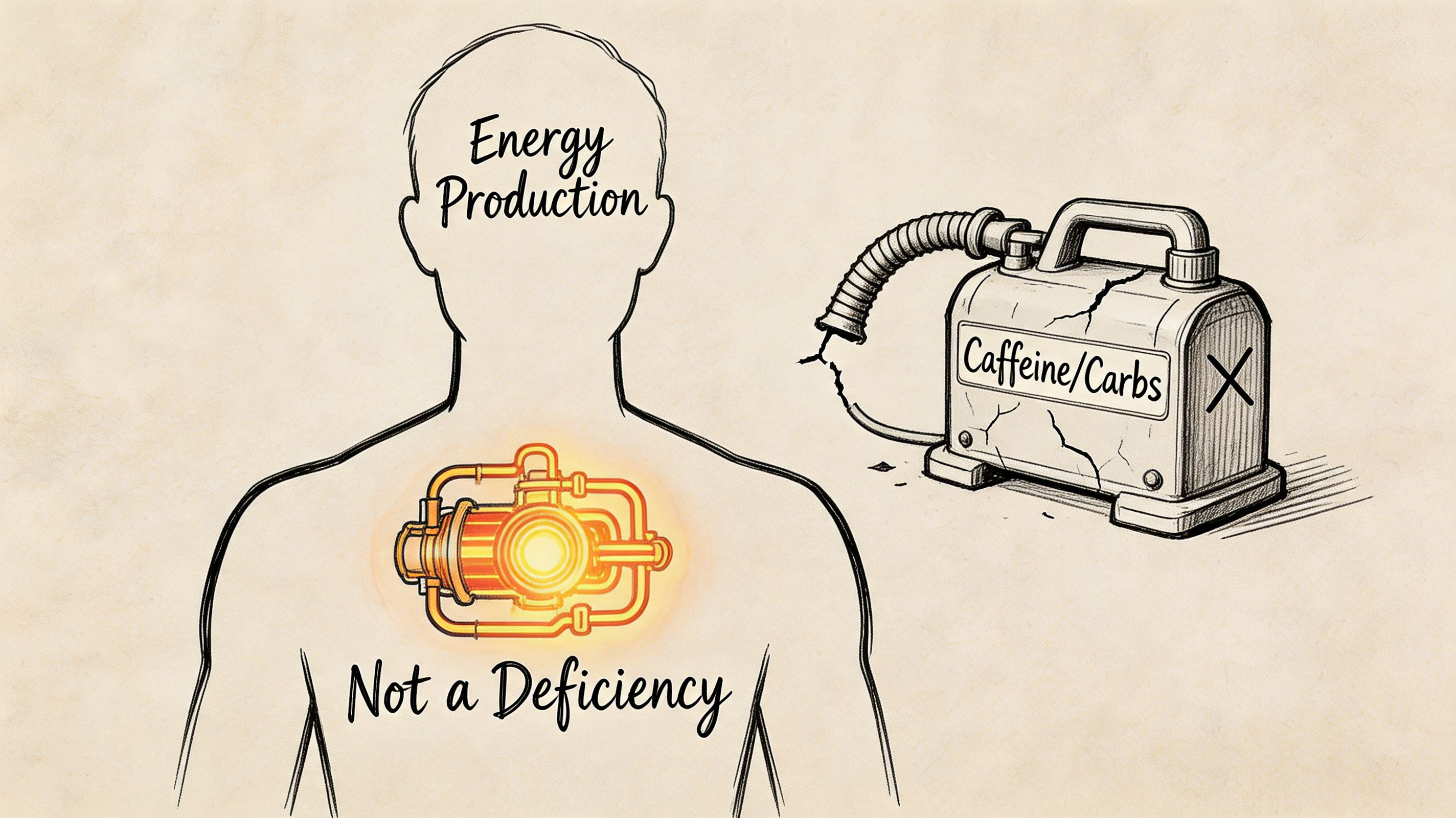
That shift matters. The discussion around caffeine is moving toward a more honest frame: repeated reliance on caffeine and carbs can point to an energy production problem, not a lack of stimulants, especially when sleep, nutrition, and recovery are weak, as argued in this energy-production reframe.
Stimulants can hide a weak foundation
Caffeine is excellent at masking. It can mask poor sleep. It can mask under-eating early in the day. It can mask the fact that you haven’t moved your body, hydrated properly, or given your brain anything steady to run on.
For a while, that seems efficient.
Then the hidden costs show up. You become more dependent on perfect timing. Your mood gets more brittle. Work blocks feel available only when chemistry lines up. The day starts controlling you.
I’ve seen founders treat espresso like a software patch for every biological bug. It never works for long. If the machine overheats because the cooling system is broken, pressing the accelerator harder doesn’t solve anything.
A better diagnostic question
When you want caffeine and carbs badly, pause and ask:
- Did I sleep enough to support executive function?
- Have I eaten anything that creates stable energy, or only fast relief?
- Have I moved at all, or am I trying to think my way out of a physiological problem?
- Am I chasing focus, or am I trying to override depletion?
Those questions are more useful than debating whether coffee is “good” or “bad.”
If you need stimulation all day, every day, the issue usually isn’t motivation. It’s capacity.
Once you see the pattern, caffeine becomes a diagnostic tool. Cravings stop being random urges and start becoming feedback. Sometimes the answer is a carefully timed coffee. Sometimes the answer is sleep debt, a real meal, a walk, or stopping a calendar that demands cognition your biology can’t support.
Dopamine Engineering An Actionable Framework
Here, caffeine and carbs stop being a habit and become a protocol.
The key idea is simple: don’t always stack them. In trained athletes, taking caffeine with a carbohydrate meal showed no additive performance benefit compared with carbohydrates alone, and the proposed reason was that high carbohydrate availability blunted caffeine’s fat-sparing mechanism, as shown in the study on caffeine and carbohydrate co-ingestion. You’re not a cyclist in a lab, but the logic is useful. More inputs at once doesn’t always mean better output.
Separate the signal from the sugar
If you always pair caffeine with fast carbs, you never learn what each input is doing.
That’s the first fix. Separate the variables. Let caffeine be caffeine. Let carbs be carbs. Stop throwing both into the system at the same time and calling the result “energy.”
A practical starting rule is to create space between them when the goal is clear, sustained focus. The exact spacing is individual, but the principle is solid: don’t default to the combo just because cafes, convenience stores, and startup culture package them together.
Try this approach:
-
Use caffeine for activation
Black coffee, espresso, or unsweetened tea can work well when you need task initiation or sharper alertness.
-
Use carbs intentionally
Save them for when you need fuel, not just emotional momentum. Choose options that behave more predictably than a pastry or soda.
-
Watch the sequence
If you start with sugar, you often create a problem caffeine then has to manage. If you start with controlled stimulation, you can make a calmer food decision later.
Choose inputs that behave predictably
Not all caffeine and carbs act the same in real life.
A large flavored latte, an energy drink, and an espresso don’t create the same downstream effects. Neither do oats, fruit, sourdough, candy, and cola. The whole point is to reduce volatility.
A good founder-grade filter is this:
| Input type | Usually more predictable | Usually more chaotic |
|---|---|---|
| Caffeine | Espresso, black coffee, unsweetened green tea | Sugary coffee drinks, soda used as focus support |
| Carbs | Oats, fruit with nuts, rice with a meal, potatoes with protein | Pastries, candy bars, sweet cereal, “snack” foods that are mostly sugar |
| Pairing | Caffeine first, real meal later | Caffeine plus dessert as breakfast |
You’re not trying to become nutritionally pure. You’re trying to remove surprise from your workday.
Field note: If an input gives you a fast sense of genius and then makes your afternoon negotiations, writing, or planning harder, it’s not a smart input for a founder day.
This is also where dopamine engineering for business owners becomes practical. You want repeatable reward loops, not random reinforcement.
Run a founder-grade testing protocol
Caffeine and carbs are evaluated emotionally. “That felt good.” “That felt bad.” That’s too vague.
Track it like an operator. Same way you’d test ad creative, landing pages, or outbound scripts.
Use this table for a week or two:
| Day/Time | Caffeine (Type/Amount) | Carbs (Type/Amount) | Time Between | Focus (1-10) | Energy (1-10) | Notes (Crash? Jitters?) |
|---|---|---|---|---|---|---|
| Monday 8:00 | ||||||
| Tuesday 10:30 | ||||||
| Wednesday 14:00 | ||||||
| Thursday 9:00 | ||||||
| Friday 15:00 |
A few things make this useful:
- Keep one variable stable: If you change caffeine source, carb type, and meal timing all at once, the data becomes noise.
- Track the crash, not just the boost: The beginning of the experience is seductive. The back half tells the truth.
- Rate work quality, not just sensation: “I felt locked in” is less useful than “I completed strategy work without context switching.”
- Notice emotional pull: If you feel compelled to repeat a combo before you’ve even evaluated output, that’s a clue.
Patterns usually show up quickly. Some founders do well with caffeine before food. Others need a real meal first or caffeine becomes too sharp. Some tolerate fruit well but not liquid sugar. Some can use carbs around training or after a long work block but not as their startup sequence.
The goal isn’t to find the perfect universal formula. It’s to build a reliable operating manual for your wiring.
Sample Protocols for the ADHD Founder
Theory matters. Real routines matter more.
Here are three simple ways to use caffeine and carbs without turning them into a daily lottery.
The deep work morning
This works when your brain is sluggish but you want a long, cleaner block.
Start with a plain coffee or unsweetened tea and skip the pastry. Work on the hardest task first while the activation is fresh. Later, eat a real meal built around protein and more stable carbs, something like eggs with oats, Greek yogurt with berries and nuts, or rice with leftovers if you’re that kind of operator.
Best use case: writing, strategy, product thinking, investor materials.
The 2 PM slump breaker
At this point, many individuals often wreck the second half of the day.
Instead of a big coffee and a cookie, go smaller and calmer. Try tea or a smaller coffee, then pair food with something steadier like fruit plus nuts, or yogurt with a bit of granola if that sits well for you. The point is to create lift without detonating your blood sugar.
Best use case: admin, follow-up, one-on-ones, sales calls that need presence more than fireworks.
Small corrections beat heroic rescues.
The meeting-heavy day
Meetings create a weird kind of fatigue. You’re stimulated, but not well fueled.
On these days, don’t rely on liquid sugar to keep yourself socially “on.” Use caffeine early if it helps you sharpen, then eat real meals on time. If you need something between calls, choose food you can predict. A sandwich, rice bowl, nuts, fruit, or leftovers beat a muffin eaten over Slack.
Best use case: leadership days, hiring, workshops, client presentations.
The pattern across all three is the same. Don’t let convenience store logic determine founder performance. You want inputs that keep your brain available, not inputs that create a brief performance peak and then steal the rest of the day.
From Volatile Fuel to a Reliable Engine
Caffeine and carbs aren’t the enemy. Randomness is.
For an ADHD founder, this combo can feel like a superpower because it temporarily solves a real problem: low activation, low clarity, high friction. But if you use it without a system, it turns on you. The morning lift becomes the afternoon fog. The rescue becomes the routine. The routine becomes burnout with decent branding.
The fix isn’t abstinence. It’s precision.
Use caffeine for activation when you need activation. Use carbs for fuel when you need fuel. Separate them often enough to learn what each one does in your body. Track the result. Build around stable energy, not dramatic saves.
That’s how you stop being the person who “works best under pressure” and become the person who can produce on purpose.
Your brain isn’t broken. It’s responsive. Give it better inputs, in a better order, and it starts acting like the high-performance engine it is.
If this article felt uncomfortably accurate, Jan Kutschera helps ADHD founders turn patterns like caffeine chaos, burnout loops, and panic productivity into engineered operating systems built for their wiring. If you want practical structure instead of more generic life hacks, his work is worth exploring.
Jan Kutschera
German founder, diagnosed with ADHD at 51. Built 4 agencies, now building systems for neurodivergent entrepreneurs. German engineering for the ADHD brain.
Connect on LinkedInRelated Articles

Founder Focus: Master pomodoro technique adhd System
Pomodoro technique adhd - Ditch generic advice! This neuroscience-backed system applies the pomodoro technique adhd for founders to engineer focus, manage

Planner Color Coding for the ADHD Brain
Ditch generic planner color coding. Learn an ADHD-friendly system for founders that boosts focus and dopamine without the overwhelm. Step-by-step guide.

ADHD-Friendly: Build A Multiple Timer App System
Beat panic productivity. Use a multiple timer app for an ADHD-friendly system. Covers setup, workflows, and real-world use.