
Elements of Delegation: The Four Parts That Make It Work
Learn the elements of delegation: task clarity, ownership, handoffs and feedback, with a decision-rights table and steps to hand off work that sticks.
Jan Kutschera
Say it’s Tuesday night and you’re rewriting a client proposal that was meant to leave your desk on Monday. You passed it to a colleague who writes well. They sent back a half-finished draft and a note asking whether the tone was right. You delegated. The work still came home.
That’s the usual failure, and it isn’t laziness. The missing piece is almost never effort. It’s a decision right that never got written down, so every judgment call still belongs to you.
The elements of delegation are four interlocking parts of one system. Task clarity says what finished looks like. Ownership says who may decide without asking. A handoff carries the context that used to live in your head. Feedback sets when progress gets checked. Drop one part, and the task boomerangs.
What follows is a glance table, a worked route through each part, and a one-hour audit you can run on a task you handed off last week.
Table of Contents
- Why Delegated Work Keeps Landing Back on Your Desk
- The Four Elements at a Glance
- Task Clarity Starts With the Result, Not the Chore
- Who Decides What Without Asking
- How to Hand Off Work With Full Context
- Checking Progress Without Hovering
- Confirm Your Delegation Setup This Week
Why Delegated Work Keeps Landing Back on Your Desk
Monday morning, you slide a client proposal to someone who can write. At 6 p.m. a half-finished draft returns, plus a message asking if the tone is right. You did hand the work across. It still came back for dinner.
Delegation isn’t the moment you pass a task. It’s the system that has to hold after you walk away. Four parts have to stay linked, or the handoff is only a gesture.
Task clarity names what done looks like. Ownership names who decides what without asking. Handoffs carry the context that used to live only in your head. Feedback sets when and how progress gets checked.
Think of a relay. Passing the baton is the easy bit. Runners still need the lap, the rules, and the exchange zone. Without those, the baton hits the track and someone sprints back to pick it up. That someone is you.
The work comes home because you kept the decisions, not because your colleague can’t do the job.
The pattern is boringly consistent. Tasks boomerang because the delegator keeps decision power. The colleague owns the typing. You still own every judgment call, so every judgment call returns.
You’ll get a quick-reference table next, then a clear route through each part. By the end you can audit one task you delegated last week against those four elements and see which one is missing.
The Four Elements at a Glance
The four parts build on each other. Clarity comes first, because you can’t assign ownership of a result you haven’t defined. Before you hand anything off, a short pass of workload triage before delegating tasks stops you from shipping a chore that should have stayed with you or been dropped.
The four elements of delegation at a glance
| Element | Question it answers | Practical example | Warning sign |
|---|---|---|---|
| Task clarity | What does finished look like? | Written done-definition with deadline and quality bar | Delegate keeps asking what good means |
| Ownership | Who decides what without asking? | Named decision area with a spending or scope limit | Work waits for the founder’s approval |
| Handoffs | What context travels with the task? | One brief with links, prior decisions and constraints | Delegate re-asks questions already answered |
| Feedback | When and how do we check progress? | Two fixed review points agreed in advance | Founder checks in daily or finds problems at the deadline |
Task clarity answers what finished looks like. A written done-definition, with a deadline and a quality bar, is the practical form. The warning sign is a delegate who keeps asking what good means.
Ownership answers who decides what without asking. Name the decision area and put a spending or scope limit on it. If work sits in a queue waiting for your approval, this row is empty.
Handoffs answer what context travels with the task. One brief, with links, prior decisions, and constraints, beats three chat threads. If they re-ask questions you already answered, the brief never left your head.
Feedback answers when and how you check progress. Two fixed review points, agreed before work starts, beat a daily poke and a surprise at the deadline.
When a delegated task fails, find which warning sign showed up and start on that row. Don’t rewrite the whole system because one cell was blank.
Task Clarity Starts With the Result, Not the Chore
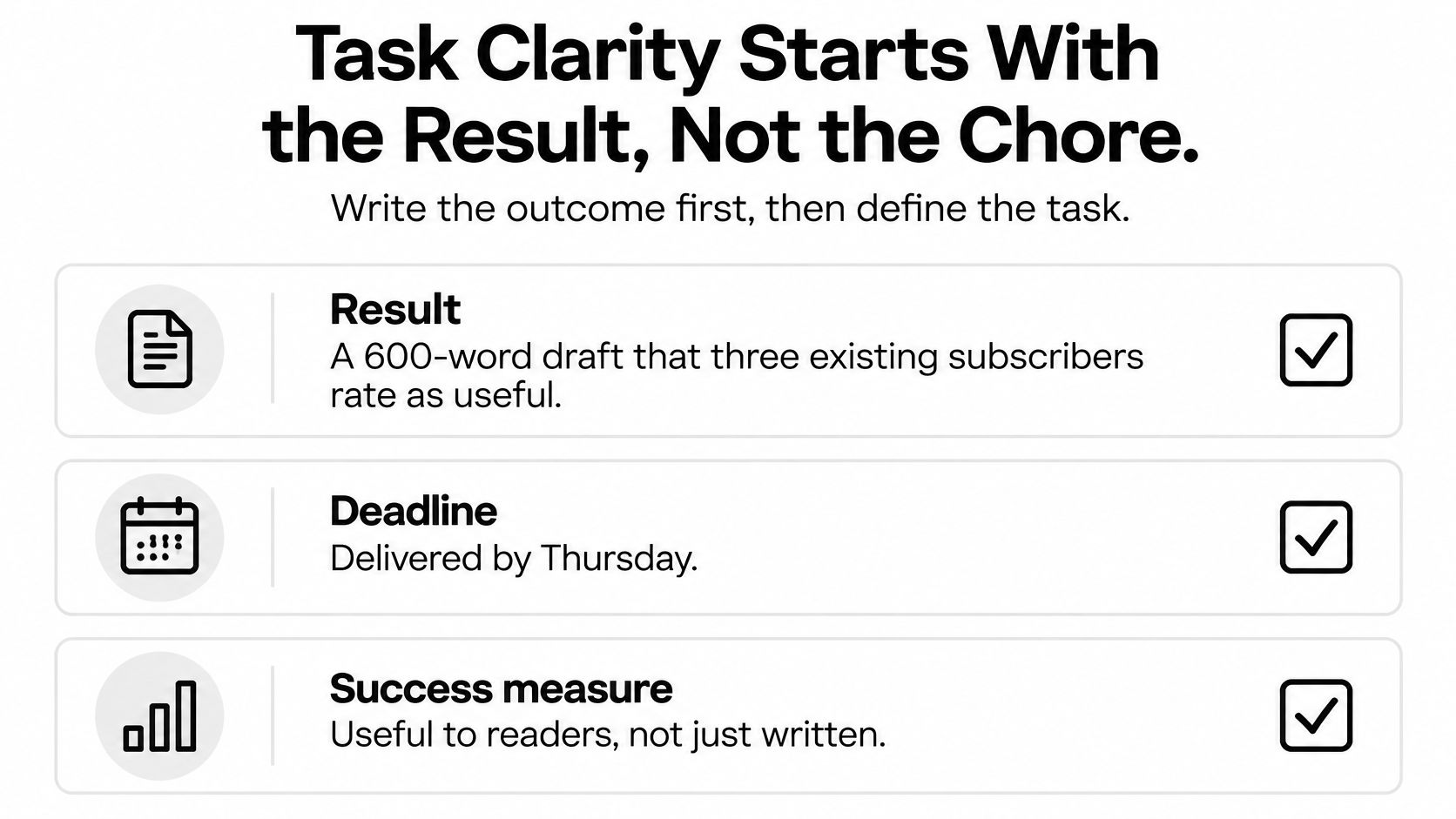
“Write the newsletter” is a chore. “A 600-word draft that three existing subscribers rate as useful, delivered by Thursday 10:00” is a result. One of those can be judged by a stranger. The other can only be judged by you, which is why it comes back.
Gallup’s analysis of 11,781 work teams found that managers account for at least 70% of the variance in employee-engagement scores. That’s why a one-line request isn’t a management system. Clear expectations, coaching while the work is underway, and a fair review against those expectations have to travel together. The person doing the work holds responsibility for finishing it. You still hold accountability for the standard, the obstacles, and whether the result matches the goal.
Four questions every brief has to answer
Say a founder asks for “a better onboarding email.” The writer guesses at tone, length, and what “better” means, then waits. A stronger ask is an email that cuts first-week support tickets by half, with two past emails attached as the quality bar.
- Outcome: What change should exist when this is done?
- Priority: What does this beat, and what can wait?
- Standard: Which past piece, metric, or checklist defines good?
- Deadline: What day and time, not “soon”?
A done-means checklist is short. Measurable outcome, quality bar, format, named owner, and date. If any line is blank, you’re still describing a chore.
If you can’t say what done looks like in one sentence, you aren’t ready to delegate.
Write that sentence, then ask whether someone who wasn’t in the room could score the result. If they couldn’t, the brief still belongs to you.
Who Decides What Without Asking
The most common failure looks like trust and feels like a bottleneck. The delegate is on the hook for the result and has no power to change scope, spend, or send the message. Every decision bounces back up. Work stalls, then someone escalates it to you, which was the point of handing it off in the first place.
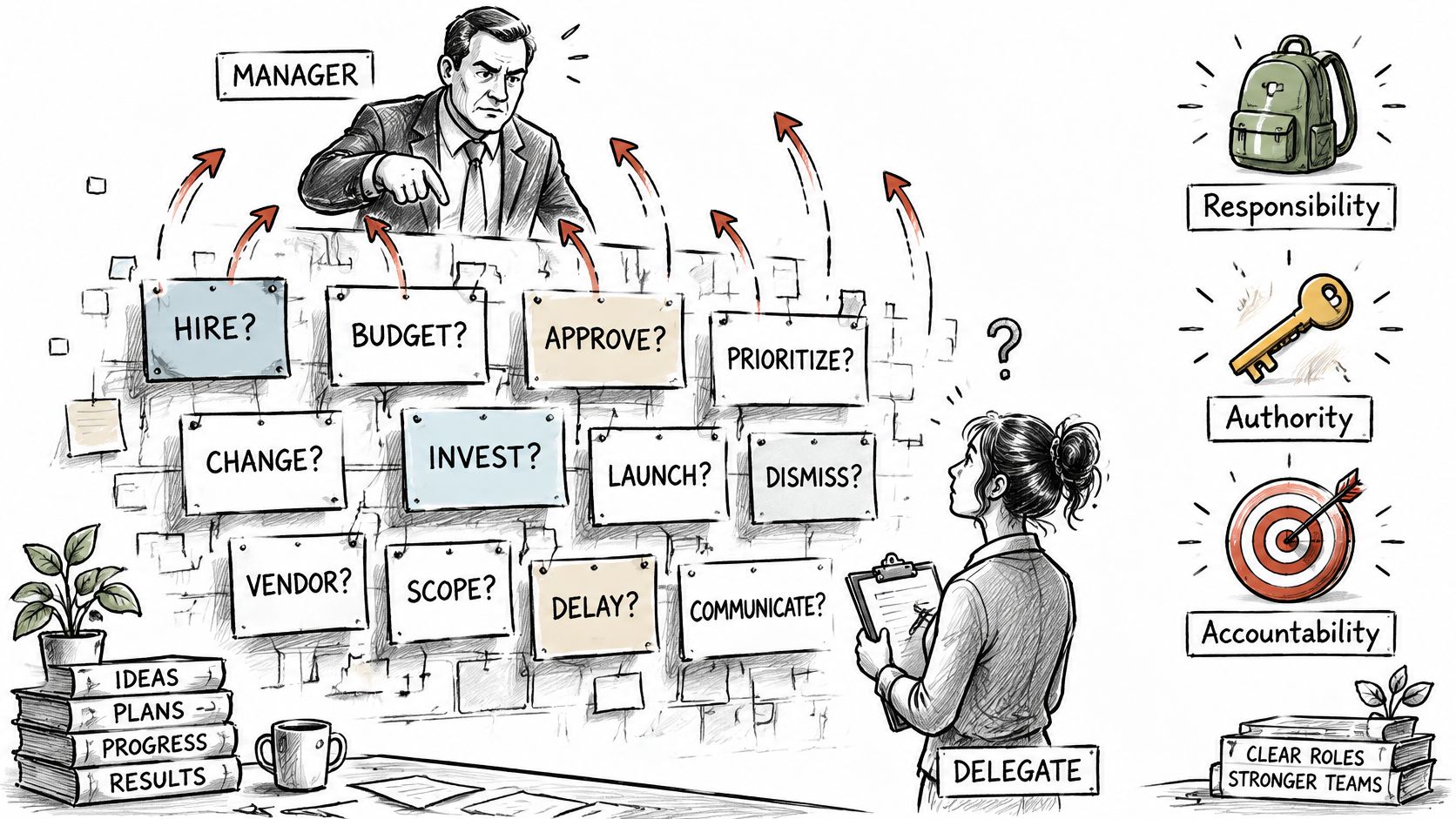
Three plain words get mixed up, and the mix-up is expensive.
Responsibility is the duty to do the work, like being the person who carries the boxes. Authority is the right to decide and to use resources, like the key to the van and a fuel card with a limit. Accountability is the duty to answer for results. That last one stays with you. You can hand over the boxes and the key. You can’t hand over the answer you’ll give the client if the delivery fails.
Established management guidance treats those three as separate, and it warns against holding someone responsible while denying them permission to change scope, spend, see the data, or make the call. That gap is accountability without control. It’s a structural reason work stalls and climbs back to the founder, especially when you keep a veto.
A matrix you can actually use
Write one matrix per role and look at it each quarter. “Just let go” is bad advice if the authority doesn’t match the autonomy. You keep final accountability. They get a permitted operating range.
Decision rights for a delegated role
| Decision | Delegate decides alone | Delegate proposes, founder approves | Founder decides |
|---|---|---|---|
| Scope change within the brief | Minor wording or format changes | Adding deliverables or extending the deadline | Changing the goal or budget |
| Spending | Up to an agreed small amount | Anything above the limit, with a quote | Any new recurring cost |
| Client-facing messages | Routine replies from approved templates | Pricing or refund talk | Contract changes or disputes |
| Hiring and team changes | Interview scheduling | Shortlist and recommendation | Final offer and dismissals |
| Creative direction | Choices inside the brand guide | New campaign concept | Shifts in brand positioning |
A task handoff names a chore. An outcome handoff names an owner, defines success, and grants that range. The test on any task is simple. What may this person decide without asking me?
For creative or high-ambiguity work, use a proposal-first rule. They bring two options and a recommendation before they act. That isn’t hovering. It’s how you stop a silent veto from becoming the process. If the hard part is coaching the judgment rather than grabbing the work back, the difference between coaching and managing is worth getting straight before the next client brief.
How to Hand Off Work With Full Context
A complete decision packet is the handoff, not an isolated to-do. You keep strategic control. Operational authority moves to the person closest to the information, which cuts the interruptions that used to land in your afternoon.
Research on organizational design splits delegation into dividing tasks, allocating them, distributing rewards, providing information, and managing exceptions. Experimental work in that line found superiors delegated less often than was economically sensible, and that people put in less effort to gather decision-relevant information when a manager only asked for input instead of handing over the decision. Profit was lower. You can delegate the typing and still create learned helplessness.
Six moves, and the slip that breaks each one
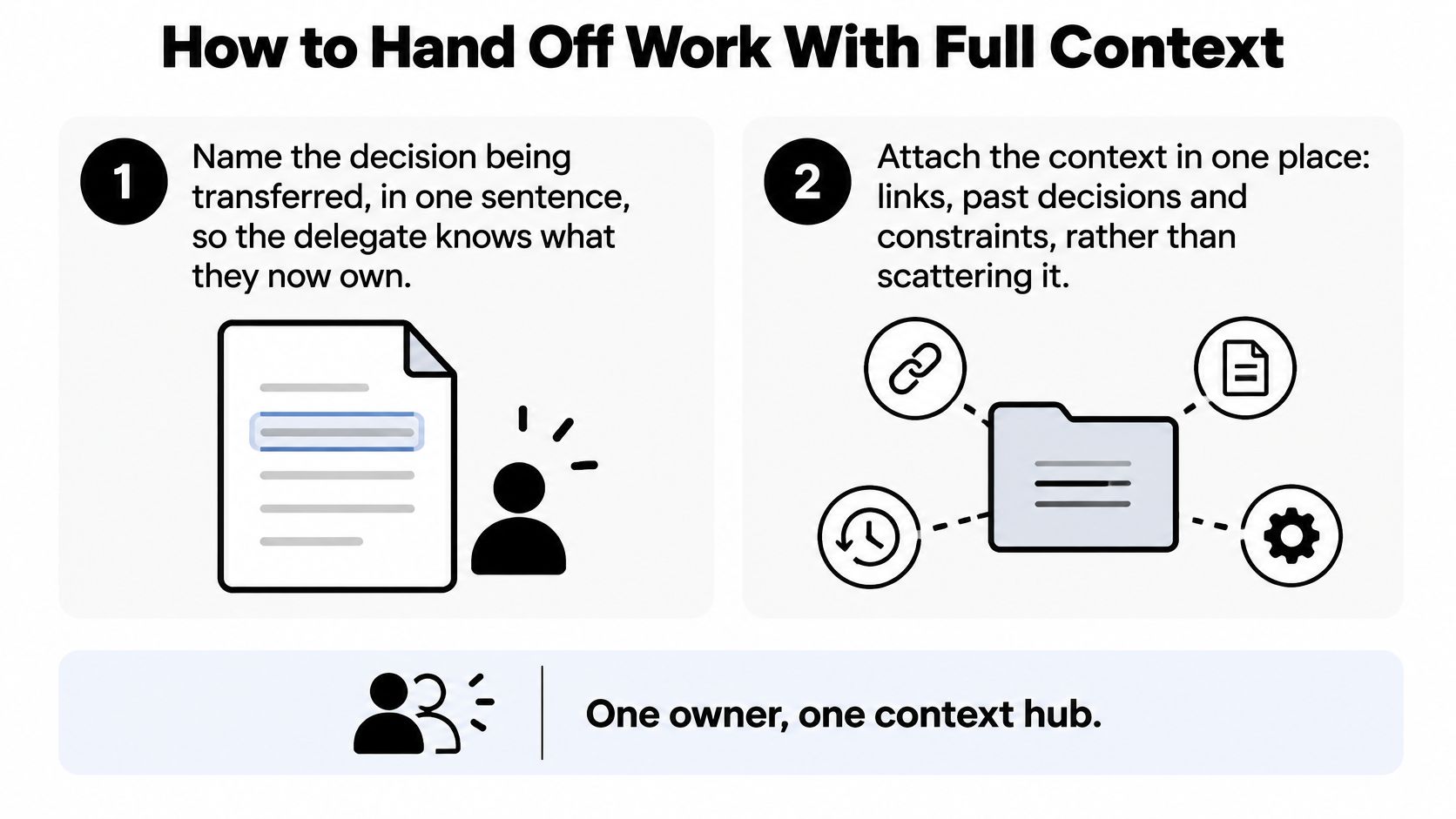
- Name the decision in one sentence. “You own the Q3 client report up to a $200 design spend” tells them what they now hold. “Can you look at the report?” does not.
- Put the context in one place. Links, past decisions, and constraints live in a single doc, not across Slack, email, and a voice note. Split context produces “where is the file?” by lunch.
- State the outcome and the time limit. Tie them to the done sentence you already wrote, with a clock on it. A floating “when you can” becomes your Friday night.
- Name the only escalation triggers. A budget above the limit, or a client complaint, comes to you. Everything else does not. Vague triggers produce either silence or a question every hour.
- Ask them to restate it. They say the task back in their own words before they start. If the restatement is wrong, you fix the brief, not the person.
- Agree the review date before work begins. Put it on the calendar while you’re both still in the conversation. A review invented later feels like a raid.
Messy channels make this worse. If status, files, and decisions live in different places, even a clean packet frays. Tightening how the team communicates is part of the handoff, not a side project.
When they hand it back
Reverse delegation sounds like “what should I do?” Don’t answer with the decision. Ask for two options and a recommendation, then respond to that. You stay the person who answers for the result. You stop being the person who rescues every stuck moment.
Checking Progress Without Hovering
People calibrate how much authority they can safely use from how you behave, not from what you announced in the kickoff. In a large employee–establishment survey, a Cambridge study of trust and delegation found that a one-standard-deviation increase in employee trust in management was associated with about a 0.6-standard-deviation increase in delegated decision rights, after establishment effects and factors such as incentives. When people expect a reasonable call to be backed, they collect local information and act. When you override often, they wait.
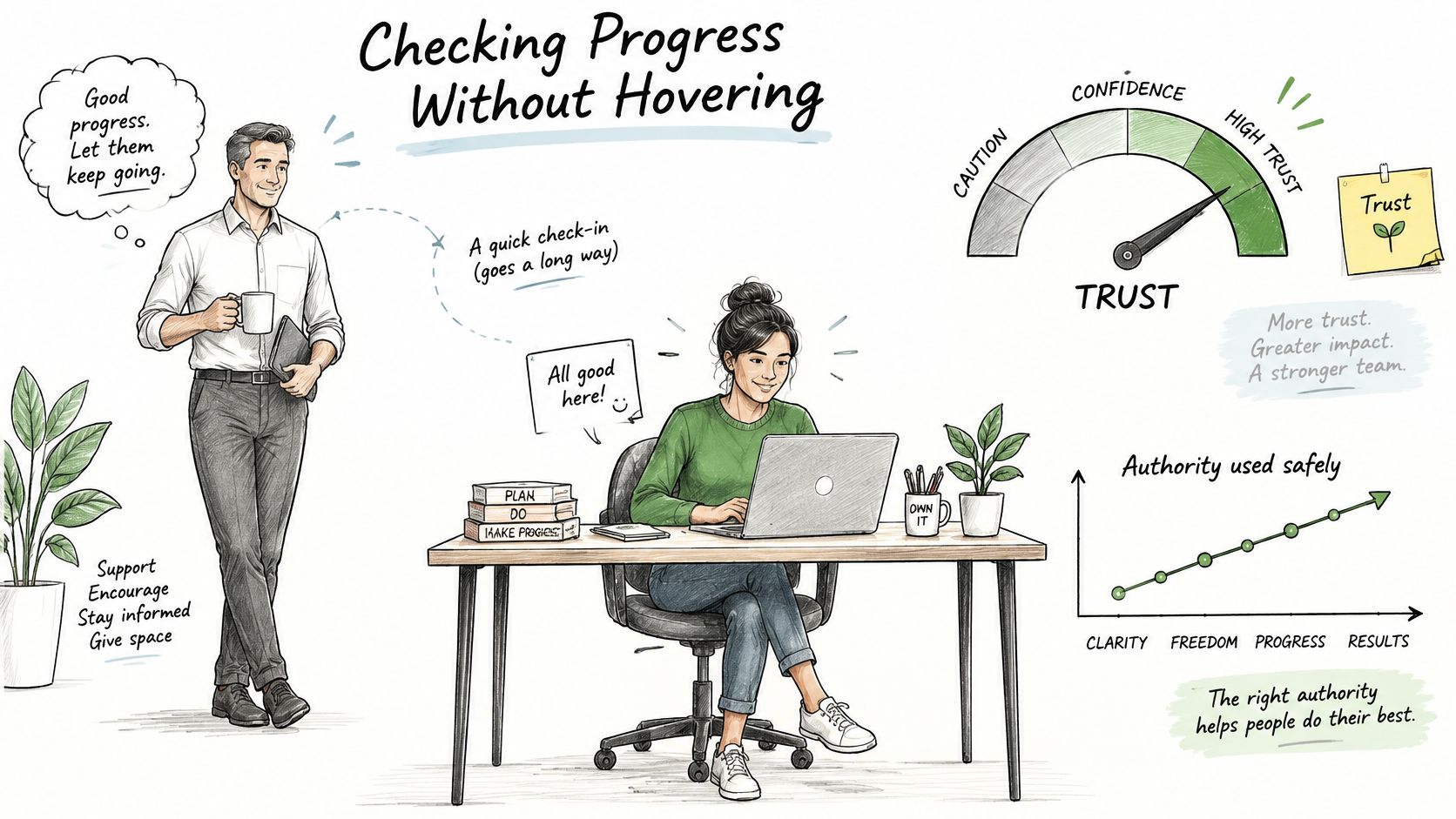
Say the homepage copy is due Friday. On Wednesday you open the doc, hate a headline, and rewrite three sections before the review. The delegate learns a clean lesson. Waiting for rescue is safer than deciding. Next time they send you a draft with the hard choices still blank.
A loop you agree before the work starts
Fixed points beat a mood. A 20-minute check at about 25% of the work, and another at about 75%, written down before anyone starts, is enough for most briefs. Founders whose attention swings get more from those predictable checkpoints than from watching the channel all day. A written decision log plus a fixed window turns trust into something you can run on a bad Tuesday, which is also how ADHD project management stays upright when urgency tries to rewrite the plan.
- Metrics: Agree what success looks like before the first keystroke.
- Review points: Two slots on the calendar, not “ping me if you need me.”
- Intervention triggers: Name the few conditions that pull you in. Everything else waits.
- Close: A short retrospective asks what to keep next time.
Don’t redefine the standard after you see the outcome. Moving the bar once the work is done teaches people that the written deal was theatre.
Praise the reasoning, not the lucky result. “You picked the shorter subject line because last month’s open rate favoured it” teaches a repeatable call. “Nice, it worked” teaches nothing. The same habit shows up in how to stay accountable to goals. You track the commitment you made, not the feeling you had when the numbers landed.
Confirm Your Delegation Setup This Week
Pick one recent handoff and score it in a single sitting. This audit is one option among others. A shared doc, a whiteboard, or a task tool all work if the four rows get filled. If you’re choosing software for the queue itself, the task management rankings from TopToolAdvisor are a useful shortlist, not a substitute for the writing.
- Score the last task. Was the done-definition written, was decision authority named, did the handoff include context, and was a review point set? Mark the blank row. That’s the one that sent the work home.
- Rewrite two lines. Restate what done means in one sentence, and add one line to the decision-rights matrix naming a decision they may now make alone.
- Book the next review. For the next delegated task, put checks at about 25% and 75% of the work on the calendar before they start.
The whole pass takes about an hour. Founders whose attention fluctuates get more from those scheduled reviews than from daily monitoring, because the check exists even on a day your focus doesn’t. Our method treats this as operating design, not a personality fix. It rests on four pillars, Cognitive Architecture, Dopamine Engineering, Strategic Delegation, and Bio-Optimization, and the delegation pillar is the one you’re tightening here.
What to watch for two weeks
- Questions: Fewer “what does good mean?” messages.
- Waiting: Fewer items sitting for your approval.
- Returns: Work comes back finished against the sentence you wrote, not as a rescue request.
Delegation sticks when the result, the decision rights, the context, and the review are all in writing before the work begins.
Jan Kutschera helps ADHD founders replace panic productivity with operating systems that match how their attention works, including Strategic Delegation with clear ownership, a definition of done, and reviews that don’t depend on willpower. If delegated work keeps landing back on your desk, the missing piece is usually a decision right you never wrote down. Visit Jan Kutschera to see how that system gets built.
Jan Kutschera
German founder, diagnosed with ADHD at 51. Built 4 agencies, now building systems for neurodivergent entrepreneurs. German engineering for the ADHD brain.
Connect on LinkedInRelated Articles
Leadership Communication Skill: A Guide for ADHD Founders
Build your leadership communication skill with clear handoffs, channel choices, ADHD-friendly team agreements and drills you can run this week.

BIOS Optimization Guide for Founders Who Hate Habits
A bios optimization guide for founders: tune sleep, fuel and movement like firmware, with ADHD-proof systems that survive launch week.
10 ADHD Productivity Tools for Founders: What Works
Ten ADHD productivity tools for founders, with honest limits and tips for choosing systems that support executive function without extra clutter.