Leadership Communication Skill: A Guide for ADHD Founders
Build your leadership communication skill with clear handoffs, channel choices, ADHD-friendly team agreements and drills you can run this week.
Jan Kutschera
You’ve just explained the new priority in Slack. Someone asks whether the old priority still matters. Someone else has already started the wrong thing. Meanwhile, your carefully delegated project has returned wearing a tiny hat labelled quick question.
For an ADHD founder, the temptation is to communicate harder: another voice note, a more energetic meeting, a heroic late-night clarification. A better fix is to make your meaning less dependent on your mood, memory, and availability. Your team doesn’t need a permanent keynote speaker. They need a leader whose instructions still make sense when that leader is having a difficult Thursday.
Table of Contents
- The Five Skills Behind Leadership Communication
- Why Enthusiasm Predicts Engagement
- Matching the Medium to the Message
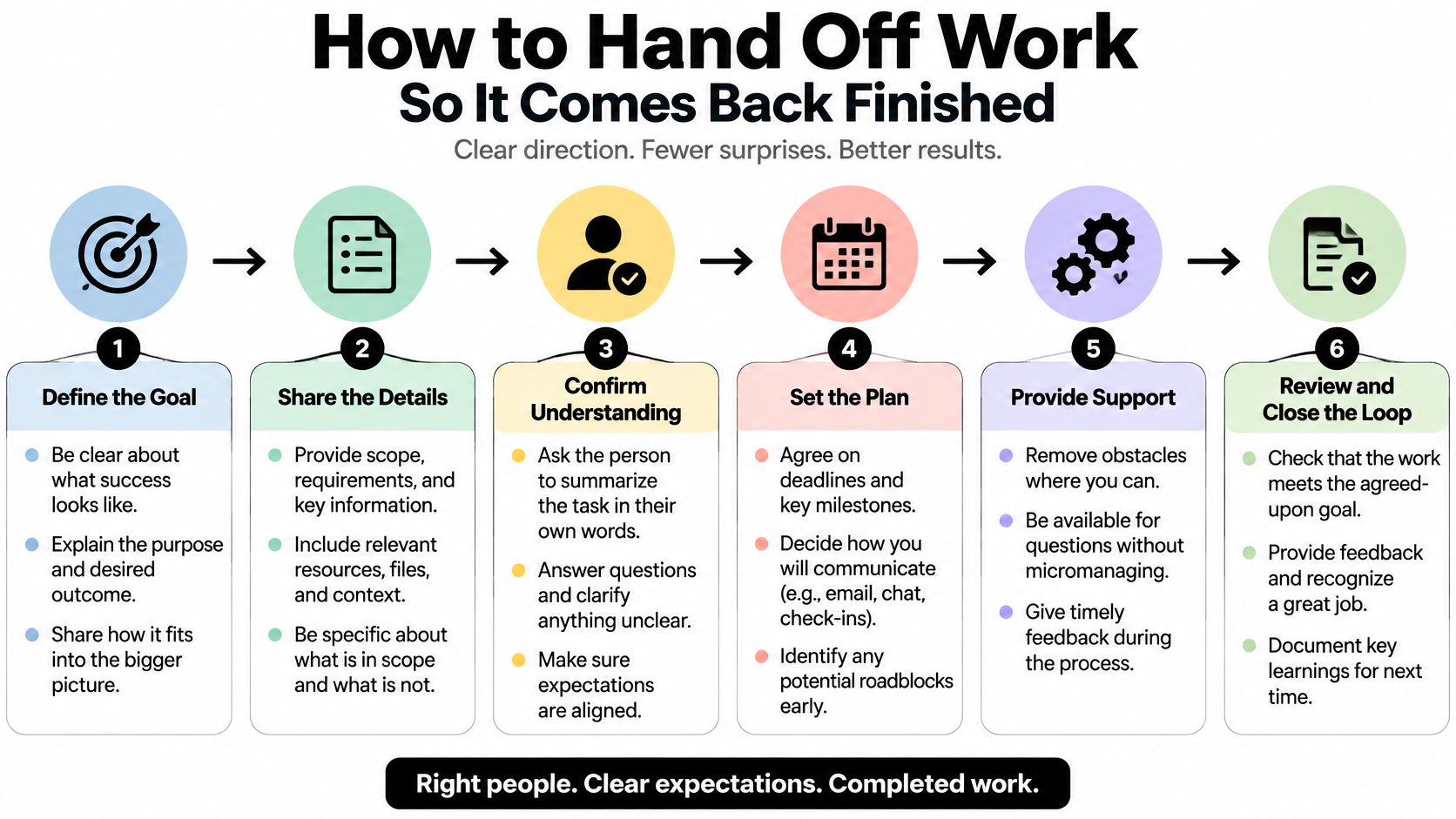
- How to Hand Off Work So It Comes Back Finished
- Talking About Your Wiring Without Disclosing a Diagnosis
- Reliability Beats Charisma When Pressure Rises
- Run One Drill This Week
The Five Skills Behind Leadership Communication
Leadership communication skill is the habit of helping your team understand, believe, and act on what you mean. Treat it as a set of trainable behaviours, not a charisma contest.
Think of communication as a delivery truck. The message is the cargo, the channel is the road, and your teammate’s understanding is the destination. Perfect cargo delivered to the wrong address is still a failed delivery, even if the driver has excellent executive presence.
Five leadership communication skills at a glance
| Skill | What It Sounds Like | Where It Breaks Down |
|---|---|---|
| Directional clarity | We’re cutting scope to hit the March launch; everything else waits. | Priorities shift in every meeting. |
| Channel matching | Decisions go in writing; alignment happens live. | Everything goes by chat, or everything waits for a meeting. |
| Active listening | So you’re worried the timeline is unrealistic. What would make it work? | You talk, then assume you were understood. |
| Closed feedback loops | We took your pricing idea; here’s why the other implementation option won. | Input disappears into a black hole. |
| Reliable follow-through | I’ll answer by Thursday, even if the answer is still thinking. | Mood and availability swing unpredictably. |
Make the behaviour visible
Directional clarity breaks when Monday’s plan becomes Friday’s ancient history. Name what’s being displaced whenever you introduce something urgent. Otherwise, your team gets an expanding collection of top priorities, which is just a to-do list wearing a crown.
Channel matching breaks when convenience wins over comprehension. Active listening breaks when you start composing your answer before the other person finishes. Paraphrasing gives them a chance to correct your interpretation before you solve the wrong problem with impressive confidence.
Choosing whether to ask a question or give an instruction matters, too. The distinction between coaching and managing helps you avoid turning a clear directive into a guessing game.
For the presence side of delivery, Unfloppable’s strategies for leading with impact offer a useful companion. Presence should help people follow your meaning, not distract from missing instructions.
Self-check: Which behaviour disappears when you get busy?
I would look hardest at closed feedback loops. Founders often remember the decision and forget the people who contributed to it. Tell them what changed, what didn’t, and why. Otherwise, your invitation to contribute starts looking suspiciously like a suggestion box over a shredder.
Why Enthusiasm Predicts Engagement
69% of employees who strongly agreed that their leaders made them enthusiastic about the future were engaged, compared with 1% among those who disagreed or strongly disagreed, according to Gallup’s account of findings published in Strengths Based Leadership.
That contrast matters because assigning work and explaining direction aren’t the same job. People can understand their next task without understanding why they should care about where the business is going.
The relationship between enthusiasm and engagement is illustrated below.

Give the pivot a destination
Say you announce an agency pivot in chat: stop selling small retainers, target larger accounts, update the pitch deck. You hear a compelling commercial strategy. Your team hears more work, an uncertain pipeline, and a deadline approaching with a clipboard.
Make the direction concrete before distributing tasks:
- Name the future state. Explain that the agency is moving toward fewer, deeper client partnerships where the team can own outcomes rather than juggle disconnected requests.
- Connect roles to that picture. Explain how account planning, sales qualification, and delivery standards each support that future.
- Say what stays stable. Clarify which client commitments, quality standards, and responsibilities aren’t changing.
You don’t need to promise an effortless transition. Credible enthusiasm can include uncertainty: the destination makes sense, the route needs testing, and you’ll explain what would make you reconsider.
For an ADHD founder, this also separates strategic meaning from personal energy. A written future state remains available when your excitement has moved on to the next fascinating problem.
A team should be able to describe the future without impersonating the founder.
The Gallup figures are correlational. They don’t prove that communication alone causes engagement, and an inspiring message won’t repair impossible workloads or broken promises.
Nor should you confuse internal engagement with attention metrics. For a separate, audience-facing measurement problem, formals.io’s guide to measuring audience engagement ROI is a useful companion, not a substitute for understanding employees.
Try a brief test: write the future you want your team to picture in plain language. Later, ask a new hire to explain it back without opening the announcement. If they can repeat the tasks but not the destination, revise the message.
Matching the Medium to the Message
Executive channel use and what each channel does best
The usage figures below come from a 2015 quantitative study of CEO internal communication, which reported email use at 83.5%, face-to-face communication at 67.2%, intranets at 38.5%, printed newsletters or memos at 31.4%, teleconferencing at 26.6%, and video or audio streaming at 19.6%.
| Channel | CEOs Using It | Best For | Weak At |
|---|---|---|---|
| 83.5% | Decisions, priorities, and documentation | Emotional nuance and quick clarification | |
| Face-to-face meetings and walkabouts | 67.2% | Alignment, listening, and sensitive change | Leaving a record and reaching large groups |
| Intranet | 38.5% | Reference material and standing policies | Two-way dialogue |
| Printed newsletters or memos | 31.4% | Formal, stable announcements | Speed and feedback |
| Teleconferencing | 26.6% | Live decisions across locations | Reading body language and resolving ambiguous tone |
| Video or audio streaming | 19.6% | Recorded updates and town halls | Real-time questions without a dedicated discussion channel |
These are a historical CEO baseline, not a current ranking. Don’t use them to argue that your startup needs printed newsletters. Your printer has suffered enough.
The practical question is which job the message must do. Use writing for priorities, decisions, and accountability. Use live conversation for alignment, listening, and sensitive change. Neither channel does the whole job by itself.
Same decision, different delivery
Say you email a pricing change to your account managers. The announcement specifies the new price but leaves renewal treatment unclear. Replies arrive asking about existing proposals, promised discounts, and clients halfway through procurement.
A live explanation lets people surface those exceptions together. A written confirmation then gives them something dependable to consult before speaking to clients. The meeting handles interpretation; the document preserves the answer.
For a distributed team, draft the decision before scheduling the call. Include what changes, who’s affected, the effective point, and unresolved questions. Invite people to read it, then use a short call for discussion rather than a ceremonial reading of the document.
This video offers another format for considering leadership communication.
Stop treating chat as the filing cabinet
Chat is useful for coordination. It’s a poor default home for decisions your team must retrieve later, especially when the answer is trapped between a GIF and a discussion about lunch.
Choose a named location, such as a Notion decision log, a shared Google Doc, or the relevant Asana task. Record the owner, decision, rationale, and unresolved issue there, then share its link in chat.
For an ADHD founder who thinks aloud quickly, add a distinction between exploration and commitment. Label an idea as exploratory until you record the decision. Your team shouldn’t have to determine whether your excited voice note was a brainstorm or a legally binding change of direction.
How to Hand Off Work So It Comes Back Finished
A delegated task comes back with a queue of questions because the handoff carried the task but left the context in your head. The delegate isn’t necessarily avoiding responsibility. They may be trying to avoid making an expensive guess.
A useful handoff transfers enough judgement to let someone proceed without borrowing your brain. Write it where the work lives, not across scattered messages.
Build the handoff before assigning it
-
State the outcome. Describe the result you want, rather than merely the activity. Asking someone to improve onboarding leaves them guessing; asking for a checklist a new client can complete without assistance gives them a target.
-
Share the context and why it matters. Explain the customer problem or business need so the delegate can make sensible trade-offs. The common slip is assuming they know which part of the assignment matters most.
-
Name the constraints. Include the deadline, available budget, required tools, and anything that must stay unchanged. Hidden constraints become surprise objections when someone returns otherwise competent work.
-
Define done with an observable check. Specify what someone should be able to inspect, test, or approve. Avoid polished, intuitive, and founder-ready unless you enjoy reviewing successive interpretations of your personality.
-
Set decision rights. Explain what the delegate can decide independently and which conditions require escalation. Without those boundaries, capable people may wait for permission you thought you’d already given.
-
Book the check-in before work starts. Choose a point where you can still correct direction without taking the task back. The common mistake is checking only at the deadline, when feedback becomes emergency rework.
The handoff sequence is summarised below.
Invite disagreement before execution
A psychological-safety competency framework connects trust-building, empathy, openness, transparent decision-making, and organizational flexibility. Apply that combination by explaining your rationale and constraints, then asking what might make the assignment fail before anyone begins.
Don’t confuse an invitation to challenge the plan with surrendering the decision. You can listen carefully and still choose a different route. Afterwards, tell contributors which input changed the assignment and why you declined other suggestions.
For more detail on transferring ownership rather than distributing errands, use these practical delegation techniques.
A hypothetical onboarding handoff could read:
- Outcome: Build a client checklist that an account manager can use without founder assistance.
- Context: Clients currently arrive without the access details delivery needs.
- Constraints: Use our existing project tool and leave the contract process unchanged.
- Done: An account manager can run a sample onboarding without missing required access.
- Authority: Change checklist wording freely; escalate any request to collect sensitive information.
- Check-in: Bring the draft to our booked review before testing it with a client.
Ask the delegate to explain the assignment back in their own words. You’re testing the handoff, not administering a surprise exam.
Talking About Your Wiring Without Disclosing a Diagnosis
Founders with ADHD can feel stuck between disclosing everything and hiding how they work. That’s a false choice. You can communicate useful work conditions without making your medical history a team agenda item.
A 2025 qualitative study of employees with ADHD.pdf) found that participants wanted support identifying and communicating the conditions under which they work best without being required to disclose their diagnosis. The practical distinction is between explaining your diagnosis and explaining how colleagues can work effectively with you.
I process decisions better with written context and a short pause.
That sentence gives your team something actionable. It doesn’t require a personal disclosure, and it doesn’t force you to perform a standardised executive persona who apparently processes everything instantly while maintaining immaculate eye contact.
Write an agreement, not an autobiography
A useful operating agreement makes mutual expectations explicit:
- Preferred channels: Put approval requests in the project task rather than scattered direct messages.
- Response expectations: State when colleagues should expect an answer and how you’ll flag a delay.
- Meeting structure: Send context beforehand and identify whether the meeting is for discussion or decision.
- Written follow-up: Name who records the outcome and where it belongs.
- Interruption norms: Define when focused work can be interrupted.
- Escalation rule: Give colleagues a clear route when waiting would create a customer, financial, or delivery risk.
Keep the agreement reciprocal. If you request written context, commit to reading it. If you protect focus time, provide a dependable alternative for urgent questions.
For individual habits that support those agreements, Kohru focus strategies for professionals provide a useful companion. A personal focus technique and a team agreement solve different problems: one helps you work; the other helps colleagues know what to expect.
Make access fair without making everyone identical
As an operating-design test, ask whether the agreement supports the role’s required output and gives colleagues a workable way to collaborate. That’s different from granting the founder permanent exemption from answering difficult questions.
Don’t treat this as a legal test for accommodations. People may need different arrangements, and privacy still matters. Offer others room to describe their working conditions without demanding explanations about their health.
Review the agreement when workload, responsibilities, or team composition changes, and put a recurring quarterly review on the calendar. An arrangement that worked during product development may be unsuitable during a launch. Revise the protocol rather than declaring someone’s brain the problem.
Reliability Beats Charisma When Pressure Rises
On Monday, you’re warm, visionary, and generous with questions. By Thursday, you’re abrupt and unreachable. Your team doesn’t know whether to bring you a problem or wait until the weather improves.
A 2025 survey reported by Veriforce found that 16% of organizations had a written psychological-safety policy, 36% had formally defined and communicated the concept, and 52% lacked formal training; perceived leadership commitment correlated with employees’ comfort raising concerns at r = 0.68. A friendly invitation to speak up isn’t the same as a dependable response when someone does.
Consistency matters most when you’re least inclined to provide it.

Build minimum viable consistency
Use simple protocols that remain usable on an overloaded day:
- Default written decisions: Let colleagues inspect your reasoning instead of reconstructing it from your tone.
- Scheduled office hours: Provide a predictable place for non-urgent questions.
- Explicit priority changes: State what stops when something new becomes urgent.
- A repair script: Address a reactive interaction rather than hoping everyone forgets it.
Post a plain status when you’re overloaded: you’re working at reduced capacity, non-urgent decisions will move to office hours, and genuine escalations should use the agreed route. Don’t make colleagues diagnose your availability from punctuation.
Repair the interaction without retreating from the decision
Use these lines as a starting point:
I came across sharp in that call.
That made it harder to raise a legitimate concern, and I’m sorry.
The deadline still stands; let’s review the scope and decide what to remove.
The apology owns the impact without becoming a performance of self-punishment. The final line distinguishes your behaviour from the business decision, which may still be necessary.
A 2025 quantitative study found positive associations between psychological safety and both leader mindfulness in communication (r = 0.500, p < 0.01) and interpersonal trust (r = 0.486, p < 0.01). The proposed pathway runs from attentive, non-reactive communication through perceived empathy and trust to a lower perceived cost of speaking up, not proof that a script causes safety.
Written reasoning supports transparency. Repair demonstrates responsiveness. Office hours make access predictable. These are practical foundations for improving team performance without requiring everyone to become an expert in founder mood interpretation.
When bad news arrives, paraphrase the concern before evaluating it. Clarify what happens next. You can hold people accountable without punishing the act of telling you.
Run One Drill This Week
Practice drills and what to measure
These are suggested practice blocks, not research-derived performance targets.
| Drill | Time | What to Measure |
|---|---|---|
| Handoff rewrite | 15 minutes | Did the next person finish without a follow-up question? |
| Channel audit | 15 minutes | How many chat-only decisions should have been written records? |
| Paraphrase-first replies | 10 minutes a day | How often does a teammate add new information after you paraphrase? |
| Feedback-loop close | 10 minutes a week | How many input-givers heard what changed and why? |
| Repair-script rehearsal | 10 minutes | How long passed between a reactive moment and a repair message? |
Don’t attempt a complete personality renovation before Friday. Pick the drill closest to an actual problem on your calendar, then practise it during real work.
For the handoff rewrite, use a recently delegated assignment and rebuild it around the outcome, context, constraints, done-check, authority, and check-in. For the channel audit, inspect recent chat decisions and move anything people will need later into its proper home.
Measure the behaviour, not your intentions
With paraphrase-first replies, notice whether colleagues correct your interpretation or add something important. New information is useful feedback, not evidence that you’ve failed at listening.
For the feedback-loop drill, contact people whose suggestions you considered and explain the result. For repair rehearsal, practise aloud before a difficult meeting so the language feels available under pressure rather than trapped in a document.
Don’t game the measures. A handoff that produces no questions isn’t automatically good; someone may be confused and reluctant to ask. Check whether the work met the agreed outcome and whether the delegate felt able to flag uncertainty.
Choose your drill, book the practice, and write Friday’s review question now. On Friday, inspect what happened rather than whether you felt like a better communicator. Keep the useful behaviour, adjust the awkward part, and practise again.
Jan Kutschera offers hands-on advisory for ADHD founders who want clearer handoffs, workable communication agreements, and less dependence on panic productivity. Visit Jan Kutschera to explore support for turning your leadership intentions into operating systems your team can rely on.
Jan Kutschera
German founder, diagnosed with ADHD at 51. Built 4 agencies, now building systems for neurodivergent entrepreneurs. German engineering for the ADHD brain.
Connect on LinkedInRelated Articles

Work with Other People Without Burning Out
Work with other people using a written charter for handoffs, meetings, and owners so ADHD founders are not the only memory.
How to Improve Team Communication for ADHD Founders
Learn how to improve team communication with async rules, handoff templates, delegation scripts and feedback loops built for ADHD-led teams.
Elements of Delegation: The Four Parts That Make It Work
Learn the elements of delegation: task clarity, ownership, handoffs and feedback, with a decision-rights table and steps to hand off work that sticks.