Making Difficult Decisions: The ADHD Founder's Framework
Stop analysis paralysis. Learn a framework for making difficult decisions, engineered for the ADHD founder's brain. Practical steps, no generic advice.
Jan Kutschera
You’re probably in one of these loops right now.
You need to decide whether to hire a COO, kill an offer that still kind of works, raise money, fire a client, or finally hand operations to someone who won’t do it exactly like you. The decision has been sitting in your tabs, your notes app, and the back of your skull for days or weeks. You’re “thinking about it,” but mostly you’re re-opening the same mental browser window and draining your battery.
That doesn’t happen because you’re weak, flaky, or secretly bad at leadership. It happens because making difficult decisions with an ADHD brain is not a mindset problem. It’s an architecture problem. If the decision lives only in your head, it mutates. It gets louder, fuzzier, more emotional, and somehow less actionable every time you revisit it.
Generic advice makes this worse. “Trust your gut” is great if your gut isn’t running on stress chemistry. “Make a pros and cons list” sounds useful until the list turns into a graveyard of half-weighted thoughts and zero commitment. Founders with ADHD don’t need more inspirational slogans. We need an operating system that can hold the decision when working memory, motivation, and emotional regulation don’t.
Table of Contents
- Why Your Brain Freezes on Big Decisions And It’s Not a Flaw
- Build Your Decision Scaffolding with Cognitive Architecture
- Hack Your Brain’s Reward System with Dopamine Engineering
- Use Strategic Delegation to Shrink the Choice
- Treat Your Physiology as a Business Strategy
- Your New Operating System for Making Hard Choices
Why Your Brain Freezes on Big Decisions And It’s Not a Flaw
The familiar scene goes like this. You know the decision matters, so you avoid it. Then you panic because you avoided it. Then you try to “be responsible” by researching everything. Then your brain starts treating each extra tab, Slack message, and edge case as equally important. By the end, you’re not closer to a decision. You’re just more activated.
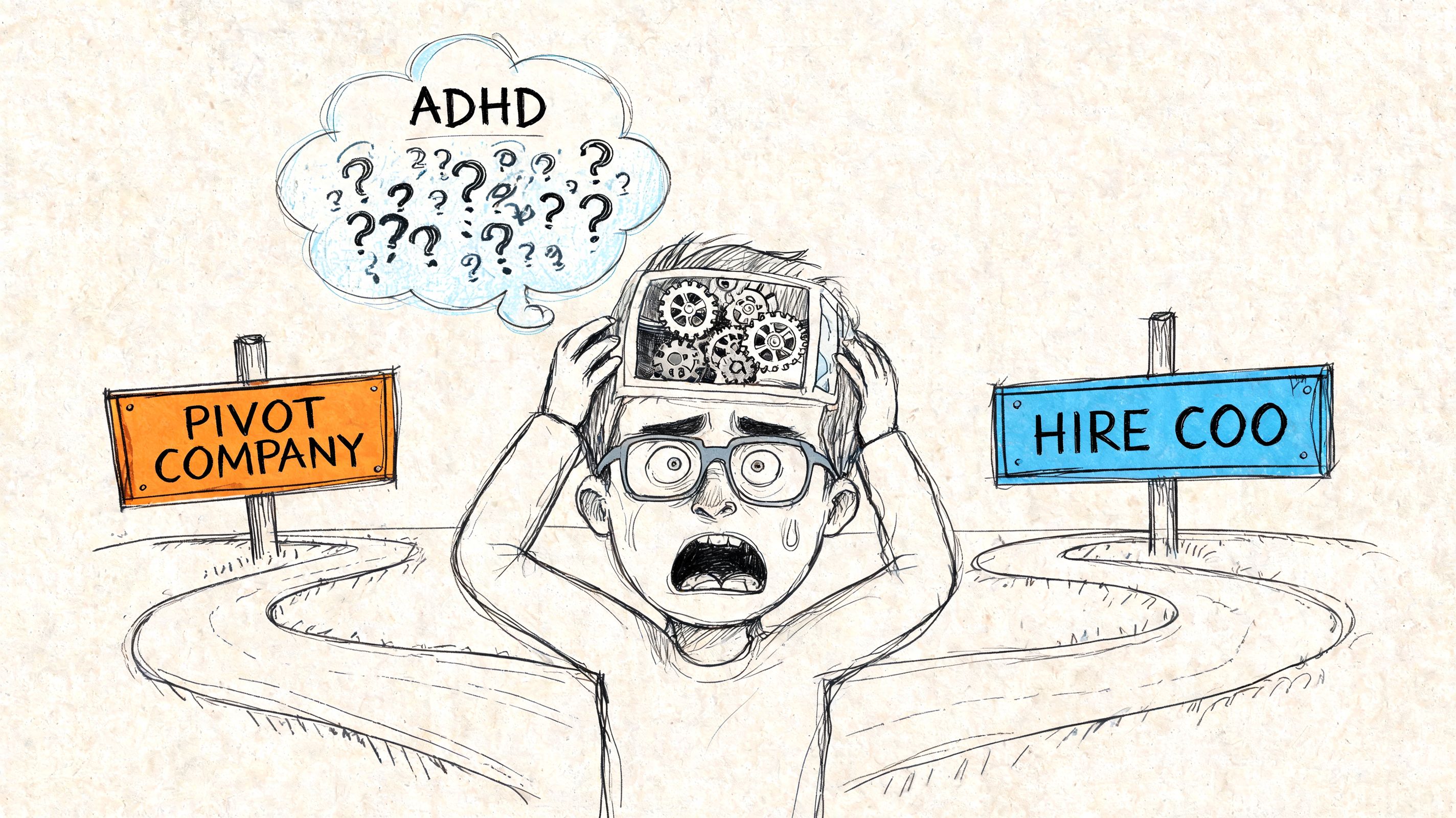
That pattern is common for a reason. Existing advice tends to assume a brain that can calmly hold options, rank them, and act in a linear way. But a 2025 HBR study on ADHD founders found that 68% reported decision fatigue as their top scaling obstacle, compared to 22% of neurotypical founders, with 70% higher burnout rates linked to these executive function challenges (reported here).
So if every “just decide” article has made you feel vaguely broken, ignore the moral framing. This is a systems mismatch.
The advice that usually backfires
“Trust your gut” fails when your gut is flooded by urgency, rejection sensitivity, and the memory of every previous mistake.
“Make a pros and cons list” fails when nothing is weighted, every item feels emotionally loud, and the list becomes another object you have to manage.
“Sleep on it” fails when the issue keeps recycling because no external structure captured the actual variables.
Practical rule: If a decision gets harder the more you think about it, stop thinking harder. Start structuring better.
That’s why making difficult decisions with ADHD needs a different model. The useful stack looks more like this:
- Cognitive Architecture to externalize the choice
- Dopamine Engineering to make follow-through possible
- Strategic Delegation to reduce how much of the decision you personally carry
- Bio-Optimization to stop bad physiology from impersonating bad judgment
If decision paralysis is a recurring pattern in your business, this breakdown of ADHD decision paralysis in business is worth keeping in your bookmarks.
What this changes in practice
You stop asking, “What’s the perfect choice?”
You start asking, “What structure lets me reach a clean, committed decision without frying my brain?”
That shift matters. Founders often assume the bottleneck is courage. Usually it’s design. The problem isn’t that you care too much. The problem is that you’re trying to run a high-stakes decision on wet hardware, no rails, and a reward system that hates ambiguity.
Build Your Decision Scaffolding with Cognitive Architecture
Good founders don’t win by having cleaner thoughts. They win by putting messy thoughts into containers that can be evaluated. That’s what I mean by Cognitive Architecture. It’s an external framework that does the sorting your brain struggles to do in real time.
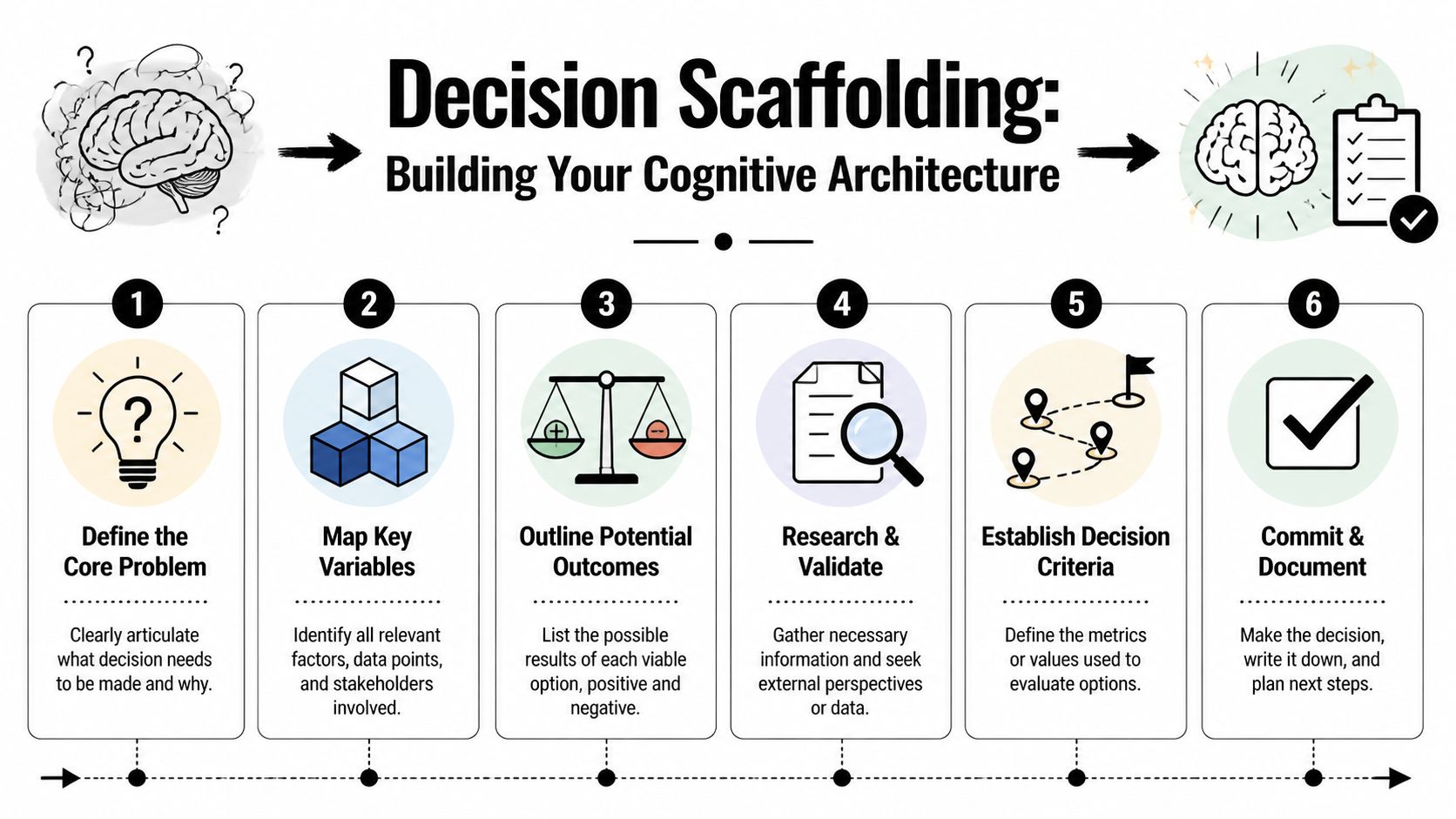
Get the decision out of your head
Start with a plain document, Notion page, Google Sheet, or even paper. The tool matters less than the fact that the decision is visible.
For a founder, the page should include:
| Item | What to write |
|---|---|
| Decision | One sentence. “Should we bootstrap for another year or pursue Series A?” |
| Options | Real choices only. No fantasy option that depends on magic energy. |
| Criteria | Revenue impact, team load, founder energy, speed, risk, customer impact |
| Time horizon | What matters this quarter versus next year |
| Kill criteria | What would make an option a hard no |
If you want a useful primer on building decisions from actual evidence instead of vibe and recency bias, this MakeAutomation guide to data-first decision-making is a solid companion.
Use a scorecard that forces reality onto the page
ClearerThinking’s method is one of the few “pros and cons” systems I respect because it doesn’t stop at listing feelings. It asks you to quantify each possible outcome by probability, impact, and duration, then calculate expected value. In user-tested scenarios, this structured approach improved decision satisfaction by 35-50% versus intuitive methods, with 72% reporting clearer outcomes (ClearerThinking’s methodology).
The workflow is simple:
- List pros and cons for each option.
- Assign probability from 0-100%.
- Assign impact on a positive or negative scale.
- Assign duration in weeks.
- Calculate EV with probability × impact × duration.
- Sum the totals for each option.
Here’s a stripped-down founder example.
Say the decision is hire a fractional COO now vs keep managing ops yourself.
For “hire fractional COO,” one pro might be:
Probability 70%, impact +8, duration 26 weeks.
For “keep managing ops yourself,” one con might be:
Probability 80%, impact -7, duration 26 weeks.
You don’t need perfect math. You need enough structure to stop every passing emotion from getting equal voting rights.
Most bad founder decisions don’t come from a lack of intelligence. They come from letting unranked variables fight in the same room.
A mini-template you can steal
Use this when a decision keeps looping:
- Option A
- Best likely upside
- Most painful downside
- Resource cost
- Effect on my energy
- Option B
- same categories
- Non-negotiables
- what must be true
- Unknowns
- what needs research, not rumination
- Decision date
- when the choice gets made
The hidden benefit is emotional. Once the decision has a structure, your brain stops treating it like fog and starts treating it like work. Fog creates dread. Work can be scheduled.
Hack Your Brain’s Reward System with Dopamine Engineering
Founders love to talk about discipline. That’s fine until discipline becomes code for repeatedly trying a method that fails your wiring.
Willpower is a terrible operating model
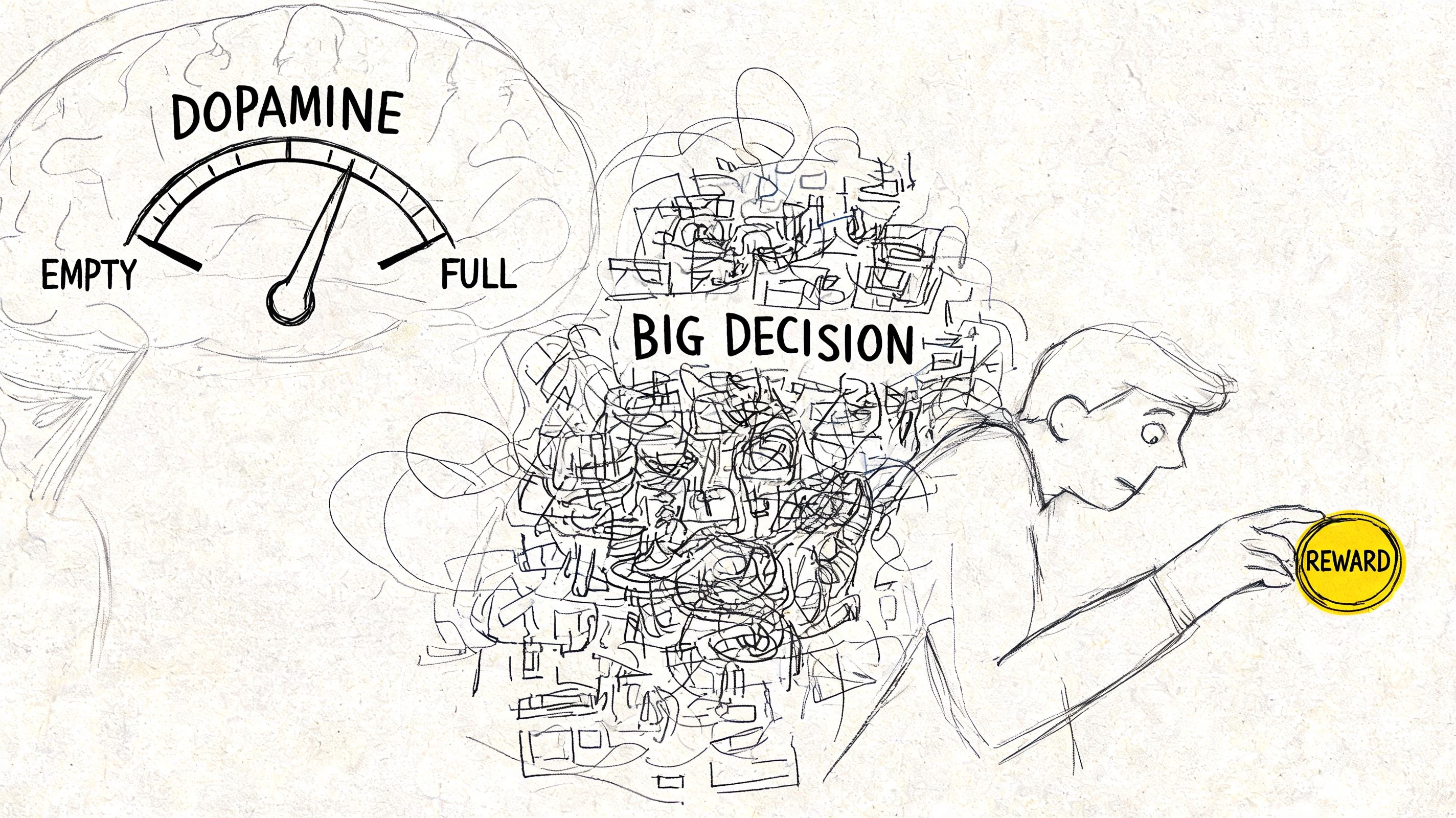
Roy Baumeister’s research on ego depletion is useful here because it kills the fantasy that you can white-knuckle high-quality decisions all day. People who made more choices in a store gave up on later math tests 30-50% quicker (summary in Business Insider). In plain English, decisions burn cognitive fuel.
That matters even more when you’re a founder. Your day is already packed with micro-decisions. Reply now or later. Join the sales call or skip it. Rewrite the landing page or leave it. Keep the underperformer one more month or act. By the time the strategic decision arrives, your tank may already be empty.
So stop trying to become a better martyr. Build a system that uses less willpower.
If this theme hits hard, this piece on the ADHD reward system and business momentum adds useful context.
Four micro-reward tactics that actually work
The trick is to make the decision process rewarding before the final answer exists. Your brain wants payoff now, not after three weeks of ambiguity.
-
Use sprinted research blocks
Give yourself one narrow task and one short window. Example: “For 25 minutes, compare only pricing and onboarding burden for these two CRM tools.” When the timer ends, stop. Completion is the reward. -
Create visible progress markers
Use a checklist with tiny substeps: define decision, gather numbers, list stakeholders, score top two options, choose. ADHD brains respond better to movement than abstraction. -
Pair boring thinking with immediate novelty
Do the hard cognitive pass, then earn a switch to a high-interest task. Not as a guilty pleasure. As part of the design. -
Reduce open loops before decision work
Close Slack. Put your phone elsewhere. Cancel the optional call. The goal is not monk mode. It’s protecting the limited reward chemistry you have.
Here’s a useful reset if you notice avoidance creeping in:
Don’t say, “I need to decide whether to restructure the company.” Say, “I need to finish Step 2 of the decision sheet before lunch.”
That framing matters because your brain can’t metabolize “huge, vague, loaded.” It can often handle “small, clear, finished.”
A quick visual explainer helps if you want to see the reward-loop logic in action:
What not to do
Don’t sit down and say, “Today I will finally solve this massive strategic issue.”
Don’t stack the decision session after five meetings and a difficult team conversation.
Don’t reward yourself only after the final answer. That’s too late for an ADHD brain. Reward the process of clarification, not just the endpoint.
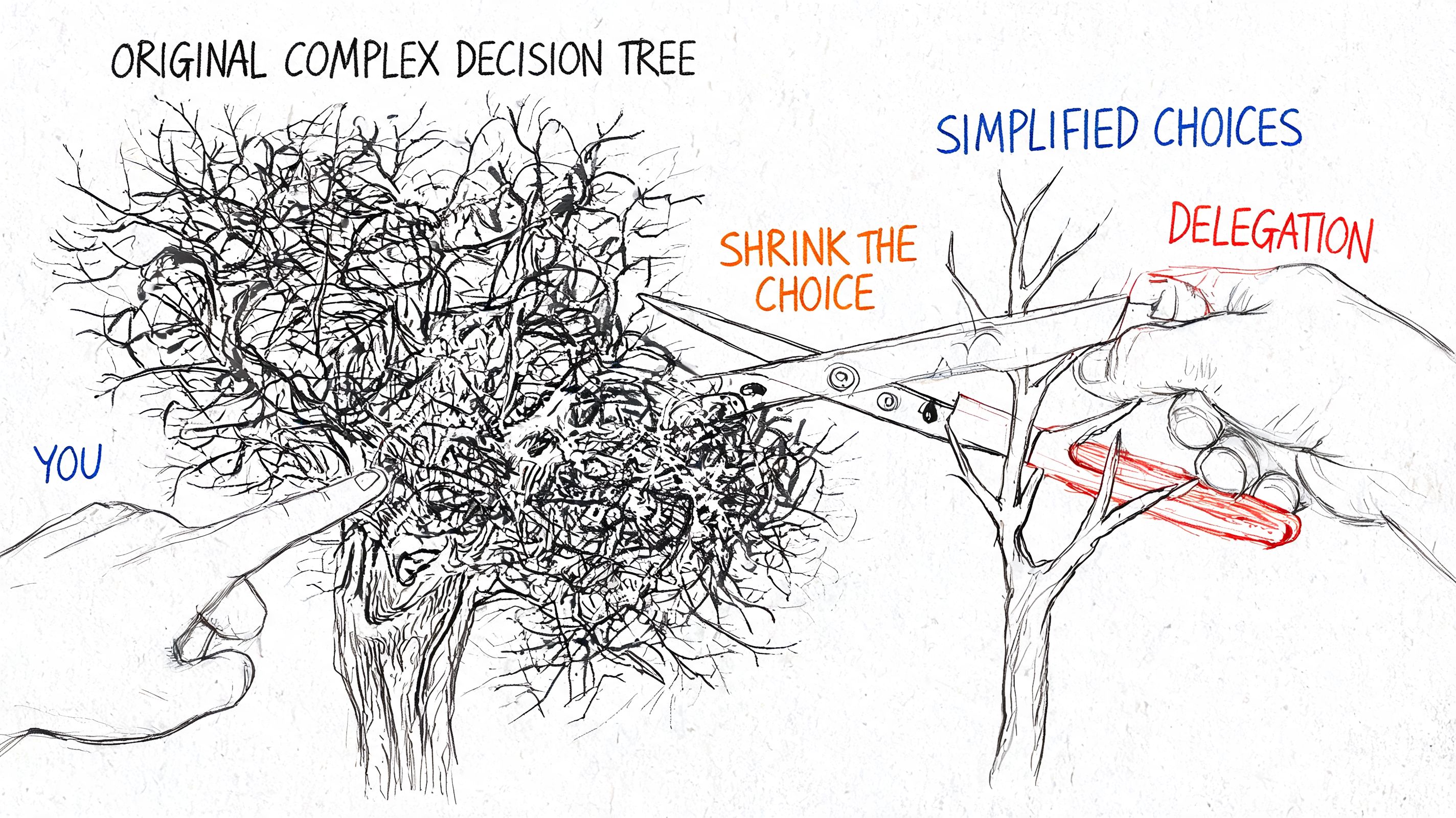
Use Strategic Delegation to Shrink the Choice
A lot of founders say they want to delegate, but what they usually mean is “I want someone to take tasks off my plate while I keep carrying the whole cognitive load.” That’s not delegation. That’s assisted overwhelm.
Delegate inputs, not just tasks
When making difficult decisions, you don’t have to delegate the final call. You can delegate the components that make the call heavy.
That matters because high-stakes delegation is a blind spot in most founder advice. A 2025 Pitt study extension found that neurodivergent leaders who pre-define veto zones and delegate the rest of the decision components see a 2.5x increase in decision speed and a 35% boost in team retention (Pitt coverage here).
The phrase to pay attention to is veto zones. That means you define what only you can decide, then push everything else outward.
For example, if the decision is “Which CRM should we adopt?” your veto zone might be:
- final vendor approval
- budget ceiling
- migration timing
Everything else can move:
- shortlist tools
- gather demos
- compare onboarding effort
- ask sales and ops for must-haves
- draft a recommendation memo
A simple decision delegation checklist
Here’s the template I like for founders.
-
Decision owner
Who makes the final call? -
Veto zone
Which parts stay with the founder, and why? -
Research owner
Who gathers facts, options, and constraints? -
Recommendation owner
Who turns raw inputs into a proposed choice? -
Deadline
When does the founder review the brief? -
Success standard
What does “good enough to decide” look like?
If you’re still the researcher, analyst, reviewer, and approver, you haven’t delegated a decision. You’ve just created witnesses.
A practical example. Say you’re choosing between hiring an in-house operator or a fractional one. Give your EA or ops lead a brief that says:
- collect three candidate profiles
- summarize compensation structure
- note ramp time and management burden
- flag risks
- recommend one option and one backup
Now your job isn’t to wander through a swamp of inputs. Your job is to evaluate a shaped decision.
If your delegation muscle is rusty, this guide on how to delegate tasks effectively helps translate the concept into team behavior.
Why founders resist this
Usually because they confuse control with involvement.
They think, “If I don’t personally touch every piece, I’ll miss something.” Sometimes you will. But when you insist on owning the whole stack, you create a different failure mode. Delays, resentful teams, panic overrides, and choices made under pressure because you waited too long.
Better delegation doesn’t remove your judgment. It protects it.
Treat Your Physiology as a Business Strategy
A lot of business advice still treats the body like a side quest. Think clearly, then maybe stretch, maybe sleep, maybe eat something that didn’t come from a wrapper. That split is nonsense.
Bad biology creates fake uncertainty
The University of Waterloo-led global study published in 2025 found a near-universal preference for self-reflection over seeking advice when making tough decisions across more than 3,500 individuals in 12 countries, spanning 13 languages, 12 research teams, and five continents (ScienceDaily summary). For founders, the useful implication is simple. If you’re going to rely heavily on inward reflection anyway, the state of the brain doing that reflection matters.
A tired brain doesn’t just feel worse. It evaluates worse. Poor sleep muddies working memory. Low movement tends to leave you mentally flat. Chaotic eating can make everything feel emotionally urgent. Then you mislabel the result as “I still need more information,” when what you often need is a better physiological state.
Non-negotiable rules for decision days
These aren’t wellness tips. They’re operating constraints.
-
Make first-pass strategic decisions earlier in the day
Don’t put your hardest choice after a calendar full of reactive work. -
Move before you evaluate
A walk, workout, or even a brisk reset changes the quality of reflection. For remote founders who struggle to build movement into long desk days, tools like BionicGym for passive calorie burn are interesting because they lower the friction around physical activation. -
Don’t decide hungry, fried, or flooded
If your nervous system is loud, your judgment gets theatrical. -
Separate idea generation from final choice
Brainstorm when you have energy. Commit when you have calm.
Here’s the point most founders miss. The body is not downstream of leadership. It is part of leadership. If you consistently make major calls while underslept, overstimulated, or physically stagnant, you’re not testing strategy. You’re testing distortion.
Your brain can’t produce clean signal from dirty input conditions.
Treating physiology as strategy sounds unsexy until you notice how many “hard decisions” become straightforward once your internal state stops sabotaging the review.
Your New Operating System for Making Hard Choices
Traditional decision frameworks are not useless. They’re incomplete. The classic seven-step rational process gives a clean linear sequence, and firms using structured processes report 15-20% higher ROI on pivots according to the UMass Dartmouth framework. The problem is that a clean sequence alone doesn’t solve executive dysfunction, willpower drain, or dopamine collapse.
That’s why the better model is an operating system, not a one-off checklist.
The four-part loop
Cognitive Architecture holds the decision outside your head.
It turns “I’m overwhelmed” into visible options, criteria, and trade-offs.
Dopamine Engineering makes progress feel possible. It replaces the fantasy of endless discipline with smaller loops your brain will re-enter.
Strategic Delegation strips the choice down to what only you should decide.
You stop acting like the human bottleneck for every input.
Bio-Optimization keeps the hardware stable enough to run the process.
No founder thinks clearly on corrupted fuel.
Put together, these four pieces do something generic advice doesn’t. They make making difficult decisions repeatable. Not painless. Not perfect. Repeatable.
Your first three reps
Don’t test this framework on the most emotionally radioactive choice in your company first. Train it.
-
This week, use it on a small decision
Pick a software tool, meeting cadence, or vendor shortlist. Build the sheet. Score the options. Make the call. -
This month, use it on a medium decision
Choose a marketing channel, revise an offer, or restructure a recurring team process. Add delegation for research inputs. -
This quarter, use it on a big decision
A hire, a pivot, a product line, a partnership, or a client model change. Protect the timing, your state, and the review process.
If you need support on the delegation side of that rollout, this guide on delegating to a virtual assistant effectively is practical because it focuses on turning vague founder expectations into assignable work.
Most founders wait until a decision becomes painful enough to force action. That’s expensive. It creates rushed calls, avoidable fatigue, and teams that can feel the chaos even when you think you’re hiding it.
A better path is boring in the best way. Externalize the choice. Protect your reward system. delegate the inputs. Fix the conditions your brain is operating under. Then decide.
That’s not less intuitive leadership. It’s leadership with better scaffolding.
If you’re done running your company through panic, Jan Kutschera helps ADHD founders build operating systems that fit how their brains work. Explore Jan Kutschera if you want practical support replacing burnout-driven decision loops with structure, delegation, and steady momentum.
Jan Kutschera
German founder, diagnosed with ADHD at 51. Built 4 agencies, now building systems for neurodivergent entrepreneurs. German engineering for the ADHD brain.
Connect on LinkedInRelated Articles

Visual Reminders for ADHD: Engineer Your Focus
Founders, ditch burnout! Learn to build high-impact visual reminders for ADHD. Go from panic productivity to an engineered operating system for success.

Business Growth Coaching for the ADHD Founder
Unlock sustainable success with business growth coaching designed for the ADHD brain. Ditch burnout for engineered systems and achieve steady momentum.
Reclaim Sleep: Revenge Bedtime Procrastination ADHD
Stop the cycle of revenge bedtime procrastination adhd. Learn why your brain does it and get actionable systems for founders to reclaim sleep and focus.