Reclaim Sleep: Revenge Bedtime Procrastination ADHD
Stop the cycle of revenge bedtime procrastination adhd. Learn why your brain does it and get actionable systems for founders to reclaim sleep and focus.
Jan Kutschera
It’s 1:00 AM. Your Slack is finally quiet, the kid is asleep, the client fire is out, and your brain suddenly decides now is the perfect time to become a tiny nightclub. You open Instagram, then YouTube, then that one article about productivity you absolutely do not need to read tonight. You know you should go to bed. You also know you’re not going to. Not yet.
If that loop feels painfully familiar, especially if you’re a founder with ADHD, you’re not broken and you’re not lazy. You’re dealing with a predictable operating system bug. The name for it is revenge bedtime procrastination adhd, and the fix usually isn’t “try harder.” It’s designing a better system than the one your tired brain keeps defeating at midnight.
Table of Contents
- The 1 AM CEO Your Brains Nightly Mutiny
- Decoding Revenge Bedtime Procrastination
- Why Your ADHD Brain Craves This Cycle
- How Nightly Revenge Bankrupts Your Business
- Dopamine Engineering Your Evening Routine
- Engineer Your Environment to Beat Procrastination
- From Nightly Rebel to Rested CEO
The 1 AM CEO Your Brains Nightly Mutiny
The scene is always stupidly predictable. You’ve spent the whole day making decisions, smoothing conflict, replying to messages, putting out fires, and pretending that your nervous system enjoys any of this. Then the house goes quiet, the lights go dim, and instead of shutting down like a sensible mammal, you start a private rebellion.
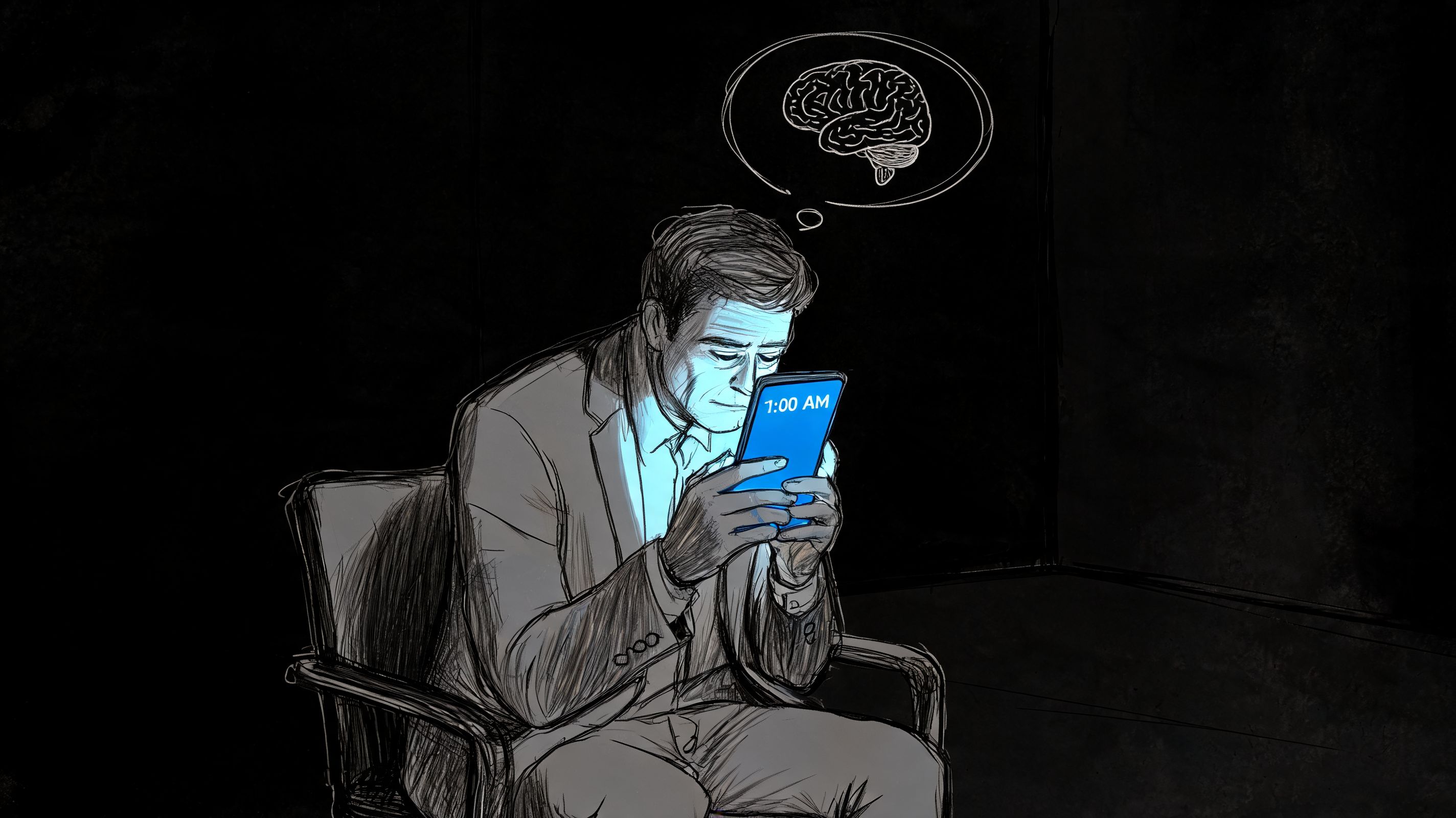
That rebellion doesn’t feel irrational in the moment. It feels deserved. You tell yourself you need a little me-time, a little decompression, one more scroll, one more episode, one more rabbit hole. Then it’s late enough that going to sleep feels like surrender.
This isn’t a discipline problem
Founders with ADHD often mislabel this pattern as weakness. It’s not. It’s what happens when a high-output brain spends all day under structure, demand, and stimulation, then tries to collect unpaid freedom at night.
The same brain that can build a company can also lose two hours to “just checking something.” If you’ve seen the same pattern show up in work through ADHD hyperfocus and procrastination loops, the bedtime version is the nighttime sequel. Different setting, same wiring.
You’re not failing a simple task. You’re trying to transition a depleted ADHD brain from high stimulation to low stimulation at the exact moment it trusts itself the least.
Your brain is staging a mutiny
During the day, the CEO in you runs the calendar. At night, the mutineer shows up. He wants compensation for the freedom tax you paid all day. He doesn’t care that tomorrow contains meetings, decisions, and consequences. He wants relief now.
That’s why generic sleep advice falls flat. “Put the phone away” is technically correct and operationally useless. It assumes the problem is information. It isn’t. The problem is architecture.
What works is treating bedtime like an engineering problem. Your current system rewards alert, overstimulated, novelty-seeking behavior at the exact hour you need calm, boring, repeatable behavior. Of course the system fails. It was built for the wrong user.
Decoding Revenge Bedtime Procrastination
Revenge bedtime procrastination sounds dramatic, but the mechanics are simple. You delay sleep on purpose so you can reclaim time that didn’t feel like yours during the day. Your brain is trying to cash a fun paycheck it never received.
The phrase came from a Chinese social media trend in the 2010s and gained wider global recognition after 2020, when remote work blurred the line between work and personal life, a pressure founders know well, as noted in this overview of revenge bedtime procrastination and ADHD.
Why it’s called revenge
“Revenge” is the emotional part. You’re not getting revenge on sleep. You’re getting revenge on a day that felt overcontrolled, overbooked, or hijacked by everyone else’s priorities.
A founder’s version often sounds like this:
- All day was reactive: Team questions, customer issues, investor pings, and admin stole every clean block.
- Nothing felt personal: Even meaningful work can feel draining when every hour belongs to obligation.
- Night feels sovereign: Midnight becomes the only time no one can ask you for anything.
That’s why the behavior feels weirdly satisfying, even when it’s self-defeating.
Why it’s called procrastination
The second half matters too. This is still procrastination. Sleep is the task you’re delaying.
That distinction is useful because it changes the intervention. If you can sleep but keep choosing not to go to bed, the issue isn’t always inability. It’s resistance to the transition.
Practical rule: If you’re tired but keep selecting stimulation over sleep, don’t start by treating it like insomnia. Start by treating it like delayed task initiation with better branding.
It’s not the same as insomnia
People with insomnia often want to sleep and can’t. People in a revenge bedtime procrastination adhd loop often could sleep, but they keep negotiating with themselves for more “earned” time first.
That difference matters because willpower usually loses after a demanding day. The solution isn’t moral pressure. The solution is reducing the psychological cost of going to bed and reducing the seductive pull of everything that isn’t bed.
Why Your ADHD Brain Craves This Cycle
At night, the ADHD brain doesn’t suddenly become irrational. It becomes more itself. The features that helped you survive the day turn into liabilities when the task is “stop everything and go lie in a dark room.”
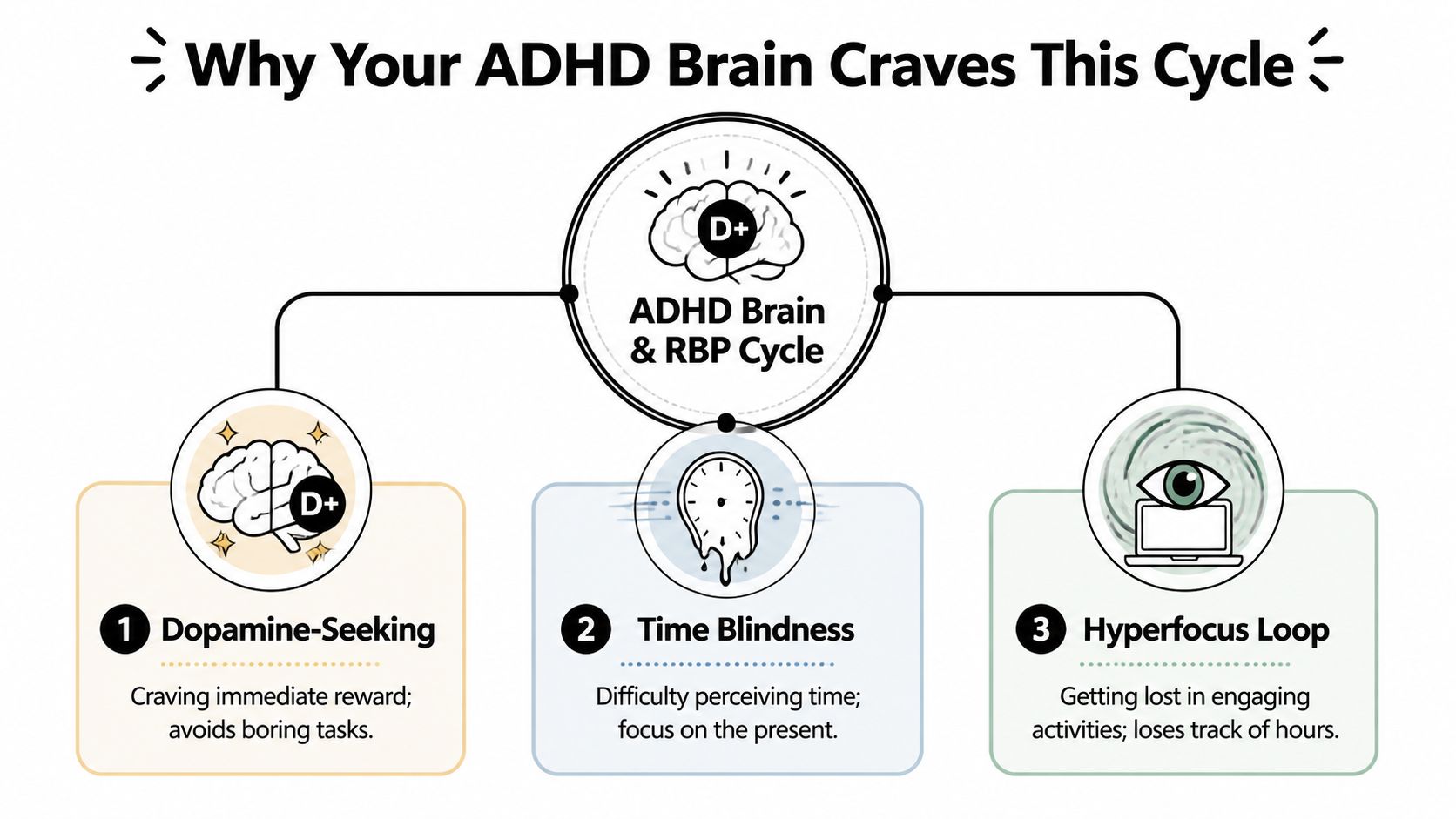
Core ADHD traits such as dopamine-seeking behavior, impulsivity, hyperfocus on stimulating activities, and time blindness create a perfect storm that makes the transition from a demanding day to a quiet bedtime unusually hard. Sleep problems also touch virtually all aspects of sleep for many people with ADHD, including difficulty falling asleep, staying asleep, poor sleep quality, daytime sleepiness, difficulty waking up, and a preference for later bedtimes.
Dopamine is picking the menu
After a long day, your brain wants relief fast. Sleep is valuable, but it’s delayed-value valuable. Scrolling, videos, shopping carts, gaming, and random research tabs are immediate-value valuable.
That difference is everything.
The ADHD brain tends to chase accessible stimulation because it changes state quickly. If your day was full of stress, masking, and forced attention, your brain isn’t asking, “What is best for me tomorrow?” It’s asking, “What gives me something now?”
A lot of standard bedtime advice ignores that reality. Better approaches borrow from the same logic behind practical strategies for ADHD symptoms, which is to build supports around the actual wiring instead of demanding neurotypical behavior from a depleted system.
Executive function is out of budget
Going to bed sounds like one task. It isn’t. It’s a chain.
Stop working. Stop scrolling. Decide to transition. Stand up. Brush teeth. Wash face. Change clothes. Plug in devices. Maybe tidy. Maybe set an alarm. Maybe remember the thing you forgot. Then lie down and tolerate your own thoughts.
For a tired ADHD founder, that’s not “bedtime.” That’s a multi-step project with weak immediate reward and lots of friction. If your executive function budget is spent, even tiny transitions feel expensive.
Time blindness distorts the runway
“Five more minutes” is one of the great bedtime scams. ADHD time perception is unreliable enough that a short detour can become a full nighttime disappearance.
What makes this nasty is that it rarely feels dramatic while it’s happening. It feels harmless. Then you look up and the night is gone.
The trap isn’t just staying up late. The trap is having a brain that doesn’t accurately price what late is costing while the transaction is happening.
A founder notices this everywhere. In meetings, in deep work, in email, in doomscrolling. Bedtime just exposes it because there’s no assistant, no team, and no external deadline forcing the switch.
How Nightly Revenge Bankrupts Your Business
A lot of people frame this as a wellness issue. It is. But if you run a company, it’s also an operations issue, a leadership issue, and a decision-quality issue.
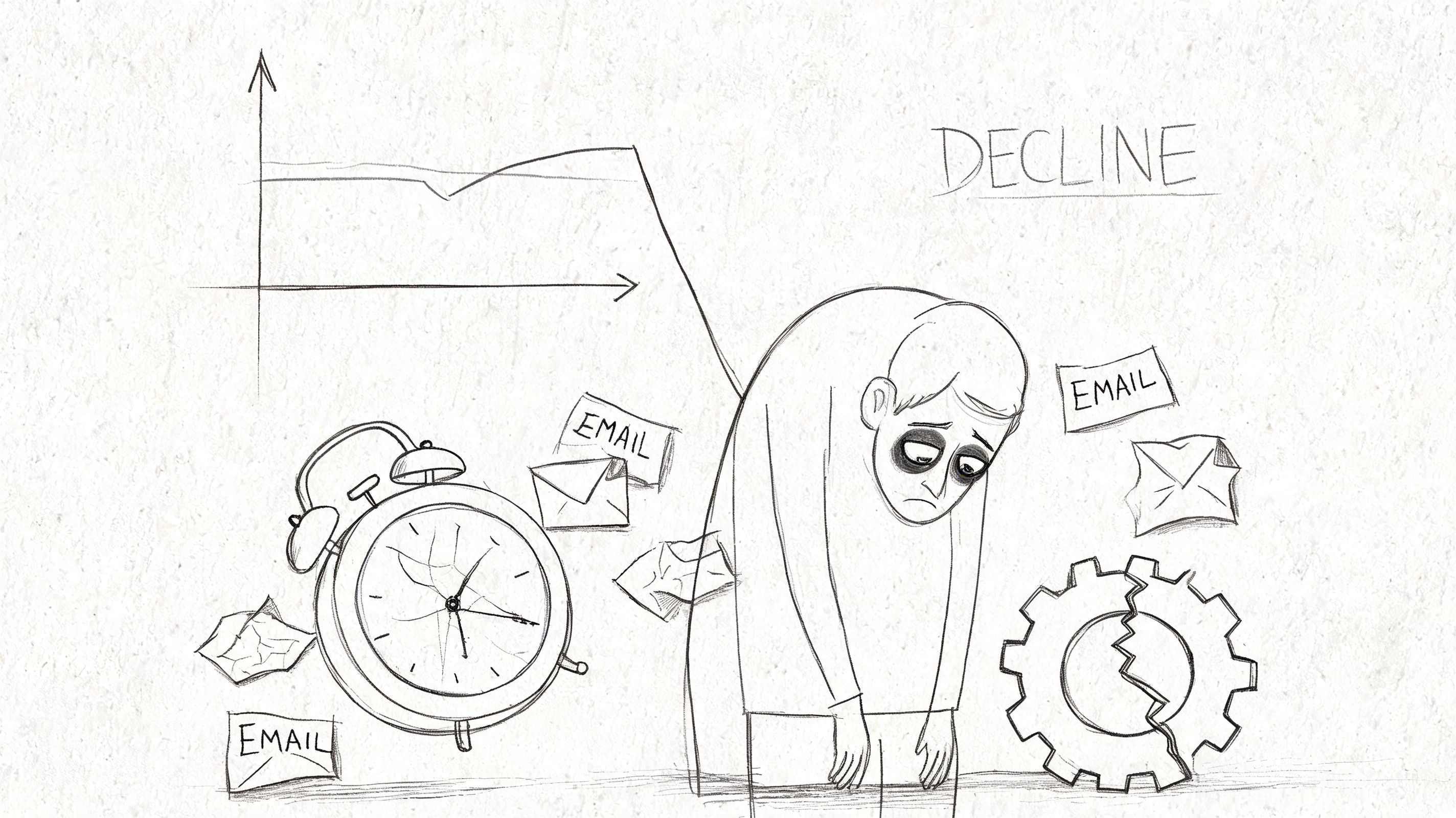
When you repeatedly cut sleep to reclaim control, you’re not borrowing against tomorrow. You’re taxing tomorrow before it starts. If founder fatigue already hits close to home, this piece on ADHD fatigue in entrepreneurs maps that cost in business terms.
Strategy gets smaller
Cognitive science shows that losing even one hour of sleep can significantly impair logical reasoning and increase microsleeps. For a founder, that’s not abstract. That’s weaker judgment in hiring, pricing, negotiation, and product calls.
Sleep debt shrinks your thinking horizon. You stop asking, “What compounds?” and start asking, “What gets me through today?”
That’s how businesses slide into panic productivity. You answer faster, react harder, and call it leadership. Meanwhile the core work, clean strategy, clear prioritization, patient decision-making, starts to rot.
Team culture feels your nervous system
Your team experiences your sleep debt whether you mention it or not. They feel it in your tone, your impatience, your inconsistency, and your ability to tolerate ambiguity.
Common founder behaviors after too many short nights:
- Overcorrecting in meetings: You jump in too early and solve the wrong problem.
- Emotional spillover: Minor setbacks feel personal, urgent, or catastrophic.
- Messy handoffs: You delegate too late, too vaguely, or with a side order of frustration.
- False urgency: Everything becomes an emergency because your brain has no buffer.
A dysregulated founder creates a dysregulated company, even with good intentions.
Here’s a useful explainer on the broader cost of poor sleep and ADHD patterns in real life and work:
The hidden balance sheet
Founders are good at tracking visible costs. Software. Payroll. CAC. Burn multiple. Sleep debt rarely shows up in the dashboard, but it changes the numbers anyway.
Not because one bad night ruins a business. Because repeated bad nights gradually distort the leader operating it.
A tired founder picks avoidant work, delays hard conversations, seeks stimulation over depth, and relies on adrenaline to fake clarity. That’s cognitive debt. Eventually somebody pays.
Dopamine Engineering Your Evening Routine
If your current evening plan is “be more disciplined,” scrap it. That’s not a system. That’s a wish.
A better frame is Dopamine Engineering. You’re not trying to eliminate stimulation. You’re giving your brain a smarter, finite version of it so bedtime stops feeling like punishment.
Replace infinite fun with finite fun
Infinite-input platforms are bedtime solvents. TikTok, Instagram Reels, YouTube Shorts, X, Reddit, and algorithmic homepages are designed to erase stopping points.
Finite fun has edges. That’s what you want at night.
Try swaps like these:
- One episode, not autoplay: Use Netflix, but turn autoplay off and pick the episode before you start.
- One chapter on Kindle: Better yet, use a device or app without tempting notifications.
- A puzzle game with natural rounds: Think chess puzzles, a crossword, or a single level game, not an endless competitive ladder.
- A playlist with a clear end: Music works better than feeds because songs finish.
The goal isn’t to become monastic. The goal is to stop feeding a brain that treats “maybe more” as an invitation to disappear.
Build a shutdown ritual your brain actually likes
Most founders make the same mistake. They create a bedtime routine that looks virtuous and feels dead. Then they wonder why they resist it.
Your shutdown ritual should contain at least one rewarding element. Not fake rewarding. Actually rewarding.
Examples that tend to work better:
- Audio pairing: A favorite podcast only gets played while brushing teeth, tidying the kitchen, or laying out tomorrow’s clothes.
- Environmental cues: Hue lights shift warmer at a set time, and your desk lamp turns off so your office stops advertising “one more task.”
- Visible closure: A paper notebook with tomorrow’s top tasks reduces the “don’t forget” panic that keeps the brain online.
If your routine is all friction and no reward, your brain will outsource the reward to your phone.
Make the first move stupidly easy
Bedtime often fails at the first transition, not the last one. So lower the activation energy.
Good examples:
- Put your charger outside the bedroom.
- Leave a book on the pillow, not the nightstand.
- Set out your toothbrush before you start your evening entertainment.
- Use app timers and screen limits before you need them, not while negotiating with yourself.
A lot of this overlaps with how founders think about ADHD dopamine in business. You don’t beat a dopamine-driven system by pretending dopamine doesn’t matter. You redirect it.
Engineer Your Environment to Beat Procrastination
Tactics help. Systems stick.
The difference is simple. A tactic asks, “What should I do tonight?” A system asks, “What setup makes the right action easier than the wrong one?” Founders who beat revenge bedtime procrastination adhd for good usually stop treating it like a nightly character test and start treating it like environmental design.
Stop stealing me-time from midnight
A lot of late-night rebellion starts because the day contained zero unclaimed space. If every waking hour belongs to the company, your brain will try to invoice the debt later.
Schedule protected me-time before evening. Not aspirationally. Put it on the calendar.
That time can be short and still matter if it is your own:
- a walk without calls
- lunch away from a screen
- twenty minutes with a guitar, a sketchpad, or a novel
- a gym session that isn’t also content consumption
This doesn’t magically erase the urge at night, but it lowers the emotional intensity. Midnight stops being the only border crossing into personal freedom.
Use hard edges, not heroic intentions
Founders love flexibility until flexibility eats them alive. Evening systems need edges.
Examples that work better than vague promises:
- Smart plugs: Cut power to a TV or office setup on schedule.
- Router schedules: Many routers let you shut off Wi-Fi to selected devices at set times.
- Focus modes: Use iPhone Screen Time, Android Digital Wellbeing, Freedom, or Opal to make your worst apps annoying enough to abandon.
- Bedroom zoning: Don’t bring the laptop into the room where you’re supposed to power down.
For some people, broader treatment support also matters. If you’re looking at the bigger picture around adult ADHD care, Integrative Psychiatry of America’s ADHD solutions offer a useful overview of options to discuss with a qualified clinician.
Delegate earlier so your brain has fuel left
Sleep problems often begin at 9:00 PM, not 1:00 AM. If you spend the day making every decision yourself, you hit evening with an empty tank.
Strategic delegation isn’t just a scale play. It protects executive function for life outside work. A founder who delegates cleanly has more capacity to shut down cleanly.
| Approach | Tactics (Quick Fixes) | Systems (Permanent Fixes) |
|---|---|---|
| Evening stimulation | Turn on Do Not Disturb | Keep the phone charging outside the bedroom |
| Screen overuse | Promise “just one episode” | Disable autoplay and block infinite-scroll apps after a set hour |
| Lack of personal time | Hope tomorrow is calmer | Schedule daily CEO me-time before the evening |
| Decision fatigue | Try to remember bedtime steps | Use a written shutdown checklist in the same order every night |
| Work spillover | Tell yourself to stop earlier | Delegate lower-value decisions before they drain the day |
Build an environment that makes bedtime boring to resist and easy to execute. Your future self should not need to negotiate with your current self.
From Nightly Rebel to Rested CEO
The most useful shift is identity, not technique. Stop calling yourself undisciplined. Start recognizing a system bug.
Revenge bedtime procrastination adhd happens when a stimulation-hungry, time-blind, transition-averse brain meets an environment built for endless access and zero stopping points. Of course that combination breaks. The answer was never more shame.
What works is a founder’s approach. Diagnose the bottleneck. Reduce friction. Add the right incentives. Remove weak points from the system. Protect capacity before it collapses.
Some nights will still go sideways. That doesn’t mean the system failed. It means you’re human, probably tired, and likely dealing with more variables than a sleep guru on the internet wants to admit. The goal isn’t perfect sleep performance. It’s reliable recovery.
A rested founder leads differently. Decisions get cleaner. Emotions stop running the meeting. Strategy gets longer than twenty-four hours. Delegation improves because your brain has enough bandwidth to think beyond the next fire.
Sleep isn’t a reward for finishing everything. Founders never finish everything. Sleep is fuel for leading well anyway.
If you’re done trying to out-discipline an ADHD brain that clearly wants better infrastructure, Jan Kutschera helps founders build operating systems that work with their wiring. His approach focuses on Cognitive Architecture, Dopamine Engineering, Strategic Delegation, and Bio-Optimization so you can replace burnout-driven hustle with sustainable clarity.
Jan Kutschera
German founder, diagnosed with ADHD at 51. Built 4 agencies, now building systems for neurodivergent entrepreneurs. German engineering for the ADHD brain.
Connect on LinkedInRelated Articles

Visual Reminders for ADHD: Engineer Your Focus
Founders, ditch burnout! Learn to build high-impact visual reminders for ADHD. Go from panic productivity to an engineered operating system for success.

Best Daily Planners for ADHD in 2026: 7 Systems for Founders
The best daily planners for ADHD founders in 2026. Engineered systems that work with your brain — not willpower lectures or generic productivity advice.
Making Difficult Decisions: The ADHD Founder's Framework
Stop analysis paralysis. Learn a framework for making difficult decisions, engineered for the ADHD founder's brain. Practical steps, no generic advice.