Meditation for Focus and Clarity That Works for ADHD Brains
Practical meditation for focus and clarity built for ADHD founders. Step-by-step routines, habit engineering, and ADHD-friendly protocols that actually stick.
Jan Kutschera
You close one tab, open another, answer a Slack message, and then remember the investor update you were supposed to finish. You sit down to meditate because every productivity podcast says it will create clarity. Two minutes later, you’re planning a new product, replaying yesterday’s argument, and checking whether your phone buzzed.
That doesn’t mean meditation is useless. It means meditation for focus and clarity has to be engineered for the brain using it. For an ADHD founder, the practice needs a trigger, a small entry cost, a suitable attentional target, an immediate reward, and a way to measure whether it helped the next piece of work.
Table of Contents
- Why Generic Meditation Advice Fails ADHD Founders
- What the Research Actually Says About Meditation and Focus
- Your Starter Protocol Built for a Distractable Brain
- Habit Engineering That Makes the Practice Stick
- Matching the Protocol to Your Specific Failure Mode
- When Meditation Backfires and What to Do Instead
- Putting Meditation Inside Your Broader Operating System
Why Generic Meditation Advice Fails ADHD Founders
Generic meditation advice assumes the hard part is remembering to be calm. ADHD founders usually face a different problem. Your attention can lock onto an interesting problem for hours, then refuse to start a routine email. Your calendar fragments the day, rejection sensitivity turns a short message into an emotional event, and constant context-switching becomes part of the job.
So the usual prescription, sit still, close your eyes, follow your breath for ten minutes, often fails before the practice has a chance to help. The failure isn’t a character flaw. The protocol asks a variable attention system to generate its own structure while removing the stimulation it normally uses to stay engaged.
Three design errors cause most of the damage:
- Insufficient external structure: “Meditate sometime in the morning” competes with every notification, meeting, and urgent idea.
- An undersized reward: A calmer mind is too delayed and abstract to compete with the immediate hit of email, novelty, or a new business problem.
- A poorly matched duration: A long session can feel like a punishment when the actual need is a short reset before a specific task.
You need the same approach that makes improve focus across work and study practical: reduce cognitive load before asking attention to perform. A recurring calendar event, a visible cue, and a defined next action matter more than finding the perfect cushion.
Stop treating meditation as a character test
The useful question isn’t, “Can I become someone who meditates every morning?” It is, “Where does my attention reliably break, and what small intervention belongs there?”
That distinction changes the role of the practice. Meditation becomes a configurable input in your operating system, alongside task lists, meeting rules, delegation, sleep, and environmental design. Your ADHD routines should carry the memory burden. You shouldn’t need heroic discipline to remember the tool that is supposed to help you use discipline.
The protocols below are deliberately small. They pair a meditation style with a recognizable failure mode, an external cue, and an observable outcome. The aim isn’t spiritual achievement. It’s fewer uncontrolled switches, cleaner task starts, and a better chance of doing the work you already decided matters.
What the Research Actually Says About Meditation and Focus
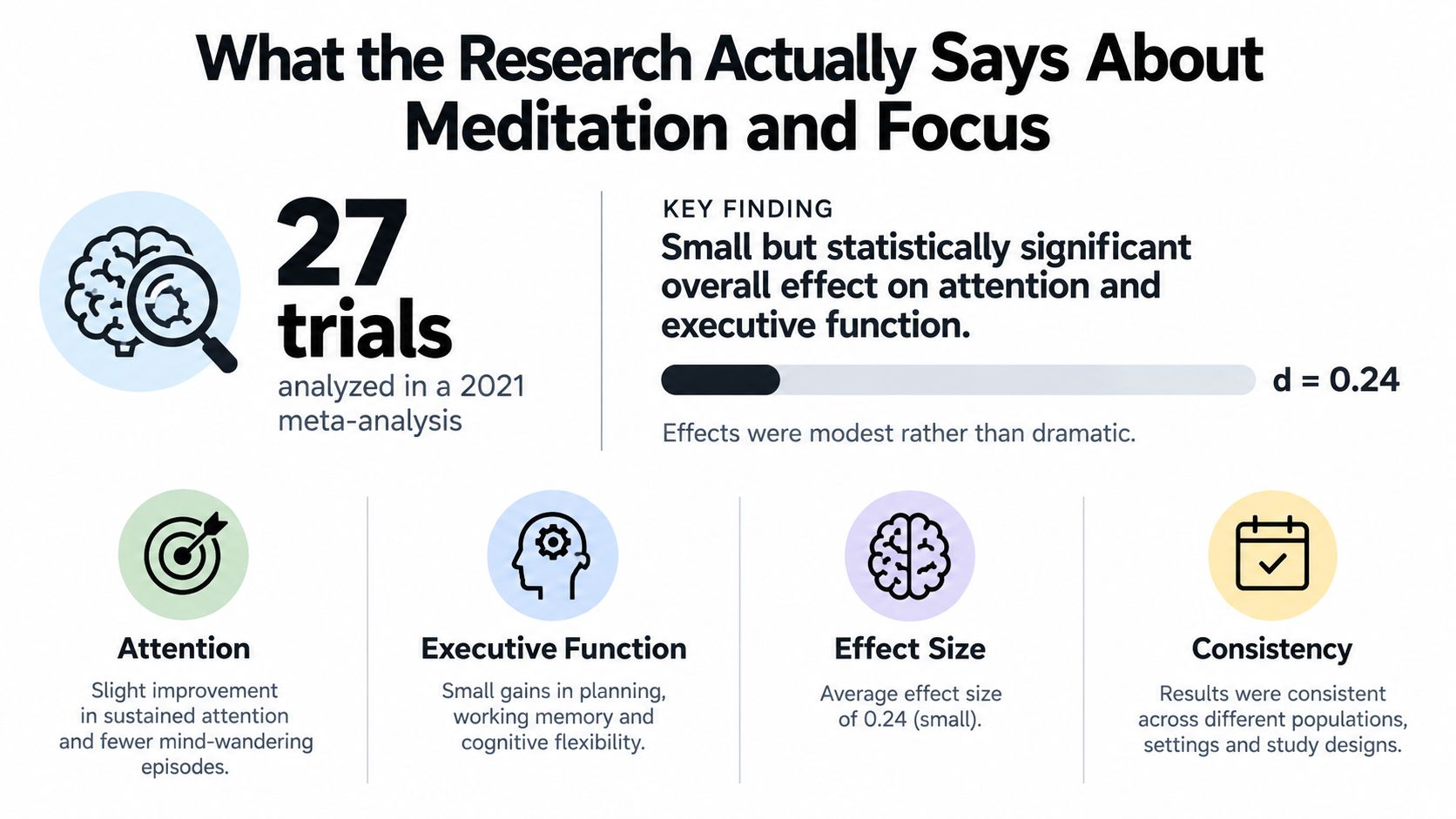
The evidence supports a useful but unglamorous conclusion: meditation can help attention, but the effect is modest, specific, and dependent on what you measure.
A 2021 systematic review and meta-analysis examined 27 randomized controlled trials involving 1,632 healthy adults. The overall effect was small but statistically significant, with Hedges’ g = 0.20. Attention improved by g = 0.18, and executive control improved by g = 0.18, while the analysis did not find a significant improvement in working memory. The review also found that more in-class sessions tended to produce stronger results, while total training hours and control-group type didn’t significantly change the effect size. (2021 systematic review and meta-analysis)
A 2023 meta-analysis makes the picture more useful. Compared with waitlist or no-treatment controls, mindfulness-based interventions improved executive attention, g = 0.301, working-memory accuracy, g = 0.326, and sustained-attention accuracy, g = 0.367. The largest reported effect was inhibition accuracy, g = 0.643, which reflects suppressing an automatic or irrelevant response. Shifting accuracy improved by g = 0.272, and subjective cognitive functioning improved by g = 0.257. (2023 meta-analysis)
The practical headline: meditation appears most useful for directing attention, sustaining it, and interrupting automatic responses. It isn’t a guaranteed working-memory upgrade or a substitute for sleep, task design, clinical ADHD treatment, or a sane workload.
The comparison condition matters. Against active controls, the effects were smaller but remained statistically significant for executive attention, working-memory accuracy, inhibition accuracy, shifting accuracy, and sustained-attention accuracy. That suggests some benefit may come from mindfulness-specific training, while structure, expectancy, regular practice, and social contact may contribute too.
For founders, this evidence points toward a narrow but valuable use case. Don’t meditate because you want a vague feeling of inner clarity. Use a short practice before the exact moment when you tend to click, react, switch, or avoid. The likely payoff is better interruption control, not a permanently silent mind.
Your Starter Protocol Built for a Distractable Brain
Start with The Three-Minute Reset. It has one purpose: create a small gap between the current state of your attention and the next deliberate action.
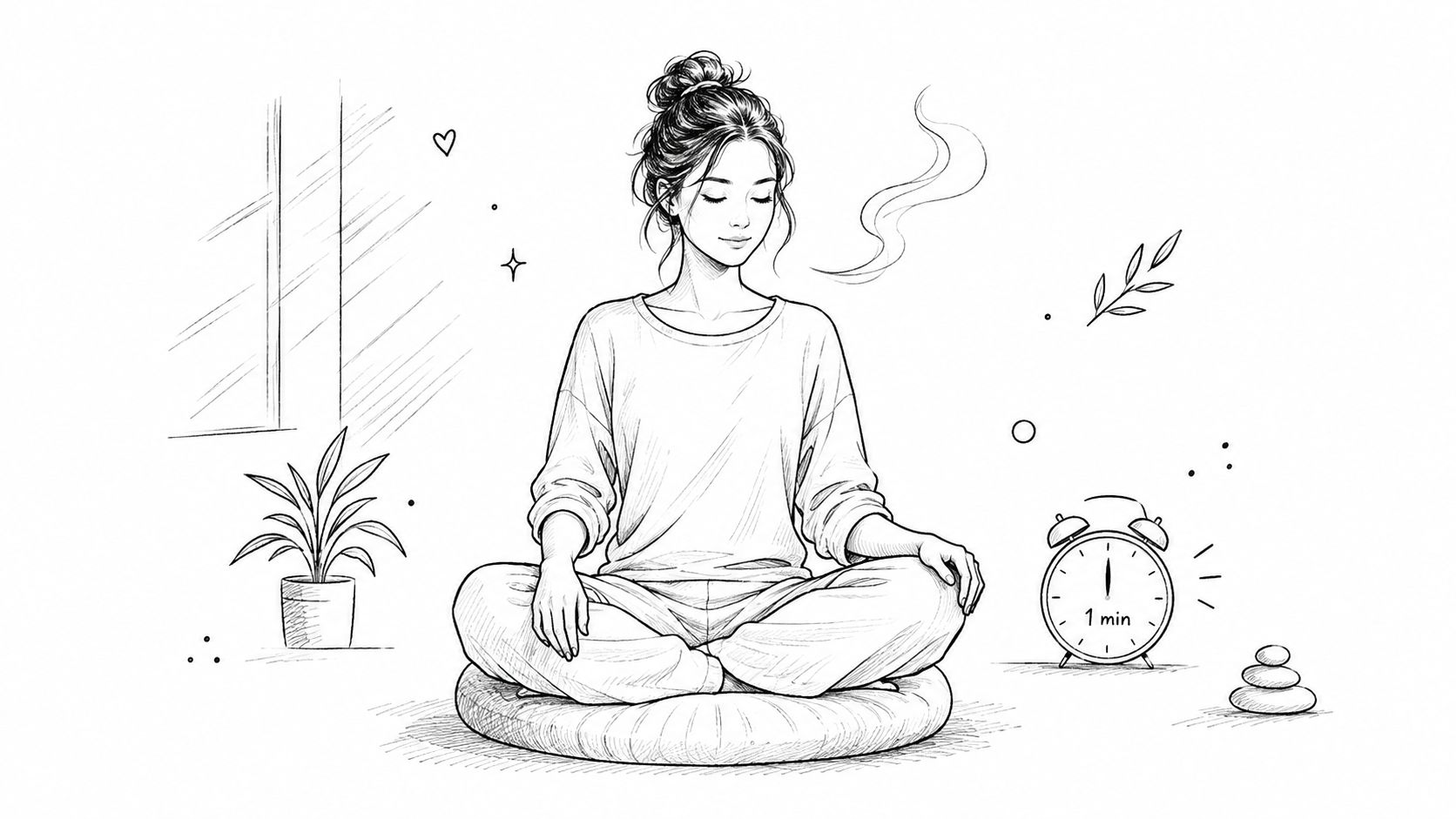
Put it directly before a recurring work transition, such as opening your project board, starting deep work, or returning from lunch. Set a timer for one to three minutes during the first week. Keep your eyes open if closing them makes your thoughts louder. Sit, stand, or walk slowly. The correct position is the one that lets you repeat the practice without bargaining with yourself.
Choose the attentional mode based on your internal noise:
- Breath anchoring: Track the physical sensation of breathing at the nose, chest, or abdomen. When attention leaves, label it “thinking” and return once.
- Open monitoring: Let sounds, body sensations, images, and thoughts appear without following any one of them. This works better when trying to force breath concentration creates more friction.
- Movement anchoring: Count steps, feel each foot land, or slowly scan the room from left to right. Use this when sitting still turns into restless planning.
The goal isn’t to eliminate distraction. The rep is the return. Each time you notice that you’ve drifted and come back, you’ve practiced the exact control you need when an email, idea, or emotional spike tries to hijack the next task.
Run the reset without decision fatigue
Use the same sequence tomorrow:
- A recurring calendar trigger fires.
- You put both feet on the floor and start the timer.
- You anchor to breath, open awareness, or movement.
- You finish by naming the next physical action, such as “open the client brief.”
- You begin that action immediately.
Pair the reset with a reward you already want. Coffee, stepping outside, one song, or a short walk can follow the practice. The reward shouldn’t require another decision. During the first two weeks, measure adherence before depth. A short session you repeat is more valuable than an impressive session you resent.
If you already use focused work intervals, place the reset immediately before one. The Pomodoro technique for ADHD can provide the outer container, while meditation helps you cross the starting line.
Use this video as an optional guided entry point, not as another obligation.
After the timer ends, don’t evaluate your meditation. Evaluate the transition. Did you start the intended task, or did you open a different tab? That answer tells you more than whether your mind felt peaceful.
Habit Engineering That Makes the Practice Stick
Motivation is unreliable fuel. A working system attaches the practice to something that already happens, makes the cue visible, and pays you immediately afterward.
Consider Maya, a fictional agency founder who loses the first hour of deep work to inbox triage. She doesn’t add “meditate” to a vague morning checklist. She identifies the moment her attention slides into client work, places a small card beside her keyboard, and schedules a two-minute preparation block before her first focused work block. When the calendar reminder appears, the card tells her exactly what to do: feet down, timer on, breath counted, next task visible.
The reward is immediate and concrete. She makes coffee and takes it outside before opening the project file. The practice isn’t competing with the inbox on abstract wellness grounds. It is replacing the familiar adrenaline loop with a predictable transition.
Use a cue, reward, and measurement loop
Keep the tracking sheet brutally small. Record the session, then record what happened afterward.
- Cue: What event starts the practice? Sliding into deep work, finishing lunch, or leaving a meeting.
- Practice: Which mode did you use? Breath, open monitoring, or movement.
- Reward: What happened immediately after? Coffee, music, sunlight, or a walk.
- Signal: Rate perceived clarity from 1 to 10, then note the next-hour work output in plain language.
- Adjustment: If the practice repeatedly increases agitation or delays the task, shorten it or change the mode.
The number isn’t a score for your character. It’s a way to replace faulty memory with a signal. Founders often remember the one session that felt brilliant or the one that felt impossible. A simple log shows whether the intervention helps your actual work.
You can also use structured self-guided anxiety support tools when anxious rumination is the barrier. Keep the tool in the same operating loop, but don’t let it become another place to browse indefinitely.
The meditation is not the goal. The goal is a more reliable handoff from one state to another. If the reset helps you start, stay, or stop, keep it. If it creates another ritual you perform while avoiding the work, redesign it.
Matching the Protocol to Your Specific Failure Mode
“Focus” is too broad to prescribe one practice. Task-switching, rumination, low-interest avoidance, and emotional impulsivity need different inputs.
| Failure mode | Protocol | Duration | Trigger cue | Expected benefit |
|---|---|---|---|---|
| Task switching | Sensory Reset | 2 minutes | Before opening a new project or app | A cleaner transition and fewer automatic clicks |
| Rumination after conflict | Name and Return | 3 minutes | After a difficult message or meeting | Distance from replaying the event and a clearer next action |
| Low-interest work | Walking Anchor | 5 minutes | Before admin, finance, or documentation | More usable activation through movement |
| Emotional impulsivity | Eyes-Open Grounding | 7 minutes | Before replying while activated | A wider attention field and more response choice |
Task switching needs a hard boundary
Before you open the next project, look at five visible objects in the room. Feel your feet. Name the project you’re leaving and the project you’re entering. Then write one sentence describing the first action in the new context.
This is not a relaxation exercise. It is a context marker. Your brain gets a clear exit signal, which reduces the chance that fragments from the previous task follow you into the next one.
Rumination needs labels, not solutions
After conflict, don’t use meditation to solve the argument. Sit or stand with eyes open and label each intrusion with a neutral word: “replay,” “prediction,” “self-attack,” or “planning.” Return to the sensation of your feet or hands.
The win is not feeling positive. The win is noticing that the mind has reopened the same file and declining to edit it during the reset. Finish by writing one controllable next step, then stop.
Low-interest work often needs movement
Walk slowly while counting steps in a repeating pattern. If you lose count, restart without criticism. Use the final minute to state the first concrete action, such as opening the expense folder or drafting the first heading.
Movement gives restless attention something physical to hold. It also makes the transition less punishing than sitting motionless while waiting for motivation to arrive.
Emotional impulsivity requires more visual contact
Keep your eyes open and soften your gaze toward the edges of your visual field. Notice the room, your posture, and the pressure of your feet against the floor. Let the emotional charge exist without turning it into a message, decision, or meeting.
Use this before responding to criticism, making a personnel decision, or sending a high-stakes email. If the activation keeps rising, don’t extend the practice. Switch to grounding or a brisk walk.
When Meditation Backfires and What to Do Instead
Meditation isn’t automatically safe just because it looks quiet. A 2025 mixed-methods study reported that 21% of participants experienced negative effects, while 63% still viewed meditation as entirely risk-free, a mismatch that can cause people to ignore warning signs. (2025 mixed-methods study)
For a burned-out founder, prolonged inward attention can be the wrong tool during acute sleep deprivation, panic, trauma-related symptoms, or severe rumination. Watch for rising agitation, intrusive imagery, emotional flooding, dissociation, or physical discomfort that intensifies rather than settles.
Use clear stop rules
Stop the session when:
- Activation rises: Your breathing becomes more strained, your body feels trapped, or panic increases.
- Attention becomes unsafe: Intrusive images or memories become overwhelming.
- Function declines: You can’t return to ordinary work, conversation, or basic orientation.
- The practice becomes avoidance: You’re using another session to tolerate an impossible workload instead of changing the workload.
Open your eyes. Name objects in the room. Put cold water on your hands, walk briskly, or complete a short structured task with an obvious finish. If symptoms persist or meditation repeatedly worsens them, seek qualified clinical support. Someone looking for local help may consider anxiety counselling in Penticton, depending on location and fit.
Meditation is a configurable attentional intervention with monitoring, not a universal cure.
Don’t use it to prove that you can tolerate conditions that need fixing. Sleep, treatment, workload, boundaries, and professional support can matter more than another timer.
Putting Meditation Inside Your Broader Operating System
Meditation works best when the rest of your system stops fighting your attention. Treat it as one input across four operating layers.
Cognitive Architecture supplies the external memory. Calendar triggers, visible next actions, and meeting boundaries tell you when to use the practice. Dopamine Engineering gives the transition a fast reward, such as coffee outside or a favorite song, so the routine doesn’t depend on delayed calm.
Strategic Delegation reduces the number of context switches meditation has to absorb. If every client approval, team question, and operational decision routes through you, a breathing exercise won’t repair the bottleneck. Bio-Optimization protects the conditions that make attention available, including sleep, food, movement, and appropriate clinical care.
Track the system for two weeks without turning it into a second job:
- Sessions completed
- Perceived clarity from 1 to 10
- Work completed in the next hour
- Sleep quality
- Reliability of team handoffs
Run a Monday launch check. Choose one failure mode, assign one protocol, attach it to one calendar trigger, prepare one reward, and define the next action that follows. Review the data at the end of the trial and keep only what improves execution.
If you want the meditation layer to sit inside a broader ADHD workflow, explore the ADHD management app alongside external planning, reminders, and task capture. The tool matters less than the architecture around it.
Jan Kutschera helps ADHD founders replace burnout-driven hustle with engineered operating systems built for their wiring. If you want meditation connected to cognitive architecture, dopamine-friendly rewards, delegation, sleep, and measurable execution, visit Jan Kutschera and start building a system that makes clarity easier to repeat.
Jan Kutschera
German founder, diagnosed with ADHD at 51. Built 4 agencies, now building systems for neurodivergent entrepreneurs. German engineering for the ADHD brain.
Connect on LinkedInRelated Articles
Dopamine Reward System Addiction Explained for Founders
Dopamine reward system addiction explained: why deadlines feel like drugs, how craving loops form, and how founders can rebuild the loop without burnout.
BIOS Optimization Guide for Founders Who Hate Habits
A bios optimization guide for founders: tune sleep, fuel and movement like firmware, with ADHD-proof systems that survive launch week.
10 ADHD Productivity Tools for Founders: What Works
Ten ADHD productivity tools for founders, with honest limits and tips for choosing systems that support executive function without extra clutter.