Dopamine Reward System Addiction Explained for Founders
Dopamine reward system addiction explained: why deadlines feel like drugs, how craving loops form, and how founders can rebuild the loop without burnout.
Jan Kutschera
Nine in the evening. The day produced three unfinished proposals, one document you opened and closed four times, and a sincere promise to start fresh tomorrow. Then a client emails with a subject line containing the word urgent, and the lights come on upstairs.
Suddenly you’re typing at speed, solving in eleven minutes what sat untouched since Tuesday. You feel sharp. You feel alive. You feel like the version of yourself who ships.
That surge isn’t a personality quirk and it isn’t a work ethic. It’s your dopamine reward system doing precisely what it evolved to do, and once you can see the machinery, you can’t unsee it.
Table of Contents
- Why Crisis Feels Like Fuel
- How the Dopamine Reward System Actually Works
- How Addiction Hijacks the Reward Loop
- When Deadlines Become the Drug
- When High Performance Crosses Into Compulsion
- When to Get Professional Help
- How to Engineer Sustainable Reward Loops
- Rewire One Loop This Week
Why Crisis Feels Like Fuel
You know the shape of the week by now. Two flat days, a Thursday that evaporates into meetings that could have been a Slack message, then a fire at nine and a strange, beautiful competence that shows up out of nowhere.
This piece argues that competence is a reward loop, not a character trait. The same circuit that makes a deadline feel like rocket fuel can learn, without your permission, to demand deadlines before it fires at all.
The route from here runs in order:
- What dopamine does, which is not what the pleasure myth claims.
- How addictive rewards hijack the loop, with a signal two to ten times louder than dinner or friendship.
- Why crisis work rides the identical circuit, and why “I work better under pressure” is half true and half alibi.
- Four observable signs that separate drive from compulsion.
- A six-step procedure for building reward loops that pay out weekly instead of annually.
This is written for founders, agency owners and senior operators, many of them ADHD-wired, who suspect their best work only arrives when something is burning. You don’t need fixing. You need to know where the lever is.
The goal isn’t to kill dopamine or discipline yourself out of ambition. It’s to aim the reward system at work that compounds instead of work that burns.
How the Dopamine Reward System Actually Works
Dopamine is not the pleasure chemical. That version of the story, where a burst of dopamine equals a burst of joy, is the reason so much productivity advice sends people hunting for the wrong lever. Dopamine is the wanting-and-learning chemical. It decides what matters, stamps a value on it, and tells the brain to repeat the behavior.
The hardware is compact. A cluster of dopamine-producing neurons in the ventral tegmental area broadcasts to the nucleus accumbens, a central hub of the brain’s reward circuitry. When that pathway lights up, it isn’t commenting on how nice something felt. It’s placing a bet on how much attention that thing deserves.
Here’s the loop those neurons run, on repeat:
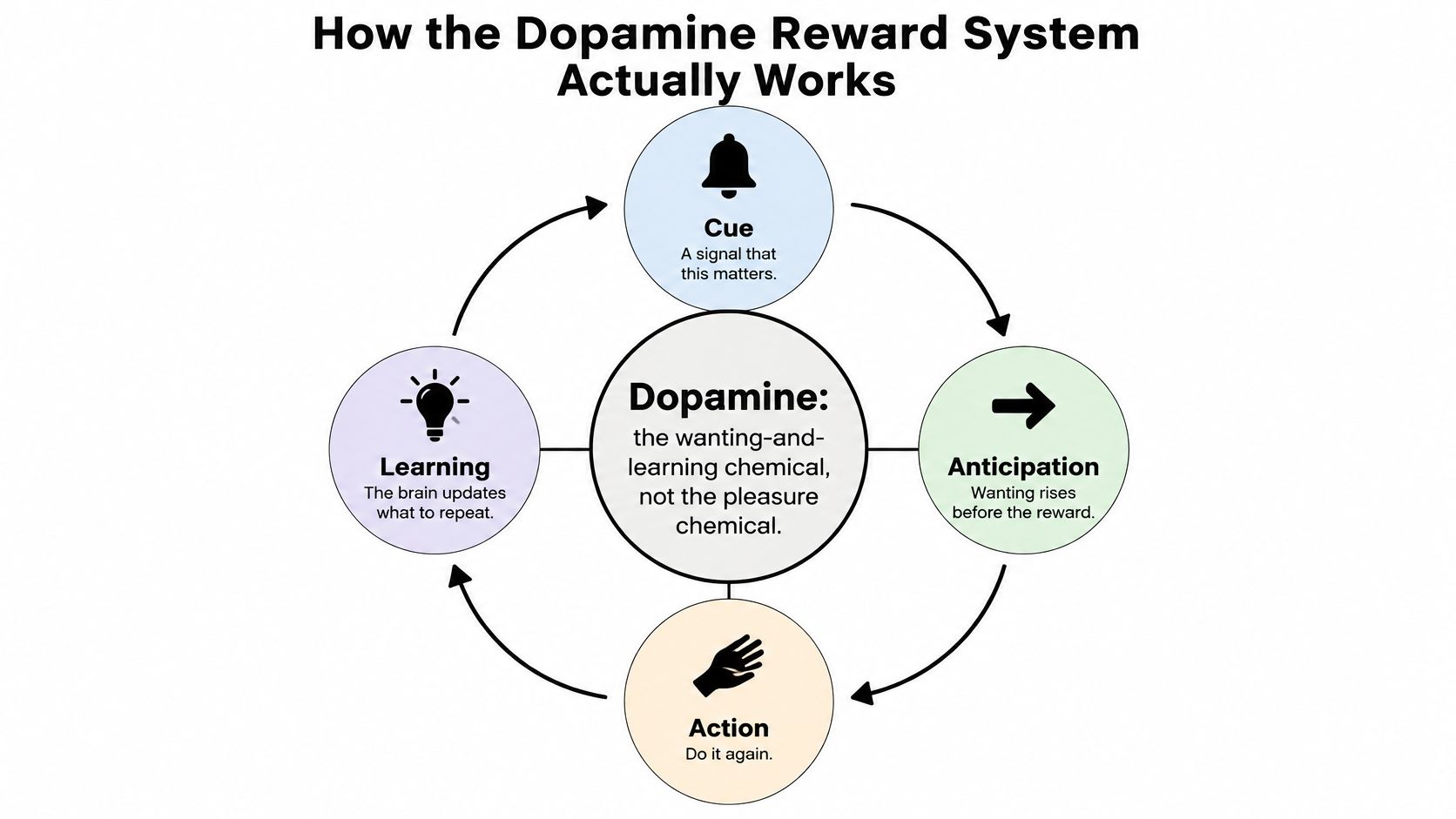
Dopamine Is a Betting App That Updates Its Own Odds
The signal tracks surprise, not satisfaction. A review of reward-prediction-error research in Neuron00731-X) describes dopamine neurons whose activity rises when an outcome is better than expected, sits near baseline when the outcome is fully predicted, and drops below baseline when it’s worse. The same review notes that addictive drugs can pharmacologically amplify this teaching signal, which is how drug-related cues end up carrying unusually high motivational value.
Think of a betting app that moves the odds the instant real money lands. Your brain isn’t tracking the reward itself so much as the gap between the forecast and the result. Beat the forecast and the app pushes a notification. Match it and the app goes quiet. Miss it and the app sulks.
That gap is the entire engine. Laid out, the model looks like this:
| Outcome vs prediction | Dopamine response | What the brain learns | Founder version |
|---|---|---|---|
| Better than expected | Spike above baseline | Repeat it and seek it out | A surprise upsell after a routine client call |
| Exactly as expected | Back to baseline | Habit runs on autopilot | The weekly report you ship without noticing |
| Worse than expected | Dip below baseline | Adjust, avoid or brace | The launch that flops and makes the next one feel risky |
The one-line version: dopamine doesn’t reward you for feeling good, it rewards you for being wrong in a useful direction.
Wanting and Liking Are Two Different Departments
Cue-triggered dopamine can make you chase something you no longer enjoy. That’s the part that confuses people. The tenth urgent fire of the quarter can feel dull and irresistible in the same breath, because the wanting system is still firing while the liking system moved out months ago.
This is why willpower arguments miss the point. You aren’t negotiating with a preference. You’re negotiating with a prediction error reinforced hundreds of times.
So the practical takeaway is blunt: whatever pays out unpredictably and generously will run your calendar, regardless of whether it’s good for you. That’s the lever that addictive rewards and crisis workflows both pull, and it’s the reason a predictable weekly win can outmuscle a heroic quarterly launch once you set it up properly.
How Addiction Hijacks the Reward Loop
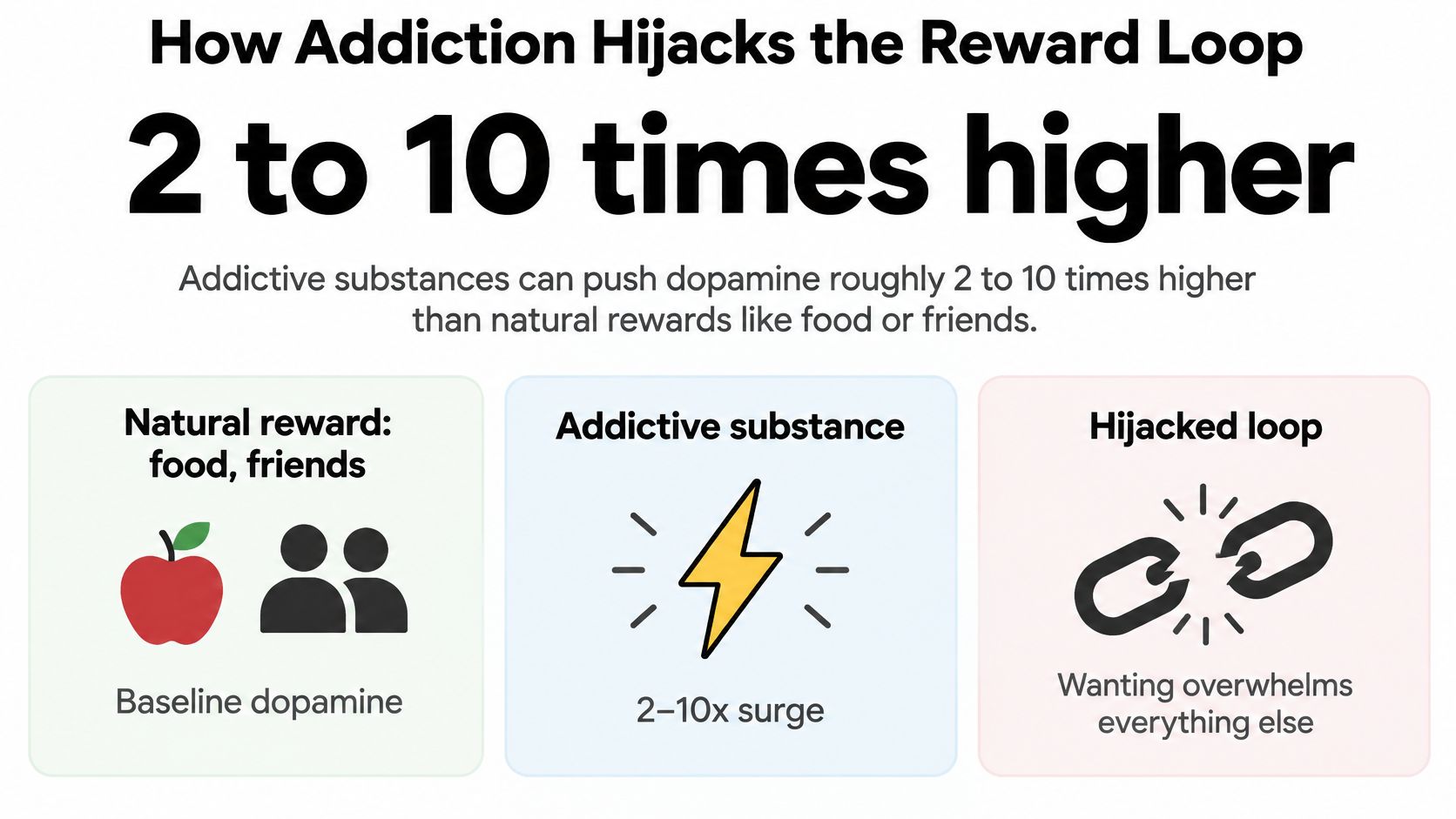
Dopamine reward system addiction develops when the signal gets louder than the system was designed to handle. Some abused substances can release approximately 2 to 10 times more dopamine than natural rewards such as eating or sex, the National Institute on Drug Abuse reports, and rapid delivery routes such as smoking or injection produce especially strong reinforcement. That’s not a mild preference. That’s the motivational equivalent of a jet engine fitted to a bicycle.
The Loudspeaker Moves to the Lobby
With repetition, the loop relocates. Dopamine starts responding harder to cues, meaning the location, the routine, the notification ping, the specific person, than to the reward itself. A review of human PET studies published in PNAS found that addicted individuals showed markedly blunted drug-induced dopamine increases, lower striatal D2 receptor availability during both early and prolonged withdrawal, and, in cocaine users specifically, receptor levels that sat below those of non-users a month after stopping and had still not fully recovered four months after cessation.
Meanwhile, drug-associated cues produced significant striatal dopamine increases tied to self-reported craving, in some cases exceeding the response to the drug itself. The announcement in the lobby now matters more than the show on stage.
Those lower receptor levels tracked reduced activity in frontal regions involved in salience attribution, decision-making and inhibitory control, including the orbitofrontal cortex and the anterior cingulate cortex. The brakes thin out at exactly the moment you need them.
Three Problems, Not One
The hijack has three layers, and only the last one tends to get noticed:
- Amplified signal: the reward arrives louder than anything the system evolved to expect, so it gets flagged as spectacularly important.
- Cue dominance: the environment, not the substance, starts running the behavior. A room, a time of day, a Slack ping.
- Weakened brakes: prefrontal control becomes less able to overrule the pull, which is why “just decide to stop” fails as a strategy.
The National Institute on Drug Abuse frames the endpoint as a chronic, relapsing disorder involving compulsive use despite harmful consequences, with functional changes across reward, stress and self-control circuits. Not a willpower defect. A changed system.
Here’s the scale of the contrast:
When Deadlines Become the Drug
None of this requires a substance. The loop is a learning mechanism, and it will happily learn from your calendar.

Take an agency owner with a proposal she’s been avoiding for two weeks. It sits there, heavy and dull, until the night before the call, when she writes the whole thing in one adrenaline-soaked sitting and concludes she works best under pressure. She doesn’t. She works best under urgency, which is a different claim with a much worse business model.
Then there’s the founder who checks deal notifications the way other people check a slot machine. The payouts are unpredictable, which is exactly what makes them train harder than a predictable salary ever could.
And the operator who feels flat in a calm week and alive only when rescuing a client fire. Same circuit, three costumes.
Why Unpredictability Beats Consistency
Unpredictable deadlines, urgent client feedback, financial wins and crisis resolution all function as intermittent reinforcers. Their unpredictability generates stronger prediction errors than steady progress does, so the loop learns a simple rule: crisis equals payout.
Watch how this plays out in the calendar:
For ADHD-wired founders, novelty and urgency generate especially strong prediction errors. That’s the edge and the trap in one package, because the crash-and-rescue cycle starts to feel like a personality trait rather than a trained pattern. It also explains why the aftermath looks so much like the ADHD burnout cycle: the same loop that produces the heroic night produces the flat week that follows it.
The Excuse That’s Half True
“I work better under pressure” survives because it contains real information. Pressure supplies three things at once: arousal that wakes up a sluggish system, a clear cue that removes the paralysis of an open-ended task, and a rescue narrative that makes the work feel meaningful.
Pressure supplies arousal, a cue and a story. It does not supply the decision about when work starts. The loop does that, and the loop has no interest in your priorities.
That’s the part people skip. Talent determines what you can produce. The loop determines when you produce it, and often whether you produce it at all without a fire.
What was learned by fire can be re-learned by design. That’s the whole remaining argument.
When High Performance Crosses Into Compulsion
One myth deserves retirement before any diagnostic: ADHD is not a dopamine-deficiency diagnosis, and it does not make addiction inevitable. The picture is messier and more interesting. Higher addiction risk seems to travel with a cluster of traits rather than one broken dial: a pull toward immediate rewards over delayed ones, weaker learning from consequences, inhibitory-control difficulties, emotional volatility and impulsive decision-making. A cluster of risk factors works like a weather report. It tells you what to prepare for, nothing more.
The useful question is concrete: has the behavior crossed a line you can observe? Four signs do most of the work.
Four Signs, One Honest Score
| Warning sign | How it shows up in founders | Healthy counterpart |
|---|---|---|
| Loss of goal-directed control | Crisis work starts before you decide it is worth doing | You start, stop and defer work by choice |
| Escalating intensity or frequency | Only all-nighters and near-misses register as achievement | Ordinary progress still feels like a win |
| Continuing despite consequences | Missed sleep, strained relationships and health warnings change nothing | Costs get noticed and factored into decisions |
| Narrowing of rewards | Hobbies, family time and quiet wins stop feeling like anything | Several sources of satisfaction stay active |
Score it against the last month. A single bad sprint describes your workload. A repeating pattern describes your wiring.
How to read your score: one occasional sign is a scheduling problem. Two or more persistent signs are a loop that needs redesign. Compulsive behavior or substance use that survives real consequences belongs in a professional assessment.
Here is why the diagnostic matters for high performers specifically. The same behaviors read as grit in a pitch deck and compulsion in a clinical interview, which makes applause a terrible measuring instrument. Investors praising your midnight shipping cadence never see your sleep data, and peers admiring your output rarely ask what it costs to produce.
When the score suggests outside eyes would help, high achiever therapy at Uptown Psychology works with people whose competence has been masking the problem. Competence is exactly what makes this pattern so hard to spot from the inside.
When to Get Professional Help
The plain test is the last one on the list: has the pattern continued despite real consequences such as health warnings, missed obligations or strained relationships? If it has, book an assessment before you run any productivity fix.
Bring a written log of the last month covering hours worked, substances used, missed sleep and the costs you noticed. Ask directly whether the assessment screens for ADHD as well, since emotional dysregulation and impulsive decision-making often travel alongside substance-use risk.
Accessible support comes in several forms. Behavioral therapy, peer support groups and, where appropriate, medication are all standard options, and the right mix depends on what the assessment finds. If you want to understand the difference between clinical care and the structural work, this comparison of coaching versus therapy is a reasonable place to start.
Seek same-week contact for withdrawal symptoms, for use that escalates despite health warnings, or for any thoughts of self-harm, and call local emergency services if someone is in immediate danger. For the overlapping territory between exhaustion and low mood, reVIBE Mental Health’s burnout recovery guide explains what treatment pathways look like in practice.
Everything below supports that care. None of it replaces it.
How to Engineer Sustainable Reward Loops
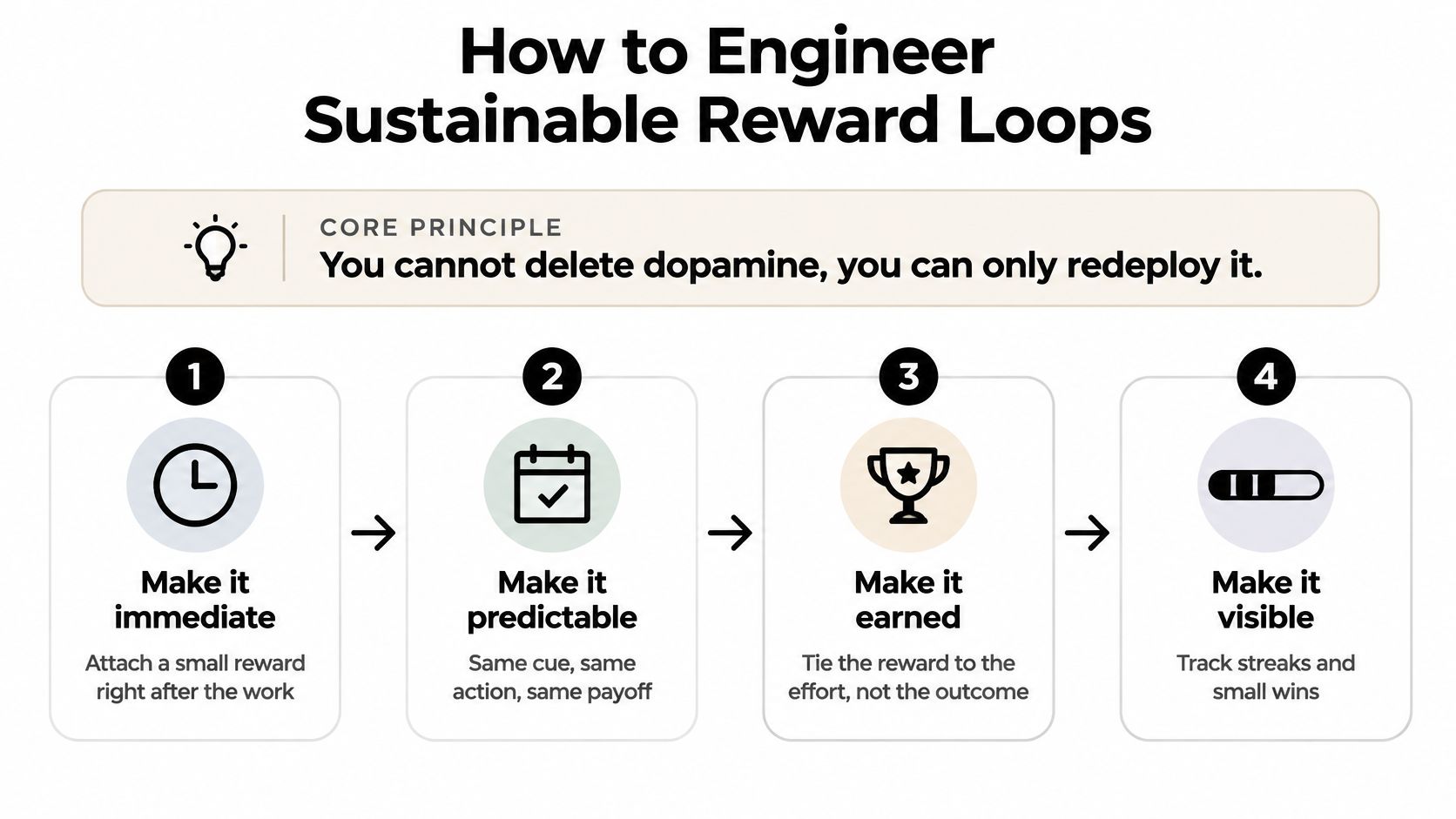
The governing principle is simple and slightly annoying: you cannot delete dopamine, you can only redeploy it. A review of incentive salience and prefrontal control in PMC puts it precisely: chronic exposure raises sensitivity to cues that predict the reward while reducing responsiveness to the reward itself, and weakened prefrontal top-down control makes behavior more vulnerable to compulsive repetition. The actionable translation is to cut reliance on high-arousal cues, meaning late-night emergencies, public pressure and last-minute novelty, and pair execution with lower-intensity recurring reinforcers.
Before the steps, here’s the whole redesign compressed into four moves:
The Six-Step Rebuild
1. Audit your spikes for one week. Log every hit and the cue that preceded it: the ping that made you check, the deadline that made you start, the praise that made you want more. Don’t judge the log. You’re looking for the pattern that repeats on Tuesday afternoons.
2. Make progress visible. A milestone board, a done column, a checklist you physically seal. The brain needs an artifact it can point at. Without one, the only visible proof of progress in your week is a fire being extinguished.
3. Shrink feedback cycles. Replace the giant launch payout with a weekly demo, a Friday client note, a short internal review. Frequent small prediction errors keep motivation online without requiring a crisis to generate them. This is the single highest-impact change for most founders, because it converts one annual dopamine event into fifty-two tiny ones.
4. Precommit the reward. Decide the treat before the task: the espresso, the walk, the episode. Tie it to finishing, never to rescuing. A reward that arrives after a fire has just reinforced the fire.
5. Turn down the arousal cues. Scheduled check-ins instead of an open inbox. Public commitments instead of public panic. Muted urgent channels during one protected deep-work block. If prefrontal control is the part that thins under chronic cue exposure, then every removed cue is a small loan against your own willpower.
6. Protect sleep, movement and meals as part of the loop. Baseline reward sensitivity recovers when the body is maintained. Skimping on all three and then wondering why nothing feels rewarding is like draining the tank and blaming the engine.
Two Reward Diets
Think of it as choosing between two diets rather than between discipline and indulgence.
- The low-intensity diet: completion visibility, scheduled feedback, meaningful progress metrics, recovery-preserving routines. It’s boring. It also compounds.
- The high-intensity diet: crises, all-nighters, public wins, last-minute novelty. It works until the week it doesn’t, and it never teaches the system to fire on an ordinary Wednesday.
If you’re ADHD-wired, add one rule: external structure beats willpower against a conditioned cue, every time. Don’t rely on remembering to skip the inbox; remove the inbox from the room. For the maintenance side of the equation, these natural ways to increase dopamine cover the baseline you’re trying to rebuild.
Rewire One Loop This Week
Pick the loudest loop you have. For most founders it’s the “only ship at midnight” pattern, because it’s the one that gets complimented. Then run the redesign on that single loop for two weeks.
- Week one, observe and instrument. Log every spike and its cue. Set up one visible completion marker and one scheduled daily feedback check.
- Week two, replace and protect. Attach a precommitted reward to finishing the task, mute the urgent channel during one deep-work block, keep sleep and meals on a fixed schedule.
At the end of two weeks, score the four warning signs again and ask a sharper question: does ordinary progress register as a win yet? If the signs persist, or if substance use or compulsive behavior continues despite real consequences, book a professional assessment. The system work complements that care and never replaces it.
Your brain will learn whatever pays out. So make sure the payout is a business that runs without the fire alarm.
If you want the operating system rather than the theory, I build one around four pillars: Cognitive Architecture, Dopamine Engineering, Strategic Delegation and Bio-Optimization, the same structures I assembled over 30 years of instinct before an ADHD diagnosis at 51 explained why they worked. Start with the free Dopamine ROI Calculator to see where your current loops are paying out, then decide how much of the rebuild you want to run with company. Visit Jan Kutschera to begin.
Jan Kutschera
German founder, diagnosed with ADHD at 51. Built 4 agencies, now building systems for neurodivergent entrepreneurs. German engineering for the ADHD brain.
Connect on LinkedInRelated Articles
Burnout Recovery Strategies: 8 Systems That Actually Work
Burnout recovery strategies for founders who run on adrenaline: eight evidence-based routines for sleep, focus, delegation and sustainable energy.
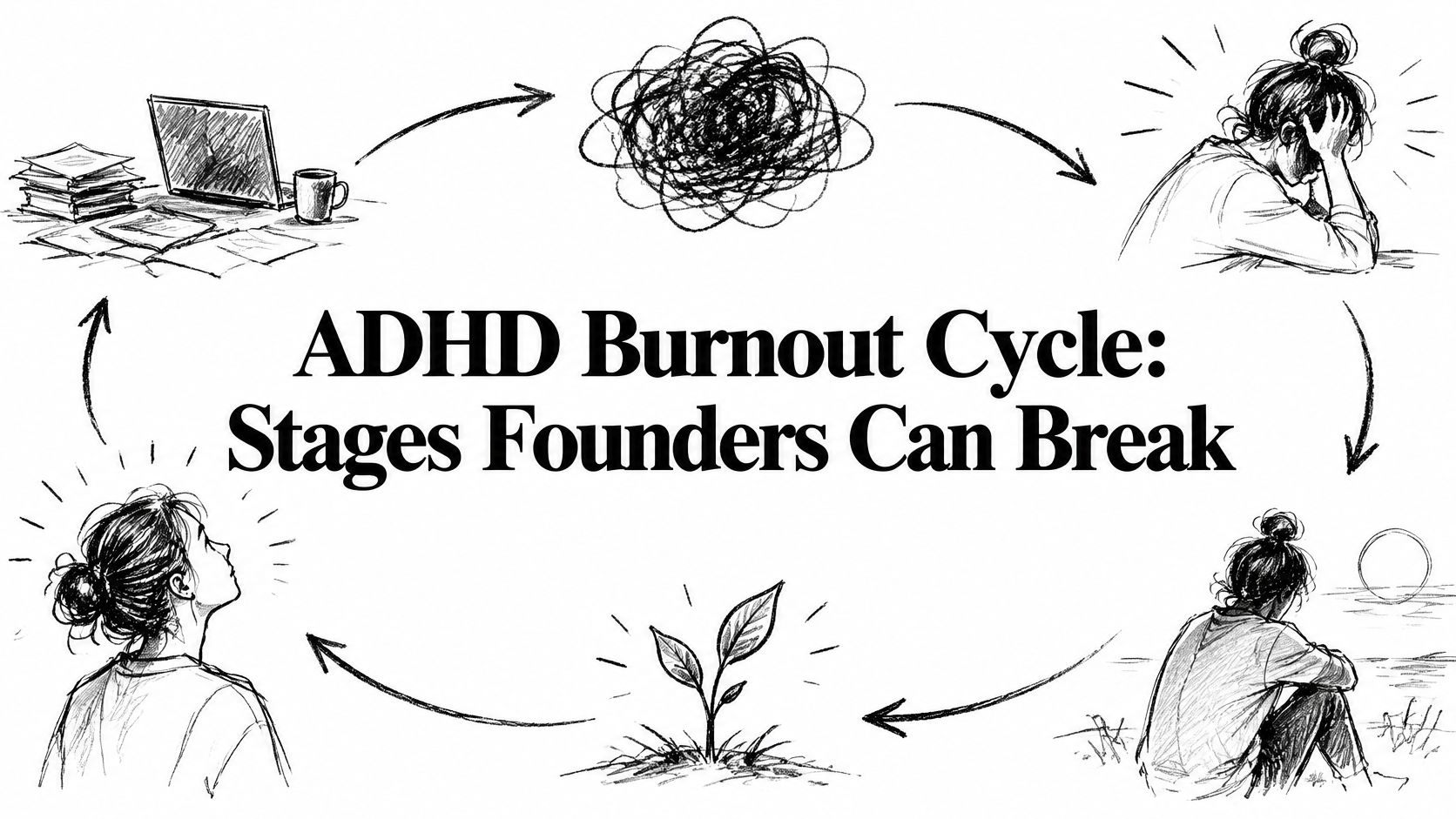
ADHD Burnout Cycle: Stages Founders Can Break
See the ADHD burnout cycle in five stages, separate it from depression, and test founder fixes before the next crash.
Executive Function Performance Test: What Scores Mean
Learn what an executive function performance test measures, how Stroop, WCST and Trail Making compare with BRIEF-A, and how to read your scores.