ADHD Project Management: Systems That Work with Your Brain
ADHD project management that works with your brain, not against it: external structure, visible tasks, smarter delegation and follow-through that lasts.
Jan Kutschera
Monday’s launch plan looked brilliant. By Thursday it’s half-dead, three tabs are still open from Tuesday, two promises have evaporated, and a client is politely asking why nothing has moved. You didn’t lose interest. The plan lost contact with the brain that has to run it.
That’s the problem with ADHD project management. It’s rarely a character issue or a missing app. It’s a mismatch between work that lives in memory and a mind that needs that work outside, visible, and matched to how attention behaves.
Table of Contents
- Match Each Project Stall to the Fix That Works
- Build External Structure That Replaces Memory
- Shrink Switching Costs with a Resumption Note
- Match Work to Stimulation, Not Just the Calendar
- Delegate Without Forcing Disclosure or Lowering Standards
- Keep Follow-Through Going When Motivation Fades
Match Each Project Stall to the Fix That Works
You know the Thursday version of this story too well. The board made sense on Monday. Then a meeting landed, a pricing doc stalled mid-thought, someone asked a sensible question you swore you’d answered, and the whole project slid into that familiar low-grade dread. Nothing exploded. It just stopped restarting.
Most stalls aren’t mysteries. They’re predictable mismatches between the task and the conditions it needs. ADHD isn’t a superpower and it’s not a curse. It’s a different operating system that crashes if it isn’t maintained. Maintenance, in project terms, means you stop asking memory, motivation, and good intentions to do jobs that an external system should do.
Find Your Stall First
Don’t rebuild your whole system this week. Find the stall you see most often, read across that row, and install only that fix. One fix, tested properly, teaches you more than six new tools installed in a panic.
| Stall | Likely Cause | External Fix | Check It Works |
|---|---|---|---|
| Forgets the next step midway | Working memory overload | Written next action on a visible card | Restart takes under two minutes |
| Starts five things, finishes none | Too much work in progress | Cap active items at three | Fewer open items each Friday |
| Derails after predictable meetings | Switch costs | Protected focus blocks plus a resumption note | Fewer handoffs need a follow-up question |
| Routine work stalls for weeks | Low stimulation | Pair with a deadline partner or novelty | Steady output on routine tasks |
| Team confused after handoffs | Unclear decision rights | Written handoff template with one owner | Fewer repeat questions in threads |
| Motivation crashes midweek | No recurring review | Fixed twenty-minute weekly review | Plan updated before Monday |
Read the table like a diagnostic, not a shopping list. If you forget the next step midway, you don’t need more discipline, you need the next physical action written where you’ll see it. If five projects are open and none are closing, a cap of three active items will hurt for a day and help for a month.
Practical rule: If a task needs you to remember where you left it, the system has already failed. Put the restart point in writing.
Run a Two-Week Test
Pick one row. Install that fix this week and count three things for two weeks. First, how many projects you restarted in under two minutes. Second, how many handoffs needed a follow-up question. Third, whether you used the Monday plan on Wednesday, or whether it became decorative stationery.
- Week one counts as baseline: Don’t judge yourself, just record restarts, follow-up questions, and open items on Friday.
- Week two keeps the same fix: Change nothing else, so you know what moved the numbers.
- Friday decides: If the numbers improve, keep the fix and add the next layer. If they don’t, change the fix, not the story about the person.
That last point matters. Blaming yourself produces shame, and shame is a terrible project manager. Changing the external condition produces information. A card in the wrong place, a cap that’s too loose, a review scheduled when you’re already depleted, those are all fixable design flaws.
For content-heavy work especially, it helps to track content from goals through publication in one visible chain, so goals, drafts, approvals, and publishing steps don’t live in four different heads. The principle is identical whether you’re shipping articles or client campaigns. If the chain is visible, a stall shows up early. If it’s held in memory, you find out when the client does.
A Quick Boundary Before You Start
This guide is general educational material, not medical advice or diagnosis. In the same spirit, we treat Revenue Reset as educational business and productivity material and not medical advice, diagnosis or treatment, and a Brain Map, quiz result or tool score is not a clinical assessment. If you have concerns about ADHD itself, speak with a qualified clinician. What follows is about work design, which you can change on a Tuesday without anyone’s permission.
Start with the row that made you wince. That’s usually the honest one. I’d pick that fix, run it for two weeks, and let the counts argue with your self-criticism. The counts usually win.
Build External Structure That Replaces Memory
A builder doesn’t stand on a site trying to remember every beam. The scaffolding goes up outside the building so the work can happen safely inside it. Good ADHD project management works the same way. You put the structure outside your head, then you do the work without also being the filing cabinet.
That distinction matters for founders in particular. The 2025 meta-analysis by Syracuse University’s Whitman School of Management synthesized 47 empirical studies and 298 effect sizes on ADHD and entrepreneurship, finding that inattention was negatively associated with post-launch entrepreneurial outcomes. Launch energy gets you started. What happens after launch depends on whether the scaffolding exists.
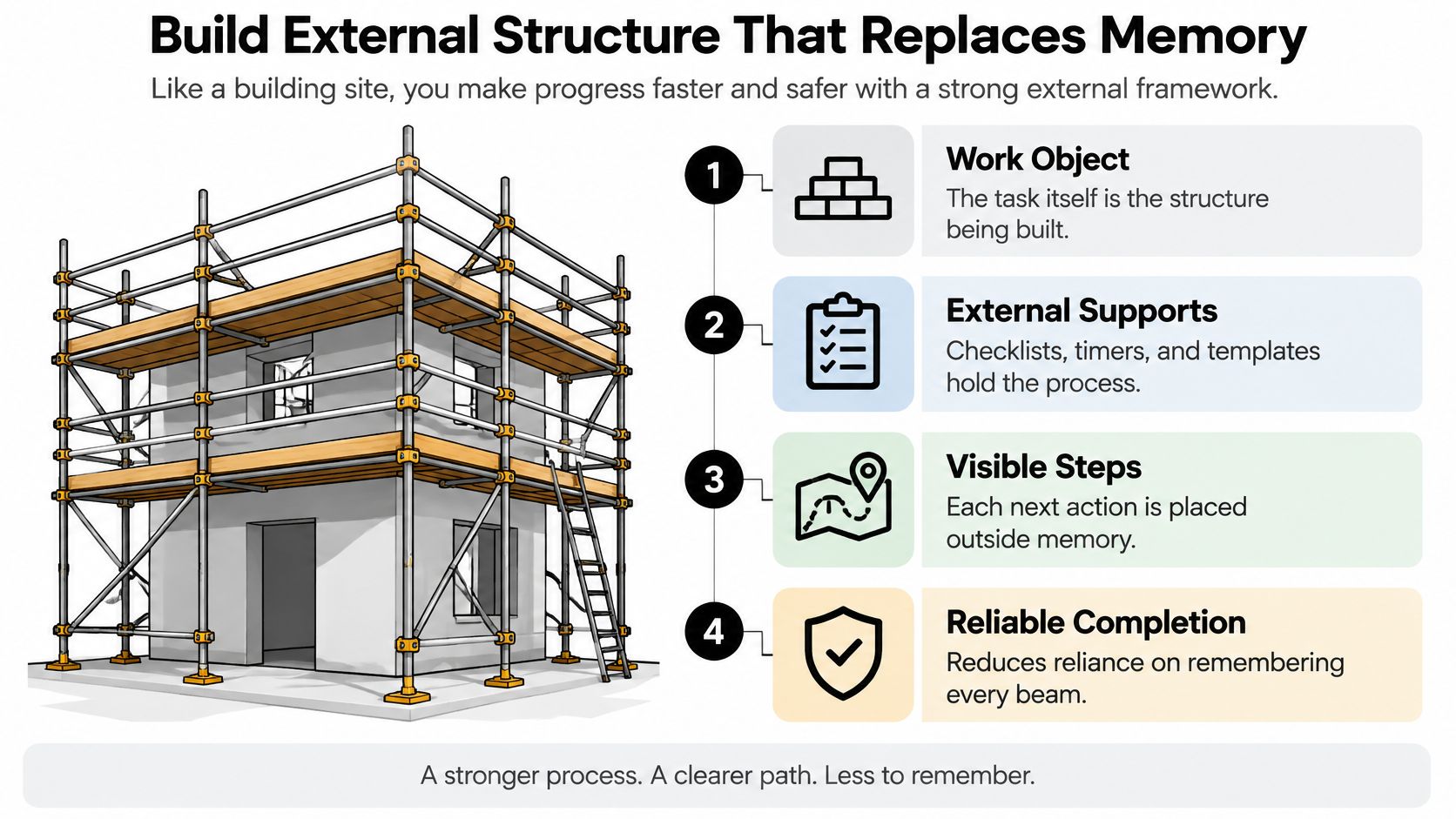
Four Layers That Hold the Work
External structure comes first. Calendars, boards, and fixed review slots hold commitments so memory doesn’t have to. In a small agency that might be a Monday planning call with a fixed agenda, same time, same three questions, so nobody spends executive function deciding how to plan.
Visible tasks come next, and many systems end up failing here. Every open item sits in one place, with one owner and one next physical action. A shared board with three columns beats a beautiful setup in Notion, Trello, or ClickUp that nobody updates. If you’re choosing or replacing the board itself, compare project tools with KeenVerdict before you migrate, because tool-hopping is its own form of avoidance.
- One home for open work: If it’s not on the board, it isn’t a commitment yet.
- One owner per item: Shared ownership usually means nobody restarts it.
- One next action in plain verbs: “Send draft to Maya” restarts work. “Client stuff” doesn’t.
The third layer is stimulation-matched roles, where work gets assigned by the conditions it needs rather than seniority or habit. Say a designer lights up during a fast-paced launch while a colleague is steadier with repetitive client reporting. Give each person more of the work their attention handles well, and support the rest with checklists and pairing instead of hope.
Sustainable follow-through is the layer people skip because it isn’t exciting. It’s a twenty-minute Friday reset that survives bad weeks, not a burst of discipline that burns out by week three. A rhythm you keep at 60 percent energy beats a perfect system you abandon.
Why Visibility Does the Heavy Lifting
Out of sight really does mean out of mind here, which is why visual reminders that keep work in view earn their place on walls, boards, and home screens. The point isn’t decoration. It’s reducing the number of decisions held in working memory at any moment.
Structure doesn’t mean more rules. It means fewer things your brain has to carry while it’s trying to do the actual job.
Finish with one self-check. Can a teammate look at your system and tell what’s in progress, who owns it, and what happens next, without asking you? If the answer is no, you don’t have scaffolding yet. You’re still the scaffolding, and that’s the job we’re trying to retire you from.
Shrink Switching Costs with a Resumption Note
The scheduled meeting is often more expensive than the surprise interruption. That sounds backwards until you look at the mechanism. In task-switching research published in PMC, inattentive traits predicted higher switch costs when switching was predictable and working-memory load was high, while hyperactive or impulsive traits did not show the same relationship and unpredictable switch costs were not associated with ADHD traits.
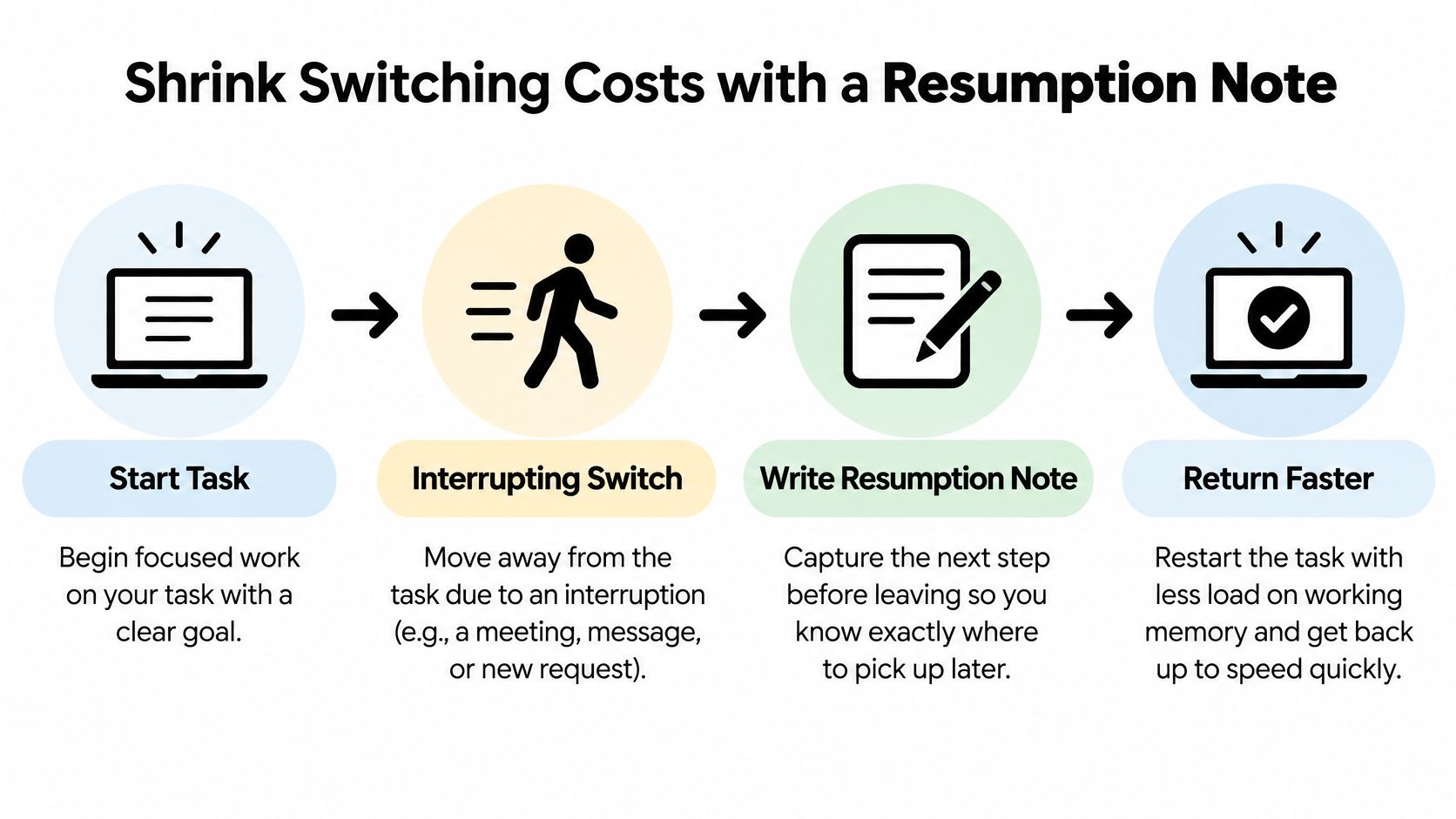
Translate that into a normal Tuesday. You’re halfway through a pricing model, holding three intermediate steps in mind, and a planned call pulls you out. The call goes fine. Then you sit back down and spend twenty minutes rebuilding a thread that felt solid half an hour ago. The meeting didn’t steal thirty minutes. It stole thirty minutes plus the rebuild.
Write the Note Before You Leave
A resumption note turns fragile internal context into an external artifact you can trust later. It takes about a minute and it has to happen before the switch, not after.
- Stop at a natural break point. Finish the sentence or the row, because mid-thought stops are the hardest to reconstruct.
- Write the current state in one line. “Pricing v2, tiers drafted, margins unchecked” tells future-you exactly where the work stands.
- Write the next physical action. “Open the sheet and copy row 14” works. “Work on pricing” doesn’t, because it offers no starting handle.
- Note any unresolved decision and who decides it. A parked decision with a named owner stops your brain from rehearsing it during the meeting.
- Close the tab or file. Leave the note as the only thing to read, so you don’t re-enter through a pile of open windows.
- On return, read the note aloud before touching anything. Hearing the next action beats scanning the screen and hoping context floats back.
The common slip is step three. Vague notes feel quicker and cost more. “Continue proposal” forces a fresh planning session every time you return, which is precisely the executive-function expense you’re trying to avoid.
Fewer Switches Beat Faster Switches
Don’t try to get better at switching. Reduce how often the switch happens and lower what it costs when it does. Batch similar activities together, so email, approvals, and follow-ups share one context instead of fragmenting the day.
Keep high-working-memory tasks in protected focus blocks, with meetings pushed to the edges where possible. Limit how many active projects one person holds at once, because every extra project is another set of intermediate steps competing for the same working memory. I’d rather see a team finish two projects cleanly than juggle five with heroic urgency.
Before any planned interruption: One line for where you are, one line for the next move, one line for what’s undecided. That’s the whole note.
Try it for a week of meetings and watch your restart time. Many individuals notice the change first in the small, unglamorous moment after a call, when work resumes in a minute instead of after a lap around the kitchen. That minute is the system working.
Match Work to Stimulation, Not Just the Calendar
More structure isn’t automatically better. That sentence annoys productivity purists, but it’s where a lot of ADHD project management advice goes wrong. A rigid calendar handed to someone whose attention runs on novelty and interest isn’t support. It’s a prettier way to fail on schedule.
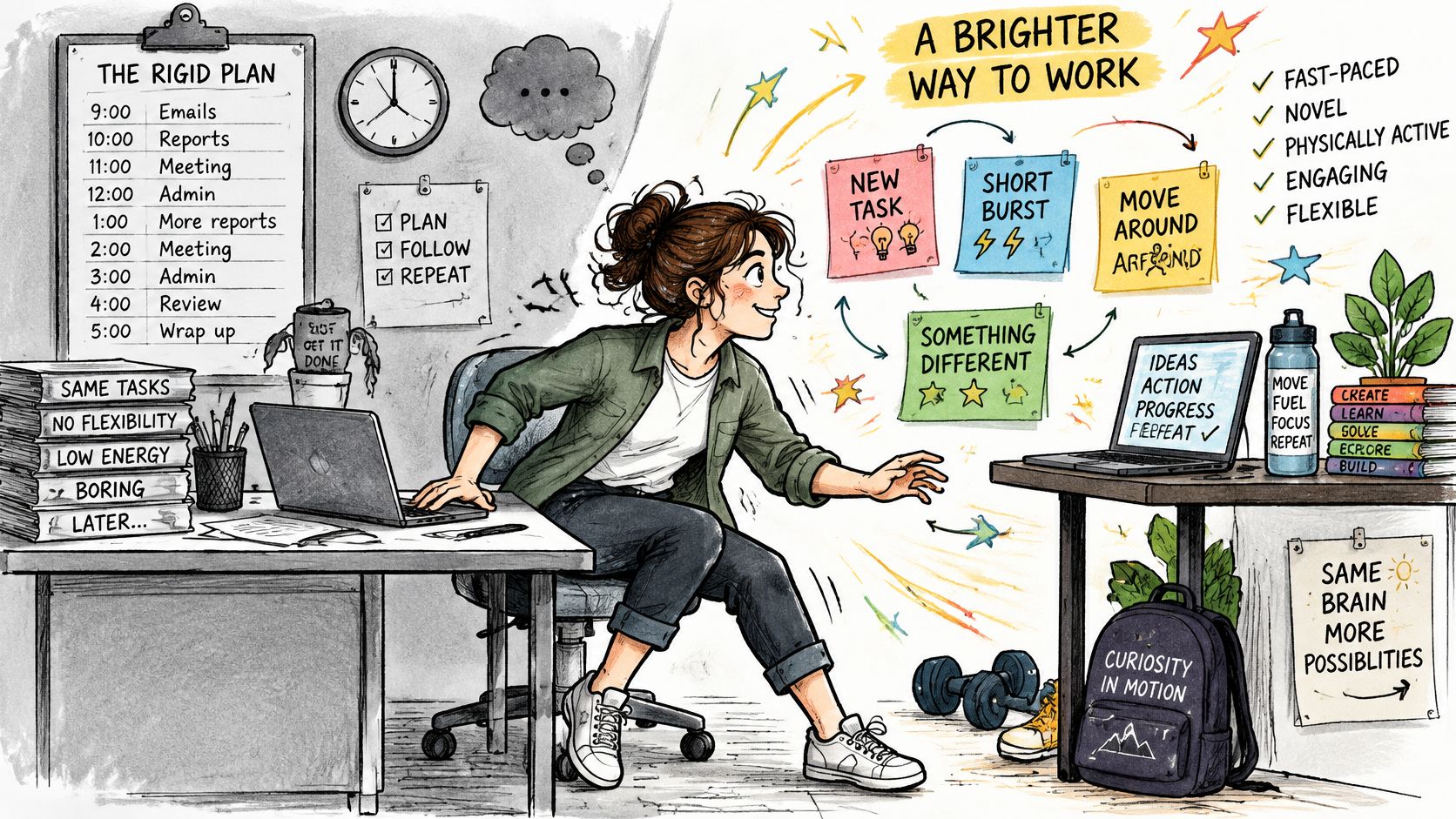
A 2025 qualitative review in the Journal of Attention Disorders found that adults with ADHD often function better in work that is novel, challenging, fast-paced, physically active, or intrinsically interesting, while repetitive work and poorly structured environments worsen difficulties. The same review identifies structure, detailed instructions, reminders, technology, and social support as useful strategies. The catch is that structure has to be stimulating and matched to the person and the task, not just thorough.
Sort Tasks by What They Ask of Attention
Instead of one universal schedule, sort work into types and give each type the conditions it needs. Initiation, deep work, coordination, and maintenance are different jobs wearing the same calendar costume.
| Task Type | Stimulation Profile | Best Conditions | Who Should Own It |
|---|---|---|---|
| Kickoff and ideation | High novelty | Short bursts in a fresh setting | Founder or creative lead |
| Deep build work | Moderate challenge | Protected focus block, no meetings | Person with the strongest focus window |
| Repetitive delivery | Low novelty | Checklist, timer and pairing | Team member with systems support |
| Coordination and follow-ups | Social and variable | Standing check-in and visible board | Project lead with reminders |
| Maintenance and admin | Low stimulation | Batched, scheduled and rewarded | Owner with clear done criteria |
Notice what the table refuses to do. It doesn’t ask the founder who electrifies a kickoff to also grind through maintenance admin on willpower alone. It batches the dull work, gives it done criteria, and attaches a reward, because variable attention is a design input, not a discipline failure.
This short video walks through matching tasks to energy and attention in practice, which is useful if your team’s calendar currently treats every hour as identical.
Where Founders Get Caught
ADHD-related strengths often support ideation and opportunity recognition. Spotting the opening, selling the vision, building the first version at speed, that’s frequently the fun part and the part that works. Repetitive delivery and follow-through become the operational risk, while everyone celebrates the pipeline.
So build your strongest scaffolding exactly there. Pair repetitive delivery with a checklist and a person. Give follow-ups a standing check-in instead of relying on someone remembering to chase. Put maintenance on a timer with a finish line, rather than letting it ooze across the week.
- Ask what gets started energetically: Those tasks reveal the stimulation profile that works.
- Ask what gets abandoned: Those tasks need novelty, pairing, or a different owner, not a lecture.
- Move one abandoned task this week: Change its conditions before you question anyone’s commitment.
I would start with that one abandoned task. It’s the cheapest experiment on this page, and it tells you whether your problem is effort or fit. Most of the time, it’s fit, and fit is something you can redesign this afternoon.
Delegate Without Forcing Disclosure or Lowering Standards
Most founders frame this as a personal organization problem. It’s a team design problem, and the numbers point that way. In a 2025 study of 106 employed adults with ADHD hosted by the University of New Hampshire, 79.3% reported negative effects on work performance, but only 58.5% used workplace adjustments, and among those receiving adjustments, 87.1% reported lower stress and anxiety and 80.6% reported improved productivity.
The most helpful adjustments in that study were remote or hybrid work, flexible hours, and noise control, while rigid structures and open offices were rated least effective. Read that as a leader and the question changes. It’s no longer “how do I get this person to try harder?” It’s “how do I build working conditions where the whole team gets reliability?”
Change the System, Not the Person
Nobody should have to disclose a diagnosis to get a clear brief. Make the useful conditions standard for everyone and you remove the disclosure dilemma entirely.
- Name one owner and one decision-maker per deliverable: Two different jobs, both written down, so approval never floats.
- Use a handoff template every time: Context, done criteria, and deadline, in three lines, in the same place.
- Set communication norms out loud: Say where updates live and what response window counts as normal.
- Offer flexibility as a standard option: Quiet hours, remote days, and flexible starts work better as defaults than as private exceptions.
If you want the mechanics of handing work over cleanly, these practical strategies for effective delegation pair well with our own guide on delegating tasks effectively as a founder. The shared principle is boring and powerful. Write the handoff down once so nobody has to reconstruct it in a thread later.
Say a project lead replaces vague status chats with a three-line handoff note. “Draft is in the shared folder, done means client-ready with pricing checked, needed Thursday, Sam decides.” The repeat questions in every thread mostly vanish, not because people got sharper, but because the answers stopped living in one person’s head.
Keep the Standards, Drop the Ambiguity
Flexibility is not a lower bar. Deadlines stay visible, done criteria stay explicit, and quality checks stay where they are. What changes is how people reach the bar, not whether it exists.
Nobody has to explain their brain to get a clear owner, a written brief, and a reasonable response window.
That stance also protects you as the lead. When decision rights and handoffs are written, your team stops routing every ambiguity through you, which frees your attention for the work only you can do. Delegation that depends on your constant availability isn’t delegation. It’s a queue with your name on it.
Start with the handoff template. I’d install that before any conversation about disclosure, tools, or working styles, because it improves reliability for every person on the team on day one. The standards stay high. The guessing goes away.
Keep Follow-Through Going When Motivation Fades
Say a founder runs a launch brilliantly for three weeks. The offer is sharp, the team is humming, the content ships on time. Then the novelty drains out, the work turns into follow-ups and fixes, and the project drifts for a month. Nobody quit. The control loop was never built, so nothing pulled the work back once motivation stopped doing it for free.
That pattern is exactly what a recurring review is designed to catch. A randomized controlled trial published in PMC evaluated Work-MAP with 46 adults with ADHD, an 11-week telehealth intervention combining individualized work-goal coaching with metacognitive executive-function training, and participants showed statistically significant, moderate-to-strong improvements in work participation, executive functioning, and quality of life, with gains maintained at a three-month follow-up.
Copy the Weekly Loop
You don’t need to replicate a clinical programme to use its logic. Treat planning as a recurring control system rather than a one-time productivity exercise, and run the same four moves each week.
- Pick deliverables you chose yourself. Self-selected goals hold attention better than inherited lists, and they make the review honest.
- Name the executive-function barrier behind each stalled task. Is it starting, sequencing, remembering, or deciding? “Stalled” is not a diagnosis of the task.
- Rehearse one concrete strategy for that barrier. One strategy, practised, beats five techniques collected.
- Review performance once a week. Same slot, short agenda, no renegotiating whether it happens.
Here’s how that looks on a real task. A client proposal stalls for nine days, and the barrier turns out to be starting the pricing section, not writing the proposal. The strategy is to open the file with last quarter’s template already inside and run a fifteen-minute timer. The task didn’t get easier. The entry point got smaller.
An accountability partner who anchors the weekly review can hold the slot when your own motivation won’t, which is rather the point. Pick someone who asks what moved and what stalled without turning it into a performance review. Jan’s ADHD diagnosis at 51 made him realise why his systems had worked, and this loop is a good example, since he’d been running versions of it by instinct for years before he had language for it.
Be honest about the limit, though. The evidence supports structured, repeated feedback loops. It doesn’t establish that every app or coaching format produces the same effect, so judge any tool by whether it sustains the loop, not by its feature list.
Your Friday Reset in Four Lines
Close each week with four prompts and nothing fancier. What moved. What stalled. Which barrier was behind the stall. One change for next week.
Write the answers where Monday-you will see them, on the board, not in a notebook that closes. Twenty minutes on Friday buys back the Thursday collapse you started this article with. That trade is available every single week, and I’d take it every time.
If your projects keep collapsing between a brilliant Monday and a silent Thursday, Jan Kutschera helps ADHD founders replace panic productivity with engineered operating systems built around external structure, stimulation-matched work, and clean delegation. Explore the frameworks, tools, and advisory options at Jan Kutschera and pick one stall from the table above to fix first this week.
Jan Kutschera
German founder, diagnosed with ADHD at 51. Built 4 agencies, now building systems for neurodivergent entrepreneurs. German engineering for the ADHD brain.
Connect on LinkedInRelated Articles

Best ADHD Planner App for Founders: 10 Ranked Picks
Searching for the best ADHD planner app? We rank 10 founder-tested options on executive-function support, delegation, sync, privacy and pricing.

Case Studies for ADHD: 6 Proven Models for Founders
Case studies for ADHD: six proven models with tactics founders can apply to structure, delegation, and energy. Practical lessons for sharper focus.
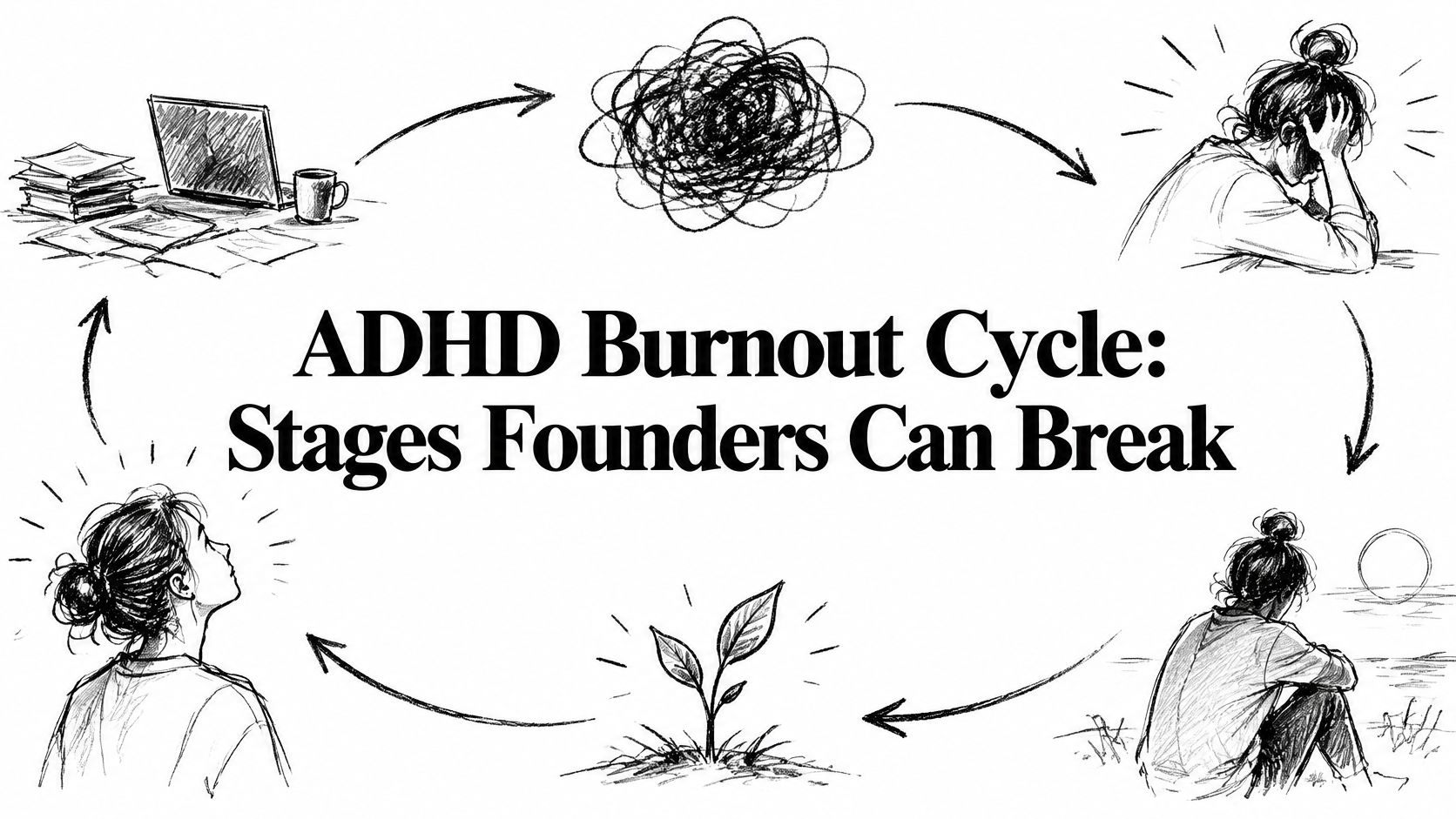
ADHD Burnout Cycle: Stages Founders Can Break
See the ADHD burnout cycle in five stages, separate it from depression, and test founder fixes before the next crash.