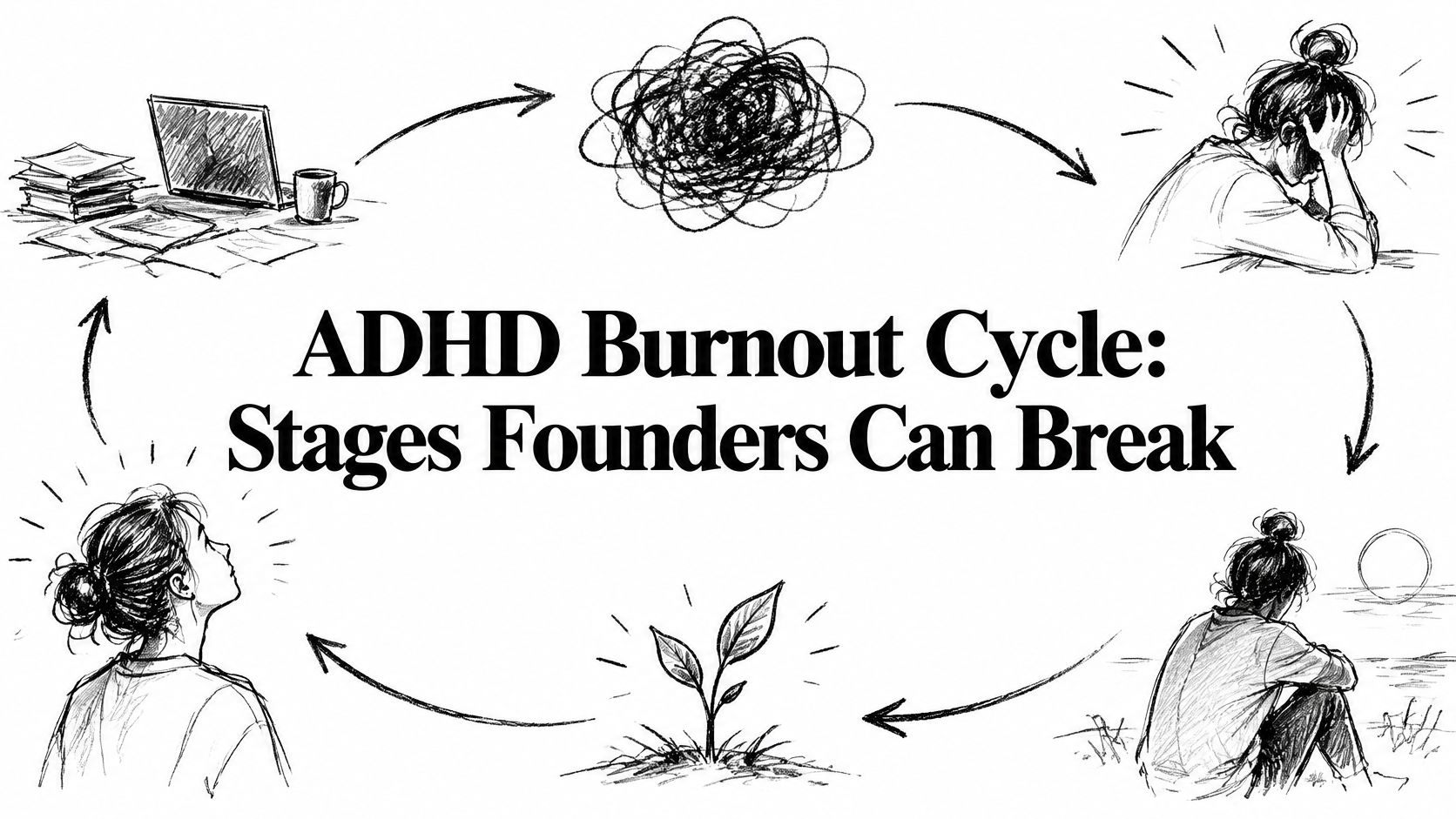
ADHD Burnout Cycle: Stages Founders Can Break
See the ADHD burnout cycle in five stages, separate it from depression, and test founder fixes before the next crash.
Jan Kutschera
You sent the investor update at 2 a.m., answered every comment before sunrise, and felt briefly like the business had a pilot again. Then you couldn’t open email for two days. You’re not looking at laziness, and you’re not looking at proof that one heroic night fixed anything. You’re looking at the ADHD burnout cycle in founder clothing, and it gets breakable only when you can name where you are inside it before the next heroic night writes your schedule for you.
Table of Contents
- Why the ADHD Burnout Cycle Hits Founders
- Five Stages You Can Mark This Week
- How Sleep Keeps the Loop Spinning
- Burnout Versus Lookalike Crashes
- When the Company Design Is the Trigger
- Four One-Week Tests That Break the Loop
Why the ADHD Burnout Cycle Hits Founders
A founder rebuilds an investor deck late at night, sends the update at 2 a.m., and wakes up wired, pleased that the work is done. By Thursday, the inbox feels like a wall. Messages pile up, small decisions become sticky, and shame starts filling the gaps.
The ADHD burnout cycle is a recurring interaction between executive-function demands, work stress, and exhaustion. It is not a formal standalone medical diagnosis. The practical question is how a founder’s capacity to organize, remember, estimate time, and start tasks interacts with the demands of running a company. When the role keeps adding work faster than the company can redistribute it, personal coping habits alone may not stop the loop.
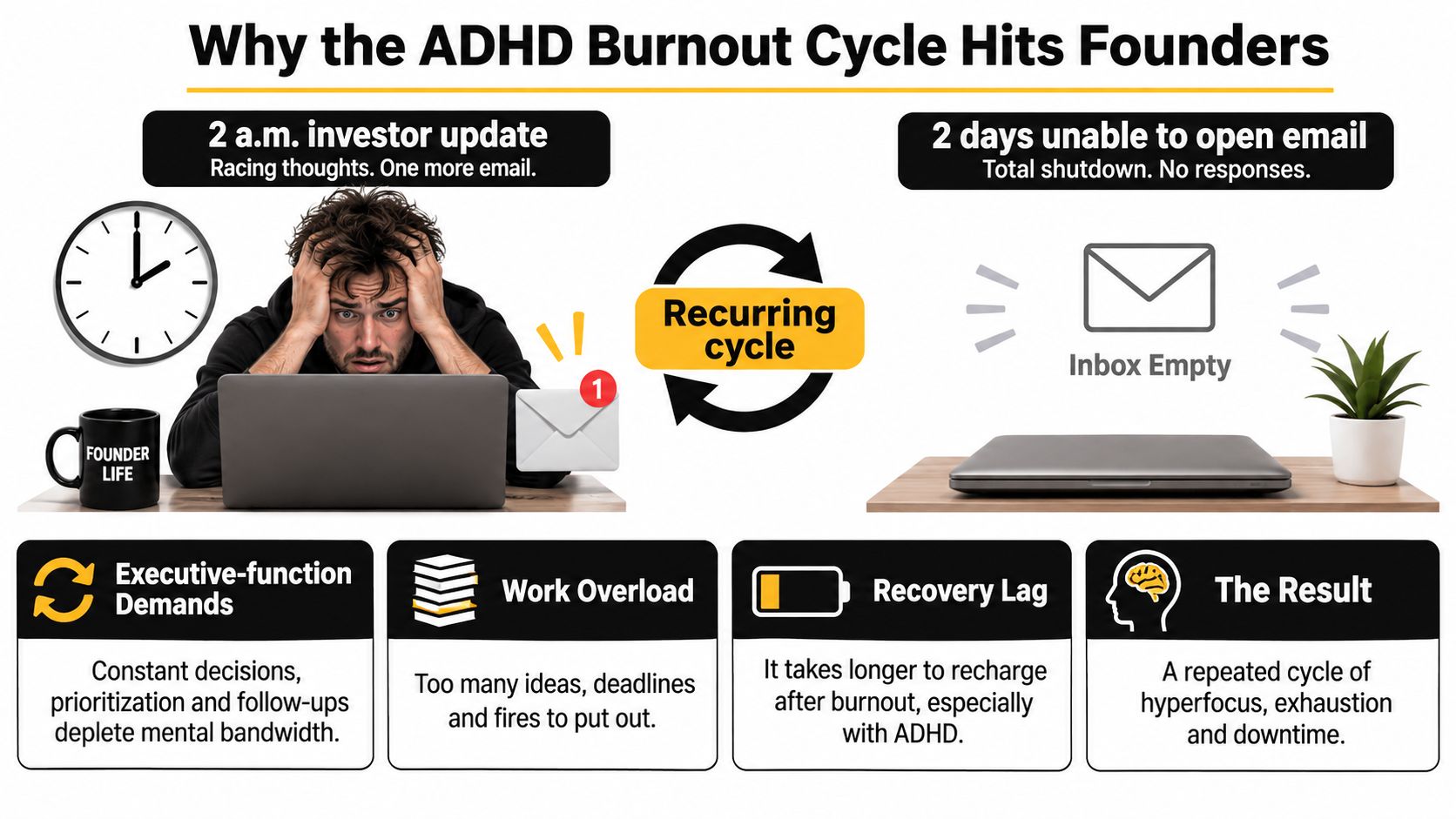
The scale behind that 2 a.m. story
Adult ADHD is not a founder-only experience. The Medscape overview of adult ADHD reports that a 2021 systematic review estimated persistent adult ADHD at 2.6% worldwide, referring to current symptoms with documented childhood onset, while symptomatic adult ADHD was estimated at 6.8%. Many diagnosed adults report career setbacks and difficulties with occupational functioning.
These figures do not establish whether any one founder meets diagnostic criteria. They do show why someone can perform impressively under pressure while struggling to sustain that performance. A company may prize the late-night rescue and overlook the recovery it consumes.
Crisis output is not the same as capacity
A deadline can sharpen attention, make priorities feel obvious, and move a backlog that had been stuck. The team sees the rescue. The quieter cost is the recovery lag afterward: ordinary tasks become harder to start, and new work keeps arriving while the founder is depleted.
Operating system rule: ADHD is not a superpower and not a curse. It is a different operating system that crashes if it is not maintained.
Maintenance is a useful way to frame the problem. An operating system has limits, needs upkeep, and cannot run every process at once. If a company depends on one founder to hold every decision, reminder, and follow-up in memory, the role can keep loading the system even when the founder is trying to work differently.
- What the hero moment hides: the recovery lag after the push, when ordinary starting gets harder.
- What the team may misread: crisis speed as evidence of baseline availability.
- What the founder may misread: relief after surviving the deadline as proof that the system works.
A new pledge to be more disciplined does not change the company’s operating design. Notice which demands repeatedly arrive at the founder and which tasks become difficult after a high-pressure push. That distinction helps identify whether the loop is being sustained by the role itself, not only by individual habits.
Five Stages You Can Mark This Week
A launch can turn a founder’s calendar into a row of urgent decisions. Marking the stages helps show how a temporary demand spike can become a repeating cycle, especially when the company depends on the founder to catch every falling task. Use the table as a calendar audit, not a personality test. Each row pairs a signal with a founder tell and a control point to try.
| Stage | Signal | Founder tell | Control point |
|---|---|---|---|
| Demand spike | Launch, investor, or client load jumps | Calendar fills with founder-only decisions | Name the demand before adding tasks |
| Executive slip | Estimating, sequencing, or starting fails | Late starts and a growing backlog | Set a WIP limit and make one next action visible |
| Crisis hyperfocus | Deadline arousal clears the queue | An all-nighter feels like the real system | Do not count the burst as true capacity |
| Crash | Fatigue, emotional exhaustion, cognitive weariness | Cannot start after the heroic push | Buffer the next day instead of adding hours |
| Avoidance restart | Depleted capacity delays the next task | Shame, then a new fire rebuilds pressure | Use a handoff checklist before the next spike |
Stage one and two: where pressure quietly loads
A demand spike might be a launch, an investor note, or a client fire. The demand itself is part of running a company. Trouble starts when each new request lands on the founder’s plate without a clear decision about what it replaces. A calendar full of founder-only choices makes the company design part of the loop, not just the founder’s habits.
The executive slip follows when estimating, sequencing, or starting becomes unreliable. The 2024 study in AIMS Public Health found that executive dysfunction mediated the link from ADHD to burnout with an indirect effect of b = 0.83 (SE = 0.16; 95% CI 0.55 to 1.16). Its strongest pathways were time self-management and self-organization and problem-solving. In practical terms, a weak estimate can leave too little time for the work, while unclear sequencing makes the backlog harder to start. Together, those gaps turn ordinary tasks into deadline pressure.
Stage three and four: where the rescue charges interest
Then comes crisis hyperfocus. Arousal rises, the queue clears, and the founder hears, “You work so well under pressure.” The compliment sees the output, not the cost. Physical fatigue, emotional exhaustion, and cognitive weariness can follow the push.
In that same study, employees with ADHD had a mean burnout score of 5.05 (SD 1.05) versus 3.76 (SD 1.17) among controls, with a large group effect of Cohen’s d = 1.13. The crash is part of the cycle: sustained compensation drains capacity, and reduced capacity makes the next delay more likely.
To track the pattern without turning journaling into another project, use a four-part structure for journal entries. Keep it to four short lines: stage, signal, cost, control. The aim is to notice what happens between the push and the next stalled task.
Stage five: the control point that matters
Avoidance restart is the stalled Monday. The task now carries shame, pressure builds, and a fresh emergency supplies the ignition the founder recognizes. When every launch or client fire still routes through one person, the company can keep recreating that pressure.
Building on the study’s finding that time self-management and self-organization matter, these practical controls help make time and sequencing visible before the high-arousal phase:
- Fixed work-in-progress limit: keep one active build instead of five open loops wearing task costumes.
- Visible next action: write the literal next move where you will see it later.
- Capacity buffer: leave room after a push rather than filling the next day immediately.
- Explicit handoff checklist: define the owner, deadline, and meaning of done outside your head.
These are operating controls, not clinical assessment or treatment. Put them in place while the calendar is calm enough to follow them.
How Sleep Keeps the Loop Spinning
Sleep is the fuel gauge founders love to argue with. You can read the exhaustion scene below without any theory at all.
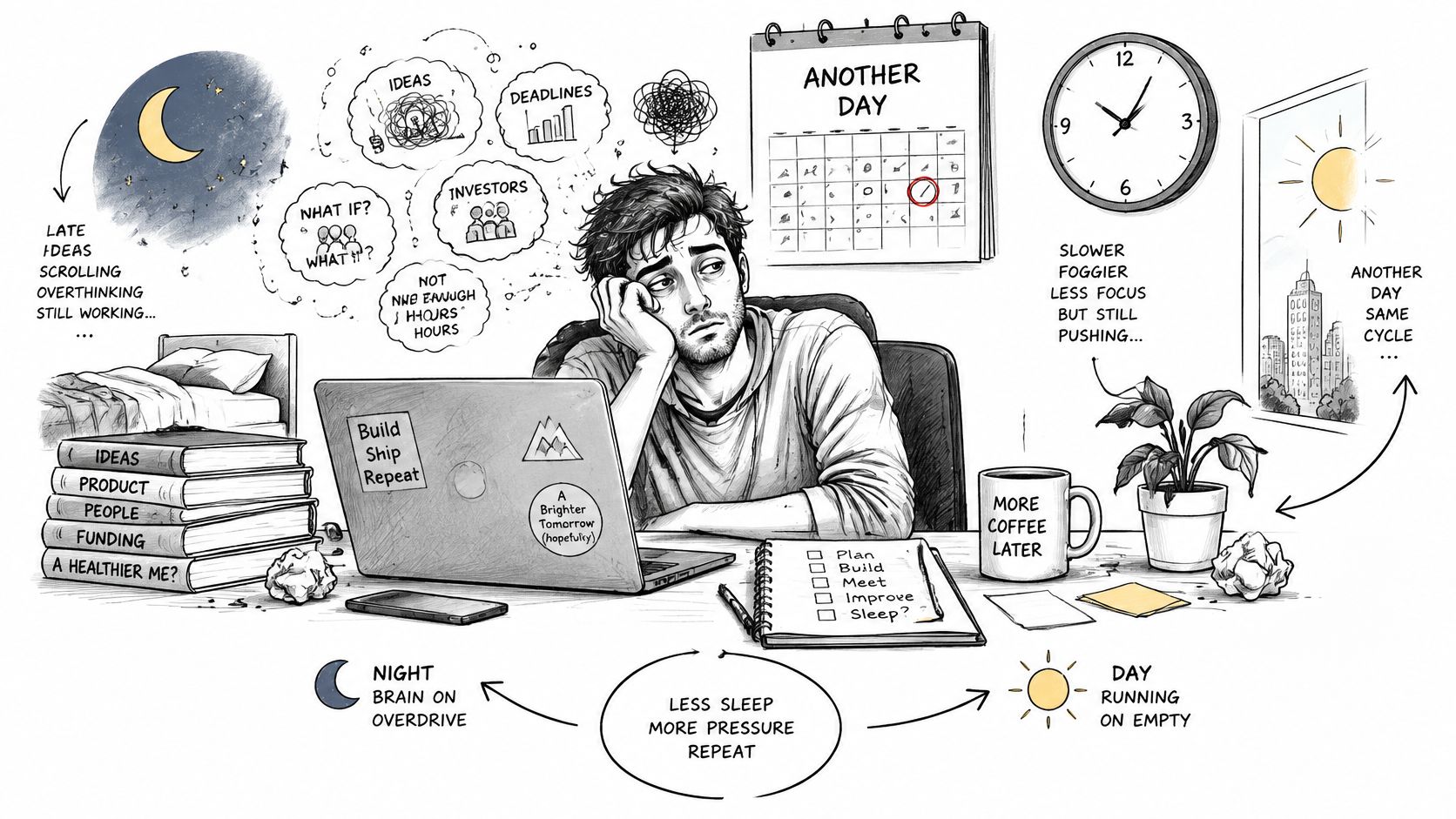
Think of a drained battery that gets jump-started with caffeine and a deadline every morning. It turns over, so you call the battery fine. Then you blame yourself when it won’t hold charge during the board call. The metaphor is tidy, but the mechanism underneath it is what lets you change the calendar.
Why a 9 a.m. brain and a 9 p.m. brain may not match
A systematic review in Brain Sciences reported that increased homeostatic sleep pressure degrades attention, cognitive speed, and memory while increasing wake-state instability. It also reported that circadian rhythms affect attention, working memory, and executive functions in people with ADHD. Adults with ADHD and an evening chronotype can show larger morning-to-evening differences in sustained attention than comparison groups.
That means a 9 a.m. board call and a 9 p.m. build session are not automatically the same brain doing the same job. Time of day and sleep alignment can materially affect performance, which is inconvenient for founders who schedule by tradition and panic.
The loop in order
Short or mistimed sleep lowers the cognitive resources you need for planning and inhibition. Once those dip, urgent stimulation starts to feel useful, maybe even necessary. Late-night work, extra caffeine, or deadline pressure gives you ignition today while stealing tomorrow night’s recovery.
That trade also explains the familiar protest. But I only get going late. Sometimes that’s chronotype, sometimes it’s accumulated pressure, and sometimes it’s both wearing the same hoodie. If your nights keep filling up because your brain won’t stand down, the pattern covered in this guide to revenge bedtime procrastination with ADHD is worth separating from simple preference, especially when your ADHD mind won’t settle long after the laptop closes.
Watch the short walkthrough below, then compare it with your own best alertness window instead of copying someone else’s wake-up theatre.
Three operating responses only
- Schedule high-consequence decisions in your best window: use your empirically strongest alertness period for pricing, hiring, and conflict, not inbox triage
- Protect a consistent sleep opportunity: guard the window like a payroll run, because it’s upstream of every executive function you rent the next day
- Add a workload buffer after poor sleep: cut the day’s commitments instead of buying output back with escalating hours
Bring in a qualified clinician when insomnia, delayed sleep timing, sleep apnea symptoms, or medication-related sleep disruption are part of the picture. This is not a supplement list or a full recovery program. It’s a scheduling correction that stops you from mistaking a sleep-driven fog for a character verdict.
Burnout Versus Lookalike Crashes
Stop treating every crash as one blob called burnout. The right response changes completely depending on which lane you’re in, and founders waste months applying productivity tactics to clinical, sleep, or medication problems.
| Domain | Looks like | Points toward | Next check |
|---|---|---|---|
| Task start and time | Cannot begin or estimate duration | ADHD execution loop | External sequence for 7 days |
| Exhaustion and cynicism | Drained and detached about the work | Occupational burnout | See if leave or a lower load restores function |
| Low mood off the clock | Little pleasure at work and at home | Depression screen | Clinician if it persists or worsens |
| Alertness by time of day | Sharp at night, unusable in the morning | Sleep or circadian mismatch | Consistent sleep window, clinician if insomnia |
| Crash tied to dose clock | Daily slump tracks medication timing | Rebound or side effect | Prescriber review, not a new habit stack |
| Every setting impaired | Home, rest, and work all degrade | Not only a job crunch | Clinical assessment before more self-tests |
How to read the table without diagnosing yourself
Task-initiation failure and time blindness point toward the execution loop. You know what matters; you may even care a lot, but starting and estimating keep breaking. That’s where external sequencing belongs.
Emotional exhaustion and cynicism look more like occupational burnout. The key check is whether real load reduction restores function. If a lighter week gives you back some traction, workload is doing real work in the story.
Little pleasure on and off the clock is a different flag. When low mood follows you into rest, relationships, and weekends, you’re no longer sorting a calendar problem. The same goes for impairment in every setting, which deserves clinical assessment rather than another app trial.
What formal care actually includes
The CDC guidance on ADHD in adults notes that adult ADHD management may involve medication, therapy, behavioral treatment, or combinations depending on the person and environment. The American Psychiatric Association similarly emphasizes structure, organization, time management, distraction reduction, medication, and psychotherapy, while noting that workplace accommodations may be appropriate. NAMI’s workplace guide says accommodations have limited direct evidence for effectiveness, so you should test and track them rather than treating one hack as universal.
Not every productivity crash is simply a dopamine problem, and that shortcut can keep you from checking sleep, mood, medication timing, or workload at all.
Run a two-week log with stop lines
For two weeks, record six things daily. Log sleep, workload, medication timing, task demands, mood, and recovery time. You’re looking for patterns a clinician can use, not collecting data for a better shame report.
Your stop lines are firm. Thoughts of self-harm, days of being unable to function, or getting worse despite rest mean you stop self-experimenting and contact a qualified clinician or urgent support. A founder dashboard is useful only when it knows when to get out of the way.
When the Company Design Is the Trigger
A founder can move from generating ideas to running daily delivery without changing the habits that once helped the business get started. If the burnout loop keeps returning, the mismatch may sit in the company’s design as much as in the founder’s routines.
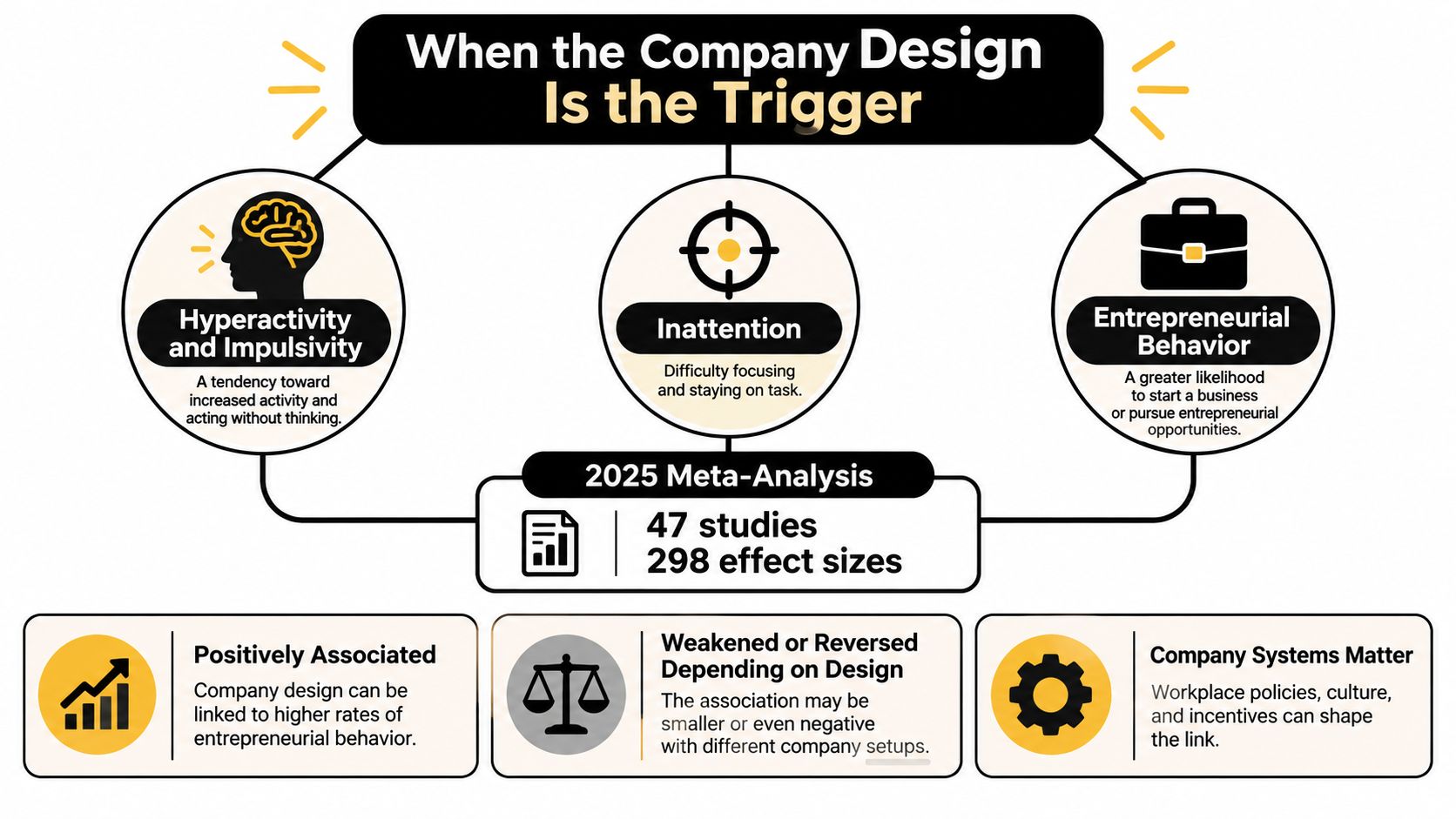
A Wharton Magazine article on investing in the founder’s brain describes a 2025 meta-analysis covering 47 empirical studies and 298 effect sizes. It found that hyperactivity and impulsivity were positively associated with entrepreneurial behavior, while inattention was negatively associated with post-launch outcomes. The shift is practical: traits that help a founder pursue a risky idea may become friction when the business depends on reliable delivery, delegation, and repeatable decisions.
Four roles, four different cognitive bills
As a creator, you generate ideas and tolerate risk. Novelty can keep the work moving, while unfinished tasks may still feel manageable.
As an operator, deadlines, delivery, and follow-through take priority. Missed estimates now affect the work others are counting on.
As a manager, people and handoffs move to the center. An unclear handoff can turn an attention gap into a delay for the whole team.
As an executive, decision rights and cadence matter. If every meaningful decision waits for your best brain at its best hour, the company is built around a state you cannot always sustain.
- Creator mismatch: too many open ideas and escalating context switching
- Operator mismatch: delivery moves only when you personally rescue it
- Manager mismatch: founder-only approvals and unclear handoffs
- Executive mismatch: performance holds only after a good night’s sleep
Stressors that would strain any executive system
Founders carry concentrated financial risk, identity tied to the company, long working hours, uncertainty, and chronic sleep disruption. These pressures can strain executive functioning regardless of diagnosis. When the strain comes from the way work is organized, another morning routine may not address the cause.
For ADHD founders, sustainable business operations means treating decision rights, delegation, and communication architecture as load-bearing parts of the company. They shape how much depends on one person, and whether work can continue when that person is not available.
The sorting test
If output collapses mainly when you become the bottleneck, redesign decision rights and communication before adding another personal routine. Name owners, write the handoff, and let a task ship without you in the thread.
If impairment also appears at home, during leave, and at work, treat it as a capacity and clinical question. The two-week log from the previous section helps you track that distinction. The aim is to identify whether the recurring failure sits in the company’s structure, the founder’s capacity, or both.
Four One-Week Tests That Break the Loop
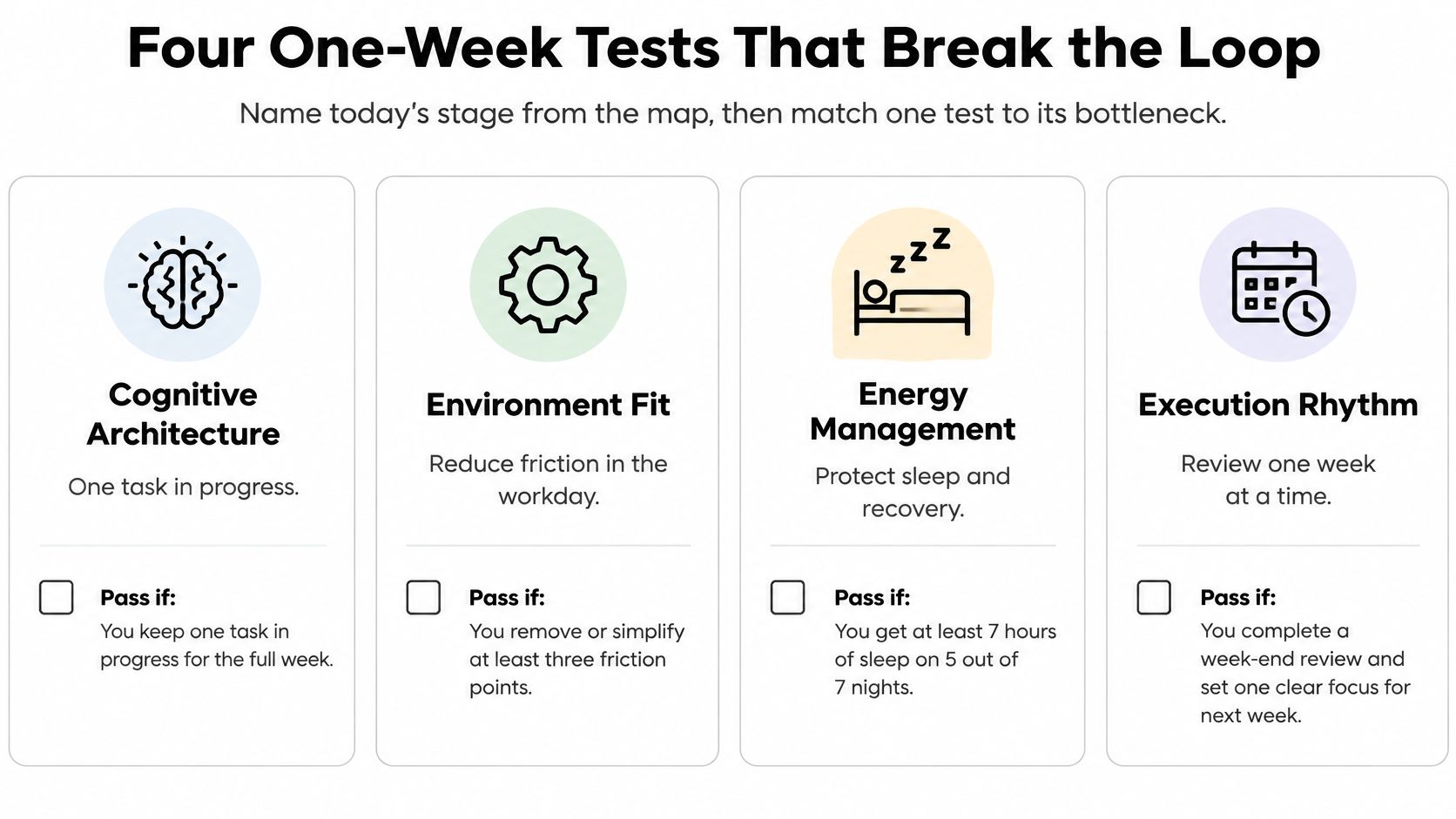
A launch can reward speed, improvisation, and last-minute focus. Later, an operator role rewards steady handoffs and repeatable decisions. If the company still depends on launch-mode habits, the founder can end up carrying every deadline and approval. Choose one test that changes the system around the bottleneck, rather than trying to rebuild your whole routine at once.
The Method has four pillars: Cognitive Architecture, Dopamine Engineering, Strategic Delegation, and Bio-Optimization. Each test below turns one pillar into a practical experiment, with a pass line you can assess after seven days.
| Pillar | Use when the bottleneck is | One-week test | Pass line |
|---|---|---|---|
| Cognitive Architecture | Late starts and missed time estimates | Keep one task in progress and a three-item next-action list | Missed starts fall versus the prior week |
| Dopamine Engineering | Crisis-seeking urges drive late nights | Give yourself a same-day reward for starting the hard task, not for an all-nighter | Crisis-seeking urges fall on a simple daily tally |
| Strategic Delegation | Founder-only approvals block delivery | Move one approval to a named owner with a written handoff checklist | The task ships without the founder in the thread |
| Bio-Optimization | You are sharp only at night and unusable in the morning | Protect a sleep window and schedule the hardest decision during your best alertness window on five weekdays | Work quality holds without extra hours |
How each test works in practice
Cognitive Architecture puts the sequence outside your head. Keep one task in progress and write a three-item next-action list in Notion, Todoist, or on paper. The tool is secondary. The useful change is that you no longer have to reconstruct the plan from memory each time you return to it.
Dopamine Engineering changes what earns a reward. Tie a same-day reward to starting the hard task, not to pushing through an all-nighter. A walk, a good coffee, or closing the laptop on time can reinforce the start. Keep the reward connected to the action you want to repeat.
Strategic Delegation changes who can move work forward. Choose one founder-only approval, name its new owner, and write a checklist for the handoff. For example, an agency owner who keeps rescuing Friday client fires can name an account lead, define what a good final send looks like, and let that person ship it without the founder in the thread. The test is whether the work can move without a rescue.
Bio-Optimization treats energy as part of the operating system. Protect a sleep window and put the hardest decision in your best alertness window on five weekdays. If your routine only works when you happen to be rested, use this guide to build ADHD routines that survive real weeks and make the rhythm predictable. For a wider founder view of pacing and workload design, read founder burnout advice from Chicago Brandstarters after choosing your single test.
Run it like an experiment, not a makeover
- Pick one test: Match it to the bottleneck you marked this week.
- Log beside it: Keep your two-week log of sleep, load, and recovery running.
- Check the pass line on day seven: Keep, adjust, or drop the test based on what happened.
- Pause at a stop line: Worsening mood, inability to function, or self-harm thoughts mean the experiment should stop.
A useful reframe: You are not bribing yourself into discipline. You are checking whether a small design change lowers the executive effort required, so crisis fuel becomes less necessary.
Jan Kutschera was diagnosed with ADHD at 51, which helped him understand why the systems he had built by instinct worked. He has been building ADHD-compatible systems for 30 years. His approach treats ADHD as a different operating system that needs maintenance, not as a superpower or a curse. The four pillars offer a way to replace scattered fixes with structures for attention, motivation, handoffs, and energy.
Free resources include the Dopamine ROI Calculator, Wall of Awful, Survival Kit, Morning Blueprint, Weekly Build Filter, Execution Audit, quizzes, and free webinars. Revenue Reset is self-paced educational business and productivity material, not medical advice, diagnosis, or treatment. The tests here are operating experiments, not a diagnostic tool or a substitute for clinical care.
Run one test for seven days, or seek clinical care if the crash is not limited to this cycle.
If your week keeps swinging between rescue mode and shutdown, Jan Kutschera helps ADHD founders build operating systems around Cognitive Architecture, Dopamine Engineering, Strategic Delegation, and Bio-Optimization. Start with a free resource and test one change against a clear pass line. When you are ready to organize those changes into a system, visit Jan Kutschera.
Jan Kutschera
German founder, diagnosed with ADHD at 51. Built 4 agencies, now building systems for neurodivergent entrepreneurs. German engineering for the ADHD brain.
Connect on LinkedInRelated Articles

Conquer Lack of Motivation ADHD: Systems for Founders
Dealing with a lack of motivation adhd? For founders, it's not a weakness. Engineer systems that bypass willpower and drive sustainable results.
10 Creative Problem Solving Techniques for ADHD Founders
Explore 10 creative problem solving techniques for ADHD founders, from Design Thinking to Pre-mortems, with steps, templates, and when to use each.
Work with Other People Without Burning Out
Work with other people using a written charter for handoffs, meetings, and owners so ADHD founders are not the only memory.