Coach Agenda Planner for ADHD Founders
Design a coach agenda planner that fits how ADHD founders actually work. Includes templates, timing scripts, delegation prompts, and follow-up loops.
Jan Kutschera
It’s 3am, your sprint board is on fire, and tomorrow’s coaching session is a pristine coach agenda planner page you already know you’ll ignore. You didn’t miss last week’s actions because you didn’t care. You missed them because the plan assumed a brain that wakes up with the same battery every day.
Table of Contents
- Why Generic Coach Agenda Planners Break ADHD Founders
- Designing the If-Then Agenda Engine
- Tracking Agenda Drift Without Killing the Conversation
- Three Agenda Modes for Variable Cognitive Load
- Mapping the Founder Brain Onto the Agenda
- Closing the Loop Between Sessions
- Coach Agenda Planner Questions Founders Actually Ask
Why Generic Coach Agenda Planners Break ADHD Founders
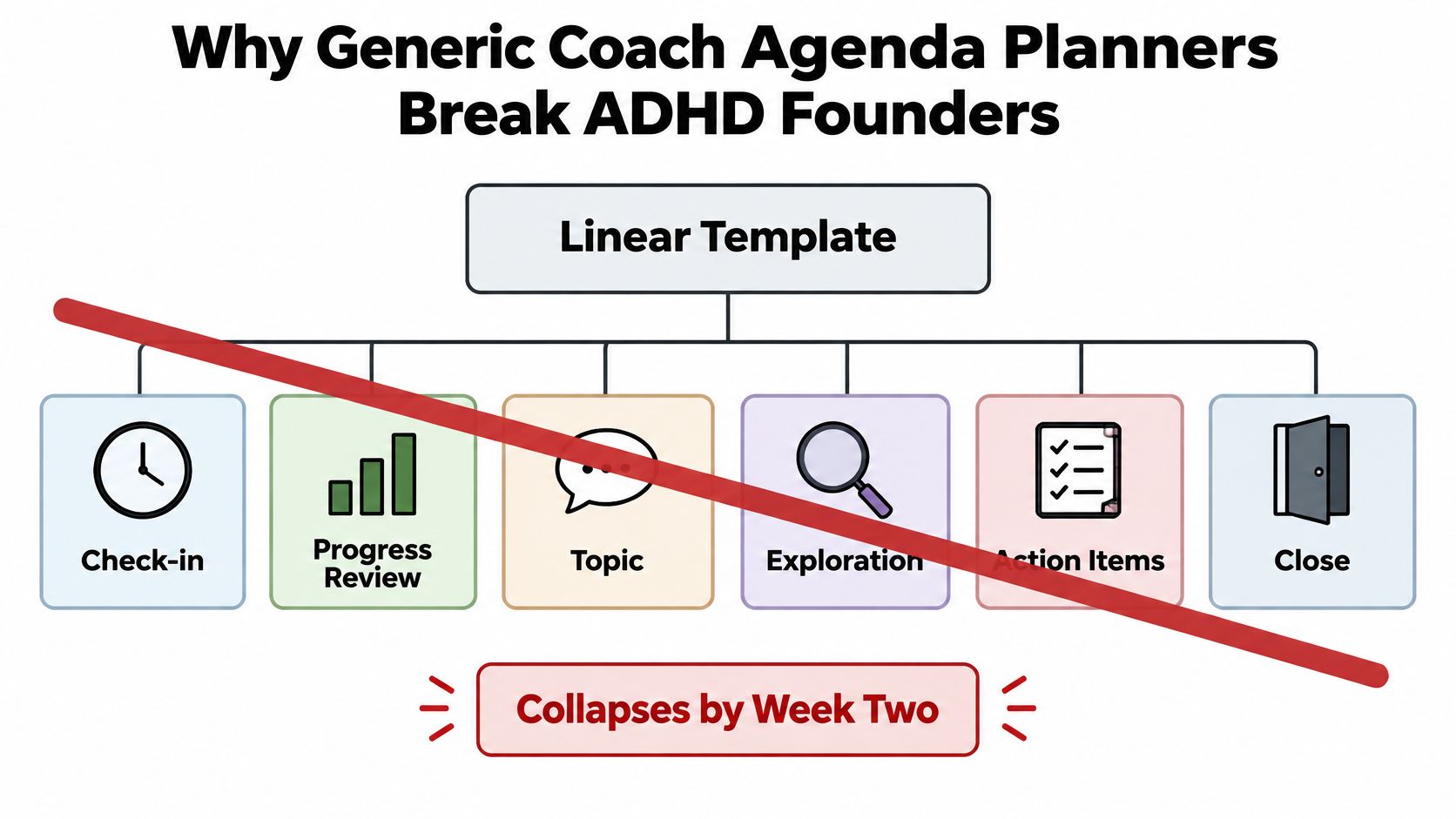
Monday, 8:47am. The planner says check-in, progress review, topic, exploration, action items, close. The founder walks in after four hours of sleep, a churned client in Slack, and three ideas he generated in the shower. By minute ten, the linear template is fiction. By Tuesday, it’s abandoned. By week two, he’s apologizing for the planner instead of using it.
That sequence isn’t a discipline problem. It’s a design mismatch, and it’s playing out at scale. The ICF’s 2023 Global Coaching Study, with 14,591 valid responses across 157 countries, estimated 109,200 coach practitioners in 2022, a 54% increase from 2019, generating $4.564 billion in annual revenue. More coaches means more templates, and most templates were built for clients with steadier executive function.
The Four Flaws That Kill It
- It assumes consistent energy: The same 60-minute structure on a sharp day and a crashed day, so the crashed day produces guilt instead of a smaller, usable session.
- It doesn’t track drift: When the conversation pivots from pricing to cofounder conflict, the planner records nothing, so nobody learns why pivots happen.
- It can’t switch modes: There’s no low-capacity version, so missing one field feels like failing the whole system.
- It isn’t shame-proofed: A missed session creates a backlog review so painful that founders avoid reopening the planner at all.
Design brief: Build for variable capacity, visible drift, and a clean restart after a miss, or don’t bother building at all.
A better system starts by picking the right human support, and that choice matters as much as the page layout, which is why finding a coach who understands ADHD founder wiring comes before template shopping. What follows is the build: an if-then engine, drift tracking, three load modes, a four-pillar session map, and a closed loop between sessions.
Designing the If-Then Agenda Engine
Stop writing topics. Start writing contracts. “Discuss Q3 priorities” is a wish. It gives your brain nothing to grab at 9am on a low-motivation Monday. An implementation intention gives it a trigger, an action, and a finish line.
Here’s the format in action: “If the Monday planning block begins at 09:00, then the founder selects three quarterly priorities, assigns one owner to each, and records the next physical action.” The situation is recognizable, the behavior is executable, and nobody has to rely on working memory to figure out what “discuss priorities” meant.
Why This Survives a Bad Week
The evidence for this isn’t thin. A meta-analysis of 94 independent tests found a medium-to-large effect on goal attainment (d = 0.65) for implementation intentions, and a later synthesis across 642 tests linked contingent formatting, strong goal commitment, and rehearsal to larger effects. Rehearsal matters for ADHD founders in particular. Read the if-then out loud at the close of the session. It takes twenty seconds and it moves the rule out of the notebook and into recognition.

The Seven Field Template Card
Copy this into Notion, a paper notebook, or whatever you’ll open:
- Objective: The one outcome this item exists to produce, written as a result, not an activity.
- Trigger and time: The specific cue, such as a calendar block, a standup ending, or a location.
- Next action: The first physical step, small enough to start without negotiating with yourself.
- Owner: One name. If it’s everyone’s job, it’s nobody’s job.
- Expected duration: A honest estimate so overload shows up on paper before it shows up as panic.
- Obstacle rule: “If X interrupts, then I do Y,” written in advance, not improvised mid-crisis.
- Review metric: The evidence you’ll check next session to know whether it happened.
This same discipline applies when a client relationship starts, not just when a session runs. Coaches setting up new engagements can borrow the structure behind welcome steps for new clients and turn each onboarding step into an if-then with an owner, instead of a friendly checklist nobody revisits.
Keep the daily version brutally short. A small number of high-value commitments, every decision externalized on the page, and a fallback action for interruptions. If the card can’t be filled in during the session, it’s too complicated to survive the week.
Tracking Agenda Drift Without Killing the Conversation
“Stay on agenda” is the worst advice you can give an ADHD founder. His best insight of the quarter will arrive sideways, mid-sentence, while he’s supposed to be talking about hiring. Kill the pivot and you kill the value. Ignore the pivot and you can’t tell a breakthrough from avoidance.
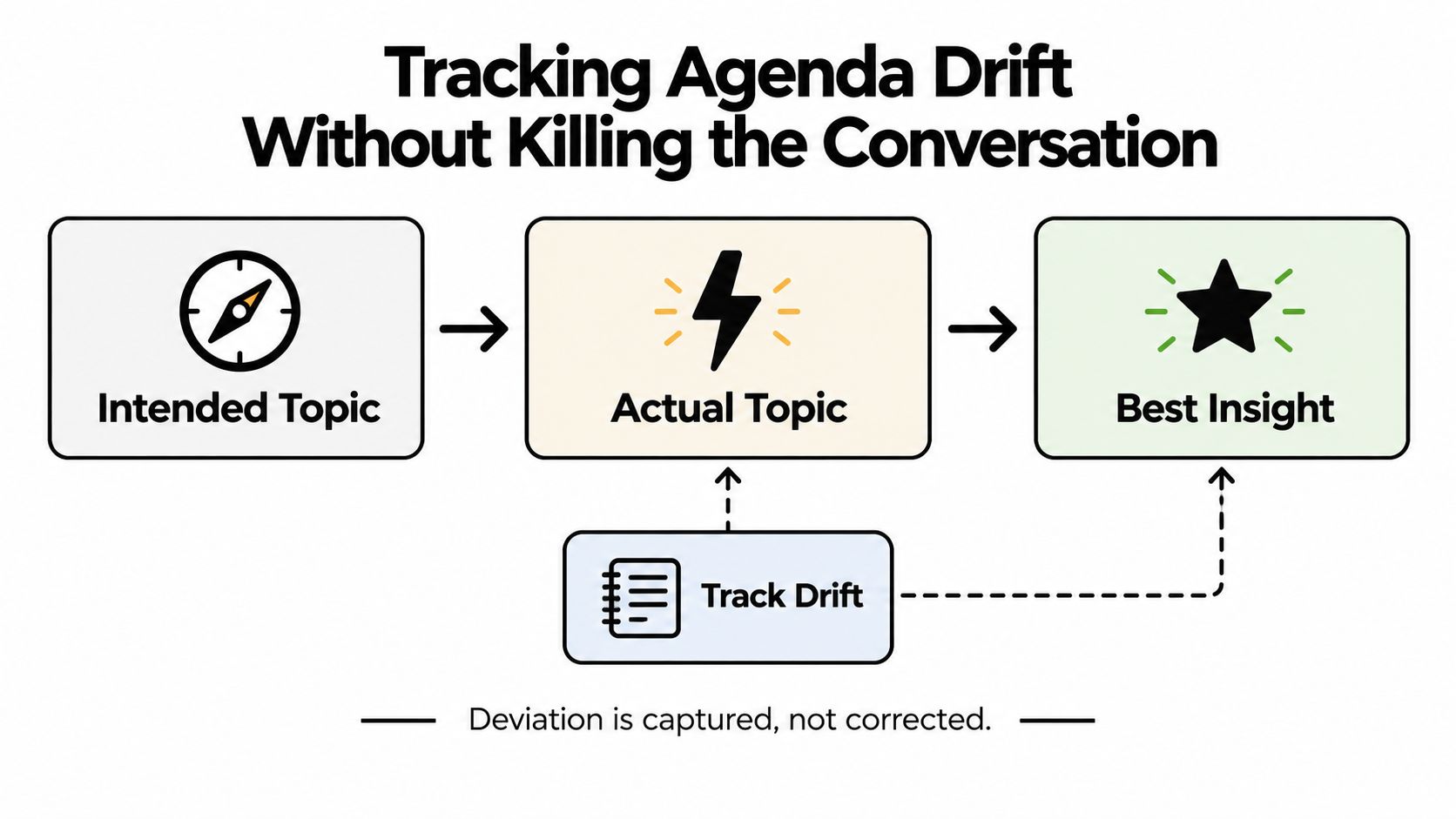
The fix isn’t rigidity. It’s visibility. A 2025 study on coaching conversations explicitly distinguishes the client’s intended agenda from the topic actually discussed, and earlier research on five business-coaching first sessions identified 117 agenda-setting instances across seven distinct actions, including suggesting action and negotiating future coaching actions. Intended and actual diverge constantly. Your planner should record that divergence instead of pretending it didn’t happen.
Four Fields That Make Drift Useful
- Intended outcome: What the founder said he wanted from this block before talking started.
- Topics covered: A short, honest list, written after the fact if needed.
- Reason for any pivot: New information, emotional charge, a crisis, or a shiny object. Name it plainly.
- Decision created by the pivot: What got decided, owned, or scheduled because the conversation moved.
Capturing this live without derailing the founder is the hard part. Take sparse notes during the session and fill the four fields in the five minutes after. Tools help here, and a one-page AI notetaker for teams gives you a clean record to mine for actual topics, so the coach isn’t splitting attention between listening and transcribing.
Reading the Pattern
Never judge a single deviation. Review four to six sessions of drift logs together and ask one question: How do I know whether abandoning the planned topic was insightfully adaptive or avoidance and distraction? Productive emergence tends to produce a decision, a named owner, or relief around a real bottleneck. Derailment tends to produce energy, novelty, and nothing scheduled. If the same topic gets abandoned three sessions running, that’s not emergence. That’s a flare marking the exact thing the next agenda should open with, while the founder is fresh.
Three Agenda Modes for Variable Cognitive Load
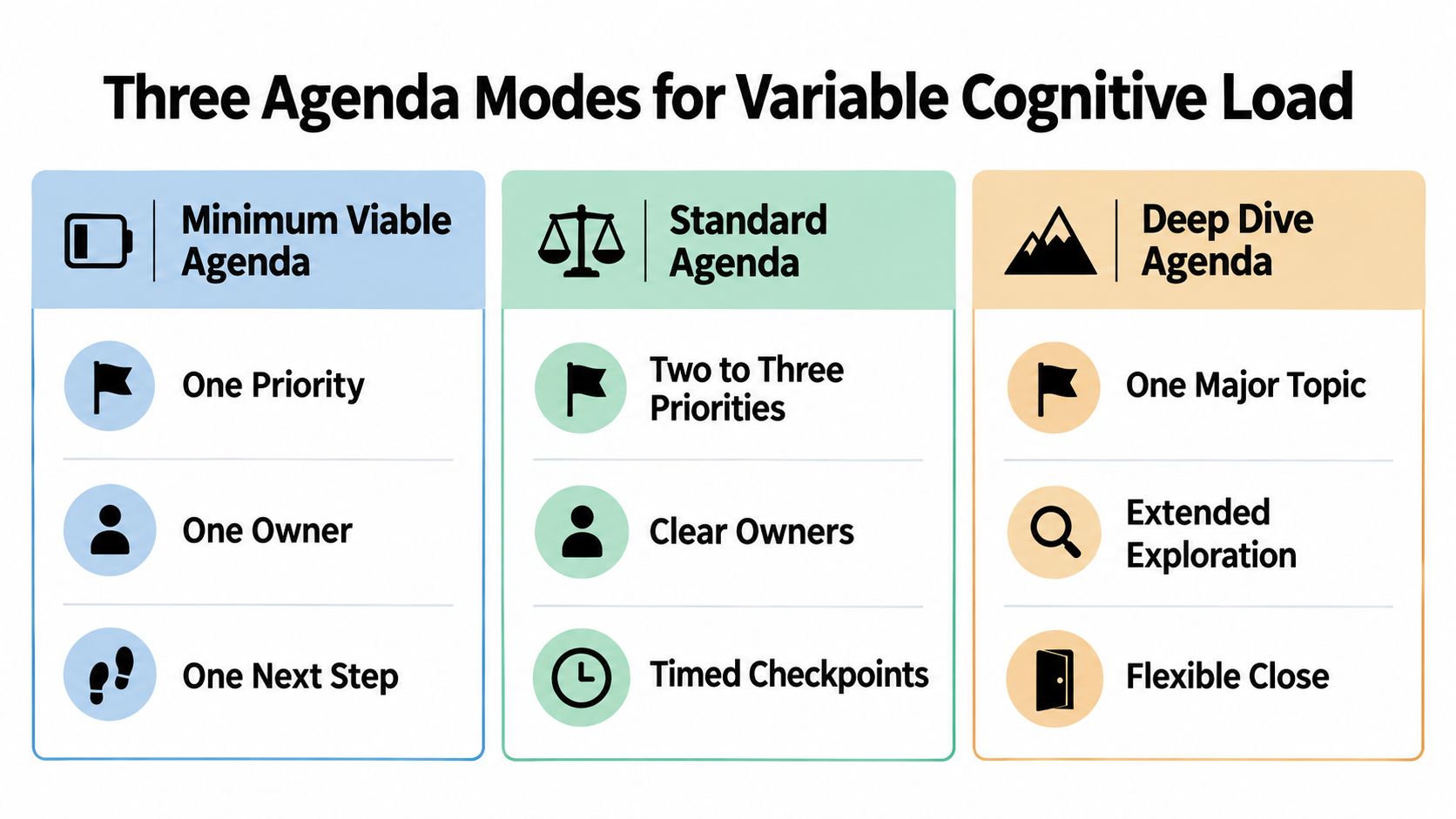
You don’t have one brain state. You have at least three, and pretending otherwise is how planners die. Before each session, spend thirty seconds picking a mode based on sleep, load, and honest capacity. The mode decides the agenda length, not your ambition.
Mode One Minimum Viable Agenda
For the crashed day. One priority, one owner, one next action, done in about fifteen minutes. The script is three questions: what’s the one thing that protects the business this week, who owns it, and what’s the first physical step. Everything else goes into a parking lot list that nobody reviews today. This mode answers the question founders face at 3am: What is the smallest agenda that still protects strategic priorities when attention, sleep, or motivation deteriorates? One protected priority beats a full template completed in resentment and forgotten by Friday.
Mode Two Standard Agenda
For a stable day, roughly forty-five minutes. Five minutes reviewing last session’s if-thens, twenty minutes on two or three priorities with owners, ten minutes clearing the delegation queue, and ten minutes writing new if-thens and rehearsing them. Timed checkpoints keep one fascinating topic from eating the session.
Mode Three High Energy Capture
For the day the founder arrives buzzing with six ideas and wants to commit to all of them. This mode is a capture-and-prioritize session, not a commitment session. Every idea gets written down, scored against current priorities, and parked for a forty-eight hour cooling period before it can become an operational promise to the team. Energy gets honored. The roadmap doesn’t get hijacked.
A missed session is data about load, not a verdict on character. Restart small, restart clean.
The Reset Protocol After a Miss
When a session or action gets skipped, run this before anything else. First, declare the backlog dead in writing, so stale items stop generating shame. Second, pick the minimum viable mode for the next session regardless of how you feel. Third, carry forward at most one old item, rewritten as a fresh if-then. Fourth, spend zero minutes explaining the miss beyond one sentence about what overloaded the system. Shame makes founders avoid the planner, and avoidance is what collapses the system.
Mapping the Founder Brain Onto the Agenda
A session that only chases the loudest fire leaves the founder’s actual operating system untouched. Jan Kutschera’s method works from four pillars, and each pillar earns a fixed slot in the standard agenda, so the session checks the whole machine instead of debugging whatever screamed last.
Where Each Pillar Lives
Cognitive Architecture is the external structure slot. Decisions get written down, triggers get set, and open loops get captured into a single trusted place. If it lives only in the founder’s head, it doesn’t exist, and this slot is where that rule gets enforced every week.
Dopamine Engineering is the reward slot, and skipping it is why founders drift back to adrenaline as fuel. Open by naming one completed action from last week, however small, and close by defining the completion signal for the next one. Novelty belongs here too, as a planned input rather than a midweek ambush on the roadmap.
Strategic Delegation gets the owner-and-handoff slot. The question is blunt: what’s leaving the founder’s plate this week, who accepts it, and by when. This is also where the genius zone gets protected, since every handoff reviewed here buys back hours for work only the founder can do.
Bio-Optimization treats the body as a business input. Sleep, movement, and nutrition get two minutes of honest reporting, not as wellness theater but because a wrecked week of sleep changes which agenda mode is realistic. The planner that ignores this data is planning for a person who doesn’t exist.
| Pillar | Agenda Slot | Typical Minutes | Starter Prompt |
|---|---|---|---|
| Cognitive Architecture | Externalize and trigger | 10 | What is still living only in your head? |
| Dopamine Engineering | Win review and reward design | 5 | What got finished, and what made it finishable? |
| Strategic Delegation | Owner and handoff queue | 10 | What leaves your plate this week, and who accepts it? |
| Bio-Optimization | Body as strategy check | 5 | What did sleep and movement actually look like? |
Coaches who want to see how software handles this kind of structured support can compare approaches in Cyndra’s guide to AI coaching, then steal the useful patterns for their own session design. For the deeper mechanics behind the first pillar, executive function coaching for ADHD founders covers why external structure outperforms willpower-based systems.
Closing the Loop Between Sessions
An agenda that ends when the call ends is a diary. The value shows up in the loop: diagnose the bottleneck, pick one behavioral experiment, schedule it, define evidence of completion, and review the result next session. Every item that leaves the room without evidence defined will return as an argument about memory.
The evidence base supports doing this carefully rather than promising miracles. An Australian clinical-practice evidence summary reported that 18 of 19 ADHD-coaching outcome studies found improvements in ADHD or executive-function symptoms, while cautioning that study quality was limited and outcome measures varied substantially. That’s a reason to track your own data instead of borrowing confidence.
The Five Minute Recap Script
Close every session with the founder, not the coach, saying these back out loud: “My one experiment this week is X. It triggers when Y happens. The first step is Z, owned by me or by name. Done looks like this evidence. If it breaks, my fallback is this.” If he can’t say it cleanly, the agenda isn’t finished, and you fix that in the room rather than discovering it next week.
The Handoff Package
- Delegation handoff template: Paste this into Slack or Notion: task, owner, definition of done, deadline, and where questions go. Five fields, no essay.
- 24-hour follow-up rule: The founder sends one short message within a day confirming the first step started, or stating what blocked it.
- Leading indicators: Track planned actions completed, overdue items, interruption recovery time, delegation handoffs accepted, sleep or energy constraints, and weekly priority attainment.
Those indicators beat a subjective focus rating every time, because they show where the system leaks. They also connect session work to outcomes the founder set for the business, and concrete examples of business goals help translate a quarterly ambition into weekly indicators worth tracking.
Monthly review rule: Once a month, read the indicators and the drift logs together. Patterns you’d never spot session by session, like every missed action following a low-sleep week, become obvious and fixable.
Watch the classic pitfalls during that review. Overloading the agenda, confusing discussion with decisions, omitting owners and deadlines, and failing to revisit experiments are the four ways this loop quietly dies.
Coach Agenda Planner Questions Founders Actually Ask
Should I Skip a Session Entirely or Run It Small
Almost never skip. Run the minimum viable mode for fifteen minutes, protect one priority, and leave. A small session keeps the thread unbroken, while a skip feeds the shame-and-avoidance cycle that kills the whole system. The exception is a genuine emergency, and even then, send the one priority in writing so the loop stays closed.
What If My Coach Resists the If-Then Structure
Ask for a four-session experiment instead of a permanent conversion. Coaches who prefer open exploration often worry that structure will flatten the conversation. Show them the drift fields and point out that the structure protects exploration rather than replacing it. If a coach still refuses any written action with an owner and a trigger, that’s diagnostic information about fit, not a debate to win.
My Business Changes Weekly So the Agenda Feels Obsolete by Wednesday
That’s normal founder terrain, and it’s why the agenda holds experiments rather than master plans. A weekly if-then only has to survive seven days. When context shifts midweek, use the obstacle rule you wrote in advance, note the pivot in the drift log, and rewrite the item at the next session. Obsolete text with a written reason is progress. A blank page is not.
How Do I Bring This to a Coach Who Has Never Worked With an ADHD Founder
Send one filled-in template card and one completed drift log before the session, not a lecture about your brain. Concrete artifacts onboard a coach faster than explanations do. Then name the three modes and say you’ll call the mode at the start of each session based on capacity. Most good coaches adapt quickly once they see the system makes their job easier, not harder.
Stop running your company on panic and a planner built for somebody else’s brain. Jan Kutschera helps ADHD founders build operating systems around Cognitive Architecture, Dopamine Engineering, Strategic Delegation, and Bio-Optimization, including agenda systems that survive low-sleep weeks and missed sessions. Visit his site to explore the Starter Kit, the application-only Founder Circle, and hands-on advisory, and bring your messiest current agenda with you.
Jan Kutschera
German founder, diagnosed with ADHD at 51. Built 4 agencies, now building systems for neurodivergent entrepreneurs. German engineering for the ADHD brain.
Connect on LinkedInRelated Articles

How to Stop Spending Money ADHD: Systems That Work
How to stop spending money ADHD without relying on willpower: friction rules, a purchase gate and a 10-minute weekly money check.

Executive Function Explained: The Brain's Air Traffic Crew
Executive function explained without jargon: the three core skills, why ADHD makes them state-dependent, and the external scaffolds that replace willpower.
Time Management for Entrepreneurs Without the Panic
Time management for entrepreneurs with ADHD: a weekly split, capacity calendar, batching, and delegation specs that replace panic productivity.