How to Stop Spending Money ADHD: Systems That Work
How to stop spending money ADHD without relying on willpower: friction rules, a purchase gate and a 10-minute weekly money check.
Jan Kutschera
It is 11 p.m. The inbox pings. A course is on sale for $349, framed as research for the business, and the card on file finishes the job before the kettle boils. The tab closes. The receipt sits there. Tomorrow’s cash position is worse, and nothing about the product was urgent.
If that scene is familiar, you are not uniquely bad with money. You are running a brain that treats novelty, speed, and a one-click button as a green light. The useful question is how to stop spending money with ADHD without turning every purchase into a character trial. The answer is architecture: friction on the channels that leak, a gate for bigger buys, and an admin system that pays the bills you would otherwise forget.
Table of Contents
- Why Willpower Fails Against ADHD Spending
- Audit the Channels Where Money Leaks Out
- How to Build Your Five-Step Spending Protocol
- The Purchase Gate for Big and Business Buys
- Fix the Admin Leaks Draining Your Cash
- When Spending Has Already Caused Debt or Distress
- Review the Rule After a Slip or Eight Weeks
Why Willpower Fails Against ADHD Spending
Say the course lands while you are already tired, already proud of a long workday, and already telling yourself this one is an investment. That story is common among founders. The buy feels like strategy. The bank statement later reads like a habit.

A 2020 Swedish population study in Science Advances looked at mental-health records for 11.55 million people and a random credit-data sample of 189,267 individuals. Adults with ADHD were more likely to miss payments across every category of unpaid claim, and they were more than four times as likely as comparison participants to incur arrears in each category. Earlier self-report work summarized in that same study also found more compulsive credit-card use, fewer savings accounts, and more reliance on payday loans or pawnshops.
A different operating system
ADHD is not a superpower and not a curse. It is a different operating system that crashes if it is not maintained. Memory, a monthly budget night, and a promise to “be better” are the crash. I would not put spending control on any of those three.
The same pattern shows up in business decisions, which is why impulse control belongs next to how ADHD impulsivity shows up in a company, not only in a shopping cart. A plain spending diet, the kind Morgan & Morgan spending diet advice lays out for cutting waste before it becomes a legal or credit problem, still needs rails. Willpower is the diet. The rails are the system.
Three levers do the work. Friction on the channels that fire fastest. A purchase gate for tools, hires, and “growth” buys. Automated administration so invoices, tax, and subscriptions stop leaking in the background.
Quick check: Which bill or card made you wince last month? That one is the first rail, not the whole personality rewrite.
Audit the Channels Where Money Leaks Out
Give this 15 minutes, not a weekend. Pull the last 60 days of card and bank transactions. Mark every purchase you made in under five minutes after the urge hit. Write the channel next to it: site, app, email, or late scroll. Then rank your own top three by how many of those marks they collected.
Speed is the feature these channels sell, and speed is the failure mode. One-click checkout deletes the pause. Buy-now-pay-later shows a slice of the price and hides the total. Promotional mail manufactures a fresh hit of novelty. Trading apps pay you, in feeling if not in profit, for tapping faster. Late-night browsing drops the bar because tired judgment is cheap judgment.
| Leak channel | Why it hits hardest | Friction to add | Setup time |
|---|---|---|---|
| One-click checkout | Saved cards remove the pause before paying | Delete stored card details from shopping sites | 10 minutes |
| Buy-now-pay-later | The split price hides the full total | Delete the accounts and keep one card for planned spending | 15 minutes |
| Promotional emails and app alerts | Each alert creates a fresh hit of novelty | Unsubscribe and mute notifications | 20 minutes |
| Trading apps | Instant execution rewards speed over thought | Set daily limits and turn off instant trades | 30 minutes |
| Late-night browsing | Tiredness lowers the bar for every purchase | Charge the phone outside the bedroom and log out of shopping apps | 5 minutes |
What the ranking is for
Do not lock all five tonight. Rank by marks, then circle the channel you will lock first. If one-click retail produced eight of the marks and the trading app produced one, the shopping sites win, even if the trading app feels more dramatic.
Owners with lumpy revenue already know that the timing of cash matters as much as the size of a buy. Practical cash flow tips for owners are a useful companion here, because a channel audit only helps if you can see which week the money has to be there.
A complex category system is the trap. You are not building a museum of transactions. You are naming the doors money walks through when you are bored, proud, or half asleep. Circle one door. Lock that one before you redesign the house.
How to Build Your Five-Step Spending Protocol
The protocol is friction first. It moves the decision earlier, before the sale email and the dopamine hit arrive together. In a 544-person study in PLOS One, ADHD symptoms stayed tied to late credit-card payments, revolving balances, debt, pawn-service use, and stronger present bias after the researchers controlled for age, income, sex, education, and substance use. Present bias means the reward in front of you outweighs the bill that is not due yet. The steps below aim at that timing, not at your morals.
The five moves, in the order I would install them, look like this.
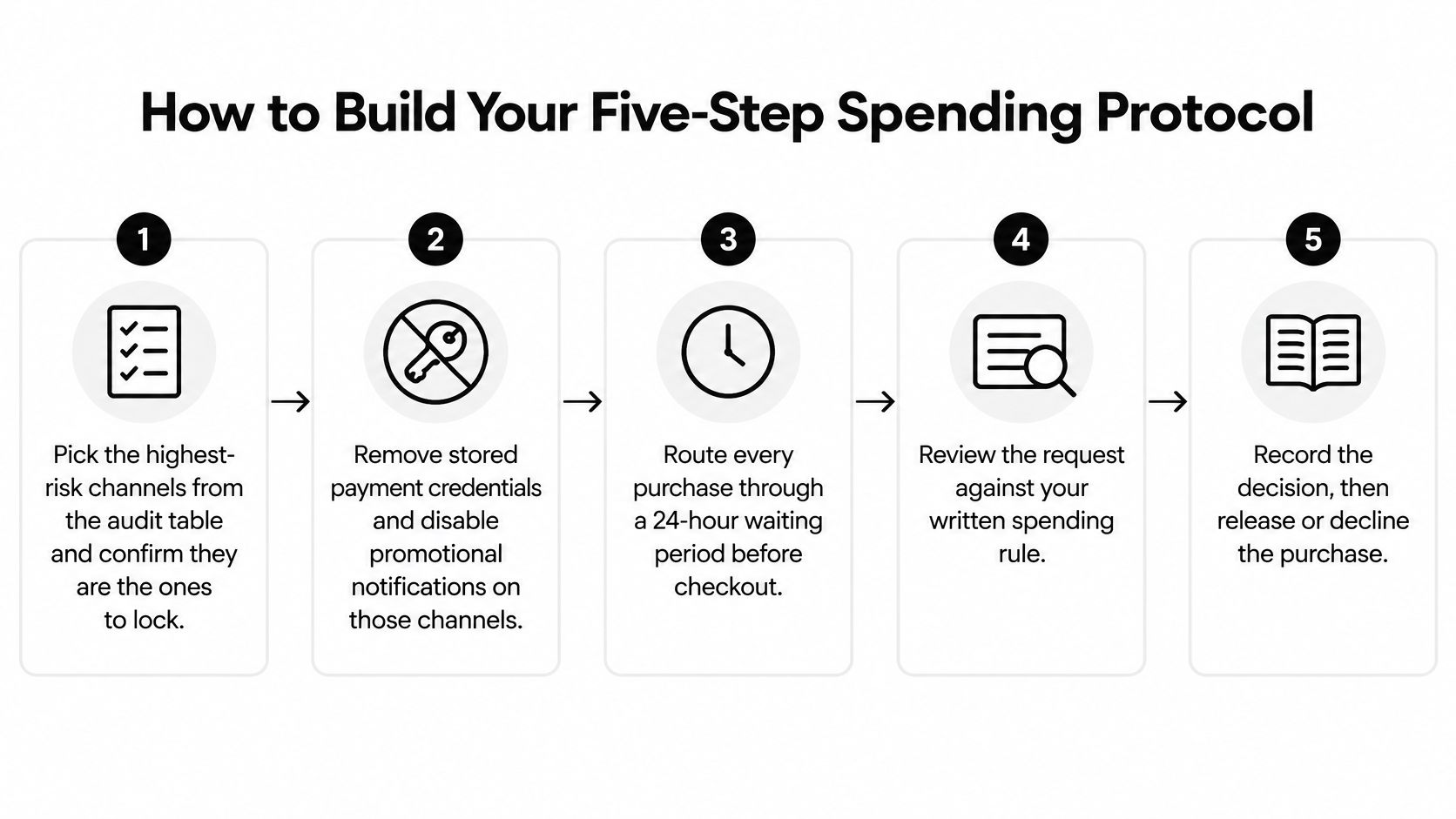
- Pick the highest-risk channels from the audit and confirm they are the ones to lock. If you lock a channel you barely use, you will feel productive and stay broke in the same places.
- Remove stored payment credentials and turn off promotional notifications on those channels only. A saved card is a loaded shortcut. Deleting it is the cheapest brake I know.
- Route discretionary money into a separate account with a fixed weekly transfer. When that balance hits zero, spending stops. You do not negotiate with yourself at checkout.
- Impose a 24-hour delay on any purchase above a threshold you set in advance, and write that number on paper where the phone usually sits. A number in your head is not a rule. A number on paper is.
- Run a 10-minute weekly review of transactions, balances, upcoming bills, and the rules you broke or threw out. Ten minutes is the point. Forty minutes is how the habit dies.
Why the timing matters
Automatic transfers and blocked payments fire before emotional arousal and novelty-seeking peak. That is the whole design. Waiting until you “feel ready to be responsible” puts the decision at the worst minute of the week.
A short walkthrough of the same idea, pause first and automate second, sits well beside the steps if you want it in your ears while you delete saved cards.
The budget that people abandon
The classic failure is a budget with twelve categories and a color code. If every coffee needs a label, the system collapses the week you are overloaded. Keep three categories only: fixed obligations, business or essential variable costs, and discretionary spending. Put minimum debt payments on autopay so one missed executive-function step does not buy you a late fee and a ding.
People rebuilding after a hard credit hit often learn this the expensive way. Post-bankruptcy budgeting habits that work make the same point from the other side of a filing: simple, repeated, and automated beats a beautiful spreadsheet you open twice.
The weekly review is a list, not a mood.
- Transactions: anything unplanned, with the channel written next to it.
- Balances: operating cash, the discretionary account, and what is left after pending charges.
- Bills due in 14 days: names and amounts, not a vague sense that “something is coming.”
- Rules that failed: one line on what broke, and one repair, not a new philosophy.
The Purchase Gate for Big and Business Buys
A software subscription can look like a business decision when the checkout page is open and the next invoice is still out of sight. A contractor can seem urgent; a course can promise to fix the pipeline. The purchase gate asks for evidence before desire gets to spend, whether the card is personal or business.
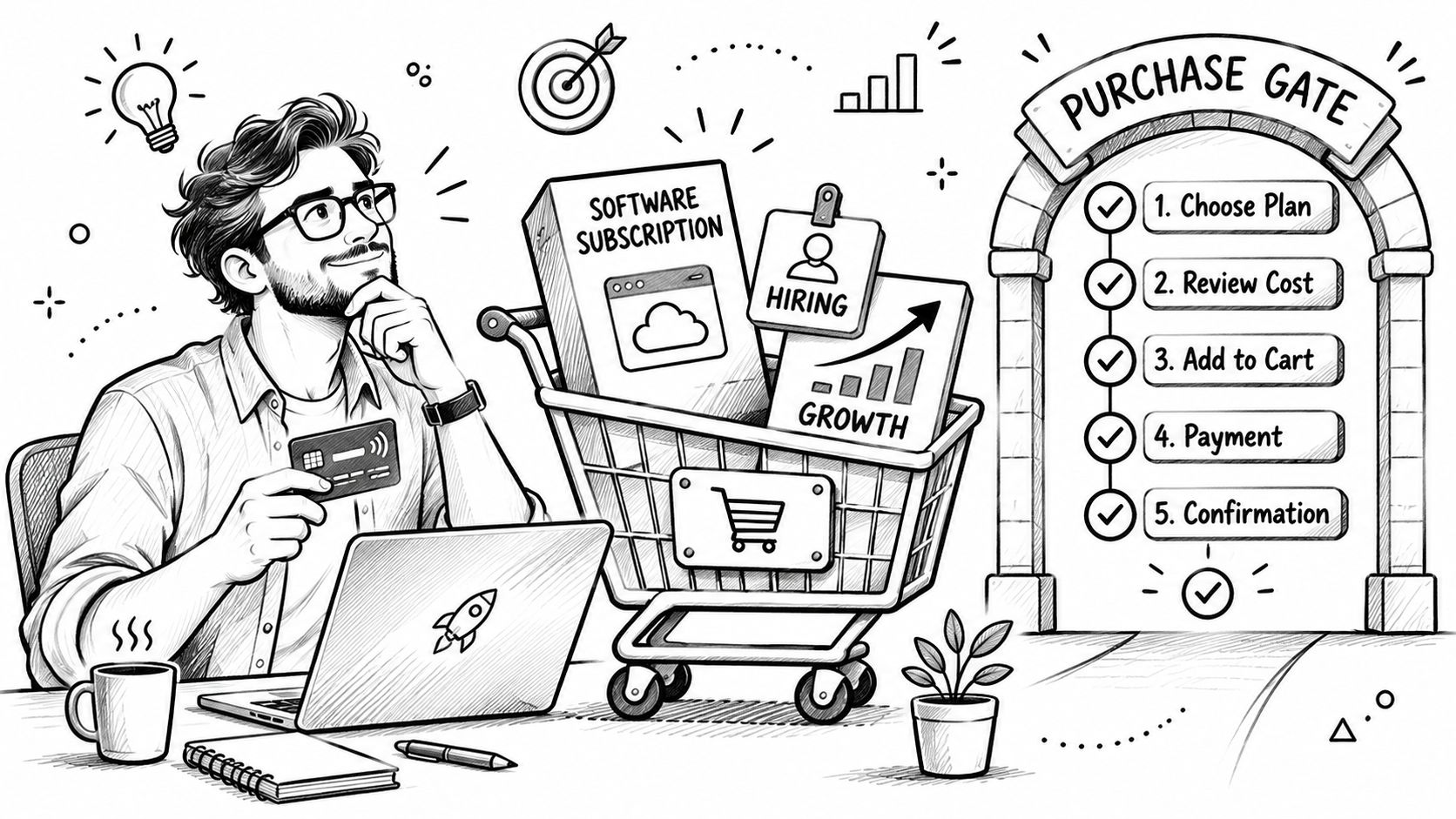
- Write down the item, its price, its business purpose, and how often you expect to use it.
- Wait 24 hours, or 72 hours for a high-cost purchase.
- Check available cash, the tax set-aside, debt repayments, and commitments due in the next 30 days.
- Ask someone else to review the purchase if it exceeds a share of monthly discretionary income you set in advance.
- Buy only if it passes a return-on-investment or utility test written before you wanted it. Otherwise, remove it from the cart.
The amounts below are examples, not universal thresholds. Set figures that fit your cash flow; keep the waiting periods and checks consistent.
| Purchase size | Wait time | Checks before buying | Second-person review |
|---|---|---|---|
| Under 100 | 24 hours | Written purpose and expected use frequency | Not required |
| 100 to 1,000 | 24 hours | Cash flow and next 30 days of commitments | Required above your set share of monthly discretionary income |
| Over 1,000 | 72 hours | Cash flow, tax obligations, debt repayment and next 30 days | Required, always |
A 2020 community study from the University of Groningen found that adults with ADHD reported more impulsive buying, more avoidant or spontaneous money decisions, and less saving than participants without ADHD. Treat that finding as context, not a diagnosis. A cart may reflect a rough week, a low mood, or a plain preference for new things. The gate still protects cash by making the same checks apply regardless of the reason.
Pre-set criteria make hard choices less vulnerable to a persuasive pitch. A clear process for making difficult decisions is especially useful when the possible benefit is immediate and the cost arrives later.
Run the gate for eight weeks. Track discretionary spending, unplanned purchases, the 30-day return rate, late payments, and savings rate. Keep the rule only if at least three measures improve without a missed essential payment. If the process feels strict while rent is slipping, it is solving the wrong problem. Fix the admin leak first.
Fix the Admin Leaks Draining Your Cash
Blocking the shopping apps can be the wrong first move. Unpaid invoices, tax dates, forgotten subscriptions, and late fees drain cash while you congratulate yourself for deleting a retail login.
A StepChange report on neurodiversity and money found that many neurodivergent participants had no defined money-management approach, could not keep a budget going after a short burst of productivity, and missed payment dates. 62% of respondents with ADHD but not autism reported difficulty remembering payment dates. Adults with ADHD also tend to have a fuzzier picture of income, bills, assets, emergency funds, and longer-term goals. A generic monthly budget assumes a salary that lands on the same day. Founder income does not do that.
Three accounts, not twelve jars
Split the money by job, then let transfers do the remembering.
| Account | What goes in | How it runs | Review |
|---|---|---|---|
| Operating account | Fixed bills, payroll and business essentials | Automatic bill payment and scheduled transfers | Weekly, 10 minutes |
| Tax and reserve account | Tax set-aside and emergency buffer | Fixed percentage transfer on each payment received | Monthly |
| Novelty account | Discretionary spending chosen in advance | Fixed weekly transfer, with the only card linked here | Weekly |
The operating account pays what must be paid. The tax and reserve account takes a fixed percentage of every payment you receive, the day it lands, so a good month does not become a tax surprise. The novelty account is deliberately small. That is the only card allowed to be impulsive, and only up to the weekly transfer.
Subscriptions and the score you actually keep
List every recurring charge. Cancel anything you did not use in the last 30 days. Move the keepers onto the operating account so they are bills, not surprises.
Measure this system by missed deadlines, not by how virtuous you felt. Automatic bill pay, a calendar prompt the day before each odd invoice, spending alerts, and one human looking at the accounts each week will beat another app you abandon. Irregular revenue is exactly why this belongs inside ADHD-friendly business systems rather than a household budget template built for a paycheck.
Put the weekly review on the calendar at a fixed time this week. If it is not on the calendar, it is a wish.
When Spending Has Already Caused Debt or Distress
“Just stop buying” is the advice that arrives after the damage, and it often makes the shame worse. You cannot execute a perfect freeze while you are avoiding the inbox that holds the statements.
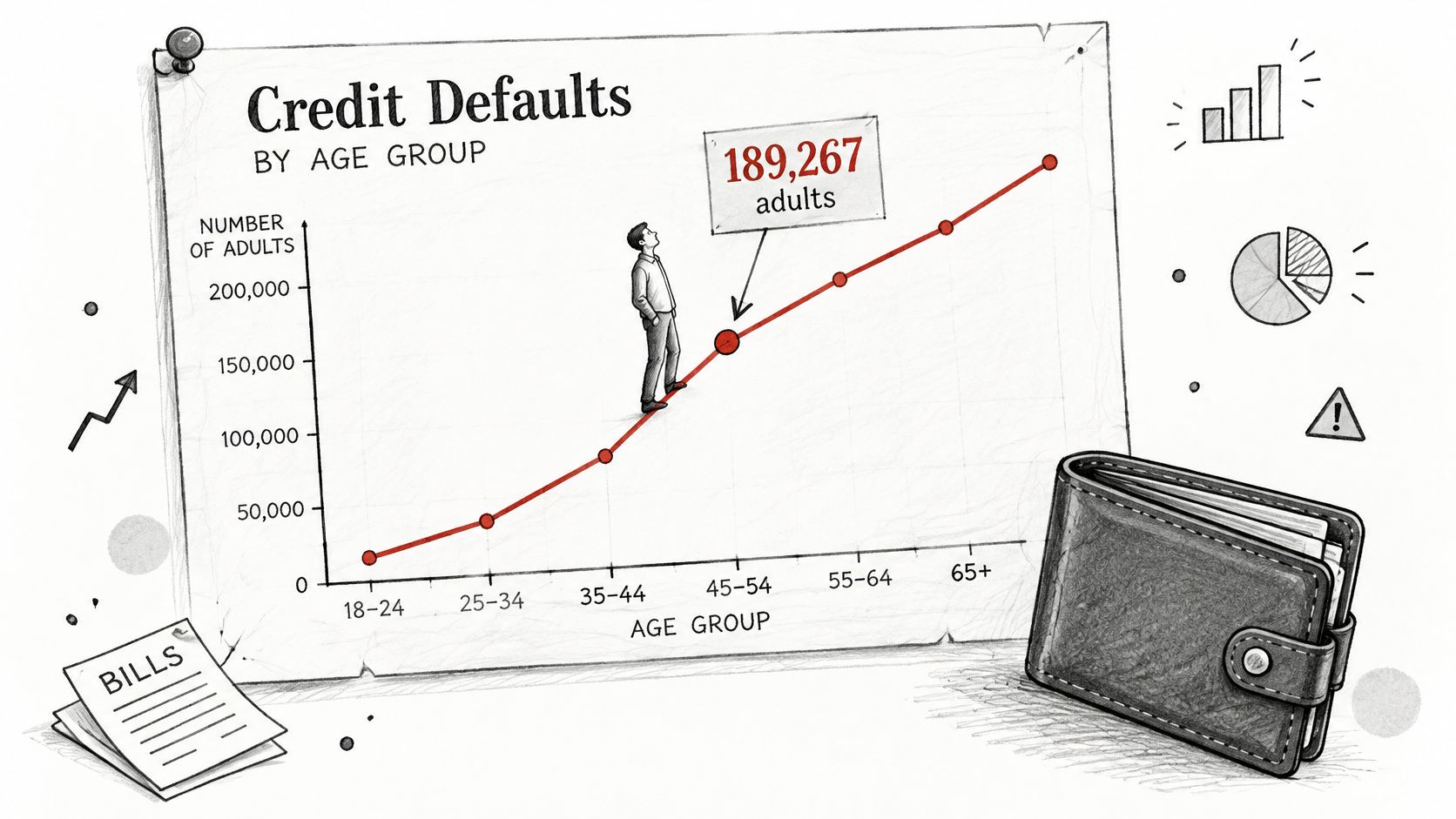
In a population study of 189,267 adults, people with ADHD began adulthood with broadly similar credit demand and default rates. Default rates then rose sharply in middle age, which meant poorer credit scores and less access to credit. After adjustment for income and other factors, financial distress was associated with a fourfold higher suicide risk among adults with ADHD, as reported in the Science Advances population paper. That is a risk marker, not a prediction about you. It is a reason to treat money trouble as a safety issue, not a motivation poster.
A staged response
Work in this order. Skipping ahead to a new budget while you are in crisis usually fails.
- Safety and creditor triage first. If you are thinking about ending your life, contact local emergency services now. In the United States, call or text 988. Then list who must be paid this week so the lights and the payroll do not become the next emergency.
- A shame-free inventory. Every debt, every subscription, every personal guarantee. No speech about how you got here.
- Professional debt counseling. A nonprofit counselor or a qualified adviser beats another night of spreadsheet guilt.
- No new high-cost credit. Payday loans, pawn, and fresh buy-now-pay-later accounts are how a bad month becomes a trap.
- A treatment review. ADHD care, depression, anxiety, sleep, and substance use all change whether any money rule can be followed. This is support, not a confession.
Founder-specific lines
Keep personal and company money in separate accounts, including the cards. Write the escalation points before you need them: a missed payroll, a tax balance you cannot cover, or a second month of avoided statements means you call the counselor or the accountant, not that you “try harder.”
Financial control here is engineered support and risk management. It is not moral discipline, and it is not proof that you are bad at business.
Review the Rule After a Slip or Eight Weeks
A slip is data with a price tag. Treat it that way, or you will rebuild the whole budget out of embarrassment and quit by Friday.
- The day you notice it, write the item, the price, the channel, and the time. Pause new discretionary purchases until the next weekly review. The pause is short on purpose. An indefinite freeze turns into avoidance.
- If a return is still open, start it inside 30 days and log it with your return notes. A returned gadget is a saved metric, not a failure you have to narrate.
- Move leftover discretionary money into the operating account only when a bill due within 14 days would otherwise be short. Leave the weekly transfer amount alone. Shrinking it mid-week as punishment just hides the next slip.
- At the 10-minute review, name one failure. A saved card. A skipped wait. Money left in the wrong account. A missed admin date. Repair that one thing. Delete the card, add friction on that channel, or move the review earlier if the buy happened after midnight. Do not repair four systems because one checkout annoyed you.
- Do not invent new categories. Fixed obligations, business or essential variable costs, and discretionary spending stay the whole map. Leave minimum debt payments on autopay so one missed step does not manufacture fees.
- At eight weeks, set the current week beside week one. Keep the protocol when it clears the bar you set and no essential payment was missed. If two or more essential payments were missed, work the admin accounts and the creditor triage before you tighten shopping rules. A stricter cart will not pay the tax office.
Free tools are enough for the logging if you do not want another subscription: a Dopamine ROI Calculator, the Wall of Awful, a Survival Kit, Morning Blueprint, Weekly Build Filter, Execution Audit, quizzes, and free webinars. If you want the map of your own wiring instead of another generic budget, the Starter Kit includes Brain Mapping, a personal blueprint, training, and the toolkit described in the offer, and that kit comes with a full refund on request within 30 days, no questions asked. I would start with the free log and the one-channel lock before paying for anything.
Jan Kutschera builds operating systems for founders with ADHD, including the money rails that keep impulse buys and missed admin from running the company. If the late-night cart and the forgotten tax date are both showing up in your month, the same external structure fixes both. Visit Jan Kutschera and start with the free tools or the Starter Kit if you want the blueprint instead of another willpower plan.
Jan Kutschera
German founder, diagnosed with ADHD at 51. Built 4 agencies, now building systems for neurodivergent entrepreneurs. German engineering for the ADHD brain.
Connect on LinkedInRelated Articles

Executive Function Explained: The Brain's Air Traffic Crew
Executive function explained without jargon: the three core skills, why ADHD makes them state-dependent, and the external scaffolds that replace willpower.
Time Management for Entrepreneurs Without the Panic
Time management for entrepreneurs with ADHD: a weekly split, capacity calendar, batching, and delegation specs that replace panic productivity.
How to Run Effective Meetings for ADHD Founders
How to run effective meetings with timeboxes, roles, agendas, and follow-up built for neurodivergent founders who want decisions, not more calls.