Executive Function Performance Test: What Scores Mean
Learn what an executive function performance test measures, how Stroop, WCST and Trail Making compare with BRIEF-A, and how to read your scores.
Jan Kutschera
Say it’s 9:40 on a Tuesday morning. The client call starts in twenty minutes, the proposal that was due yesterday is still half-written, and there’s a Slack thread about a handoff you apparently agreed to in a meeting you only half attended. You aren’t lazy and you aren’t short of ideas. The machinery that decides what to start, what to switch to and what to drop has gone quiet at the exact moment you needed it loudest.
So you book a test. An hour in a quiet room, a few timed puzzles, a report full of numbers, and a line that says your executive function performance sits in the average range. Reassuring for about four days. Then the same Tuesday happens again.
That gap, between a decent score and a messy calendar, is the whole story. An executive function performance test measures capacity under tidy conditions, and your week is not tidy. The useful move is to know what these tests sample, read your own numbers without flattery or panic, and then convert them into changes in how you work. Not a verdict. A build guide.
Table of Contents
- The Executive Function Tests You Will Actually Meet
- Performance Tasks and Questionnaires Show Different Things
- Online Screens or Full Neuropsychological Batteries
- Reading Your Scores Without Fooling Yourself
- Where Performance Tests Fall Short in Real Life
- Turning Results Into Your Operating System
- Choose Your Next Step Before You Book Anything
The Executive Function Tests You Will Actually Meet
Think of executive function as the project manager of the brain. She decides what gets started, which meeting you walk out of, when to switch from the deck to the invoice, and when to stop editing a sentence that has been fine for twenty minutes. That job has a dozen sub-tasks, and no single test captures the role.
No single test measures one unified ability, and that’s a statistical finding rather than a slogan. A 2018 systematic review and re-analysis examined confirmatory-factor-analysis evidence from 46 samples containing 9,756 participants and found that no factor model consistently fit every sample. Among adult samples, nested-factor models were accepted most often, in approximately 41 to 42% of cases, but selected as the preferred model in only 8 to 30% of analyses. Among children and adolescents, a unidimensional model was accepted in approximately 32 to 36% of samples and selected in 21 to 53%, with some support for two-factor models.
The practical reading is plain. Scores from these tasks are shaped by overlapping processes, including working-memory updating, response inhibition and cognitive shifting, rather than by a clean “executive function” capacity in a box. That’s why a battery of several tasks is more defensible than one heroic task sitting alone.
Instruments travel in packs for the same reason. A 2025 study published in Developmental Science assessed 1,093 adolescents from eight locations in seven countries using computerized Stroop, Tower of London and working-memory tasks. Same handful of tools, very different school systems underneath.
| Test | What it targets | How it works | Typical time |
|---|---|---|---|
| Stroop Color-Word Test | Interference inhibition and processing speed | Read colour words printed in mismatched ink | About 5 minutes |
| Wisconsin Card Sorting Test | Rule discovery and cognitive flexibility | Sort cards by a rule you must infer from feedback | 15-20 minutes |
| Trail Making Test A | Visual scanning and processing speed | Connect numbers 1 to 25 in order | About 5 minutes |
| Trail Making Test B | Set shifting between numbers and letters | Alternate numbers and letters in sequence | About 5 minutes |
| N-back | Working-memory updating | Respond when the current item matches the one shown n steps earlier | 10-15 minutes |
| Continuous Performance Test | Sustained attention and response control | Respond to targets in a stream and withhold on non-targets | About 14 minutes (CPT-II) |
| Tower of London | Planning and sequencing | Move discs to match a target arrangement in the fewest moves | 10-15 minutes |
| BRIEF-A (questionnaire) | Everyday executive functioning as rated by the person or an informant | 75 items rated on how often a problem occurs | About 10-15 minutes |
How to Read a Row Without a Psychology Degree
Start from the symptom, then find the row. If your problem is the handoff you dropped between two projects, that’s a switching cost, so the Trail Making Test B row is the one that speaks to it. If you say yes to three commitments in a meeting and regret it by lunchtime, read the Stroop row. If your attention slides off a ninety-minute call, look at the Continuous Performance Test.
If what you want is the treatment pathway rather than the test menu, the ADHD diagnosis and treatment guide walks through how assessment, medication and follow-up fit together around results like these.
Performance Tasks and Questionnaires Show Different Things
Two instruments, two questions. A performance task is a stopwatch and an error count taken in a controlled room. A questionnaire is a diary of how often a problem turns up in your actual life. Same person, different evidence, and neither one is the whole truth.
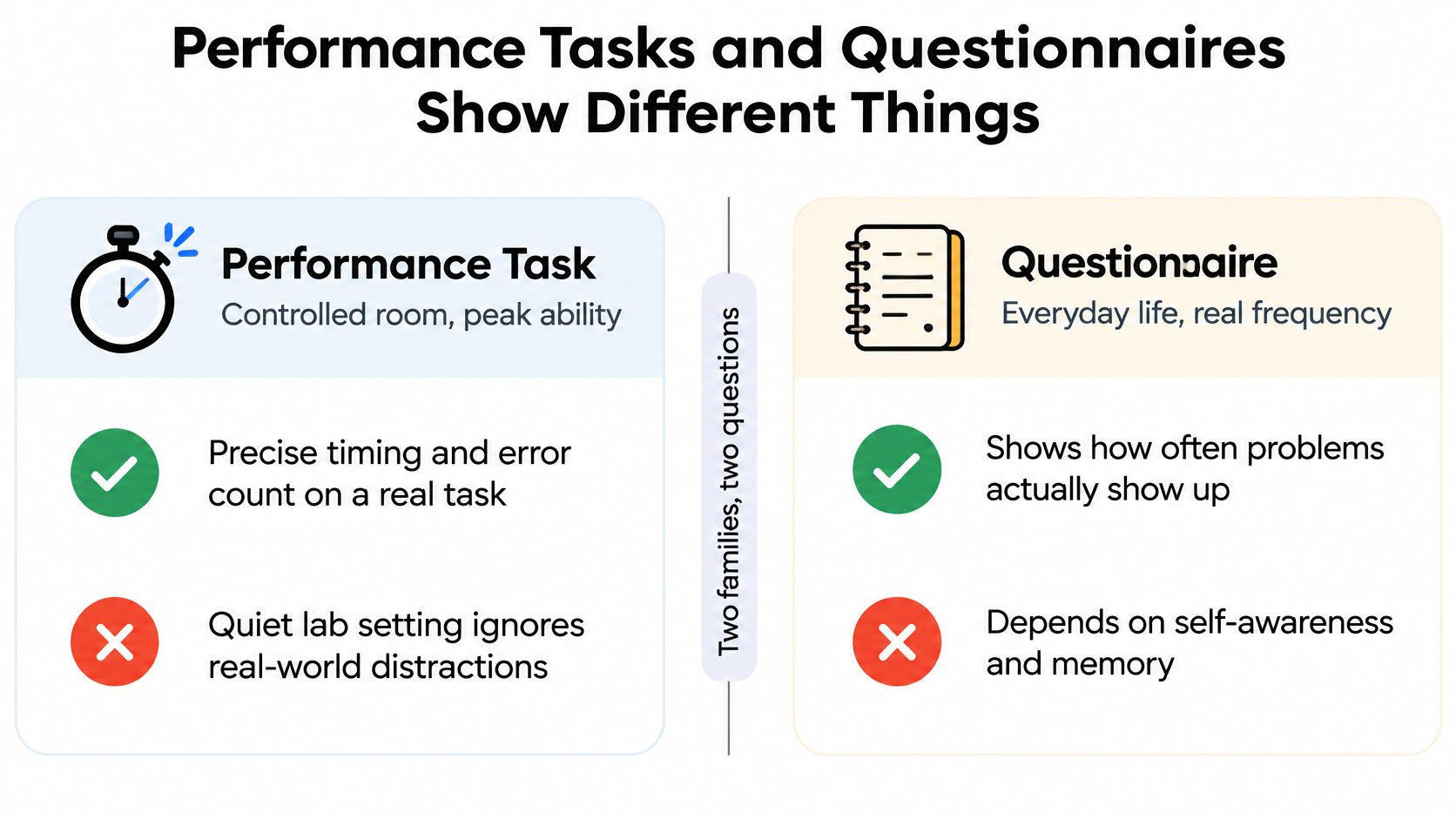
The stopwatch side. Timed, scored, repeatable. You can sit the same task in March and again in September and compare the two, which is more than most self-knowledge offers. The catch is the setting: standard instructions, no client waiting, no phone buzzing, and a thin line between that room and a chaotic workday.
- You get a number, not a feeling: reaction time and error counts are recorded the same way for everyone.
- You can repeat it: same task, same conditions, one variable changed at a time.
- It’s context-blind: nobody tests you with three interruptions and a deadline attached.
The diary side. The BRIEF-A asks about 75 everyday behaviours, each rated on how often it causes a problem, and it can be filled in by you or by someone who knows your week. It catches the Tuesday, not the testing room.
- It shows frequency: how often the handoff slips, not just whether it can.
- It adds the outside view: a co-founder or partner reports what you’ve learned to normalise.
- It leans on self-awareness: avoidance can make a problem invisible in your own answers.
The two views disagree often enough that the disagreement is its own research question. A 2025 study comparing performance-based and self-report executive-function measures examined 193 community adults, including 111 women, with a mean age of 25.08 years, published in 2025. The two families aren’t competing for one crown. They’re answering different questions.
Rule of thumb: use a task to see capacity under standard conditions, and a questionnaire to see the pattern across a month. When they disagree, the gap is the finding, not an error.
Online Screens or Full Neuropsychological Batteries
Two routes exist, and they’re built for different questions.
- Online screen: 10 to 30 minutes, one to three tasks, an automated report at the end. Cheap enough to repeat, useful for spotting a trend across months.
- Full battery: several hours, often split across two sessions, several domains covered, run by a licensed neuropsychologist who also watches how you work and writes the results up against norms.
| Option | Duration | Coverage | Who interprets | Best use |
|---|---|---|---|---|
| Online screen | 10-30 minutes | One to three tasks | Automated report | Tracking trends over months, not diagnosis |
| Full neuropsychological battery | Several hours, often over two sessions | Multiple domains: CPT, Stroop, Trail Making, WCST, digit span | Licensed neuropsychologist with written report and norms | Diagnosis or workplace accommodation |
A defensible battery samples distinct processes instead of leaning on one global number. In adult ADHD research, the most frequently used instruments include the Continuous Performance Test for sustained attention and response control, the Stroop Color-Word Test for interference inhibition and processing speed, the Trail Making Test for visual scanning, speed and set shifting, the Wisconsin Card Sorting Test for rule discovery and cognitive flexibility, WAIS digit-span tasks for working memory, and Go/No-Go tasks for motor-response inhibition, as set out in a 2024 review of executive-function assessment in adult ADHD.
The payoff is a profile rather than a pass or fail. Omission errors and reaction-time variability on a CPT point to vigilance instability, while commission errors point to inhibitory-control problems. A Stroop interference score quantifies what suppressing an automatic response costs you, and TMT-B minus TMT-A separates switching demand from basic visuomotor speed. Because performance moves with sleep, medication timing, anxiety, practice effects and task relevance, repeat testing needs standard conditions and age-adjusted norms, not one bad afternoon treated as a diagnosis.
The signal is usually quieter than people expect. The same review describes adult ADHD findings as generally subtle, with particular weaknesses in complex-information processing speed, attention and auditory-verbal learning.
A quiz result or a score from a self-serve app is not a clinical assessment, however clean the chart looks. When the answer matters, psychological testing at Providers for Healthy Living is the model to look for: a full battery, a licensed examiner, a written report with norms rather than an automated percentage.
Before You Book Either One
Tell the examiner about medication timing, sleep debt and anxiety before the session starts, because all three move scores. Ask whether the report includes age-based norms, and keep conditions identical across repeat sessions, down to time of day and caffeine intake. Online tools are usually low cost while batteries are priced per session, so weigh the price of a report against the cost of a wrong decision about a role, a hire or a treatment plan.
Reading Your Scores Without Fooling Yourself
Numbers first. A T-score is standardised so that 50 is the average and 10 points equal one standard deviation, which lets your result be read against age-matched peers instead of an arbitrary cutoff. The Behavior Rating Inventory of Executive Function, the widely used everyday measure, was normed using ratings from 1,419 parents and 720 teachers across rural, suburban and urban settings, and a 2010 Dutch normative study of the BRIEF applied it to children and adolescents aged 5 to 18 and found that reported executive-function problems generally decreased with age. Norms exist because raw scores don’t mean much on their own.
The bands below follow the BRIEF convention, which most scoring reports use. A 65 signals a clinically significant concern worth a professional conversation rather than a personality label.
| Score band | T-score | What it suggests |
|---|---|---|
| Average | 40-59 | Within the typical range; keep tracking over time |
| Elevated | 60-64 | Notable; check whether the pattern repeats across contexts |
| Clinically significant | 65 and above | Discuss the result with a qualified clinician |
The High-Achiever Trap
Average is a group word. In a study of executive functioning in high-IQ adults with ADHD published in Psychological Medicine, 64 high-IQ adults with ADHD were compared with 53 high-IQ controls. The ADHD group performed worse on several executive-function measures, yet its average test performance remained within the normal range. Some measures, including complex-figure and verbal-learning performance, significantly predicted real-world functioning across participants.
Three things get tangled in that sentence. Group average is what a study reports. Individual impairment is what you experience. Functional cost is what your calendar, your team and your sleep keep a receipt for. High ability, compensatory strategies, adrenaline-based work habits and a supportive environment can hold performance up during a test while raising the effort required to keep output steady afterwards.
So track the cost, not only the score. Look at how much your results vary across tasks, how much effort steady output takes, which commitments you’ve missed this quarter, how long recovery takes after a sprint, and where delegation keeps failing. Those are observable facts about your week, and they’re harder to flatter than a percentile.
Write three real outcomes next to your scores tonight: one missed commitment, one recovery time, one delegation failure. If your tidy score and your messy outcomes tell different stories, believe the outcomes and let the score be a footnote.
Where Performance Tests Fall Short in Real Life
The question high performers ask most often goes like this. Why can I score normally in a quiet, time-limited assessment and still miss deadlines, lose handoffs, and only start moving when the deadline catches fire? That’s not a character flaw. It’s a measurement gap, and it has a name.
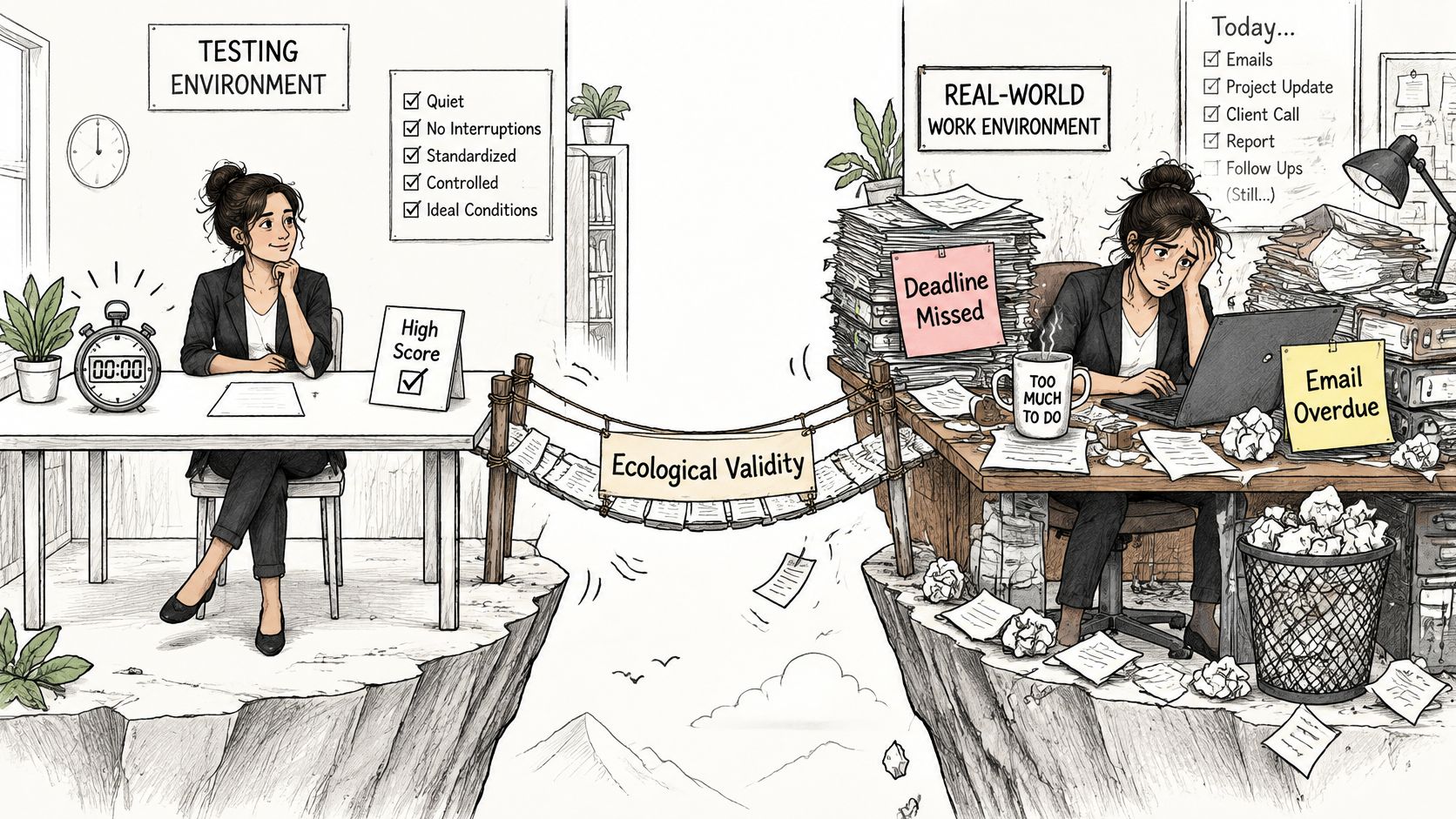
Ecological validity is the formal term for it. A review of ecological validity in executive-function research identifies a persistent problem: many conventional tests have limited correspondence with naturalistic behaviour, and making a task look more realistic doesn’t guarantee it predicts functioning outside the test setting. Test performance reflects capacity under standardised conditions. Entrepreneurial execution also depends on motivation, reward salience, sleep, stress, interruptions, time perception and how your environment is structured.
Test-Day Conditions That Move the Number
- Sleep debt: a short night costs you most on the long, dull vigilance blocks.
- Caffeine and medication timing: an 8am dose and a 2pm dose are different experiments.
- Test anxiety: being watched changes how carefully you move.
- Practice effects: the second attempt at the same task is partly a memory test.
The research direction that follows isn’t a better single score. It’s multimethod assessment, combining performance tasks with self- or informant-reports and naturalistic measures, and the field is exploring virtual-reality and computer-based tasks that capture attention and executive function during more realistic activities, including homework-like work in everyday environments. Those approaches remain promising rather than proven replacements for clinical judgement.
The consequence is practical. No single score is a verdict. Retest under standard conditions so you’re comparing like with like, and keep a log of real outcomes beside it: the proposal that shipped late, the handoff that vanished, the week that ran on urgency and then collapsed. If you want the mechanics behind that gap, executive dysfunction in ADHD breaks down which process tends to fail and when it fails.
Turning Results Into Your Operating System
ADHD is not a superpower and not a curse. It is a different operating system that crashes if it is not maintained.
Treat the report as a wiring diagram, not a report card. The tests tell you which demand is expensive. Your job is to stop paying for that demand in the same currency every week.
From Trail Making to Tuesday Morning
Trail Making is the cleanest example because it splits one task into two demands. Part A asks you to connect sequential numbers, so it mostly measures visual attention and processing speed, scored on completion time and errors. Part B adds alternating between numbers and letters, which raises set-shifting and working-memory demands. A large B-to-A time increase can indicate switching inefficiency, while slow performance on both parts may instead reflect generalized processing-speed or visual-motor limitations, as the NCBI cognitive assessment chapter on executive measures describes.
That decomposition is directly actionable. A switching-specific weakness supports batching, explicit transition cues and written handoff protocols, while a broad speed deficit supports cutting time pressure, pre-structuring information before work starts and leaning on external reminders. Errors and qualitative behaviour matter too, because a loss of sequence, a rule violation or a burst of self-corrections can produce the same completion time as efficient work. Laboratory tasks capture constrained capacity, while instruments such as the BRIEF and BDEFS capture how difficulties show up in daily work and self-management.
| Pattern in your results | Likely demand | System change |
|---|---|---|
| Slow on Trail B, normal on Trail A | Switching cost | Batch similar tasks; write explicit transition cues and handoff notes |
| Slow on both Trail parts | Processing speed and visual-motor load | Remove time pressure; pre-structure inputs before work starts |
| Many CPT omission errors | Sustained attention drifting | Keep a visible task board with short timed check-ins |
| Many Stroop interference errors or impulsive commitments | Inhibitory control under pressure | Add a pause step before commitments; use checklists for irreversible actions |
Four Levers That Fit a Real Week
Take the pattern and pull one lever, not four.
- Cognitive Architecture. Build external structure that bypasses the fragile function: one visible task board, a handoff template with named fields, a ten-minute transition cue written into the calendar before each switch.
- Dopamine Engineering. Put the reward at the completion point rather than the start, because something visible at the finish line is what makes the last twenty minutes of a dull task survivable.
- Strategic Delegation. Hand switching-heavy or detail-heavy work to people who find it restful. Your relief and their preference are usually the same transaction.
- Bio-Optimization. Schedule sleep and movement like meetings, with a start time and a cost for cancelling.
Pick one change this week and review it after four to six weeks with the honesty you’d apply to a hire. If you want more depth on the habits underneath each lever, ADHD executive function strategies covers the mechanics.
Choose Your Next Step Before You Book Anything
Three moves, in order.
- Write down three recent failures in plain words. A missed handoff, a decision that sat for two weeks, a thread you lost. No interpretation, no adjectives.
- Match each one to a row from the first table. Then decide what you need: a self-check you can run monthly, a clinician-led battery, or only a system change.
- Choose the first action. If the problem touches your health, income or employment, arrange a formal assessment with a qualified clinician. If it’s about structure, build the external system now, and executive function coaching for ADHD is where that build gets specific instead of staying a plan.
When a profile needs to become a working setup rather than another document, the ADHD Founder System Sprint includes an individual consulting session plus the preparation, follow-up materials and support set out in the offer. Everything in this article is educational. A Brain Map, a quiz result or a tool score is not a clinical assessment, and nothing here diagnoses anything.
One decision today is enough. Book the clinician call, or write the first handoff protocol and use it on the next project that lands.
If you’ve built success at the cost of constant crisis, Jan Kutschera works with founders who have ADHD to replace adrenaline-driven hustle with operating systems built for their wiring. The four pillars, Cognitive Architecture, Dopamine Engineering, Strategic Delegation and Bio-Optimization, are how a test result becomes a structure you can run a company on. Visit Jan Kutschera and pick the entry point that matches the problem in front of you this week.
Jan Kutschera
German founder, diagnosed with ADHD at 51. Built 4 agencies, now building systems for neurodivergent entrepreneurs. German engineering for the ADHD brain.
Connect on LinkedInRelated Articles
Dopamine Reward System Addiction Explained for Founders
Dopamine reward system addiction explained: why deadlines feel like drugs, how craving loops form, and how founders can rebuild the loop without burnout.
Leadership Communication Skill: A Guide for ADHD Founders
Build your leadership communication skill with clear handoffs, channel choices, ADHD-friendly team agreements and drills you can run this week.
Hold Me Accountable: A Practical ADHD Founder Guide
Hold me accountable without surveillance or shame: a step-by-step ADHD founder playbook for partners, cadences, reminders and reliable follow-through.