Hold Me Accountable: A Practical ADHD Founder Guide
Hold me accountable without surveillance or shame: a step-by-step ADHD founder playbook for partners, cadences, reminders and reliable follow-through.
Jan Kutschera
Eighty-two percent of people in a multi-year workplace study either tried and failed to hold others accountable or avoided doing it altogether, according to the landmark accountability study that collected responses from more than 40,000 participants across hundreds of organizations between April 2011 and June 2014. In the same study, 85% were unsure what their organization was trying to achieve.
That reframes the whole request. When a founder asks a friend to hold me accountable for shipping the pricing page, they aren’t describing a personality defect that needs a firmer friend. They’re describing a missing structure, and the friend has just been handed a job with no brief, no metric and no review.
What follows is the setup I’d install instead. Two partners chosen by role, commitments written as if-then rules with a repair clause, and a review that redesigns the system rather than grading the person.
Table of Contents
- Why Willpower Alone Cannot Hold a Founder Accountable
- Choosing the Right Accountability Partner
- How to Write Commitments You Can Actually Track
- Build Cadences and Handoff Rituals That Stick
- Recover Fast When Accountability Breaks Down
- Start Your First Two-Week Accountability Loop
Why Willpower Alone Cannot Hold a Founder Accountable
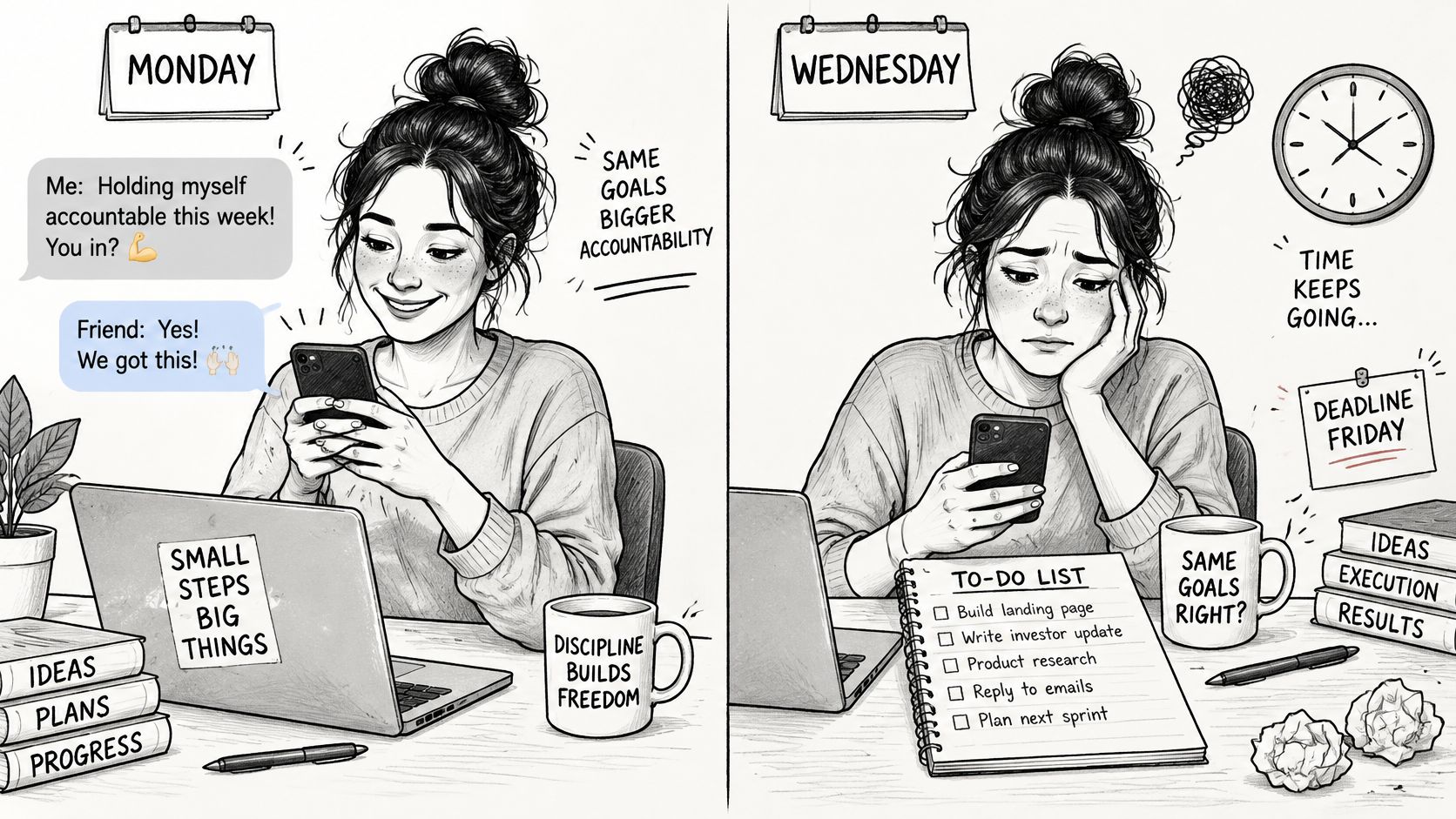
A founder can agree to finish a pricing page on Monday and have no clear next step by Wednesday. The promise may be sincere; the system around it is still missing. A text message gives the commitment a witness, not an owner, a measure of done or a review point.
The gap is a leadership problem, not a willpower problem
Gallup’s 2025 workplace research ranked “creating accountability” last among seven leadership competencies. Only 46% of leaders rated themselves exceptional or outstanding at holding everyone responsible for exceptional performance, and just 30% of managers gave their own leaders that rating, according to Gallup’s accountability research. Among employees who strongly agreed their manager held them accountable, 28% were engaged, compared with 6% of those who disagreed.
Those figures show that even leaders in formal roles rate themselves only moderately strong at accountability. For a founder with ADHD, adding self-criticism rarely fixes the gap. Make the work visible and define what happens after a missed commitment. Practical ADHD executive function strategies can help move planning and follow-through out of working memory and into the environment.
Three failure patterns worth naming
- Commitments held only in memory. Record the promise where the work happens, with a due date and a location the other person can access.
- Check-ins that feel like surveillance. “Did you do it?” invites defensiveness. “What blocked the next step?” gives you information for adjusting the plan.
- Deadlines that rely on panic. If a task only moves under pressure, the deadline is doing the work of a system. Break the commitment into a next action that can be started without an emergency.
Reframe: A missed commitment is information about the system that produced it, not a verdict on the person who missed it.
Run the five-minute self-audit
Take one recent missed commitment and answer these questions plainly.
- Where was it recorded? If it lived only in your head or a message thread, it was easy to lose among other demands.
- Who owned it? “The team” is too vague. Name one person responsible for the next action.
- What happened the next morning? If nobody agreed on a recovery step, the miss was left unresolved and could repeat.
A clear operating system can streamline processes and boost accountability by making responsibilities and follow-through part of the work itself.
Choosing the Right Accountability Partner
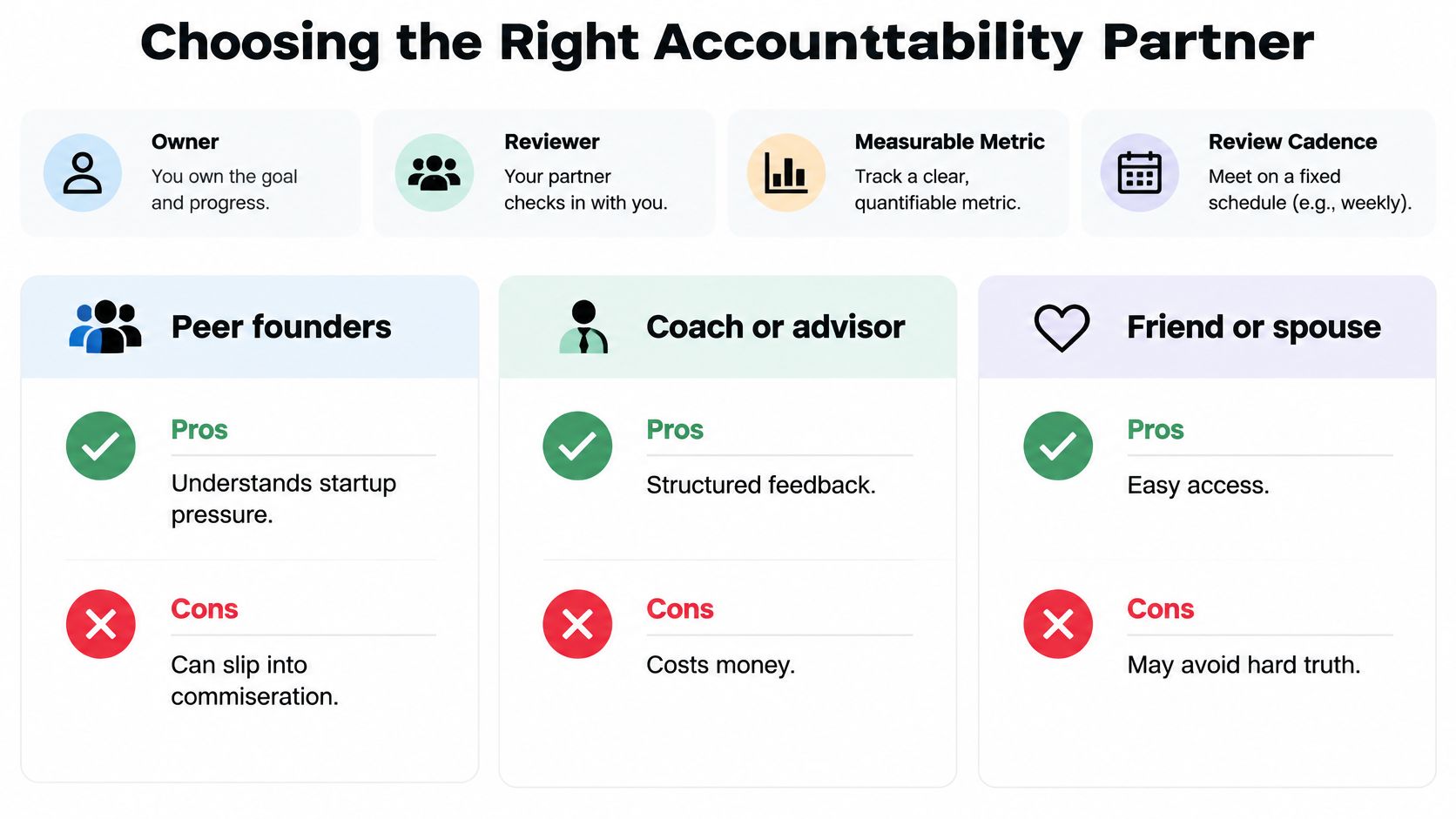
An accountability partner should fill a role your own system cannot: give an honest review, add structure to handoffs, or keep a written record. For an ADHD founder, one partner rarely does all three well. Choose two by role: a peer founder for review and a team lead or operations partner for work that leaves your desk.
Keep accountability private by default. In a randomized trial of 210 college students, revealing participants’ names reduced the likelihood that they made commitments by 9.7 to 11 percentage points, roughly a 20% reduction relative to anonymity, according to the randomized commitment study. Public pressure can make the cost of committing feel higher; it does not guarantee follow-through.
| Partner type | Best for | Main risk |
|---|---|---|
| Peer founder (non-competing) | Shared weekly outcomes and candid review | Drifts into venting without a fixed agenda |
| Paid coach or advisor | Spotting structural blind spots | Cost and reliance on a single voice |
| Team lead or ops partner | Delegated tasks and visible handoffs | Feels like surveillance if the metric is unclear |
| Written async log with a reviewer | Quiet tracking without a live meeting | Momentum fades without a named reviewer |
| Automated tracker or reminder app | Recurring triggers and completion logging | Notification fatigue; logs get ignored |
Start with two distinct jobs. Ask a non-competing peer to challenge whether your weekly outcome is realistic. Ask a team lead or operations partner to clarify ownership and handoffs for work that depends on others. A coach or advisor can help when the obstacle is structural and hard to spot from inside. A friend or spouse may be easy to reach, but personal closeness can make candid feedback harder.
The ask: “Could you review two outcomes with me every Friday for 30 minutes? I’ll send them Thursday night. Please tell me what’s unclear or unrealistic.”
If your reviewer is a team lead, you can ask for workflow support without disclosing a diagnosis: “I work best when I know the next handoff and its due date. Could we confirm the owner and due date for each open task on Monday?” The trade-off is straightforward: more visibility can clarify responsibility, but unclear metrics can make the same check-in feel like surveillance.
If you’d rather watch than read, the video below covers the same territory.
Agree on the job, the review cadence, and what happens when a commitment slips before you begin. A partner should help redesign an unworkable commitment, not turn a missed task into a character assessment. For another overview of what a partner relationship is and isn’t, see this accountability partner guide.
How to Write Commitments You Can Actually Track
“Ship the new onboarding flow” names an ambition, not a commitment. A trackable commitment specifies an outcome, an owner, a trigger and a next action: if it is 09:00 on Tuesday, then I will send the client-status update from the project dashboard. The decision is made in advance, so you do not have to negotiate with yourself when it is time to start.
Implementation intentions have a strong evidence base. A meta-analysis of 94 independent studies with more than 8,000 participants found a medium-to-large improvement in goal attainment, d = 0.65, according to Gollwitzer and Sheeran’s research on implementation intentions.
Six steps per commitment
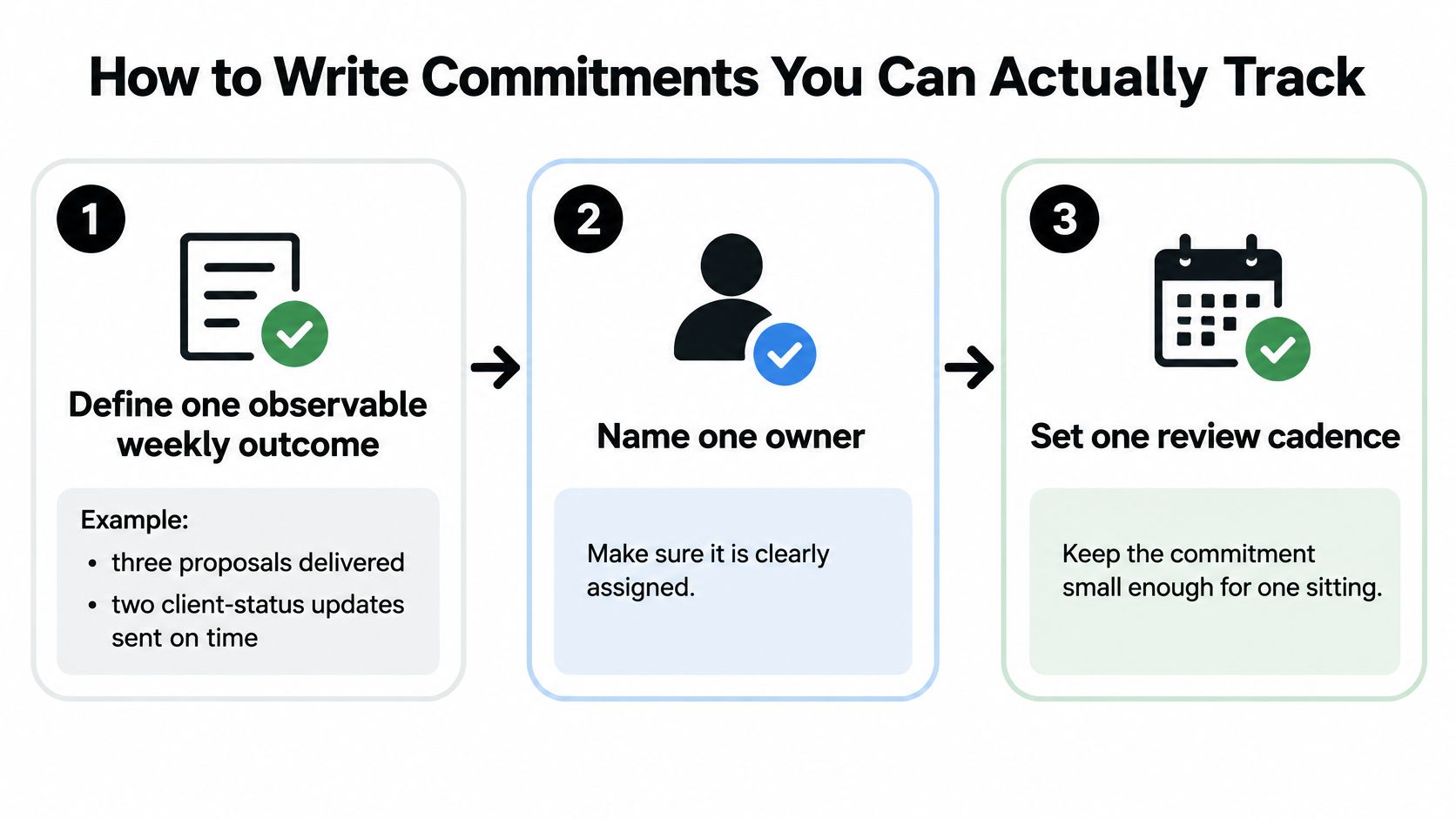
- Define one observable weekly outcome. Write “three proposals delivered” or “two client-status updates sent on time.” A reviewer can verify a count; a claim like “I made good progress” invites a debate about effort.
- Name one owner, and make it you. Shared ownership makes it easy for everyone to assume someone else will act. Delegate tasks after you have made clear what you own and what completion looks like.
- Write the trigger. Specify a time and place, not a mood. “When I open my laptop” leaves room to drift. “09:00 Tuesday, with the dashboard open” tells you when to begin.
- Set the minimum viable action. Choose the smallest version that still counts as done and fits in one sitting. Twenty minutes of drafting is concrete; “finish the deck” can expand until the day is gone.
- Log it where the reviewer can see it. Put each commitment in a visible row. A meeting follow-up task log is easier to review than a chat thread that disappears under new messages.
- Write the repair clause before you need it. Decide what happens after a miss while you are calm. That way, a difficult morning does not become a referendum on your character.
Recovery rule: If I miss the commitment, then within 24 hours I reschedule the smallest next action and notify the owner.
Pair completion with an immediate, modest reward: a walk around the block, a coffee or a satisfying checkmark. The point is to make finishing feel rewarding, rather than relying on deadline adrenaline to get started.
Say the if-then rule out loud once before its trigger. Rehearsal can make the cue easier to act on, but the plan still needs to serve an outcome you care about. A commitment chosen to impress a reviewer is easy to abandon when the week gets crowded.
Three design flaws cause predictable trouble: measuring intention instead of behaviour, choosing an outcome too large for one sitting, and leaving the response to a missed commitment undefined. Fix those before asking a partner to nag you. They are a reviewer, not a human alarm clock.
Build Cadences and Handoff Rituals That Stick
Accountability systems rarely collapse from lack of effort. They collapse because nobody knows what the week is for, and because the due date was treated as a suggestion. Get ownership and dates right and most of the rest follows on its own.
The evidence points the same way. A 2025 systematic review of 44 interventions found that effective approaches combined clear reporting mechanisms with leadership role-modelling, structured culture change and goal-oriented techniques, rather than relying on consequences alone, according to the review of accountability interventions. Consequences feel decisive. They’re the least reliable lever on the bench.
That produces a useful contrarian rule: more pressure is not more accountability. Accountability strengthens when ambiguity drops and the next action becomes visible. A founder who adds a fifth weekly meeting and no owner list gets worse, not better.
| Ritual | Frequency and length | Owner | Output |
|---|---|---|---|
| Morning commitment note | Daily, 5 minutes | Founder | Three named outcomes for the day |
| Handoff check | Daily, 10 minutes | Team lead or partner | Confirmed owner and due date for each open task |
| Accountability review | Weekly, 30 minutes | Partner and founder | Completion rate and one system redesign |
| Quarterly reset | Every 90 days, 2 hours | Founder and advisor | Revised outcomes and delegation map |
The check-in opener
Open every check-in with three sentences in this order: “Here is what I committed to. Here is what happened. Here is the next step.” The order carries the meaning. The commitment comes first so the conversation is anchored to a specific promise, the account of what happened comes second without adjectives, and the next step comes last so nobody leaves the call without one.
The handoff template
Every handoff carries four fields: what is being handed over, who owns it, the due date, and what done looks like. Say them in that sequence. If the owner can’t repeat the “done looks like” line back to you, the handoff didn’t happen; it was an announcement with a witness.
Check-ins and reviews are different animals
A check-in asks what is next. A review asks what the system got wrong. Mixing them is how a 30-minute review becomes a 60-minute status recital with no decisions in it. Cap the review at half an hour and force one output: one change to a trigger, a scope or an owner before anyone closes the laptop.
Start smaller than feels impressive. The morning note and the weekly review alone will hold for two clean weeks. Add the handoff check after that, or you’ll be running four rituals and completing none of them. Handoffs are also where delegation lives or dies, so the craft of working effectively with other people is worth sharpening before you add a fourth ritual.
Recover Fast When Accountability Breaks Down
A missed commitment is a data point about the system, not a ruling on your character. The useful question isn’t “why am I like this,” it’s “which part of the design produced this result.” Three moves cover nearly every miss.
- Diagnose the system. The trigger was invisible, the scope was too big for one sitting, or the log lived somewhere the reviewer never opened. Change the design element rather than your self-image.
- Renegotiate the scope. Shrink the next action until it can start within ten minutes. Half a delivered commitment beats a heroic commitment abandoned, and the reviewer should treat the renegotiation as good news.
- Reassign ownership. Some misses are staffing decisions in disguise. If the task needed a skill or a role you don’t have, the honest move is handing it to someone who does, and saying so out loud.
Three questions for the weekly review
Was the trigger visible? Was the action small enough to start in ten minutes? Did the reviewer see the log?
Ask them in that order and write the answers down. If the third answer is “the reviewer never saw it,” the problem isn’t discipline. It’s a permissions problem in your tracker, and it takes four minutes to fix.
Context changes the cadence
Work design matters as much as resolve. In 2025 research involving 106 employed adults with ADHD across 21 industries, 79.3% reported negative effects on work performance, while only 58.5% used workplace adjustments. Among those receiving adjustments, 87.1% reported lower stress and anxiety and 80.6% reported improved productivity, per the University of New Hampshire research on ADHD workplace supports. Remote or hybrid work, flexible hours and noise control ranked among the most beneficial supports; rigid structures and open offices ranked least effective.
That cuts both ways, which is the part most accountability advice misses. A home office removes the commute and the interruptions, and it also removes the social presence, transitions and manager visibility that used to start your day. Some founders focus better remote. Others stall and can’t name the reason.
So build choice rather than surveillance: a written commitment for a quiet day, a 10-minute live check-in when momentum drops, a co-working block when the home office stops working. Use the calendar as your automation layer and keep exactly one reminder per outcome. Two notifications for one commitment teaches you to ignore both.
| Symptom | Likely cause | Fix |
|---|---|---|
| Three check-ins missed in a row | Cadence too long or too vague | Shrink to a 10-minute daily check |
| Commitments accepted, then ignored | Scope too large for one sitting | Split into the smallest next action |
| Reminders ignored | Notification overload | Keep one trigger per outcome |
| Dread before reviews | Review feels like punishment | Ask only diagnostic questions |
| Work stalls when remote | Lost external cues | Add a co-working block or live check-in |
One bad week is not a new identity. The skill worth building is handling setbacks as maintenance work, the way you’d treat a broken deploy rather than a moral failing.
Start Your First Two-Week Accountability Loop
Monday morning is the right start, and the first version should feel almost embarrassingly small. This is a two-week install, not a personality overhaul.
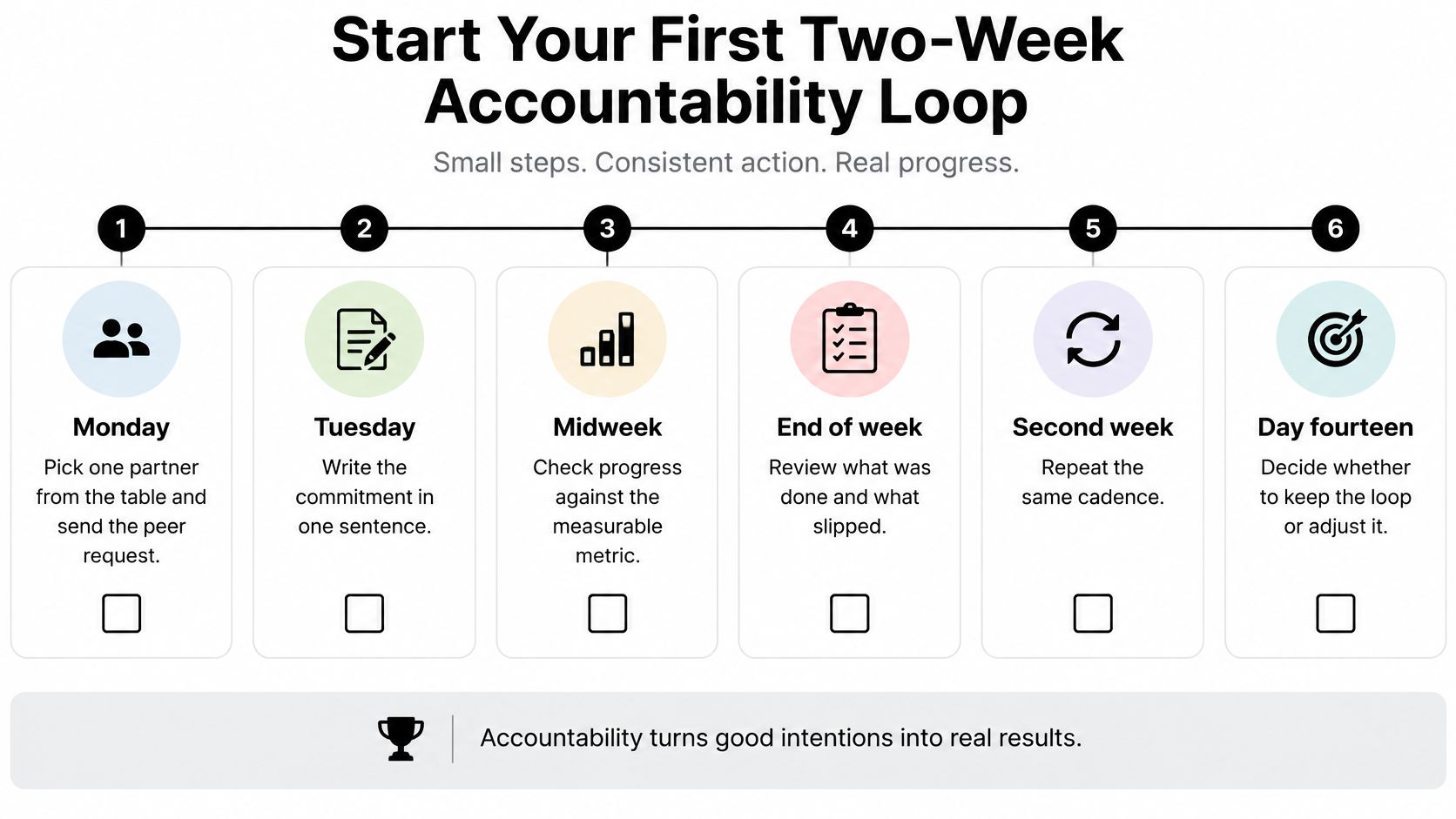
Day 1, choose your reviewers. Two people, maximum: one for review, one for structure. Send the 30-minute Friday request exactly as written and don’t soften it with apologies. If you already have a team lead, book the 10-minute daily handoff check instead of hunting for a peer.
Day 2, write three commitments. Three, not ten. Each one gets an if-then trigger, a minimum viable action, one log location and a repair clause for the morning it goes sideways.
Day 3, put the rituals in the calendar. The 5-minute morning note and the 30-minute Friday review are fixed. The handoff check is optional in week one, and skipping it is a legitimate choice rather than a failure.
Days 4 through 9, run it and log it. One shared place, one row per commitment, updated the same day. Delete every reminder that isn’t tied to a named outcome; that cleanup alone usually recovers a surprising amount of attention.
Day 10, hold the first review. Run the diagnostic questions, compute a completion rate, and make exactly one system change before the call ends. One change. Two changes means you’ll implement neither.
Day 14, decide. Keep the partner, adjust the cadence, or add a ritual, and use the symptom table as the checklist rather than your mood on the day. The loop is working when the review feels boring. Boring means the commitments are sized correctly, the owner is obvious, and nobody is performing enthusiasm to cover for a system that doesn’t exist.
If you’d rather install a working version than assemble one from parts, Steal My Build includes training, prompts, resources and included tools, with staged content delivery so each piece shows up when you’re ready to use it.
Jan Kutschera works with founders who have already proved they can sprint and want to stop living on adrenaline. The approach is the same one in this guide, scaled into a full operating system: written commitments, named owners, review cadences that catch a missed week before it becomes a missed quarter. Visit Jan Kutschera and start with the piece you’re missing first.
Jan Kutschera
German founder, diagnosed with ADHD at 51. Built 4 agencies, now building systems for neurodivergent entrepreneurs. German engineering for the ADHD brain.
Connect on LinkedInRelated Articles

Best ADHD Planner App for Founders: 10 Ranked Picks
Searching for the best ADHD planner app? We rank 10 founder-tested options on executive-function support, delegation, sync, privacy and pricing.
ADHD Project Management: Systems That Work with Your Brain
ADHD project management that works with your brain, not against it: external structure, visible tasks, smarter delegation and follow-through that lasts.
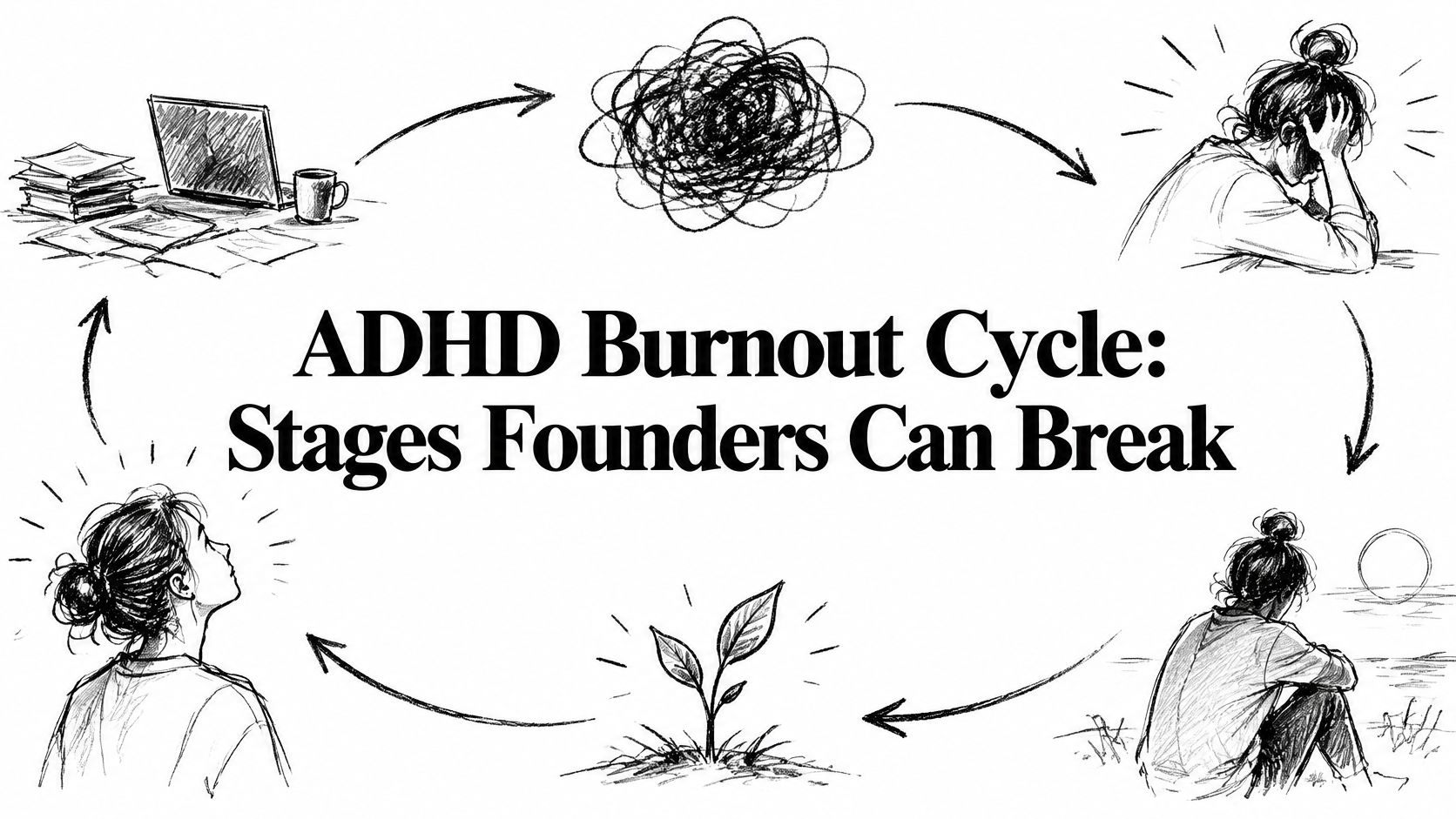
ADHD Burnout Cycle: Stages Founders Can Break
See the ADHD burnout cycle in five stages, separate it from depression, and test founder fixes before the next crash.