How to Run Effective Meetings for ADHD Founders
How to run effective meetings with timeboxes, roles, agendas, and follow-up built for neurodivergent founders who want decisions, not more calls.
Jan Kutschera
Your Tuesday had nine calls on it. One was double-booked, two existed because nobody read the thread, and the deck you opened four times never made it past slide four. By Wednesday morning, nobody could quote the pricing decision you made at 4:40pm.
Microsoft’s 2025 Work Trend Index puts a number on that week: employees were interrupted on average every two minutes by a meeting, email, or notification, and 57% of meetings were ad hoc calls with no calendar invitation at all (Microsoft WorkLab). If you have ADHD, that isn’t background noise. It’s an environment engineered against your working memory.
Meetings are where a company’s decisions happen, and they’re the one piece of operating infrastructure you can rebuild this week without buying anything. I treat a meeting as cognitive architecture: a structure that holds the question, the options, and the owner so nobody has to carry them in their head. Install five things and the calendar changes shape: a format card, a pre-call offload, a live decision loop, a scorecard, and a repair kit for the calls that still go sideways.
Table of Contents
- Meetings Cost More Than the Calendar Shows
- Meeting Formats Timeboxes and Roles
- Plan One Outcome Before You Send Invites
- Run the Clock and Lock Every Decision
- Follow Up with Owners Deadlines and Scores
- Fix Drift Silence and the Wrong Room
- Install the System on Next Week’s Calendar
Meetings Cost More Than the Calendar Shows
Say a founder’s week looks like this. Monday, six calls. Tuesday, five, one of which exists because two people disagreed in a Slack thread. Wednesday, a pricing decision made verbally at 4:40pm that three attendees will remember three different ways by Thursday. Friday arrives, the deck is unfinished, and every activity dashboard calls the week productive.
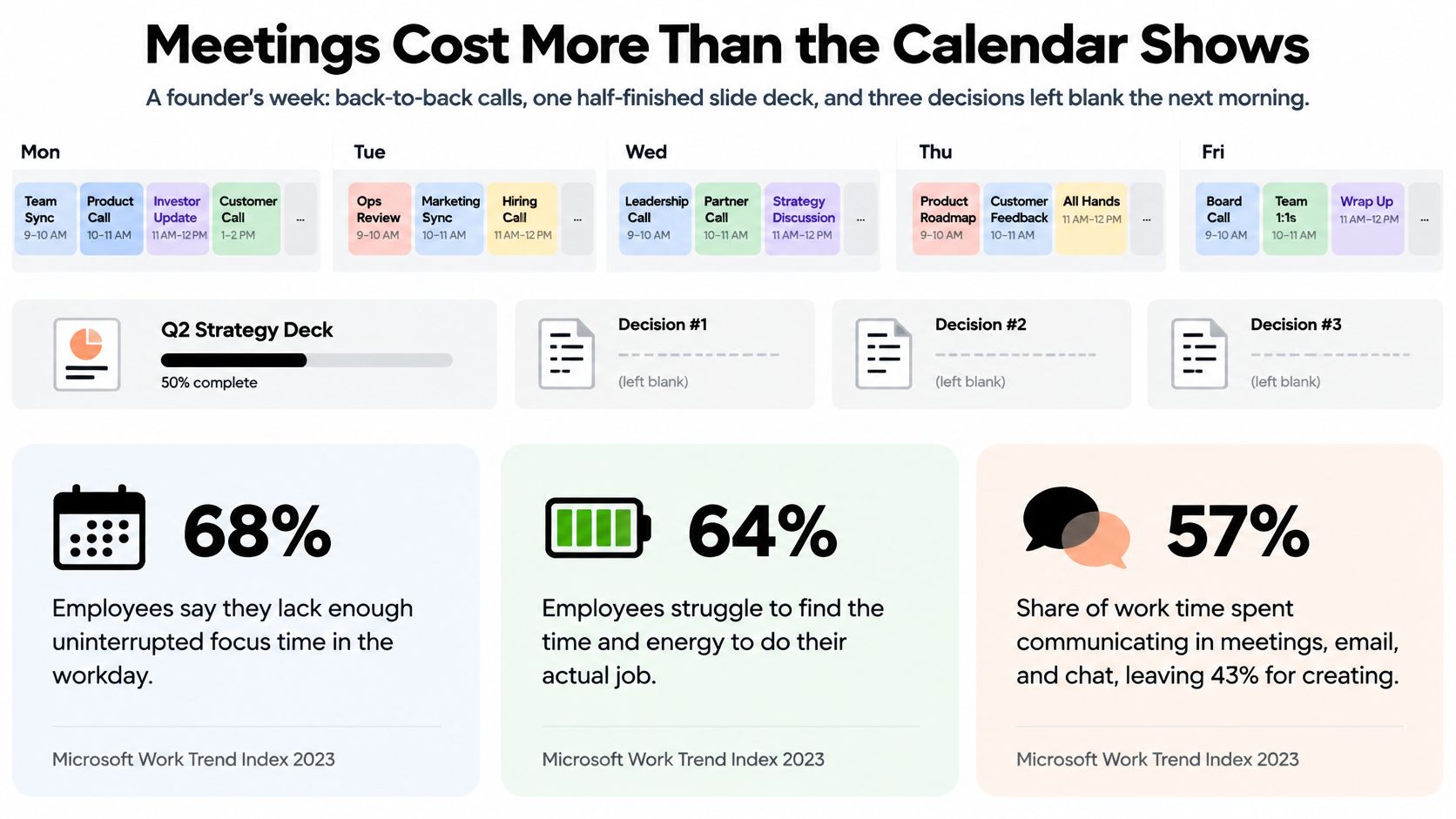
Microsoft’s 2023 Work Trend Index surveyed 31,000 full-time employees and self-employed workers across 31 markets between 1 February and 14 March 2023, and its ranking is worth taping to your monitor. Inefficient meetings were the number-one productivity disruptor. Unclear goals came second, too many meetings third, which tells you volume alone isn’t the problem. Employees were also joining 192% more Microsoft Teams meetings and calls per week than in February 2020, roughly three times as many.
Those calls are expensive because they eat the wrong budget. The same index found the average employee spent 57% of working time communicating through meetings, email, and chat, against 43% creating documents, spreadsheets, and presentations. Read that as a spending limit. Creation time is the minority stake in your own week, and every accepted invite draws it down.
Virtual rooms sharpened the friction. 58% said brainstorming was difficult online, 57% found catching up after joining late hard, 56% struggled to summarize what happened, and 55% left without clear next steps. Those four failures are executive-function failures, not effort failures. If you can’t summarize it and can’t see the next step, the meeting offloaded nothing, and your brain keeps chewing on it at 11pm.
You don’t need more discipline. You need architecture: one purpose named before anyone joins, one decision per agenda item, owners written down while people are still in the room.
The only test that matters: could a teammate who missed the call execute the work from the notes alone? If not, it was a conversation, not a decision.
Meeting Formats Timeboxes and Roles
Most meeting advice fails because it treats a pricing decision, a status update, and a coaching conversation as the same animal and prescribes the same 30 minutes for all three. A format card fixes that on one page.
The format card to paste into your calendar
| Format | Purpose | Default timebox | Who is in the room | Required output |
|---|---|---|---|---|
| Decision huddle | One yes, no, or choice | 15-25 minutes | Decider plus at most two experts | Recorded decision and rationale |
| Working session | Make the artifact | 45-50 minutes | Only the people doing the work | Draft, deck, or spec section |
| Weekly ops | Exceptions, not status theatre | 25 minutes | Function leads | Owner, due date, and blocker |
| One-to-one | Unblock and coach | 25-30 minutes | Founder and one person | One commitment each |
| Async update | Share information | No meeting | Written channel only | Comment or acknowledgement |
| Strategy block | Choose among options | 50 minutes | Small senior group with pre-reads | Chosen option plus what was rejected |
Six rows cover almost everything a founder schedules. The value isn’t in the rows themselves. It’s the discipline of picking one before the invite goes out and writing its output into the invite title.
Four roles and an invite rule that holds
Name the roles in the invite so the founder isn’t all of them by default:
- Decider: the person whose call it is. One name, not “the leadership team.”
- Facilitator: watches the clock and the parking lot, says the outcome aloud before moving on.
- Scribe: types the decision live, while people are still looking at it.
- Contributor: invited for a fact they hold or work they leave with.
On a small team, one person wears two hats. On a team of one, you wear four, which is precisely why it gets written down.
Invite rule: if someone isn’t deciding, supplying a missing fact, or leaving with work, they get the notes, not the slot.
Timeboxes earn their keep here. A timer turns “we should probably wrap up” into a visible boundary, and a boundary is different from a wish. If the problem is that duration evaporates rather than that you don’t care, these tools for managing time blindness are the companion set.
What the evidence says about shorter and smaller
The CIPD’s 2023 evidence review of productive meetings tested the assumptions behind most of this advice. It found no negative relationship between meeting duration and perceived effectiveness, so chopping every call to 25 minutes changes nothing on its own. It found no significant overall link between meeting size and effectiveness, though larger groups were associated with lower punctuality and attendee involvement. Lighting, temperature, comfort, and refreshments made a small contribution. The central test stayed the same: did the gathering help participants achieve meaningful work goals?
So treat the card as ADHD-friendly defaults tuned for attention and transitions, not commandments. A huddle is short because a yes-or-no doesn’t need 50 minutes. A strategy block is long because choosing among three written options needs room to think out loud.
If you want pre-built scaffolds to bend toward these formats, the OKR meeting agenda templates from The OKR Hub give you a starting structure instead of a blank document.
Pick one row this week. Write its output into the invite. Decline any meeting that can’t name that output, including your own.
Plan One Outcome Before You Send Invites
The meeting is decided before it starts, by whether someone wrote a single sentence naming what the hour must produce. Attention is variable. Working memory is expensive. The invite is where you offload both.
The six-move offload
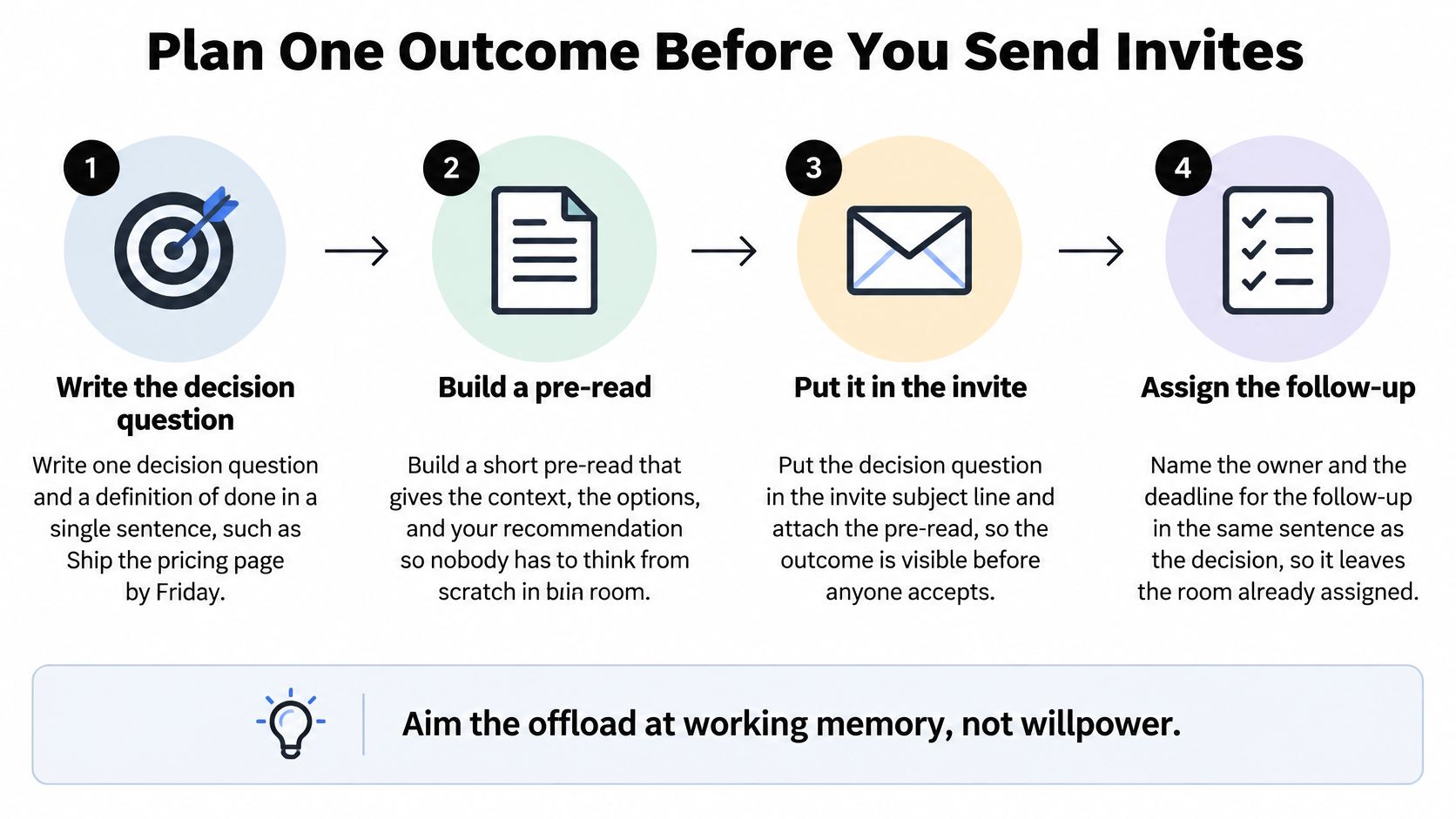
- Write one decision question and a definition of done. One sentence, specific enough to be wrong: “Ship the pricing page Friday if support can staff chat.” A sentence nobody can disagree with isn’t a decision question, it’s a mood.
- Label every candidate item. Information, discussion, or decision. Pure updates go to a written channel. A status round-robin is a message in a meeting costume.
- Send a one-page pre-read. Twenty-four hours ahead for a decision, 48 for strategy, with the question at the top and the options already listed. If nobody reads it, move the reading into the room and cut an item to pay for it.
- Build a five-line agenda. Outcome, pre-work, timed blocks running from the most important decision to the low-risk topics, a parking lot, and the close. A 25-minute huddle might get blocks of 3, 8, 8, and 6 minutes.
- Name facilitator, scribe, and decider in the invite. Default-mode founders become all three and then can’t think.
- Open the decision log and start the timer before anyone joins. A blank document opened after the call is a memory test with a hangover.
An agenda is not the intervention
The agenda gets overcredited. The CIPD’s scientific summary of the productive-meetings evidence puts formal agendas at only small associations with perceived effectiveness, around r = .14 to .18, while leader behaviour, goal clarity, focused communication, positive climate, and punctuality show more meaningful relationships. A tidy list of topics does not rescue a call with no decision to make.
Run the review’s five stages as architecture, not paperwork: define one decision or outcome before inviting anyone, send a concise agenda with time allocations and required preparation, assign a facilitator to enforce focused communication and equal airtime, close each item with a verbal decision summary, and publish owners, deadlines, and unresolved questions immediately afterward. Each stage removes one thing the brain would otherwise have to hold: why we’re here, what’s coming, who is steering, what was decided, and who owes what by when.
| Line | What it holds | Example |
|---|---|---|
| Outcome | One decision question and a definition of done | Ship the pricing page Friday if support can staff chat |
| Pre-work | What to read and by when | One page with two options, 24 hours ahead for a decision, 48 for strategy |
| Blocks | Timed sequence from the highest-impact decision to lower-risk topics | 3, 8, 8, and 6 minutes in a 25-minute huddle |
| Parking lot | Where a new idea goes without reopening the decision | Shared link, not a live debate |
| Close | How the item ends before the next block | Ten-second verbal summary, one owner, and a deadline |
For a founder with ADHD, the whole point is externalization. Don’t trust that you’ll remember who nodded, which option was rejected, or why. Write it while the room is still watching you type, because the visible record is the shared working memory the call keeps trying to borrow.
Pre-flight, six items: outcome sentence written, pre-read sent, items labelled, roles named, timer visible, decision log open. Miss one and the meeting starts in debt.
Run the Clock and Lock Every Decision
The pricing-page session is the test case. Twenty minutes in, someone asks whether the whole pricing model is right, and the room is suddenly debating brand positioning with fourteen minutes left. This is the exact moment where most founders lose the call and then describe it afterward as a good discussion.
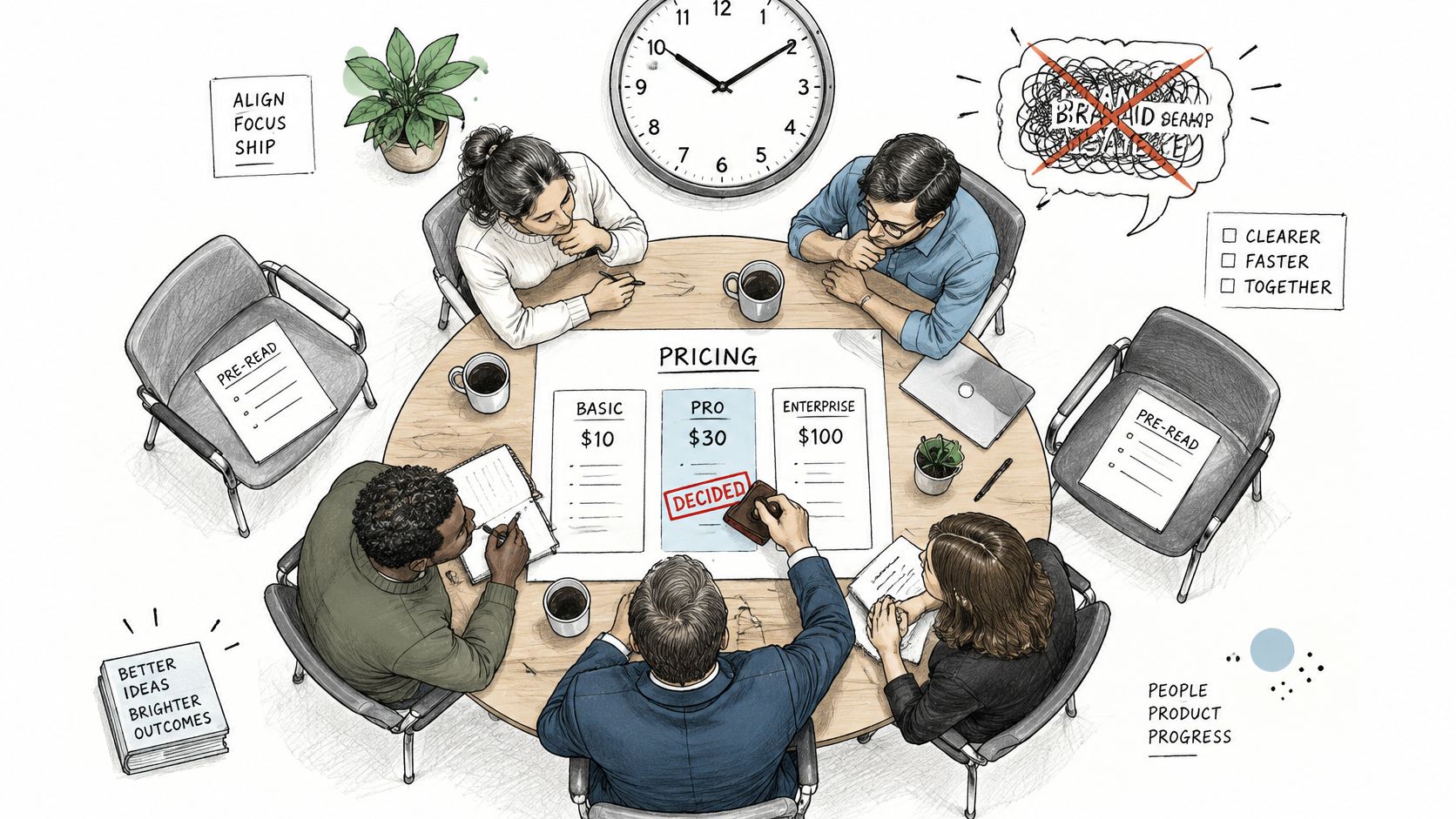
Start on time even if two people are late. Latecomers read the pre-read. A live recap for the benefit of the last arrival punishes everyone who showed up, and it trains the whole team to be late.
The loop that runs inside every block
Same six beats every time, said out loud so the room can hear the shape of the decision:
- State the objective in one sentence.
- Surface only the facts that were in the pre-read.
- Name two or three options, not a spectrum.
- Test cost and benefit in one pass.
- Choose.
- Assign implementation, with a name and a date.
When a novel idea spikes mid-block, the facilitator uses one sentence: “Parking that, back to the question.” The idea goes into the written parking lot, so creativity is kept rather than shamed, and the decision stays closed.
Parking lot principle: a new idea is not a reason to reopen a decision. It’s a line item for the next agenda.
Here’s the same mechanics walked through live, if watching beats reading.
The Cambridge Effective Meetings Toolkit reports that agenda use and ending on time correlate with perceived effectiveness, while meeting size and length do not. The same review identifies what poor organization costs: 44% reported insufficient time for other work, 43% unclear actions, and 38% loss of project focus. Those are the three symptoms that make a founder feel busy and behind at the same time.
The scribe types the decision, the rationale, the single owner, and the deadline while people are still looking at the slide. Close each item with a ten-second verbal summary before the next block opens. End on time even if the last item has to be escalated, because the next hour belongs to someone’s creation work, including yours.
Then finish with a short reward beat, because punishment doesn’t sustain a habit. The scribe reads the wins, each owner hears their own name and date, and you mark the outcome done in the log. That beat replaces the adrenaline of a sprawling debate with something repeatable.
The benchmark isn’t “everyone spoke.” It’s a recorded rationale, one accountable owner, and nothing that rolls into next week’s agenda.
Follow Up with Owners Deadlines and Scores
Retrieval fails if the recap waits until evening. Fifteen minutes after the call, while the decisions are still warm, the scribe publishes three blocks and nothing else: decisions with their rationale, actions, and unresolved questions with a next home.
Every action carries five fields. One owner. A definition of done. A deadline. Where the work lives. What “stuck” looks like. That last field is the one that stops you from becoming the human reminder system. No co-owners either. If two people must touch it, name the accountable one and the contributor, because “we” is how an action dies politely.
An ownerless action is a project with no home, and the same logic governs how work stays visible between meetings, which is where ADHD-friendly project management earns its keep. If the tracking habit is the weak link rather than the meeting itself, AIDictation’s guide to action item tracking goes deeper on the mechanics of keeping assignments alive after the room empties.
The scorecard that decides whether a recurring call survives
| Metric | Keep threshold | How to log it | If it misses |
|---|---|---|---|
| Agenda tasks completed | Four of five planned blocks done | Done versus planned blocks | Shorten the agenda or split the format |
| Actions with one owner and a due date | Every action | Five-field handoff rows | Do not end the item; assign before leaving |
| Decision latency | Same day for a huddle, 48 hours for strategy | Timestamp on the decision log | The topic wasn’t ready; move it async |
| Creation time protected | Founder creation blocks left intact | Calendar audit after the week | Delete the recurring hold |
Run a two-week experiment instead of importing someone else’s standup culture. Week one keeps the current rhythm and logs those four numbers. Week two deletes the meetings that fell under the bar and replaces status rounds with written updates. The scorecard decides, not the vibe in the room.
Take one worked row. A weekly ops books 25 minutes, closes four of five items, and leaves one action with no owner. It doesn’t get a pep talk about accountability. It gets rewritten with a shorter agenda, or it gets cancelled.
Judgement call: a recurring meeting that can’t beat these lines for two consecutive cycles is not a meeting. It’s a habit with a calendar entry.
Fix Drift Silence and the Wrong Room
Some calls still fail after the format card, the pre-read, and the timer are in place. The efficient move is one repair for the next occurrence, then leave the rest of the system alone that week.
| Symptom | Likely cause | Single fix |
|---|---|---|
| The call leaves the decision question | Novelty-seeking topic drift | Parking lot plus a spoken return to the question |
| People freeze or talk over each other | Uneven processing speed | Five-minute silent write before discussion |
| Late joiners restart the meeting | No external context | Pre-read and no live recap |
| The room is polite and useless | Too many spectators | Cut to decider, needed experts, and doers |
| Updates consume the slot | Information disguised as a meeting | Move it to the async channel |
| The same item returns next week | No owner or kill rule | Assign a date or remove it from the agenda |
The room choice nobody audits
Hybrid is the standard compromise, and the evidence disagrees with it. A 2024 ACM field study comparing remote and hybrid formats found that fully remote meetings were perceived as more inclusive and effective overall: 50% of respondents rated remote meetings more effective than either hybrid format, while only 25% ranked remote meetings worse than both (ACM Digital Library). Adding a video link to a room conversation may create a less equitable format than standardizing the meeting as remote for everyone.
So decide mode by inclusion and decision quality, not by who already shares a desk. If one person is remote, everyone joins remote. Rotate the hard time zone rather than asking the same three people to take 6am calls. Put the identical written pre-read in front of every zone, because a spoken briefing reaches whoever happens to be awake.
The same logic fixes the meeting that survives on politeness. Cancel an update item, or an action with no owner, instead of adding another channel to discuss it. Silence in a meeting is usually a processing-speed problem or an invite-list problem, and the guide to team communication covers the async side of both.
Try it on the next call: all remote, camera optional, decision log open before the first word.
Install the System on Next Week’s Calendar
Don’t rebuild the calendar. Rebuild one recurring meeting, the one that most often ends with nobody owning anything.
Rename it with its output, something like “Pricing page: ship or slip.” Attach the matching row from the format card, send the one-sentence outcome 24 hours ahead, drop the shared decision log into the invite, and name a facilitator and a scribe even if that’s the same person wearing two hats.
Run it once. Within 15 minutes of the close, publish the five-field handoff. Score it the same day against the four lines: four of five planned blocks done, every action with one owner and a date, decision latency inside a day for huddles and 48 hours for strategy, creation blocks still intact. If the same hold misses those lines for two cycles, cancel it and keep the hour.
This is what the method behind adhd-founder.com calls Cognitive Architecture, one of four pillars alongside Dopamine Engineering, Strategic Delegation, and Bio-Optimization. When a live working session beats another article, a booked System Sprint is the attended version.
The trade is simple: fewer meetings, notes a teammate can execute without you, and an hour left to build something.
If your calendar keeps winning, Jan Kutschera builds the external structure that gets it back, using Cognitive Architecture, Dopamine Engineering, Strategic Delegation, and Bio-Optimization rather than willpower. A System Sprint is the live, booked working session where your worst recurring meeting gets rebuilt on the call, with the preparation and follow-up materials to match. Start at Jan Kutschera and bring the meeting that most reliably ends without an owner.
Jan Kutschera
German founder, diagnosed with ADHD at 51. Built 4 agencies, now building systems for neurodivergent entrepreneurs. German engineering for the ADHD brain.
Connect on LinkedInRelated Articles
Time Management for Entrepreneurs Without the Panic
Time management for entrepreneurs with ADHD: a weekly split, capacity calendar, batching, and delegation specs that replace panic productivity.
ADHD Paralysis Symptoms and How to Restart
ADHD paralysis symptoms explained with freeze patterns, likely drivers, and a first move that restarts the stuck task.
Dopamine Reward System Addiction Explained for Founders
Dopamine reward system addiction explained: why deadlines feel like drugs, how craving loops form, and how founders can rebuild the loop without burnout.