
Accountability Partner App: 10 Picks for ADHD Founders
Compare 10 accountability partner apps for ADHD founders: how each works, setup workflows, privacy and pricing trade-offs, and which fits your needs.
Jan Kutschera
It’s 9:40 on a Tuesday. The quarterly plan is due, your calendar has four meetings, and you’ve spent an hour reorganizing your inbox. At least the folders look confident.
An accountability partner app promises to fix this kind of morning. But the options range from a stranger on a video call to a commitment that charges your card. Those aren’t interchangeable solutions. One helps you open the document. Another makes ignoring it expensive.
Ten ways other people can keep you honest, and where each one breaks, is the useful comparison. The picks below prioritize the problems ADHD founders need to solve: starting, staying with a work block, following through, and keeping costs and personal data under control.
- Body doubling gives you a scheduled place to work alongside someone.
- Partner matching adds recurring conversations about commitments.
- Habit sharing makes routines visible to someone you trust.
- Financial stakes attach a consequence to missing a measurable target.
Delegation needs an extra layer. A coworking partner can help you write the brief, but they can’t make your employee accept ownership. To build accountability across ecommerce teams, connect personal commitments to named owners, explicit deliverables, and agreed review points. Otherwise, you’re just procrastinating in company.
Table of Contents
- 1. Focusmate
- 2. 95
- 3. Focused Space
- 4. Supporti
- 5. Flow Club
- 6. Deepwrk
- 7. HabitShare
- 8. Aspra
- 9. Forfeit
- 10. Beeminder
- How the 10 accountability partner apps compare on format, free access, and platforms
- Choose the Mechanism First, Then the App, Before Your Next Missed Deadline
1. Focusmate
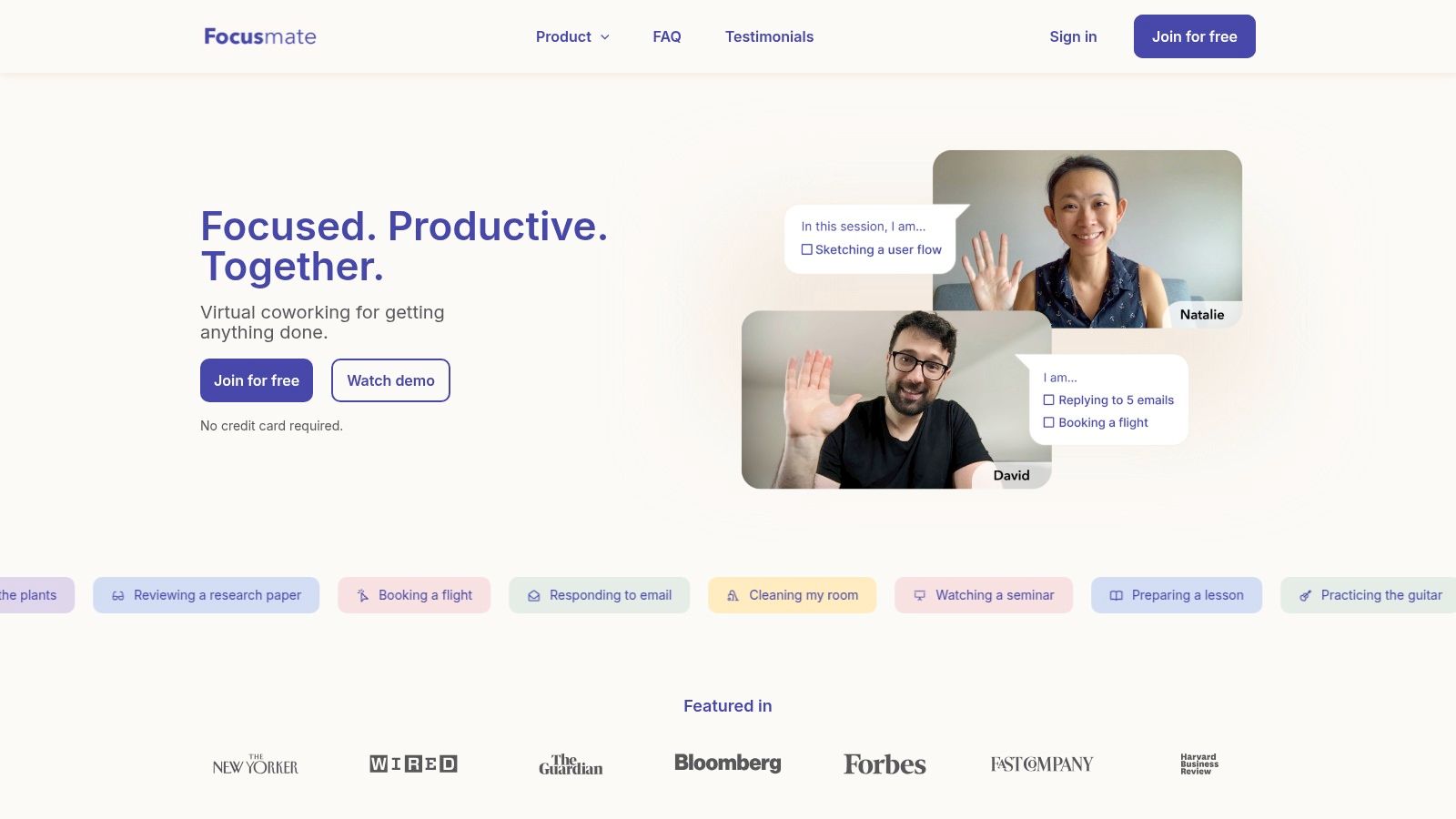
Best for starting the task you already understand. Focusmate pairs you with another person for a scheduled video work session. You state your intention, work attentively, and report back at the end.
That’s a useful boundary when the alternative is negotiating with yourself until lunch. Pick a visible deliverable before joining: draft the proposal introduction, reconcile the outstanding invoices, or finish the delegation brief. Don’t arrive with the intention to work on the business. That phrase can accommodate almost any browser tab.
Where the structure helps
The practical value of ADHD body doubling is the external appointment. You’re no longer deciding whether to begin while simultaneously deciding what to do.
- Starting: Schedule the session against your avoided task, not your easiest admin.
- Staying: Keep the declared deliverable visible beside your document.
- Handoffs: Use the block to prepare instructions, then send them through your normal team system.
The free tier makes an initial test possible, while paid access suits more frequent use. Check the current allowance and billing terms before subscribing.
Who it will frustrate: founders who dislike staying visible on camera or want someone to challenge their priorities. Your partner is a coworking companion, not a supervisor, project manager, or ADHD specialist.
Keep confidential documents off shared displays. Describe the work at a safe level, such as preparing a client proposal, rather than explaining the client’s financial situation.
2. 95
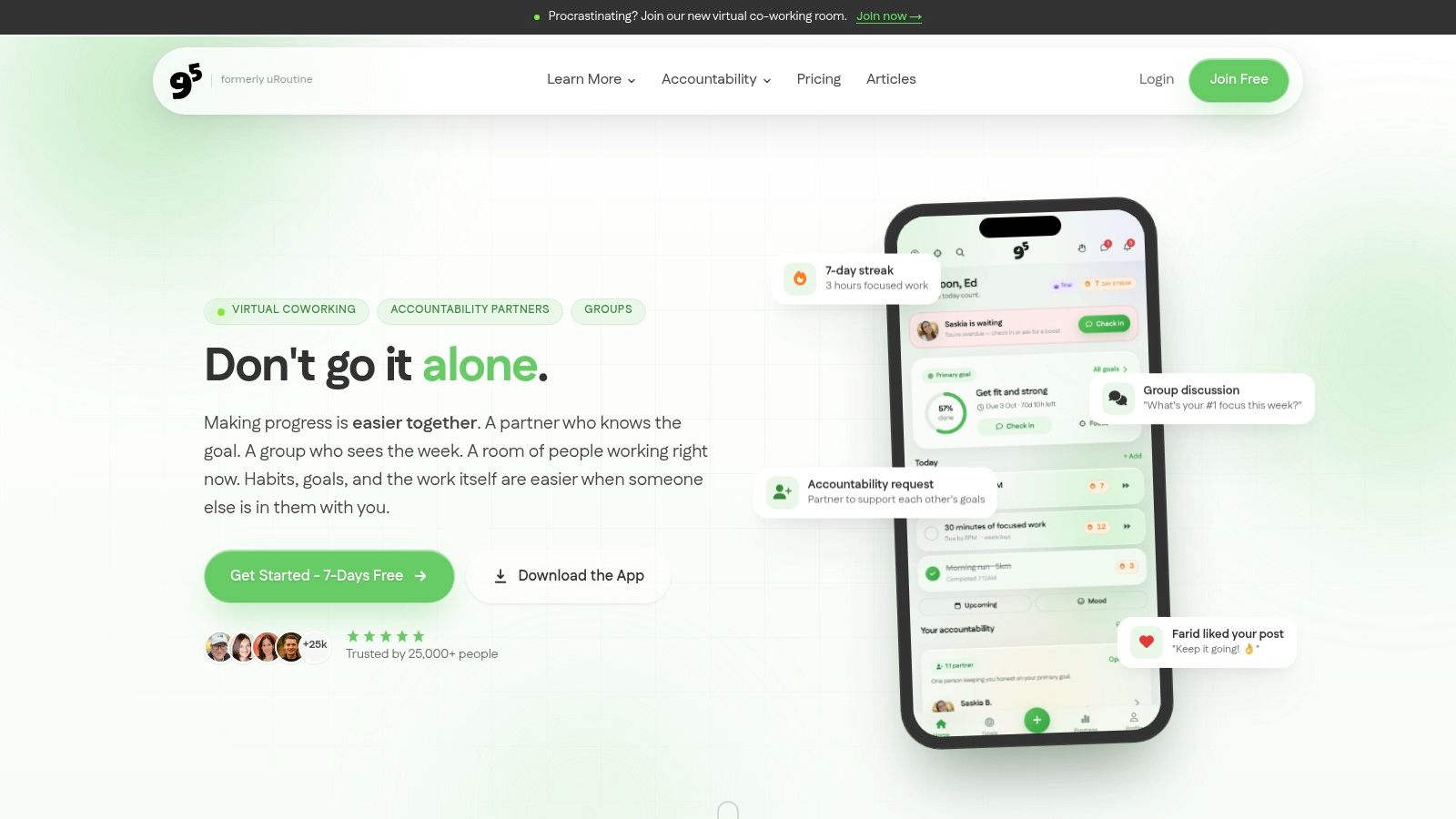
Already know someone who’ll notice when you disappear? Start with that relationship rather than shopping for a stranger. 95 combines goals, habits, check-ins, partner options, and webcam-free coworking.
You can invite someone you trust or explore paid matching and groups. Matching considers factors such as goals, time zone, intensity, and communication preferences. That makes it a flexible candidate when you need both work sessions and follow-through between them.
Choose a narrow starting setup
The danger is configuring every available format before making a commitment. A goal dashboard can become a beautifully organized substitute for doing the goal.
- For task initiation: Try the shared coworking timer without adding a complicated tracking routine.
- For follow-through: Agree on a specific check-in and what evidence of completion looks like.
- For delegation: Track your responsibility to send the brief, answer questions, or approve the result, not your colleague’s entire workload.
The webcam-free room is particularly relevant if being watched adds friction rather than focus. You still get shared work time without turning your home office into a broadcast studio.
Who it will frustrate: anyone who wants an immediate, single-purpose experience. The range of options requires decisions, and a new match may not provide lasting continuity.
Matching and groups require Premium. Separate the feature you need from the features you might someday use, and share only the goal detail your partner needs.
3. Focused Space
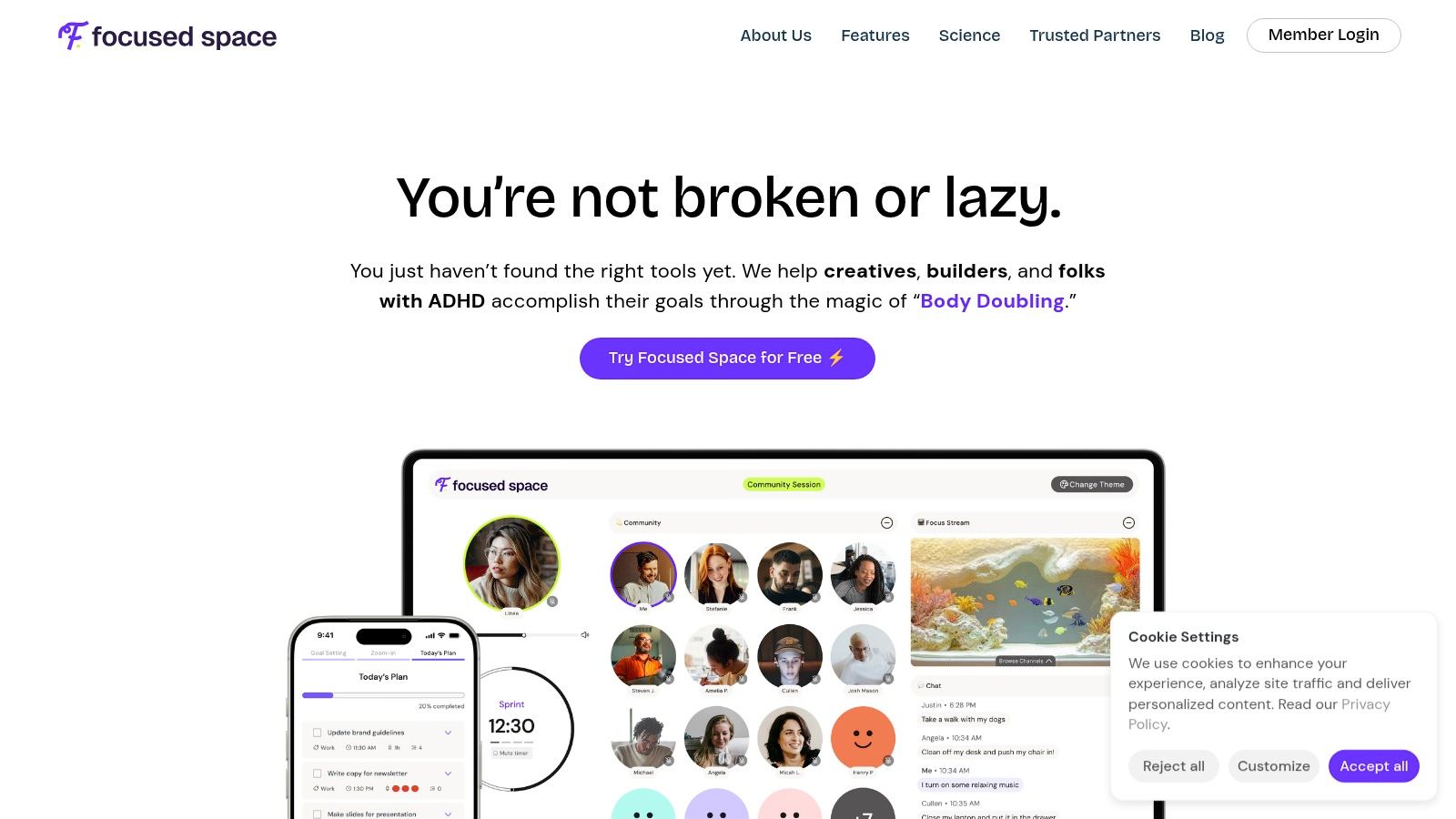
Focused Space suits founders who want someone else to run the room. Focused Space offers hosted online coworking, goal tracking, and community features, with positioning that includes creatives, builders, and people with ADHD.
Unlike a private partner arrangement, the hosted format doesn’t depend on you maintaining a relationship before you can work. You attend a scheduled session and use the structure already in place.
That’s helpful when the task itself is manageable but organizing your working day isn’t. Protect the session in your calendar, silence team notifications, and prepare the relevant document before it begins. Scheduling focus while leaving every interruption switched on is optimistic performance art.
Practical rule: Book the work block around a deliverable, not a mood. Feeling ready shouldn’t be an admission requirement.
Membership versus occasional rescue
Individual and team access options make this worth considering for recurring use. Monthly billing is also a less committed way to assess fit than immediately choosing an annual plan.
The trial converts to a paid plan unless canceled, so record the cancellation deadline when you enroll. Don’t assign that job to Future You without a calendar event.
Who it will frustrate: occasional users and people who find group presence distracting. A hosted room won’t automatically solve unclear priorities or missing handoffs.
Pair the session with environmental preparation from a focus guide for remote professionals. The host supplies structure; you still need to close the inbox.
4. Supporti
Opening the document isn’t always the problem. Sometimes you begin enthusiastically, then abandon the commitment when another priority gets louder.
Supporti focuses on ongoing mutual accountability through matched partnerships, daily actions, progress tracking, and in-app messaging. You can continue with a buddy or request another match.
Before joining, define your accountability partner’s role. Decide whether you want encouragement, a direct question, or help reducing an unrealistic commitment. Otherwise, you may receive cheerful applause when you need someone to ask whether you sent the proposal.
Continuity has a social cost
A peer-reviewed study of mobile digital interventions found that adding peer-support accountability groups didn’t significantly increase app use beyond an orientation session alone. A social feature isn’t automatically a working accountability system.
Make the relationship operational:
- Commit clearly: Name an action you control, such as sending the revised brief.
- Report clearly: Distinguish completed, partly completed, and blocked.
- Recover deliberately: Agree what happens after a miss, without turning the conversation into a character assessment.
Who it will frustrate: founders who don’t want daily messaging or resent the reciprocal work of supporting someone else. Partner responsiveness also affects the experience.
Supporti becomes a paid subscription after its trial. Use the trial to assess the communication burden, not just whether you like the interface. A pleasant chat is useful, but it isn’t the same as completed work.
5. Flow Club
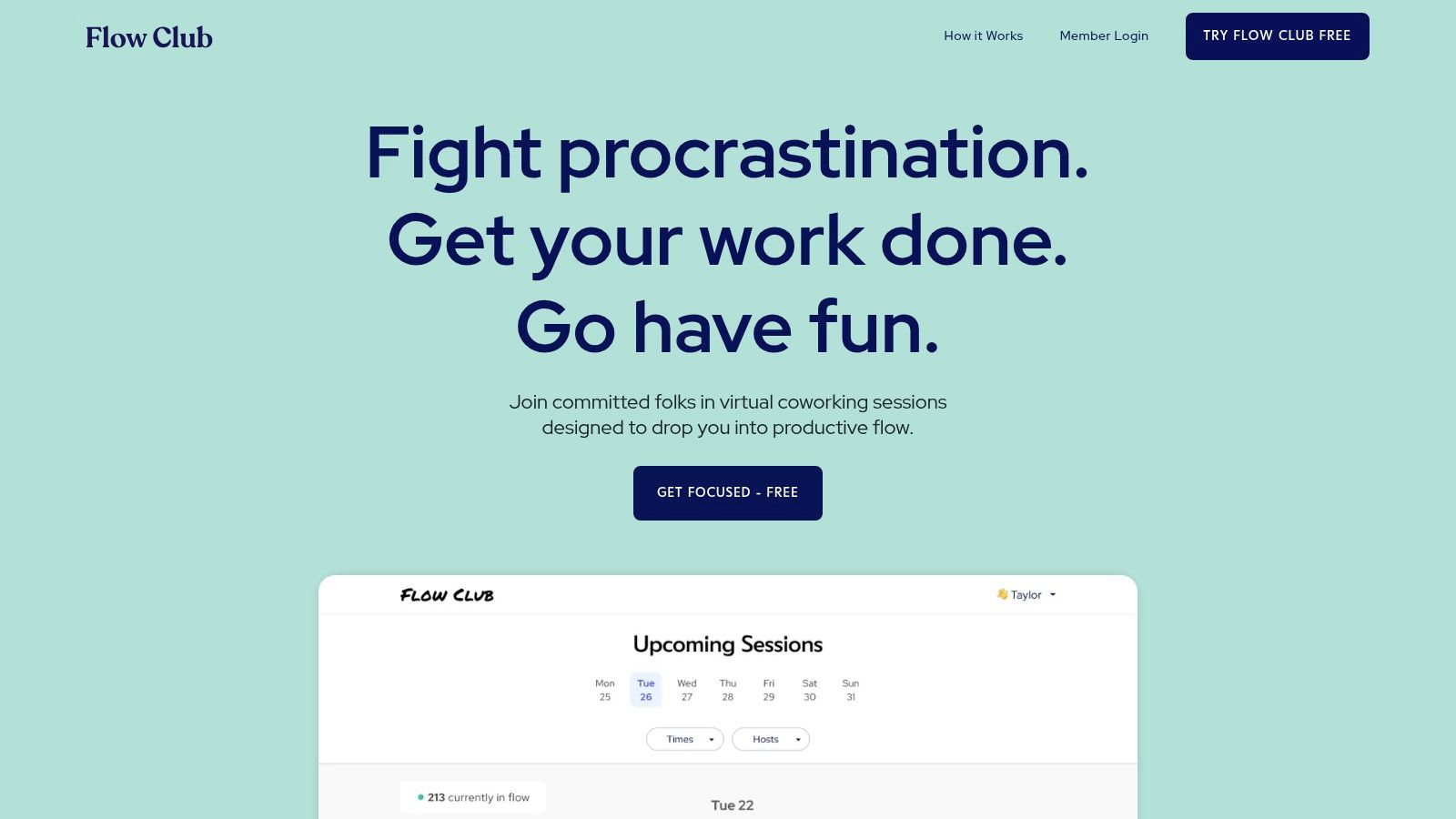
Choose Flow Club when you want a group rhythm without being responsible for hosting it. Flow Club runs facilitated virtual coworking with intention-setting, quiet work, and a closing reflection.
You can participate through chat, and camera-off options reduce the barrier for people who don’t want a continuous video presence. That makes it meaningfully different from choosing a private video partner.
The host supplies boundaries. You supply a task small enough to finish, or at least move to a defined stopping point.
Use the debrief for decisions
Don’t make the closing reflection a vague report that you were busy. State what changed and what happens next.
- Starting: Open the exact file before the work period begins.
- Staying: Park unrelated ideas in a scratch document rather than following them.
- Delegating: End with the brief sent, the owner identified, and the next review scheduled.
A group can feel less intense than a private pairing. It can also become another room in which you compare your output with everyone else’s. Keep your attention on your own commitment.
Who it will frustrate: founders seeking detailed project management or people who find shared-room energy distracting. Attendance doesn’t establish whether you chose the right task.
Treat membership as a recurring operating expense, not a motivational souvenir. Check current pricing and any eligibility-based discounts before paying, then judge value by sessions you use. Keep client names and sensitive internal details out of shared goals.
6. Deepwrk
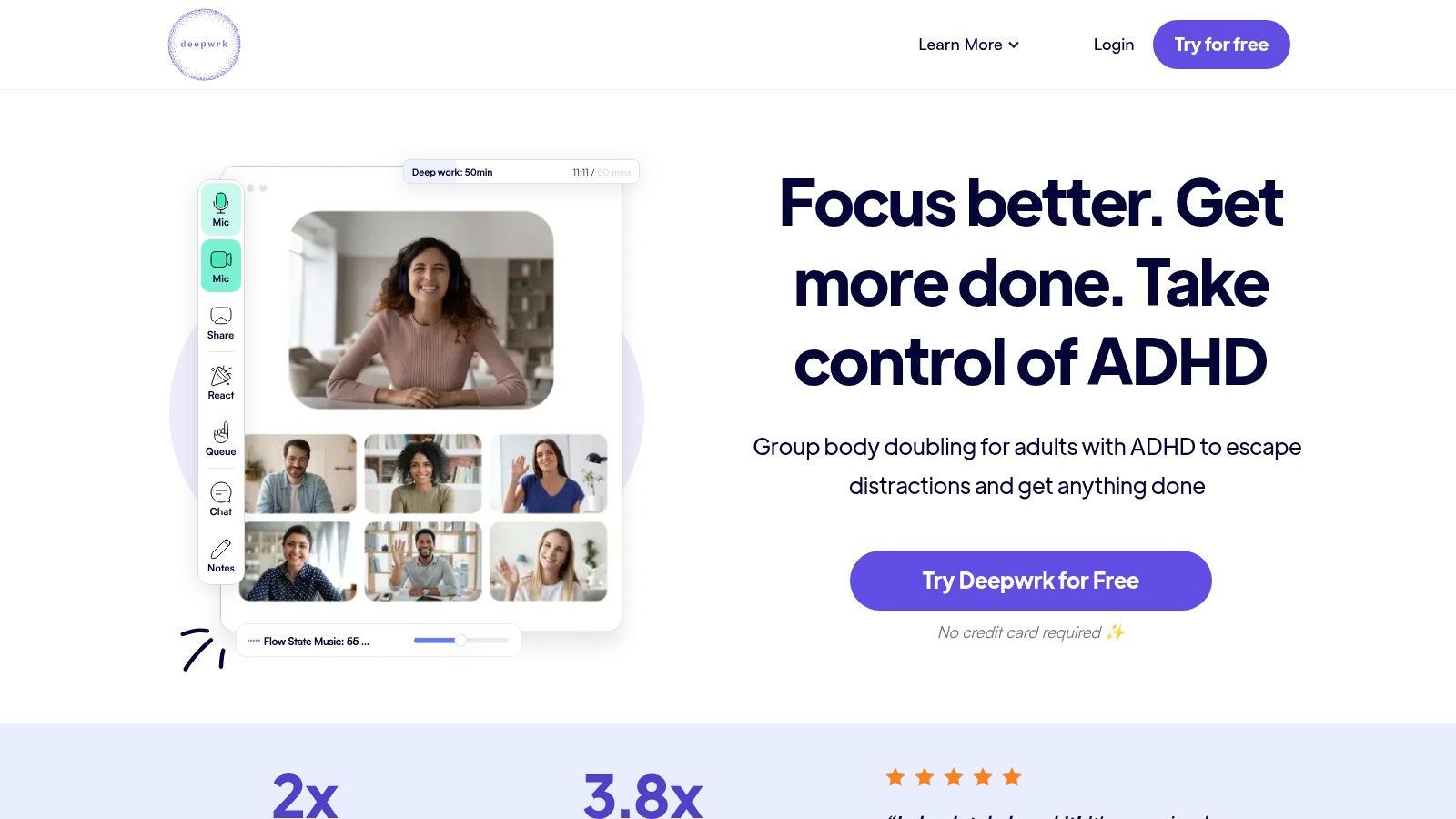
Say you’ve reached your desk, opened the task, and immediately started redesigning the process around it. Deepwrk is worth considering when you need a ready-made work routine.
Deepwrk offers facilitated body-doubling sessions geared toward adults with ADHD. Sessions follow an agenda of task-setting, focused work, and a recap, with planning events and community support also advertised.
Optional camera use matters on low-capacity days. You can seek structure without making looking presentable another prerequisite for starting.
Bring work, not an entire backlog
Choose a task with a clear boundary. Drafting the handoff instructions fits better than fixing operations.
The session agenda reduces decisions about how to begin, but it doesn’t remove decisions about priority. Use time management apps for ADHD to hold deadlines and capacity outside the coworking room, rather than expecting a session calendar to become your complete business system.
A work block is successful when you move the right commitment forward, not when you remain impressively seated.
Who it will frustrate: founders who need a consistent private partner or whose tasks don’t fit a fixed session format. A group host can facilitate the room without understanding your company’s dependencies.
A trial is advertised without requiring a credit card. Confirm checkout currency before purchasing because the pricing information includes different currency denominations.
For confidential work, share a sanitized task description. Preparing a staffing plan says enough; naming the employee under discussion says too much.
7. HabitShare
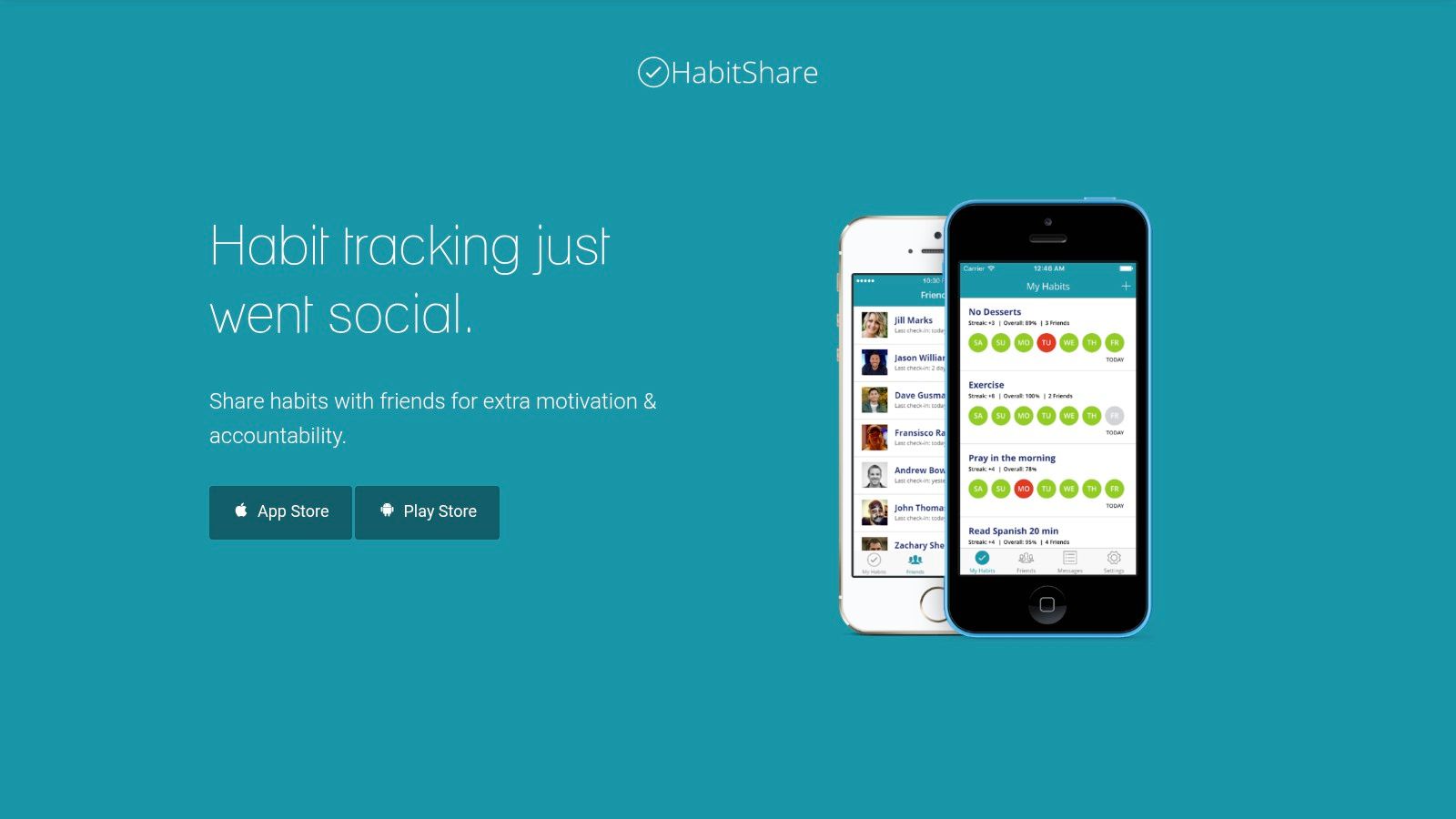
Not every commitment needs a video call. HabitShare fits recurring routines that benefit from quiet visibility. HabitShare is a free social habit tracker for iOS and Android, with selective sharing and reminders.
You bring the partner. You also choose which habits they can see, while keeping others private.
That makes it a sensible fit for a planning routine, movement break, or end-of-day handoff review. It’s less suitable for a launch with dependencies, approvals, and shifting deadlines. A checked box can’t explain why legal hasn’t approved the contract.
Share the behavior, not the whole business
Use habit descriptions that preserve confidentiality. Review pending approvals is safer than a habit containing client names or personnel issues.
- For continuity: Track a repeatable action rather than an ambitious outcome.
- For delegation: Track whether you reviewed blocked work or answered outstanding questions.
- For recovery: Agree that a missed entry prompts a helpful question, not a lecture.
That distinction matters because satisfaction and continued use aren’t interchangeable. An evaluation of the Adult ADHD App recorded more than 18,000 downloads, while about 6,400 people returned after initial use.
Who it will frustrate: founders who need matching, live work sessions, or milestone discussions. HabitShare can make a routine visible, but it won’t supply an engaged partner.
The free model lowers the financial barrier. Your real investment is remembering to log and choosing someone who’ll respond constructively.
8. Aspra

Aspra is the quieter option for an existing partnership. Aspra supports solo use or a paired setup, with selected shared goals and actions alongside private goals and journal entries.
There’s no need to join a larger community to make the arrangement useful. Invite someone who already understands your boundaries, then agree which commitments belong in the shared space.
This suits founders who want visibility without a social feed. The service also says it doesn’t rely on streaks or leaderboards. Your quarterly plan doesn’t need a podium.
Selective sharing isn’t a full privacy policy
Per-goal visibility is valuable, but it doesn’t answer every question about storage, deletion, or third-party access. A review of mental-health app privacy practices found that 48% lacked an account-deletion option, which makes deletion worth checking rather than assuming.
That finding isn’t an assessment of Aspra. It’s a reason to examine any app before entering sensitive founder notes.
- Share selectively: Publish the next action, not confidential background material.
- Keep handoffs separate: Your partner can see that you sent a brief without receiving the brief itself.
- Check billing: The Partner plan lets the invited person join free, but review renewal terms before choosing a billing period.
Who it will frustrate: Android users, people who need partner matching, and founders who want group coworking. Aspra is iPhone-only and expects you to bring the relationship.
9. Forfeit
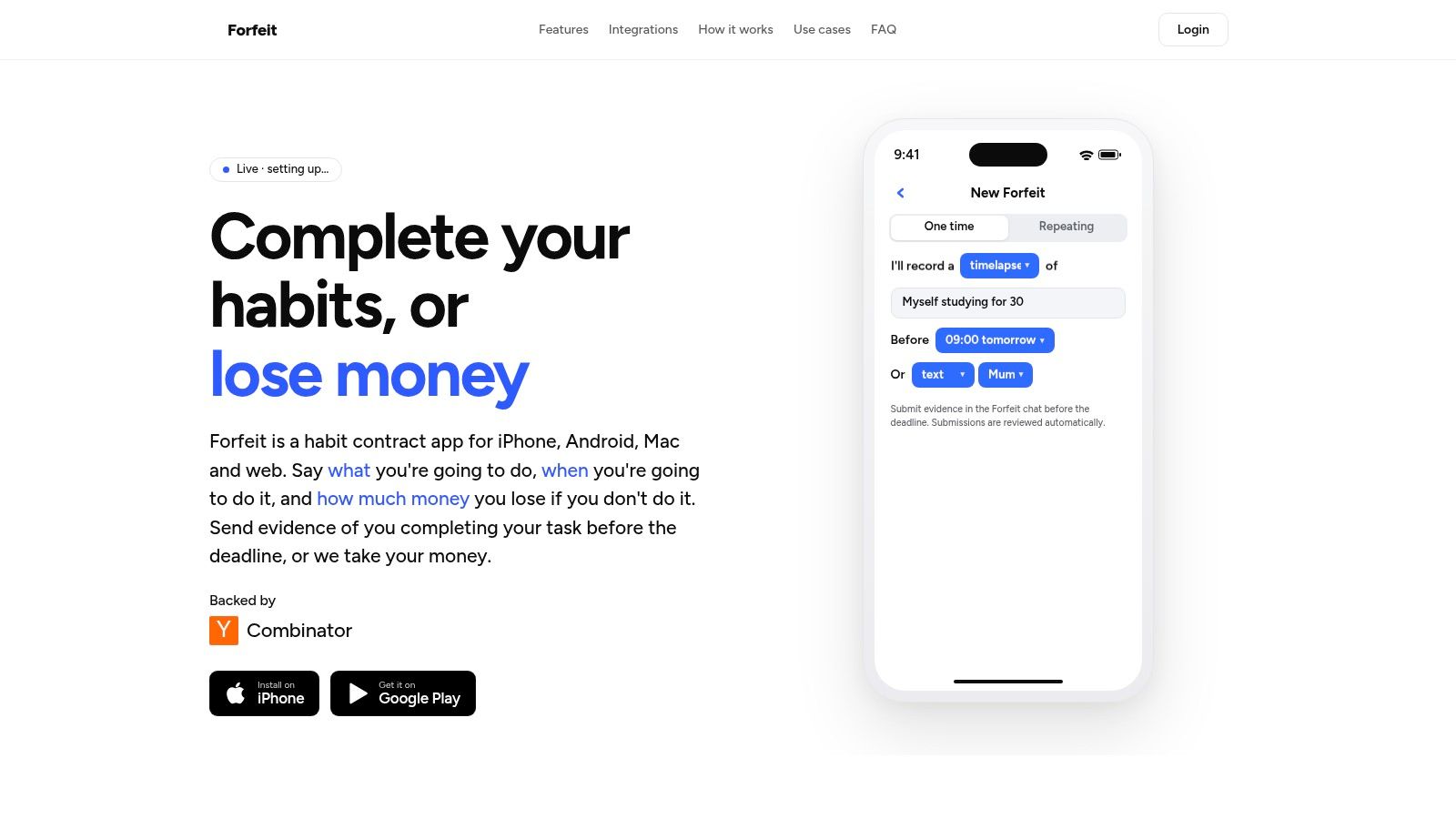
A financial consequence is a different mechanism from encouragement. Forfeit suits bounded commitments you control and can verify. Forfeit lets users set deadlines and monetary stakes, then verify completion through evidence or connected data.
It also offers blocking features and AI accountability functionality. Those can add enforcement, but enforcement won’t tell you whether the task was sensible.
Submitting a redacted screenshot of a completed draft is a plausible use. Staking money on a client approving that draft isn’t. You don’t control the client, however persuasive your follow-up email becomes.
Set limits before motivation spikes
Keep the subscription cost separate from the money you could lose on commitments. Both belong in your budget.
- Cap exposure: Decide what you can comfortably lose before creating stakes.
- Test verification: Confirm that acceptable proof is practical and doesn’t expose client information.
- Review permissions: Enable only the access needed for the specific mechanism you’ll use.
Boundary: Don’t put money behind an outcome controlled by a client, colleague, investor, or delivery dependency.
Who it will frustrate: founders already operating under financial stress, people who overcommit when enthusiastic, and anyone who needs supportive problem-solving rather than consequences.
After a miss, examine ambiguity, capacity, and dependencies before raising the stakes. A larger penalty doesn’t clarify a vague brief.
Treat AI-generated task breakdowns and suggestions as drafts. Review them against your actual workload, and don’t upload confidential material merely to make verification convenient.
10. Beeminder
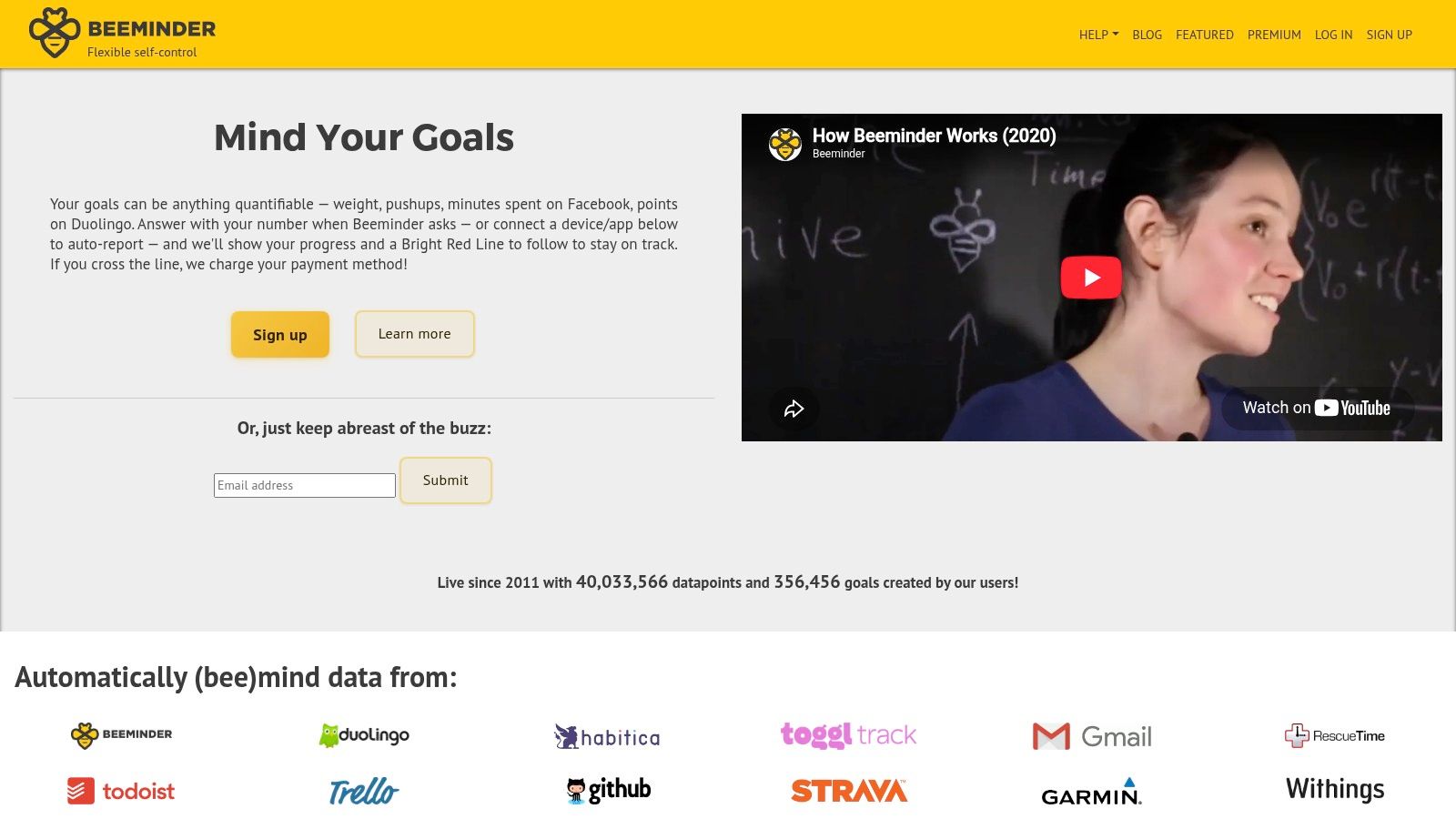
If graphs help you confront drift before a deadline becomes a fire, Beeminder is the more quantitative financial-stakes option. Beeminder tracks measurable progress against a required pace, with monetary pledges that can trigger when you fall behind.
You can log manually or connect supported data sources. Integrations can reduce logging work, but they don’t remove the need to choose a useful measure.
Focused-work time is measurable. Building a healthy company is not a clean daily input. Don’t squeeze the latter into a graph just because the graph is available.
Measure behavior without rewarding busywork
Choose an action that supports the business outcome without pretending to be the outcome itself. A planning review or a completed documentation routine is easier to define than strategic progress.
For delegation, consider your own recurring responsibility, such as reviewing blocked tasks. Don’t measure how many messages you send your team. They’ve suffered enough.
- Starting: Set a conservative pace that remains realistic during a difficult week.
- Staying: Use compatible tracking where it reduces admin rather than creating more.
- Cost control: Understand pledge escalation, subscription options, and goal-change rules before committing.
Who it will frustrate: founders who dislike setup, work on highly variable projects, or turn every metric into a competitive sport against themselves.
Beeminder is better suited to sustained measurable behaviors than complex deliverables. If you keep adjusting the definition to protect the graph, simplify the commitment. The business needs reliable action, not creative accounting.
How the 10 accountability partner apps compare on format, free access, and platforms
| Item | Accountability format | Free option | Platforms |
|---|---|---|---|
| Focusmate | Scheduled one-to-one coworking with check-ins | Free sessions available | Browser-based video |
| 95 | Goals, habits, partner or group check-ins, and coworking | Invite a known partner; matching and groups require Premium | iOS, Android, web |
| Focused Space | Hosted coworking sessions, goal tracking, and community | Free trial; converts to paid unless canceled | Online sessions |
| Supporti | Matched one-to-one buddy with daily actions and check-ins | Free trial; then paid subscription | iPhone, Android |
| Flow Club | Hosted group coworking with goal-setting and reflection | Free option not stated | Online sessions |
| Deepwrk | Facilitated group coworking with task-setting and recap | Free trial advertised; no credit card required | Online sessions |
| HabitShare | Friend-visible habit tracking | Free | iOS, Android |
| Aspra | Shared goals and actions for two people | Invited partner joins free with a paid Partner plan | iPhone |
| Forfeit | Personal commitments with stakes and completion verification | Free option not stated | iOS, Android, Mac, web |
| Beeminder | Measurable goals tracked against a progress line, with pledges | Free access details not stated | Web, mobile |
The formats point to different failure points. Scheduled coworking gives a task a start time; shared habits keep recurring actions visible; partner matching adds ongoing interaction; financial stakes attach a cost to missed targets. Free access and device support vary, so check the offer before building a routine around a particular app.
Choose the Mechanism First, Then the App, Before Your Next Missed Deadline
Start with the failure you see most often. If you can’t begin, try scheduled body doubling through Focusmate or Focused Space. If you start but lose the block, a hosted format such as Flow Club or Deepwrk may provide clearer boundaries.
For recurring routines, HabitShare or Aspra can make a commitment visible without scheduling another call. Supporti and 95 suit people who want ongoing partner interaction. Beeminder and Forfeit deserve consideration only when consequences help you act without encouraging reckless commitments.
Don’t confuse an appealing interface with durable support. A systematic review of ADHD mobile-health applications rated overall app quality as moderate and identified engagement as a weakness despite stronger functionality.
Run a small, honest trial
Test a chosen tool for a fortnight. That’s a practical evaluation window, not a promise about habit formation.
- Record the action: Did you start the avoided task or complete the promised handoff?
- Record the burden: How much setup, logging, messaging, or verification did it require?
- Record the recovery: Could you return after missing a commitment without creating a backlog of guilt?
- Record the cost: Include subscriptions, money at risk, and time spent managing the arrangement.
Drop the app if it adds admin without improving follow-through. Don’t keep paying because abandoning a productivity subscription feels insufficiently productive.
Delegation still needs a named owner, a definition of done, and a review point. Use the app to help you fulfill your side of that arrangement, not to monitor everyone else more aggressively.
The wider system matters, too. ADHD Founder’s approach combines external structures, sustainable reward loops, strategic delegation, and sleep, nutrition, and movement treated as business strategy. An accountability app should fit that system rather than become another demand you have to remember.
For reflection on the commitments you choose, consider a closer look at Self Fidelity. Then return to the practical question: what support will help you complete the next meaningful action?
Before enrolling, check video requirements, renewal terms, data controls, and third-party charges. Review AI-generated suggestions before relying on them. Choose the mechanism that remains usable during a difficult week, not just the one that looks attractive during a burst of optimism.
We offer the ADHD Founder Starter Kit / Brain Map, an application-only Founder Circle, and individual consulting through the System Sprint to help founders build external structure around how they work. Visit Jan Kutschera to choose support for clearer commitments, practical delegation, and an operating system that doesn’t depend on deadline panic.
Jan Kutschera
German founder, diagnosed with ADHD at 51. Built 4 agencies, now building systems for neurodivergent entrepreneurs. German engineering for the ADHD brain.
Connect on LinkedInRelated Articles
10 Exercise Accountability App Picks for ADHD Founders
Compare 10 exercise accountability app options for ADHD founders, with pricing notes, pros, cons, setup templates, and honest limits for each tool.

Best ADHD Planner for Adults: A 2026 Guide
Find the best ADHD planner for adults with a quick-pick table, a founder card you can copy, dopamine rewards, and a 14-day test.

10 Creative Problem Solving Techniques for ADHD Founders
Explore 10 creative problem solving techniques for ADHD founders, from Design Thinking to Pre-mortems, with steps, templates, and when to use each.