10 Creative Problem Solving Techniques for ADHD Founders
Explore 10 creative problem solving techniques for ADHD founders, from Design Thinking to Pre-mortems, with steps, templates, and when to use each.
Jan Kutschera
At nine in the morning, the idea is obvious. You know how to fix onboarding, simplify the agency’s offer, or stop every client question landing in your inbox. By the afternoon, you’ve opened a competitor’s website, rearranged a Notion board, interrupted someone on Slack, and somehow started researching a different business.
The original problem remains undecided. Your team is waiting.
For an ADHD founder, creative problem solving stalls when the process asks too much of working memory, attention, and follow-through. You try to hold the problem, compare alternatives, absorb interruptions, and pick a next step, all inside your head. That is a crowded meeting room with no chairperson.
A meta-analysis of ADHD and entrepreneurship found that ADHD symptoms were associated with stronger entrepreneurial attitudes and behaviors, while inattention was linked to poorer post-launch outcomes. Generating ideas and delivering them are different jobs.
Don’t ask your brain to store the problem, invent the answer, and manage the project simultaneously.
The techniques below hand those jobs to an external checklist, a fixed sequence, or a hard stopping point. Each one is matched to a specific bottleneck, whether that is working memory, attention drift, interruption, or decision looping. You get a time-boxed way to run it, a cue for what to hand off, and a rule for when to reach for it. Pair any of them with evidence, such as customer behaviors that signal genuine buying interest, rather than treating enthusiasm as validation.
Choose the technique that matches today’s bottleneck. Skip the rest.
Table of Contents
- 1. Design Thinking
- 2. SCAMPER
- 3. Six Thinking Hats
- 4. Mind Mapping
- 5. Five Whys
- 6. Pre-mortem
- 7. Working Backwards
- 8. Reverse Brainstorming
- 9. TRIZ (Theory of Inventive Problem Solving)
- 10. Brainwriting (6-3-5 Method)
- How the ten techniques compare at a glance
- Pick One Technique Today and Run It Before Lunch
1. Design Thinking
Choose this when you don’t yet understand the customer’s problem. Design thinking moves through understanding people, defining the problem, generating options, prototyping, and testing. For a founder who jumps from frustration straight to building, that sequence adds a useful speed bump.
Keep the stages visible rather than carrying them in your head.
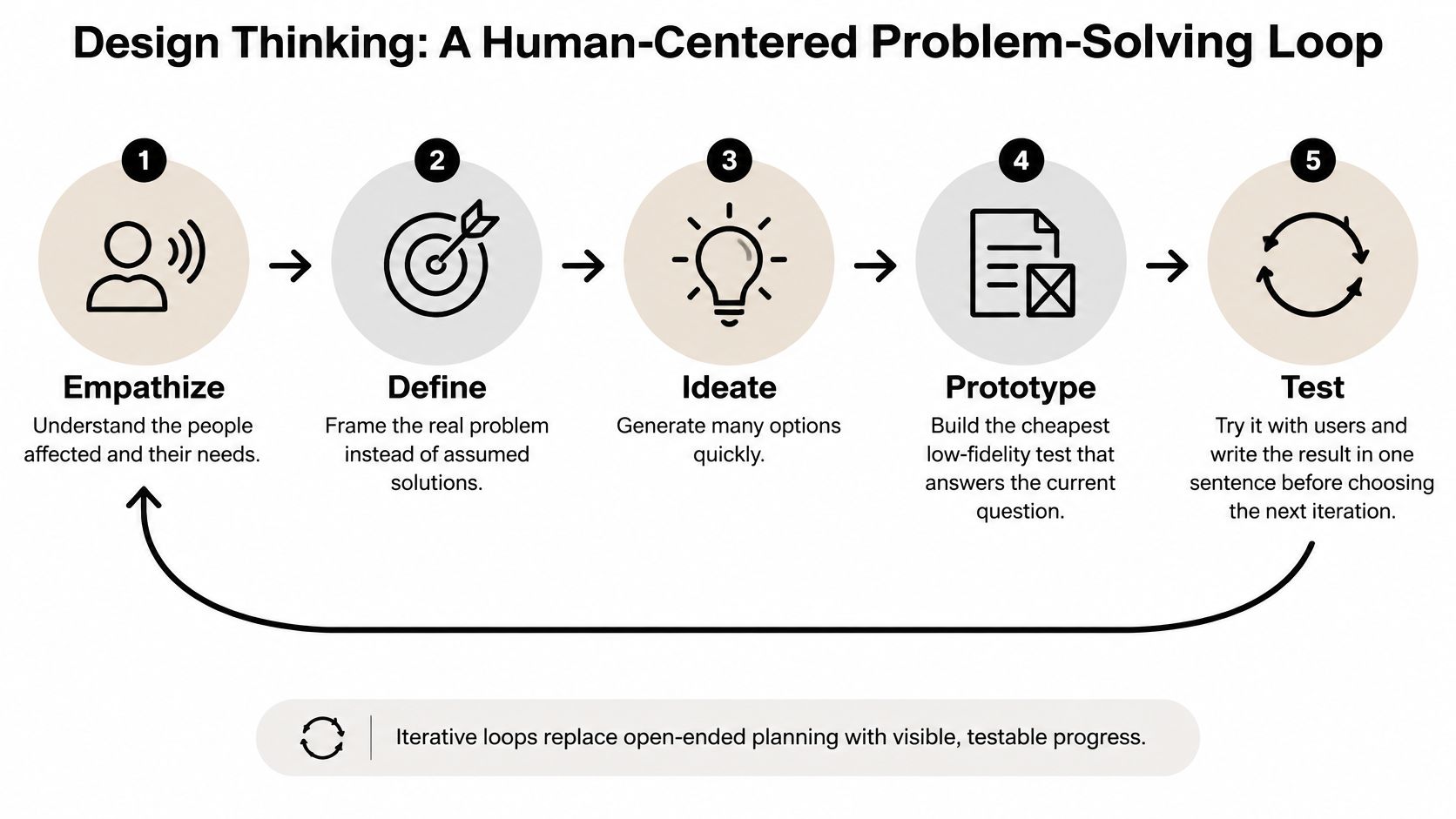
Say customers abandon your agency’s intake form. Don’t immediately commission a better-looking form. Ask a customer to complete it while explaining what feels confusing, risky, or unnecessary.
Run a Small Learning Loop
- Frame, five minutes: Write the customer’s obstacle without naming your preferred solution.
- Generate, ten minutes: Sketch alternatives, including removing the step entirely.
- Prototype, fifteen minutes: Build a paper form or rough Figma screen, then schedule a customer test.
Delegation cue: Ask your account manager to arrange the test and capture observations. Keep founder interpretation separate from what the customer did.
The Forrester study summarized in IBM’s Total Economic Impact analysis reported average project-timeline reductions of 18% for Enterprise Design Thinking. Those survey and modeled results aren’t a promise for your sprint. Establish your own baseline.
Use this walkthrough to support the process, not postpone the test.
Finish with a sentence stating what the test taught you. Skip the elaborate workshop when a customer conversation will answer the question.
2. SCAMPER
Your onboarding process already exists. It’s just awkward, repetitive, and somehow requires your approval whenever someone changes a comma.
SCAMPER works on something concrete, using these prompts: Substitute, Combine, Adapt, Modify, Put to another use, Eliminate, and Reverse. That makes it useful when attention drifts in response to an intimidating blank page.
A familiar object makes the approach easy to visualize.

Change the Existing Thing
Give each prompt two minutes on a shared page. Substitute a recorded explanation for a recurring call. Combine duplicate intake questions. Eliminate an approval that nobody can explain.
Then spend five minutes selecting a change that’s cheap to reverse. Don’t select the most entertaining concept automatically. Choose the one most likely to remove the specific friction you named.
For an agency handoff, reversing the process might mean letting the delivery lead define the brief before sales finalizes the promise. That’s more useful than generating another clever welcome email.
Delegation cue: Have the person who runs the process own the experiment. Ask them to record the current steps, change the selected step, and flag anything that becomes harder downstream.
Choose this when an existing product or workflow needs improvement, not reinvention. Skip it when you still don’t know whose problem you’re solving. A checklist can generate variations on the wrong answer just as efficiently as the right one.
3. Six Thinking Hats
The founder is discussing possibilities. The operations lead is discussing risk. The salesperson is defending the customer relationship. Everyone thinks everyone else has missed the point.
Six Thinking Hats separates those conversations. Everyone uses the same perspective together: White for facts, Red for feelings, Black for risks, Yellow for benefits, Green for alternatives, and Blue for process.
The colors represent modes of thinking, not permanent team personalities.

For a hiring decision, start with Blue to define what must be decided. Move through facts, reactions, benefits, risks, and alternatives, then return to Blue for the decision. Allocate roughly three minutes per perspective.
Facilitation rule: Capture an off-topic contribution under its matching hat, then return to the current question.
That parking space helps when an insight feels too urgent to hold back. A study of entrepreneurs and ADHD symptoms associated higher symptom levels with greater perceived team conflict, reinforcing the importance of shared interpretation rather than assuming everyone follows your leap.
Delegation cue: Let someone other than the founder facilitate and record the decision. Give them explicit permission to interrupt you.
Choose this when discussions keep mixing evidence, intuition, and objections. Pair it with a consistent approach to making difficult decisions. Skip the hat terminology if your team dislikes it. Label the agenda with the perspectives instead.
4. Mind Mapping
Working-memory bottleneck? Put the moving parts where you can see them. Mind mapping lets you capture related thoughts without deciding their final order first.
Start with a question, not a topic. How do we deliver client work without founder rescue? is useful. Agency growth is an invitation to redraw your entire business.
The visual structure can stay simple.

Map, Then Convert
Spend ten minutes adding branches such as approvals, missing information, skills, and customer expectations. Use short labels. Add detail only where it helps explain a connection.
Next, spend five minutes marking what’s known, assumed, or unanswered. A crowded branch isn’t automatically the biggest problem. It might be the one you enjoy thinking about.
Use the remaining ten minutes to convert a selected branch into an action. For example, turn “unclear approvals” into a task to document which decisions the account manager can make without you.
Delegation cue: Ask an operations partner to translate the selected branch into tasks with owners and completion conditions. Keep the original map attached as context, not as the task manager.
Choose this when you can sense connections but lose them in linear notes. Paper, Miro, or a plain whiteboard all work. Skip color coding if it becomes a stationery side quest.
A map is finished when it enables a decision. It doesn’t need to become attractive enough to frame.
5. Five Whys
The deadline slipped again. Your first explanation is that someone forgot. That may describe the immediate event, but it doesn’t explain why the system depended on remembering.
Five Whys moves from symptom toward a changeable cause. Write each answer down so interruptions don’t force everyone to reconstruct the conversation.
For a hypothetical agency project, the chain might look like this:
- Visible problem: The designer started late.
- Immediate cause: The approved brief arrived late.
- Upstream cause: Sales hadn’t collected required assets.
- Process gap: Nobody owned checking readiness before scheduling.
Investigate Instead of Prosecuting
Set a fifteen-minute timer. Ask why the observed event happened, then check the answer against task records, messages, or the people doing the work.
Don’t force the chain to reach a predetermined depth. Stop when you’ve found a cause you can change and have enough evidence to justify testing the fix.
In this scenario, introduce a readiness check before production dates are promised. Don’t prescribe a reminder app to the designer when the necessary inputs never arrived.
Delegation cue: Assign the investigation to the process owner, with input from everyone involved. The founder shouldn’t supply every answer from memory.
Choose this when a recurring operational fire has a traceable sequence. Skip a single-chain explanation for messy problems with several interacting causes. If the answers branch, map those branches rather than pretending the business has one root cause.
6. Pre-mortem
Optimism is useful for starting projects. It’s less useful when nobody feels comfortable mentioning that the launch depends on a supplier who hasn’t replied.
A pre-mortem makes failure discussable before commitments become expensive. It’s particularly useful when excitement has narrowed your attention to everything that could go right.
Tell the team to assume the project has failed after launch. Ask each person to write plausible reasons privately before anyone speaks.
Turn Risks Into Triggers
Allow five minutes for silent writing, ten for grouping concerns, and ten for choosing safeguards. For a campaign, contributors might identify missing tracking, delayed approvals, or an offer the sales team can’t explain.
Convert each selected risk into an operational instruction:
- Warning sign: What would tell us the risk is becoming real?
- Response: What will we do when that signal appears?
- Owner: Who checks and acts without waiting for founder rescue?
Delegation cue: Give each safeguard to the person closest to the signal. Your media buyer can check tracking; your account lead can monitor approval delays.
Choose this when you’re about to make a consequential commitment and the room feels suspiciously unanimous. Stop once you have actionable safeguards. Endless disaster storytelling is anxiety with a meeting invitation.
A pre-mortem won’t eliminate setbacks. Combine preparation with a practical approach to handling setbacks so a problem triggers a response rather than a business-wide panic.
7. Working Backwards
Write the customer-facing announcement before writing the task list. If you can’t explain the benefit plainly, you probably aren’t ready to delegate the build.
Working Backwards gives attention a destination. Instead of chasing every appealing feature, define what the customer will be able to do when the work is complete.
Say you’re considering a client portal. Your draft announcement shouldn’t celebrate a dashboard. It should explain that clients can find the latest approved work without searching email threads.
Draft the Outcome Before the Plan
Spend ten minutes writing a headline and opening paragraph. Spend another ten answering difficult questions about who needs it, what changes for them, and what they’ll do instead if you don’t build it.
Use the final ten minutes to identify the smallest deliverable that could demonstrate the benefit. A well-organized shared folder might test the premise before custom software does.
Delegation cue: Hand over the outcome document, boundaries, and acceptance conditions. Don’t hand over a vague instruction to “make the portal better.”
Connect the outcome to your wider priorities using concrete business goal examples. Otherwise, a beautifully specified project can still be the wrong project.
Choose this when you keep changing direction during execution or delegates need repeated clarification. Treat the announcement as a hypothesis, not customer evidence. Elegant copy doesn’t prove demand, and an exciting launch sentence doesn’t authorize unlimited scope.
8. Reverse Brainstorming
How could we make absolutely certain a new client regrets hiring us?
That question can produce more specific answers than another polite discussion about improving customer experience. Ignore their questions. Request the same information repeatedly. Hide the timeline. Surprise them with extra fees.
Reverse brainstorming turns those failure mechanisms into design requirements. It helps when conventional brainstorming produces familiar slogans and little else.
Run the negative phase for ten minutes, then spend ten minutes reversing the answers. Use a final five minutes to choose a countermeasure.
- Create confusion: Reverse it into a visible timeline with a named contact.
- Repeat requests: Reverse it into an intake record the delivery team can access.
- Hide changes: Reverse it into an explicit scope-change approval.
Keep the target on the process. This isn’t permission to turn a workshop into a roast of a colleague.
Delegation cue: Let your customer-facing lead own the selected change and report what still confuses clients afterward. The output should be a safeguard, not a document full of excellent complaints.
Choose this when people know what bad looks like but struggle to describe a better alternative. It’s especially handy for handoffs, retention, and delivery reliability.
Skip it when team trust is low enough that negative examples will feel personal. Use anonymous written contributions or investigate a specific incident instead. Humor can loosen thinking, but sarcasm isn’t a substitute for a workable process.
9. TRIZ (Theory of Inventive Problem Solving)
You want faster client responses, but answering everything immediately destroys your focus. Before accepting that trade-off, ask whether both needs can be met through a different arrangement.
TRIZ starts with contradictions. Write yours plainly: improving one thing appears to worsen another. Then explore structural changes rather than asking everyone to try harder.
Cross-industry thinking is relevant here. In Autodesk’s 2025 Digital Transformation Pulse, 80% of digitally mature companies reported adopting techniques and tools from other industries. That doesn’t validate a particular solution, but it supports looking beyond your own sector for approaches.
Resolve the Contradiction
Give yourself five minutes to describe the conflict. Spend fifteen exploring these lenses:
- Separate: Could different people or channels handle urgent and routine requests?
- Prepare: Could templates or advance instructions remove recurring questions?
- Segment: Could the service change according to the request’s complexity?
For the response-time problem, a team member could triage messages while genuine emergencies use a defined escalation route. Clients receive acknowledgment without every notification reaching the founder.
Delegation cue: Ask your operations lead to draft the routing rules and test ambiguous examples with you.
Choose this when the same trade-off keeps returning despite local improvements. This is a lightweight application, not a substitute for specialist technical TRIZ work. Don’t spend the afternoon mastering a framework when a clear escalation policy solves today’s problem.
10. Brainwriting (6-3-5 Method)
The founder speaks first. Everyone starts refining the founder’s idea. Later, someone mentions a better alternative that never made it into the meeting.
Brainwriting separates contribution from airtime. People write before discussing, then build on what others have written. That gives an interrupted thought somewhere to exist without requiring its author to fight for the floor.
Start Silently
For a practical 6-3-5-style session, invite six people, ask for three ideas each, and use five-minute writing intervals before passing the sheets. Keep contributions short enough that the next person can understand them without a presentation.
If your team is smaller, adapt the format. Don’t recruit spectators just to satisfy the name.
Use a specific prompt such as reducing client approval delays. Later rounds can add a constraint, combine suggestions, or challenge an assumption.
A study of Italian consulting organizations frames creative problem solving around repeatable delivery capabilities, including idea generation, prototyping, and selection. Apply that discipline here: written ideas still need an evaluation step.
Delegation cue: Ask a facilitator to group duplicates while preserving unusual suggestions. Have the delivery owner assess feasibility before anyone commits resources.
Choose this when interruptions, hierarchy, or fast speakers narrow participation. After writing, select against an agreed criterion such as customer relevance or testability. Don’t mistake a popular suggestion for a validated solution.
How the ten techniques compare at a glance
Scan the table as a filter. Every method has a different cost in attention and setup, and the Typical Time column assumes a time-boxed session with a defined output, so treat each figure as a ceiling rather than a target.
| Item | Core Output | Best For | Group or Solo | Typical Time |
|---|---|---|---|---|
| Design Thinking | Tested prototypes shaped by user feedback | Ambiguous, human-centered problems | Team with user input | About 30 minutes for one learning loop |
| SCAMPER | Ideas generated from seven prompts | Improving an existing product or process | Solo or group | Under an hour |
| Six Thinking Hats | A decision examined from six perspectives | Structured group decisions | Group | About 20 minutes at three minutes per perspective |
| Mind Mapping | A visual map of related ideas | Exploring and organizing connected ideas | Solo or group | About 25 minutes |
| Five Whys | A visible chain leading to a root cause | Finding causes of clearly defined problems | Solo or small team | A short conversation |
| Pre-mortem | A prioritized list of project risks and actions | Anticipating failure before execution | Group | A short session |
| Working Backwards | A customer-focused announcement and FAQ | Clarifying product value before development | Team | About 30 minutes of drafting |
| Reverse Brainstorming | Countermeasures created by inverting negative ideas | Breaking through a creative block or surfacing failure modes | Usually group | Short, time-boxed session |
| TRIZ (Theory of Inventive Problem Solving) | Solutions to contradictions using inventive principles | Technical problems involving trade-offs | Solo or team | About 20 minutes for a lightweight contradiction analysis |
| Brainwriting (6-3-5 Method) | Written ideas built on across rounds | Inclusive, structured group ideation | Group | About 30 minutes |
Two columns deserve a second look before you choose. Group or Solo matters more than it seems: the group formats supply external structure that holds attention when yours drifts, while the solo formats demand a visible timer and a hard stopping point you set in advance. Typical Time tells you whether a method survives an interruption. Anything under half an hour can finish inside one focus window; anything longer should be split across two sittings or handed to a facilitator who keeps the room on the clock.
When a session risks running long, delegate the timekeeping itself. A founder mid-flow will always choose one more round over ending on schedule.
Pick One Technique Today and Run It Before Lunch
This is a menu, not a curriculum. You don’t need to become the founder who knows every framework and still hasn’t approved the brief.
Match the method to the place where work stops. If the problem is unclear, use design thinking. If your head contains a tangled collection of dependencies, make a mind map. If you keep circling alternatives, use Six Thinking Hats to separate the discussion and close the decision.
For recurring fires, investigate with Five Whys. Before a consequential commitment, run a pre-mortem. When the group keeps echoing whoever speaks first, begin with brainwriting.
Make the Session Finishable
Set aside thirty minutes this week for a real problem, not an abstract innovation exercise. Write the question at the top of a page and define what you expect to leave with.
That output might be:
- A clarified problem: Who is affected, what happens, and what evidence supports it.
- A selected experiment: What you’ll test and what result would change your mind.
- A usable handoff: Who owns the next action and what completion looks like.
Keep new, unrelated ideas in a separate parking space. You’re not rejecting them. You’re preventing an interesting possibility from replacing a commitment.
Give that parking space a review point, too. Otherwise, it becomes either an intimidating backlog or a loophole for reopening decisions whenever the current work gets dull.
Completion beats collection: A useful session ends with a next action, not just a fuller whiteboard.
The method behind this approach combines Cognitive Architecture, Dopamine Engineering, Strategic Delegation, and Bio-Optimization. Cognitive Architecture makes the sequence visible. Dopamine Engineering supports sustainable rewards for progress rather than dependence on deadline panic.
Strategic Delegation gives complementary people meaningful ownership. Bio-Optimization treats sleep, nutrition, and movement as business strategy rather than whatever remains after work.
These aren’t instructions to become a different person. They’re ways to stop assigning every operational responsibility to the same tired brain.
Nor are these techniques medical treatment. Use them as business processes, adapt them to your needs, and judge them by whether decisions become clearer and execution becomes more reliable.
Choose one technique now. Set a timer, write the problem, and produce its first concrete output before the day ends.
Jan Kutschera helps founders with ADHD replace burnout-driven hustle with operating systems built around their wiring. Visit Jan Kutschera to explore the Starter Kit, Founder Circle, and hands-on advisory, and turn a useful problem-solving session into a more reliable way of running your business.
Jan Kutschera
German founder, diagnosed with ADHD at 51. Built 4 agencies, now building systems for neurodivergent entrepreneurs. German engineering for the ADHD brain.
Connect on LinkedInRelated Articles

Accountability Partner App: 10 Picks for ADHD Founders
Compare 10 accountability partner apps for ADHD founders: how each works, setup workflows, privacy and pricing trade-offs, and which fits your needs.
ADHD Burnout Cycle: Stages Founders Can Break
See the ADHD burnout cycle in five stages, separate it from depression, and test founder fixes before the next crash.

Best ADHD Planner for Adults: A 2026 Guide
Find the best ADHD planner for adults with a quick-pick table, a founder card you can copy, dopamine rewards, and a 14-day test.