
Sustainable Business Operations for ADHD Founders
Build sustainable business operations that run on your brain's wiring: a diagnostic, five-step loop, delegation rules and metrics for ADHD founders.
Jan Kutschera
Your inbox still has yesterday’s approvals, the studio lights ran all weekend, and the only person who can close the monthly client report is you. That is not a busy season. It is an operating system that lives in your head, and your head just took a meeting.
I would start with a 30-minute look at the leaks, not another app. In 2024, 85% of surveyed executives said their organizations had increased sustainability investments during the previous year, up from 75% in 2023, according to Deloitte’s global survey of more than 2,100 C-suite executives. Money is already moving. The founder who cannot find the leak still pays twice.
Table of Contents
- Diagnose Where Your Operations Leak Time, Money and Energy
- How to Build the Five-Step Operating Loop
- Externalize the Routines Your Memory Cannot Hold
- Delegate by Capability and Set Founder Boundaries
- Engineer Reward Loops and Bio-Habits as Operating Inputs
- Metrics That Show Your Operations Are Getting Sustainable
- Pick Quick Wins and Your First Pilot, Then Set the Scale Gate
Diagnose Where Your Operations Leak Time, Money and Energy
Sustainable business operations are the routines, owners and measures that keep energy, spending, people and output steady without heroics.
Pull one week of calendar, one month of supplier invoices, and a count of your own approvals from the inbox. Score each area red, amber, or green with this table.
| Area | Warning sign | Five-minute test |
|---|---|---|
| Purchasing | Same one-off vendors bought again every month | Count repeat one-off purchases in the last 12 months of invoices |
| Travel and meetings | Trips booked last minute at premium rates | Count flights and trains booked under seven days ahead in last quarter’s emails |
| Energy and equipment | Servers, lights or machines running on weekends | Check one weekend’s utility or cloud usage |
| Digital infrastructure | Unused software seats and idle cloud instances | Compare paid seats with active users last month and list instances with under 5 percent CPU |
| Handoffs and documentation | Critical process known by one person only | Ask a teammate to run one monthly task from written notes alone |
| Decisions | Founder approves routine spend within a day | Count your approvals in a typical week |
| Rework and waste | Deliverables reopened or re-sent after delivery | Count deliverables reopened in the last month of project files |
Walk the rows in order. Purchasing goes red when the same one-off vendor shows up every month because nobody wrote a preferred list. Travel goes red when flights and trains are booked under seven days ahead at premium rates. Energy goes red when servers, lights, or machines still run on weekends. Digital infrastructure goes red when paid seats outnumber active users, or a cloud instance sits under 5 percent CPU.
Handoffs go red when a teammate cannot run one monthly task from written notes. That red almost always predicts the others. A single missing person stalls purchasing, travel, and rework at once. Decisions go red when you approve routine spend inside a day. Rework goes red when finished files get reopened.
NotionSender’s guide to efficient workflows is worth a look after the score, because a cleaner handoff only sticks once you know which area is actually red.
Rank the three worst areas. Those three are your pilot candidates.
How to Build the Five-Step Operating Loop
A loop beats a poster on the wall. Each step exists so the next one has something real to act on.
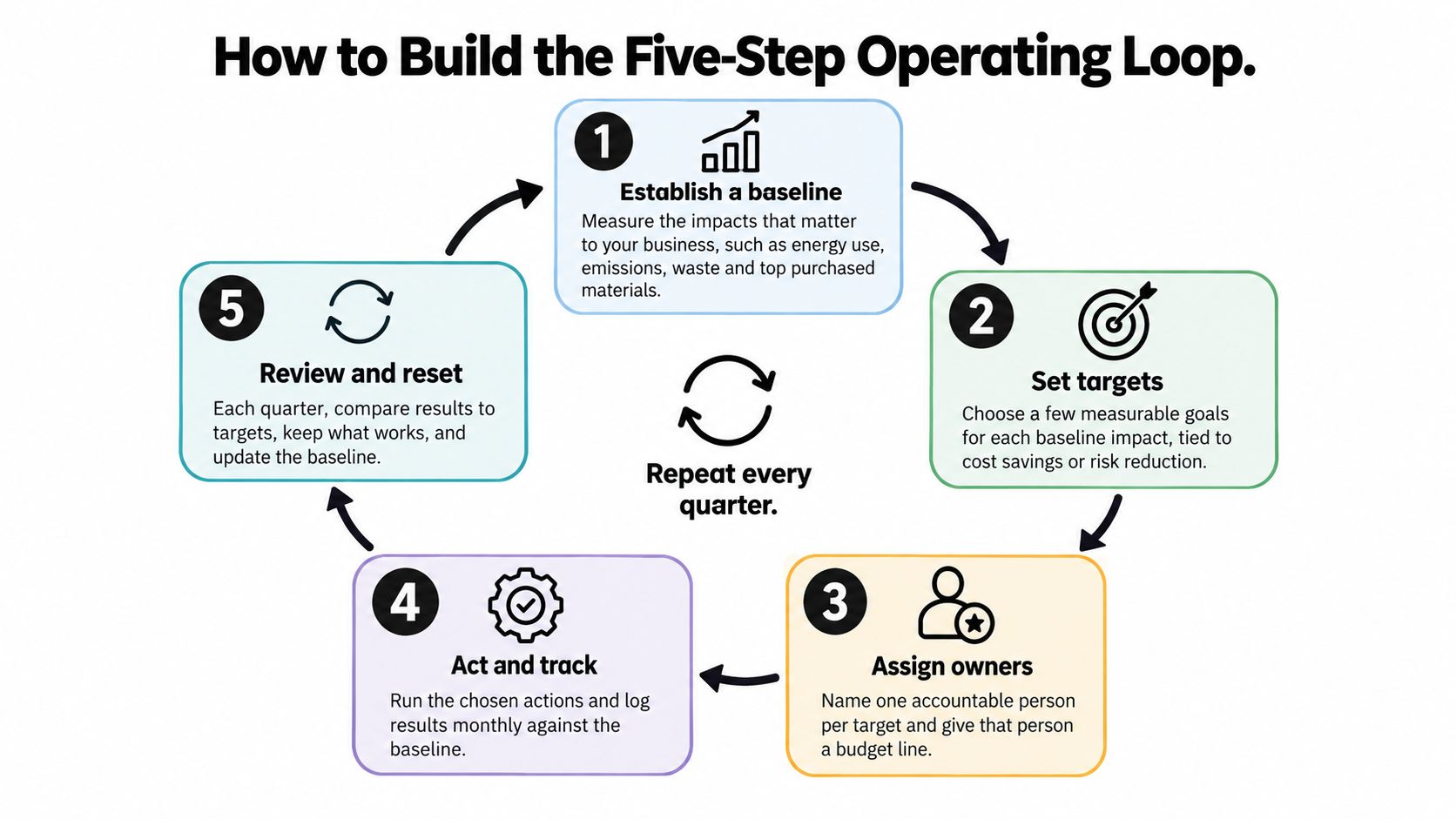
- Establish a baseline from invoices and utility bills, not guesses. Energy use, emissions, waste, and top purchased categories only count if a bill backs them. Estimates feel tidy and then fall apart in the first review.
- Assign one owner and one target per area, with a deadline and a data source written beside the number. Shared ownership is how a target becomes nobody’s job by Friday.
- Write the target into the monthly plan and the budget. If it doesn’t compete with client work for time and money, it loses. Every time.
- Track two or three leading indicators each month. Travel volume, cloud utilization, and supplier compliance move while you can still change them. An annual carbon total arrives after the money is gone.
- Run a quarterly corrective-action review. Keep, change, or drop each target, and write the reason down. A dropped target with a reason is progress. A silent one is drift.
A systematic review of 87 peer-reviewed studies names the barriers that kill this loop: fragmented governance, weak accountability, dependence on individual champions, disciplinary silos, and project-based implementation. The same review finds that whole-organization strategies, distributed leadership, and integration into planning and reporting systems are what move the work forward.
Say a 12-person agency pulls six months of invoices and finds last-minute flights are the biggest controllable cost. That becomes target one. The ops lead owns it, the data source is the booking inbox, and the deadline is the next quarter. Travel volume is the monthly indicator, not a year-end speech.
Two failure modes show up constantly. One enthusiastic person owns everything, then priorities shift and the system dies with their calendar. Or measurement happens once a year, so nobody can see travel volume, cloud use, or rework while they can still fix them.
Escalation rule: every target goes live with an owner, a baseline, a deadline, a data source, and a written trigger for who acts when the number misses.
The loop is easier to see than to remember, which is the point of putting it on one page.
Publish your own baseline-to-target change and your implementation completion rate. There is no honest universal success percentage to borrow.
Externalize the Routines Your Memory Cannot Hold
Your memory is the weakest part in the company. Routines belong in documents and calendars, not in the hope that you’ll remember on Thursday.
Four tools cover almost every recurring mess.
A one-page SOP has six fields: purpose, trigger, owner, steps, a definition of done, and a last-reviewed date. Example: the monthly invoice pack triggers on the first working day, the finance lead owns it, and “done” means the file is in the shared folder with totals that match the bank export.
A delivery checklist sits on every recurring client job. The designer doesn’t rely on remembering alt text, the export settings, and the client folder name. The list does that.
A shared exceptions queue replaces “I’ll ping them later.” Missed files, late suppliers, and odd client requests land in one list with an owner and a date. If it isn’t in the queue, it doesn’t exist.
Reminders tied to the trigger, not to a vague intention. The booking tool pings when a trip is requested inside seven days. A reminder that says “be better about travel” never fires.
Papa’s guide to realistic daily planning pairs well with that queue, because a daily list only works when exceptions already have a home outside your head. The same idea shows up in building routines that don’t depend on willpower.
| Rhythm | Owner | What it covers | Time box |
|---|---|---|---|
| Daily | Founder or ops lead | Exceptions queue and open handoffs | 15 minutes |
| Weekly | Team lead | Leading indicators and approvals log | 45 minutes |
| Monthly | Founder with finance lead | Budget against sustainability targets and supplier review | 60 minutes |
| Quarterly | Founder and leadership team | Corrective-action review and target reset | Half a day |
Write it for everyone
Recent U.S. survey data from Understood.org shows that 51% of employed neurodivergent adults have requested workplace accommodations, yet 68% do not know what accommodations they are entitled to and 51% do not know whom to approach at work. Waiting for disclosure means many never get the structure.
Offer written instructions, structured meeting summaries, and predictable communication to the whole team. Flexible schedules and accessible tools help the person who will never ask, and they help everyone else on a bad week.
External structure doesn’t kill creative work. It parks admin recall so attention stays on the decisions that need taste. Test it this week: could a new hire finish the process from the document alone? If they have to message you, the SOP isn’t done.
Delegate by Capability and Set Founder Boundaries
Decide who decides before you hand anything off. Delegate by capability, not by availability. The person best placed makes the call, even when you happen to be free. Free is not the same as qualified, and your open afternoon is how routine spend keeps landing back in your inbox.
| Decision type | Decides day to day | Founder steps in when |
|---|---|---|
| Hiring for a repeat role | Team lead using a scorecard | Final candidate sits above the approved salary band |
| Sustainability target changes | Founder with finance lead | A target is missed two quarters in a row |
| Production or client incident | Named backup owner | Backup cannot resolve the incident within two hours |
Put the rest in the same matrix. The ops lead renews suppliers under $1,000 unless spend rises more than 10 percent. The account manager answers clients within 24 hours unless the client threatens to leave. You and the finance lead change targets together. Everyone else stops guessing.
A 2025 study summarized by Fortune found that 45% of entrepreneurs who maintained work-life boundaries reported low burnout, compared with only 6% of those who struggled to maintain boundaries. Non-boundary-setters were nearly three times as likely to report high burnout.
That is an internal control, not a lifestyle perk. Panic can spike output for a day and then slowly wreck sleep, delegation, and the quality clients pay for.
Post the response window. A client email answered in four hours every time trains the client to expect four hours, including Sunday.
Three controls do the job. Publish response windows for clients and staff. Set escalation thresholds in writing, like the 10 percent spend rise and the two-hour incident clock. Use a dashboard that splits real emergencies from novelty and from poor planning. If a request can wait until the weekly 45-minute review, it is not an emergency.
The ugly edge case is client credentials that only you hold. Name a backup owner in the first month, even if that person is slower. Slow and present beats fast and on a plane. How to delegate tasks effectively is the companion piece once the matrix exists, because a handoff without decision rights just creates a second inbox.
Engineer Reward Loops and Bio-Habits as Operating Inputs
People treat sleep and food as private business. In a founder-led company they are scheduling inputs. A tired brain approves the bad flight, skips the SOP, and calls it hustle.
Reward engineering means the routine itself produces a small win, so the work doesn’t need a deadline to start. Three tactics are enough.
A visible progress board. Each closed target moves a marker. You see the month move, which beats a spreadsheet you open once and abandon.
A two-minute close after the weekly review. Check the box, then take a five-minute walk before the next call. The walk is the punctuation, not a wellness poster.
A paired reward with a gate. The good coffee happens after the handoff note is filed. No note, no coffee. Silly on purpose, and it works because the reward sits on the behavior you keep skipping.
Put the body on the calendar
Schedule decision-heavy work after a consistent night’s sleep, not after a late one. Eat a planned meal before the monthly budget review so you aren’t negotiating suppliers while hungry. Block movement between meetings the same way you block a client call. Tie a caffeine cutoff to the afternoon review so the 4 p.m. decision isn’t running on a third espresso.
These are calendar choices, not treatment. If you take ADHD medication, coordinate timing with your prescriber and doctor. Don’t borrow someone else’s dose schedule from a podcast.
On a bad sleep week, cut the decision load. Move non-urgent reviews to the next day. Pushing through feels brave and produces the approvals you’ll have to undo.
Metrics That Show Your Operations Are Getting Sustainable
You fly out for a week. On Tuesday a supplier invoice doubles, on Thursday a client delivery bounces back for rework, and nobody spots either until you land. That is the test these metrics exist for: the numbers have to catch problems while you are unreachable.
Review them in the same meeting as the cadence above. Start with the first few measures in this table, beginning with energy.
| Metric | How to calculate | Review cadence | Starting threshold |
|---|---|---|---|
| Energy intensity | kWh per client project or team member | Monthly | Rising two months in a row |
| Emissions by source | tCO2e split into electricity, travel and purchased goods | Quarterly | Any category rising with no project reason |
| Target completion rate | Targets closed on time divided by targets set | Monthly | Fewer than 8 of 10 targets closed on time |
| Handoff failure rate | Handoffs needing rework divided by total handoffs | Weekly | More than 1 in 10 handoffs reworked |
| Decision latency | Hours from request to decision on routine items | Weekly | More than 24 hours on routine items |
| Documented critical processes | Processes with a written SOP divided by critical processes | Quarterly | Any critical process still without an SOP |
| Unplanned work share | Unscheduled hours divided by total hours | Weekly | Above 20 percent of hours unscheduled |
Track kWh per client project or team member every month. A rise shows up in the bill while you can still shut something off. In the quarterly review, split emissions into electricity, travel, and purchased goods so you can see which category moved and whether a project explains it.
The same pattern runs at global scale. In 2024, energy-related carbon dioxide emissions reached a record 37.8 gigatonnes, up 0.8% from the previous year, according to the IEA Global Energy Review. Fuel-combustion emissions rose by approximately 1%, or 357 million tonnes of CO2, while industrial-process emissions fell 2.3%, or 62 million tonnes. Efficiency in one corner never offset growth in another. Your version of that mistake is a greener office with last-minute flights still climbing.
Treat every threshold above as a starter. After the first quarter, swap in your own baseline and publish the baseline-to-target change alongside your target completion rate. A percentage borrowed from a template tells nobody anything.
Two rows tell you whether the company survives your absence: documented critical processes and handoff failure rate. If critical work still has no SOP, or more than 1 in 10 handoffs need rework, the business is still you. This is also why the thresholds sit in the table instead of in your head. Whoever runs the review, whatever their wiring, sees the same red flag you would. A dashboard that needs your memory to read it is a diary.
The thinking behind smarter ecommerce growth with Menza applies here too: a metric only earns its place when someone changes a decision with it. The same discipline holds when you set business goals you can actually review.
Pick Quick Wins and Your First Pilot, Then Set the Scale Gate
Rank fixes by how fast they pay back, then pilot one process. Seven launches at once is how awareness dies and the checklist becomes wallpaper. The fast wins also pay for the slow ones: the software seats you cancel this month free budget for the work that takes a quarter.
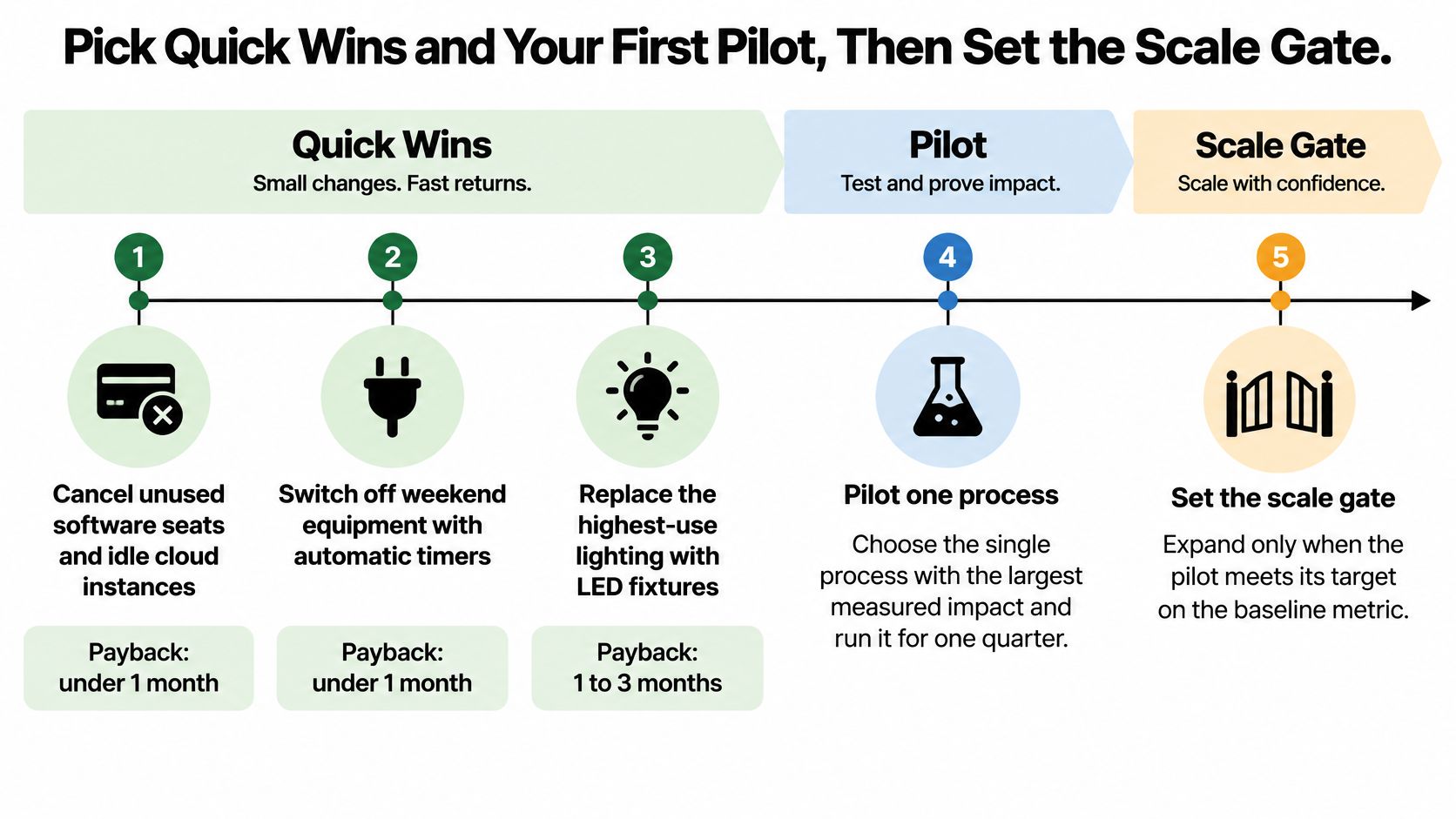
- Cancel unused software seats and idle cloud instances from the diagnostic. This usually pays back inside a month.
- Switch off weekend equipment with a shutdown checklist. Same payback window, and it does not need a committee.
- Move repeat one-off purchases onto a preferred supplier list so the same vendor stops being a monthly surprise.
- Book travel at least seven days ahead. The premium on last-minute flights is the tax you pay for having no rule.
- Attach a written SOP to each recurring client delivery, so the file lives in the document instead of in someone’s head.
A barrier analysis combining a literature review, expert consultation, and interpretive structural modeling identified 18 interconnected barriers across eight levels, with lack of awareness, lack of knowledge, resistance to change, and inefficient communication as the dominant high-driving barriers, according to Sustainability. Tools are rarely what stalls you. Team members who never heard why the change exists will route around it, so design the rollout for the person most likely to forget the change exists. Everyone else gets the benefit for free.
The eight-week gate
Use weeks one and two to map the operating system and mark where sustainability decisions are made in practice. Give each role a short training at the point of work; a slide deck in a separate meeting will not survive a busy Tuesday. Weeks three to six belong to one controllable process from your red list, instrumented with a baseline and weekly exception metrics. Write the SOP in weeks seven and eight. Scale only when adoption and data quality hold steady.
The scale gate is four consecutive weeks of complete data, a falling exception rate, and the process running without you in the room.
That last condition is the one that matters for a founder-led company. A pilot that only works while you remember to check it is another task living in your head. Repeat the reason for each change in the same sentence as the new step: “We book seven days ahead because last-minute fares were the biggest controllable cost” beats “please use the new form.”
An operating model that cuts energy use while raising overload moves the cost into burnout and missed handoffs. Keep watching exception rate, cycle time, and workload volatility next to the resource number, so the gate catches overload before you scale it.
This week, pick the highest-ranked red area, name its owner today, and book the first review on the calendar before you close the laptop.
Jan Kutschera builds operating systems for founders with ADHD, so energy, handoffs, and decisions keep running when your memory doesn’t. The Starter Kit, Founder Circle, and advisory work turn the loops in this piece into templates you can run next week. Visit Jan Kutschera and pick the setup that matches how your company really works.
Jan Kutschera
German founder, diagnosed with ADHD at 51. Built 4 agencies, now building systems for neurodivergent entrepreneurs. German engineering for the ADHD brain.
Connect on LinkedInRelated Articles

Accountability Partner App: 10 Picks for ADHD Founders
Compare 10 accountability partner apps for ADHD founders: how each works, setup workflows, privacy and pricing trade-offs, and which fits your needs.
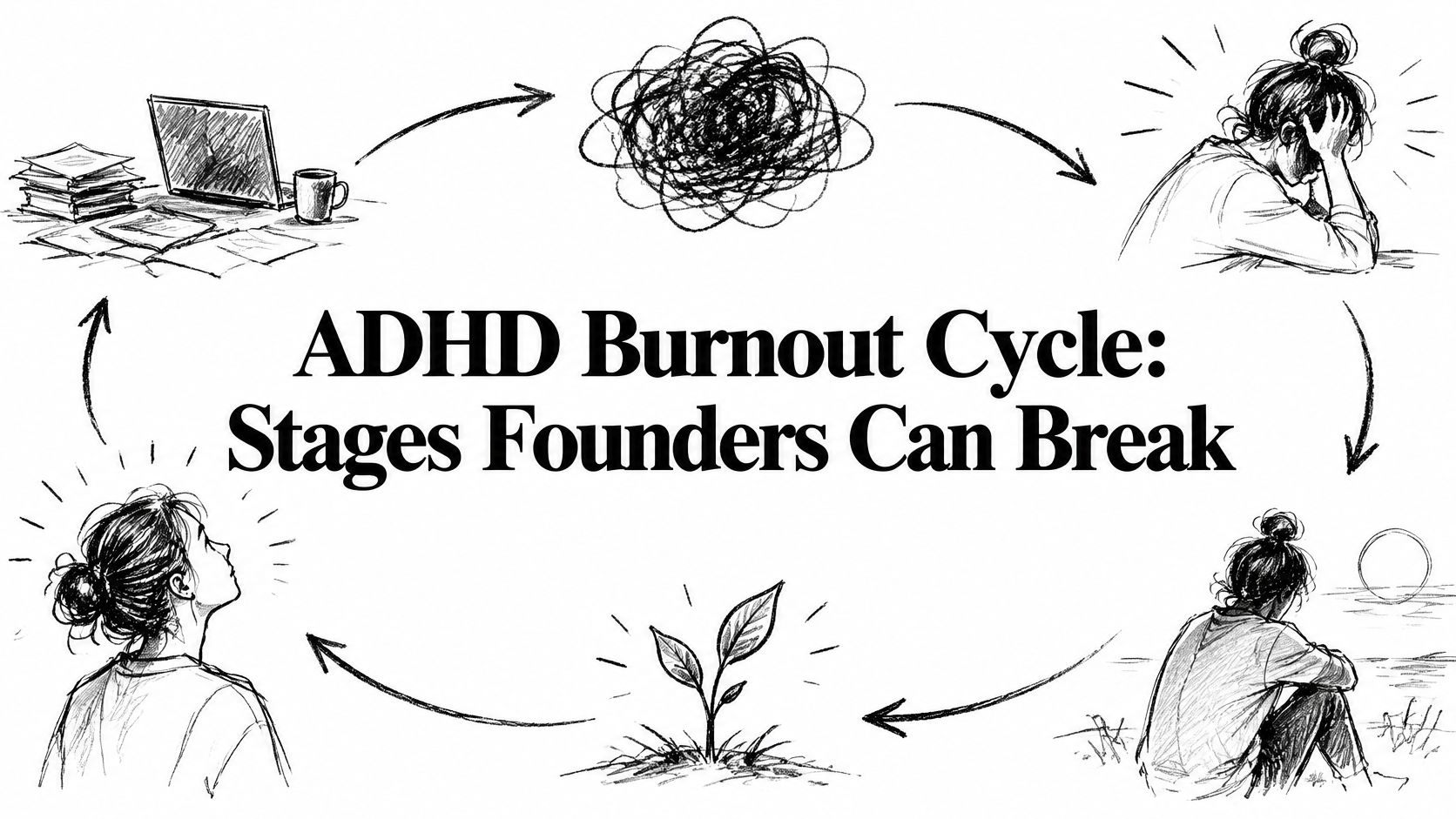
ADHD Burnout Cycle: Stages Founders Can Break
See the ADHD burnout cycle in five stages, separate it from depression, and test founder fixes before the next crash.

Best ADHD Planner for Adults: A 2026 Guide
Find the best ADHD planner for adults with a quick-pick table, a founder card you can copy, dopamine rewards, and a 14-day test.