Work with Other People Without Burning Out
Work with other people using a written charter for handoffs, meetings, and owners so ADHD founders are not the only memory.
Jan Kutschera
It’s Tuesday. The client has changed the offer, your designer has the wrong brief, and someone wants to know whether the invoice went out. Only you know the answers. Your team chat looks lively, which would be encouraging if anyone were sure what to do next.
You don’t need to become more available. You need a way to work with other people without becoming their shared memory, emergency editor, and human search engine. That means explicit rules that work whether anyone discloses ADHD or not, plus firm boundaries before AI agents join the notification parade.
Table of Contents
- When the Founder Becomes the Bottleneck
- A Charter Anyone Can Follow
- How to Hand Off Work That Stays Done
- Meetings That End With One Owner
- Failure Modes and the Fix for Each
- Where Humans Stay in Charge of AI
- Install the Charter Before the Next Crisis
When the Founder Becomes the Bottleneck
Say your agency is rewriting a landing page. You approved the new offer on a call, explained it to the copywriter in chat, and mentioned the revised deadline while the designer was leaving. Everyone heard something. Nobody received the same assignment.
That’s an operating gap, not evidence that you or your team are defective.
The scene below captures the problem: capable people, plenty of effort, and one person carrying all the missing context.

Test whether people can challenge you
Google’s Project Aristotle, launched in 2012 and examining 180 teams, identified psychological safety as the strongest predictor of team effectiveness, ahead of collective seniority or individual credentials, according to this American Management Association account.
Translate that into a business question: can your designer tell you the landing page is wrong before the client does? If challenging you requires a ceremonial sacrifice, people will keep polishing the wrong page.
Leadership test: When someone flags a problem, ask what needs changing before asking who caused it.
Orderly silence isn’t coordination. Your daily tax arrives when decisions stay in chat, deadlines stay in your head, and every request drags you out of focused work. Filta’s explanation of the cost of leaders doing operational work offers a useful lens for reviewing what you’re personally carrying.
Separate developing people from supervising every move. This distinction between coaching and managing helps you choose the intervention instead of automatically taking over.
Your operating kit needs a charter, a handoff packet, accountable meetings, targeted fixes, and human control over AI decisions. Pick a live client project to install it on. Don’t buy another tool first.
A Charter Anyone Can Follow
Copy this diagnosis-neutral collaboration charter into your project workspace today. Use Notion, Asana, Trello, or a shared document you already maintain. The software isn’t the agreement.
| Rule | Replaces | What people see | Owner |
|---|---|---|---|
| Written decisions | Memory in chat | Decision log with date, choice, deadline | Named decider |
| One owner per outcome | Shared responsibility | A single name on the task | That owner |
| Async update by a set time | Status meetings | A short written update in one channel | Each contributor |
| Handoff packet | Drive-by messages | Goal, done definition, links, deadline, reviewer | Person sending the work |
| Agenda before the meeting | Open calendar time | Purpose, decision needed, timebox | Meeting owner |
| Weekly outcome review | Hours tracked | Result compared with the promise | Owner plus founder |
| Preference card | A disclosure conversation | Hours, channel, reply window, definition of done | Each person |
| One source of truth | Scattered docs and threads | A single board or doc for the project | Ops owner |
Make support available without a diagnosis
37% of neurodivergent employees chose not to disclose to any coworkers, according to Gallup’s Neurodiversity in the Workplace report. Don’t build a collaboration system that works only after someone shares private health information.
A preference card asks how to coordinate work. It doesn’t ask someone to explain their brain, defend their needs, or disclose medication over a planning call. Everyone, including the founder, should be allowed to submit one.
Use these fields:
- Working hours: When I’m available, including my time zone.
- Preferred channel: Where assignments and questions should reach me.
- Reply window: When you can expect an acknowledgment.
- Definition of done: What I need specified before accepting work.
A person can request written instructions without naming ADHD. Another can request an agenda because they prepare better in advance. Neither needs to present a medical case.
This baseline doesn’t replace individualized support. It removes unnecessary ambiguity before anyone has to ask.
Turn the charter into visible behavior
Create a decision log with date, decision, owner, deadline, and where the proof lives. Proof might be the approved page, client acceptance email, or published campaign. Link to the artifact, not an entire folder containing archaeological layers of old work.
For async updates, use a compact pattern: completed, next, blocked, decision needed. Agree on the posting time and time zone. Don’t replace a status meeting with an all-day written performance.
Ownership means responsibility for moving the outcome forward, not doing every subtask personally. The owner gets help, identifies blockers, and confirms completion. They don’t wait for the founder to notice trouble.
Use the weekly review to compare the promised result with the actual result. Someone sitting online all afternoon isn’t proof of progress, and someone working isn’t evidence of disengagement.
Post the charter on your live project and assign an owner to every open task before the day ends. If the team has to ask where the charter lives, put it somewhere less imaginative.
How to Hand Off Work That Stays Done
Before delegating, separate execution from authority. Keep decisions that change client promises, money, or hiring with the responsible human leader. Delegate work whose completion the receiver can check against written criteria.
If tone requires your judgment, delegate the rewrite but retain sign-off. Put that sign-off in the assignment. Nobody enjoys discovering the secret final boss after submitting their work.
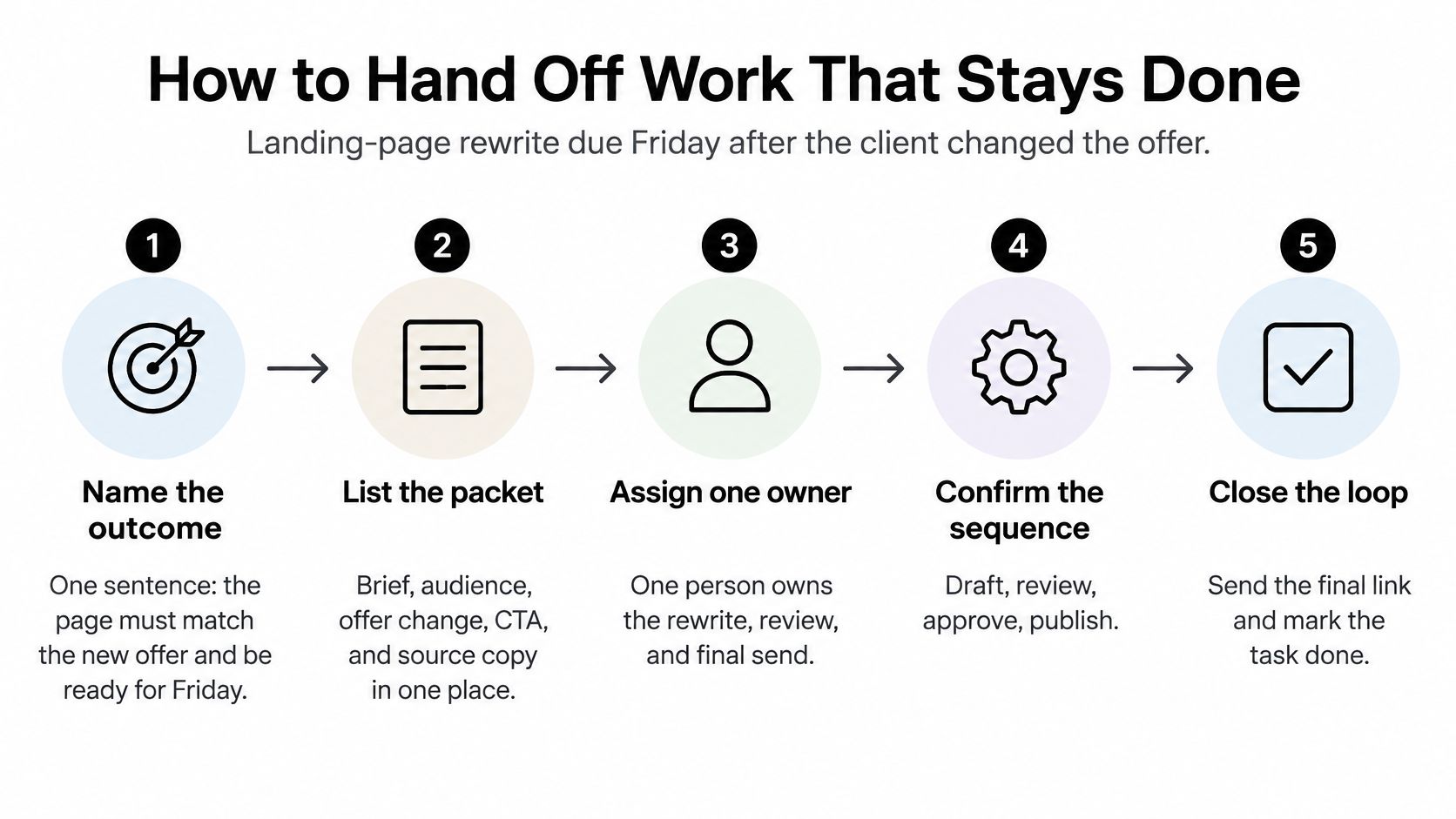
Use this flow to keep the landing-page rewrite moving from brief to final link.
Build the packet before sending the ping
Say the client changed the offer and needs the page ready Friday. Use these moves as your handoff procedure.
-
Name the outcome. Write that the landing page must sell the newly approved offer and be ready for Friday’s launch. Asking someone to improve the page leaves them guessing which problem they’re solving.
-
Define done with checkable criteria. For this assignment, require a headline matching the new offer, an approved proof point, and a mobile layout without broken elements. The receiver should be able to inspect their work before submitting it.
-
Attach only useful context. Include the current page, approved offer, audience brief, call to action, and authorized source copy. Label obsolete drafts clearly. Don’t send someone into chat history with a metaphorical headlamp.
-
Set the deadline and response expectations. For example, request the draft Thursday morning, review Thursday afternoon, and publication Friday. Require blockers to be raised the same working day, within agreed hours. State the time zone.
-
Name the reviewer and approval test. The account lead checks offer accuracy and tone; the designer checks the mobile presentation. Name the final approver rather than leaving the founder available for surprise editing duty.
-
Send a compact written packet. Use the script below. For anyone whose context disappears between interruptions, a verbal assignment isn’t a dependable reference. Put the accepted version where they can retrieve it.
-
Record ownership immediately. Add the outcome owner to the project board when you send the assignment. Include draft, review, approval, and publication states so nobody mistakes submission for completion.
Copy this handoff script
Outcome: Rewrite the landing page for the approved new offer.
Done checks: Offer-matched headline, approved proof point, working mobile layout.
Links: Current page, offer brief, source copy, design file.
Deadline: Draft Thursday morning; approved page ready Friday.
Reviewer: Account lead approves copy; designer checks layout.
If blocked: What specific missing input or decision prevents your next move?
Give the receiver a 15-minute packet check as a team rule: they can return an assignment missing acceptance criteria before starting. That’s clarification, not insubordination.
For a broader delegation framework, use our guide to delegating tasks effectively. When automation crosses the same boundaries, Projectify’s guide to coordinating human and AI task handoffs is a useful companion.
Use the video below alongside a real assignment, not as another item in your watch-later graveyard.
On Friday, the reviewer marks pass or names the failed criterion and required fix. Once approved, the founder doesn’t reopen the file because a different adjective occurred to them over breakfast.
Meetings That End With One Owner
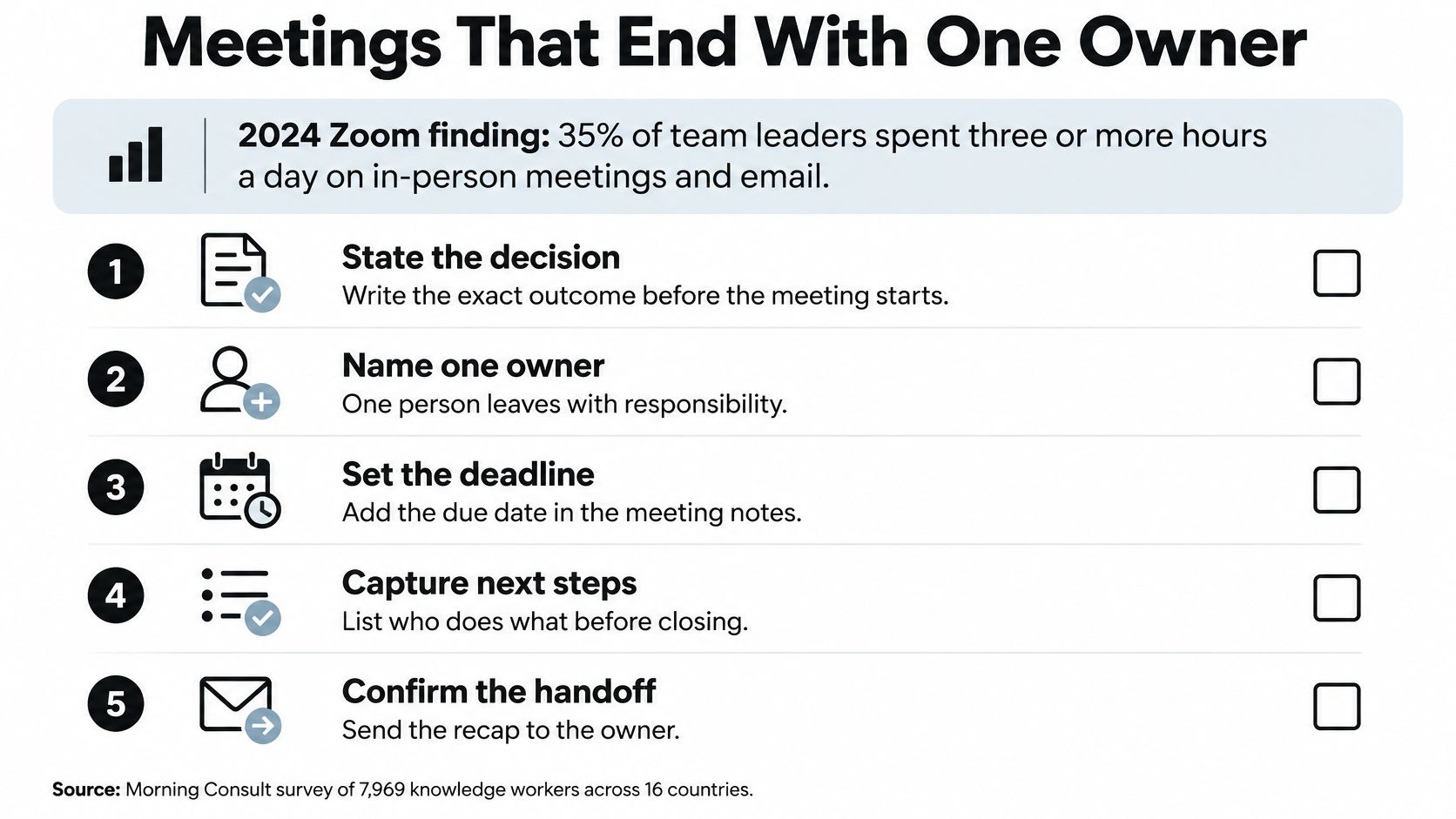
In 2024, 35% of team leaders reported spending three or more hours per day on in-person meetings and email, according to Zoom’s Global Collaboration in the Workplace report, based on Morning Consult’s survey of 7,969 knowledge workers across 16 countries. Don’t treat that load as a leadership aspiration.
Treat your internal calendar as a design problem. A meeting should resolve something, produce something, or inspect a promised result. Otherwise, you’ve scheduled a group notification.
Admit only meetings with a job
Set a 25-minute default for internal meetings as an operating rule, not a scientifically magical duration. Before anyone accepts, the organizer supplies the purpose, decision needed, essential attendees, and preparation.
Allow these formats:
- Decision meeting: Resolve a defined choice with a named decider. Participants bring options and trade-offs, not an invitation to brainstorm indefinitely.
- Working session: Open the shared document and produce the actual deliverable. If everyone merely discusses working later, rename it.
- Weekly outcome review: Reserve a 20-minute slot to inspect commitments, blockers, and necessary changes. Don’t have everyone narrate their week.
A working session still needs a decision line, such as agreeing which draft becomes review-ready. An outcome review needs decisions about blocked or changed commitments. The label doesn’t excuse a vague invitation.
Use this checklist when planning the close, not after everyone has disappeared.
Read the opening and closing aloud
Open with the decision, alternatives, and risk you need examined. For the landing page, the founder can say:
We need to decide whether Friday’s launch includes the new pricing section. We can publish the approved core page or wait for the complete revision. What risk am I missing?
Then stop talking. Asking for objections while delivering an uninterrupted defense of your preference isn’t consultation.
Close by reading the actual commitment:
Decision: Publish the approved core page. Owner: Maya. Deadline: Friday before launch. Record: The project decision log, with the approved version attached.
Give the owner room to confirm capacity and dependencies. Attendance isn’t acceptance, and silence isn’t a delivery promise.
If the decision isn’t ready, end the meeting and assign a written brief identifying the missing information. Don’t book a sequel just because the calendar offers a convenient button.
For recurring review bottlenecks, Crowbert’s guide to build a faster content approval workflow can help you inspect the approval path rather than adding another call. Our practical guide to improving team communication also helps separate coordination from constant availability.
Apply the same close in an office or on a video call. The useful artifact is the recorded commitment, not where everyone sat. Try a week of declining internal invitations without a decision line, and explain exactly what the organizer needs to add.
Failure Modes and the Fix for Each
The task comes back unfinished. Your first impulse is to explain it again, more slowly, with the weary expression of someone managing a preschool.
Inspect the assignment first. If the receiver couldn’t distinguish finished from almost finished, a stronger lecture won’t repair the missing acceptance criteria.
| Symptom | Likely cause | Fix this week |
|---|---|---|
| Work comes back half done | No definition of done | Rewrite the packet before reassigning |
| Founder rewrites it at night | No named reviewer | Assign one reviewer and a pass-fail check |
| Another meeting gets booked | Decision never logged | Require last decision on the next invite |
| Smart people go quiet | Speaking up feels costly | Open the review with one risk each |
| Deadlines arrive as surprises | No reply window | Same-day for blockers, next morning for drafts |
| Drafts sit unread in chat | No quality owner | Name one reviewer before more output is made |
Repair the document or role first
For bounce-back work, test the rewritten packet on the next handoff. Don’t add another owner to compensate for unclear instructions. You’ll get competing assumptions with better attendance.
For nighttime founder rewrites, prohibit silent edits after approval. If the work fails a criterion, the reviewer returns that criterion to the owner. If the founder changes direction, record a scope change instead of pretending the original assignment was obvious.
A missing-decision fix is visible on the next invitation. Require the organizer to include the previous decision and explain what has changed. Reopening a settled choice should require new information, not a fresh audience.
For surprise deadlines, apply the reply-window agreement to the next blocked task. Specify working hours and coverage rather than implying permanent availability. A missed response becomes a coordination issue to investigate, not a personality verdict.
Make early warnings safe to deliver
A meta-analysis covering approximately 5,000 teams, summarized by UC Berkeley Haas, found an association between psychological safety and team performance that was stronger in creative, problem-solving, and knowledge-intensive work. Safety doesn’t remove accountability. It lets people reveal the information accountability depends on.
Open the review with each person naming a risk before discussing successes. Ask what help or decision they need, then document the response. Don’t reward the warning with public cross-examination.
People will judge your invitation to speak up by what you do with the first inconvenient answer.
Give this habit several weekly reviews before judging it. That’s a trial period, not a promise that trust appears on schedule. Look for earlier warnings and more specific concerns, not compulsory vulnerability.
For unread AI drafts, stop generating more until a reviewer accepts responsibility for the queue. Check the next batch for reviewed, rejected, and approved states.
Choose the symptom that happened last week and change only that row for seven days. Otherwise, your improvement program becomes another unfinished project.
Where Humans Stay in Charge of AI
An AI agent can act like another teammate who never tires of producing drafts. For an ADHD founder, that can mean useful administrative relief or an expanding collection of things waiting for attention.
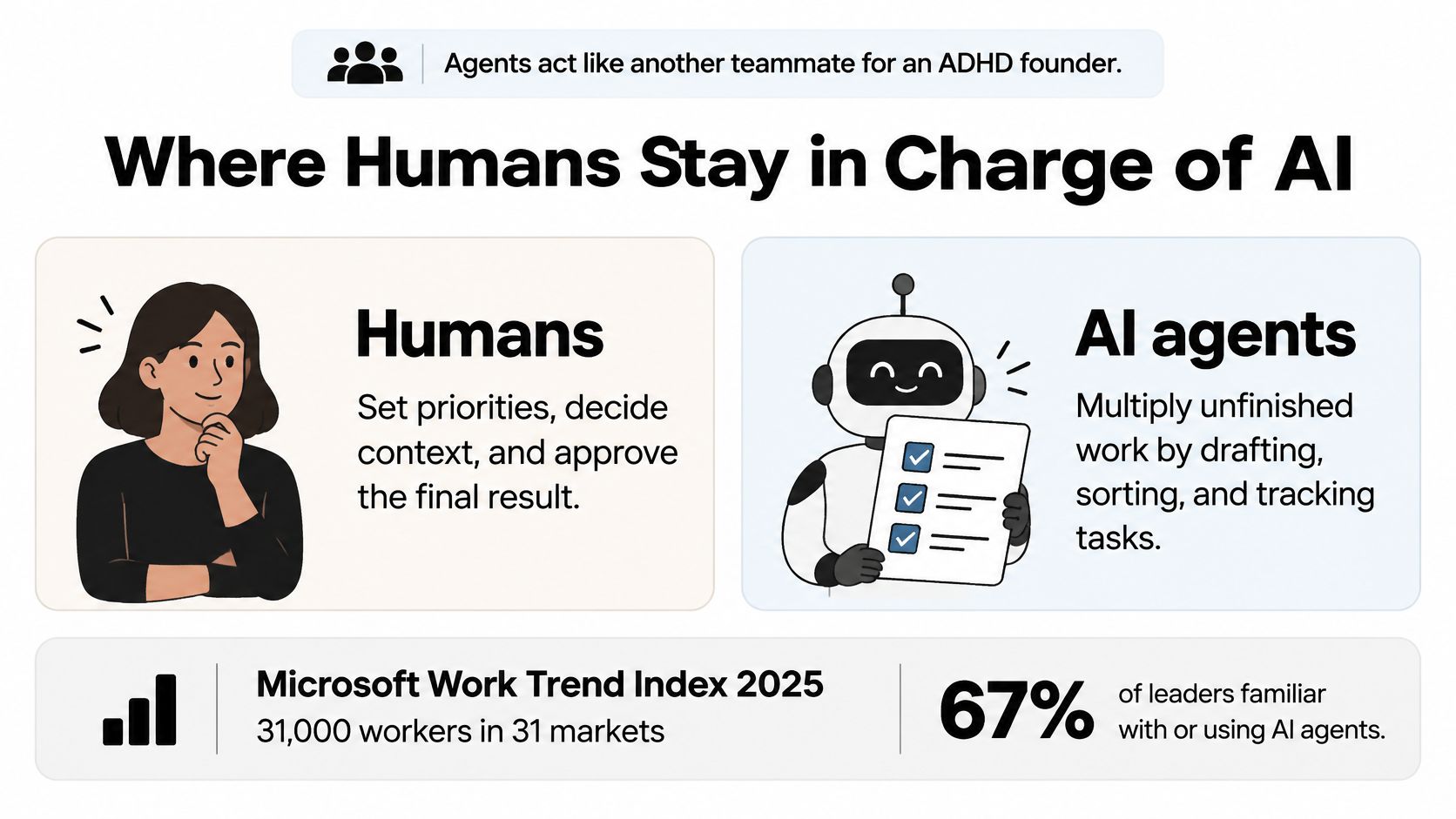
In Microsoft’s 2025 Work Trend Index, based on 31,000 workers across 31 markets, 67% of leaders were familiar or extremely familiar with AI agents, compared with 40% of employees, according to Microsoft’s report. That familiarity gap is a reason to write explicit permissions, not assume everyone shares the leader’s understanding.
Separate production from authority
Use this ownership charter before connecting an agent to live workflows.
| Work | Human | AI agent | Reviewer |
|---|---|---|---|
| Client tone and promises | Decides and signs | Drafts only | Founder or account lead |
| Status summaries | Approves the send | Compiles from the board | Ops owner |
| Research first pass | Writes the question | Gathers sources | Domain owner |
| Money, hiring, escalations | Decides | Flags only | Founder |
| Routine follow-ups | Sets the rule | Sends inside the rule | Thread owner |
No agent gets authority by sounding confident. A polished sentence doesn’t authorize a discount, a hiring rejection, or a revised client commitment.
For research, the domain owner checks whether sources support the claims. For status summaries, ops verifies exceptions and blockers before sending. Routine follow-ups need a written boundary specifying permitted recipients, content, and stop conditions.
Keep this division visible wherever people assign agent work.
Judge the workflow, not the output pile
Store agent output in the project workspace, label it unreviewed, and attach the reviewer and expected review time. Don’t scatter drafts across personal chats and automation dashboards. Keep sensitive information out of workflows that haven’t been authorized for it.
Use a trial lasting two weeks as a practical evaluation window. Track:
- Rework rate: Which outputs needed correction before use, and why.
- Human overrides: Where the reviewer rejected the agent’s recommendation.
- Trust and checking burden: Whether people can rely on approved work or the founder keeps checking everything twice.
Choose an active coordination channel and route automation notices there. Batch routine notifications; reserve immediate alerts for defined exceptions. If the agent creates more interruption than the admin it removes, redesign the workflow.
Paste this into the charter: Agents draft and fetch. Humans decide and sign.
Install the Charter Before the Next Crisis
Don’t announce a company-wide transformation with a slide deck and a brave new folder structure. Install the rules on a real project, where missing information has consequences and people can tell you what’s unusable.
Use this seven-day schedule as an implementation plan.
- Day 1: Post the charter and move a live project onto a single board. Name the person responsible for keeping it current.
- Day 2: Rewrite the oldest bouncing task as a handoff packet. Get the receiver and reviewer to accept it.
- Day 3: Reshape invitations without a decision line. Keep the short outcome review and remove duplicate status reporting.
- Day 4: Collect preference cards without requesting diagnoses. Resolve conflicting response expectations explicitly.
- Day 5: Put a human reviewer on agent output. Pause unchecked drafts and unauthorized sends.
- Day 6: Choose last week’s failure symptom and apply its corresponding fix. Resist renovating everything else.
- Day 7: Read the decision log without asking the founder for help. Can you identify owners, deadlines, and approved work?
Test whether people can operate without you
If people still need your private explanation to interpret the board, the system isn’t finished. Correct the missing field or unclear rule rather than congratulating everyone on adopting the tool.
You can wire these habits into a broader operating system later. Today’s job is smaller and more useful: publish the Day 1 charter before the next client fire, while you still have enough attention to write it clearly.
Our work at Jan Kutschera helps founders build operating systems around Cognitive Architecture, Dopamine Engineering, Strategic Delegation, and Bio-Optimization, including the structures needed for clearer team handoffs. Visit for free resources such as the Execution Audit and Weekly Build Filter, or explore hands-on advisory if you want help making these rules part of how your team works.
Jan Kutschera
German founder, diagnosed with ADHD at 51. Built 4 agencies, now building systems for neurodivergent entrepreneurs. German engineering for the ADHD brain.
Connect on LinkedInRelated Articles
How to Improve Team Communication for ADHD Founders
Learn how to improve team communication with async rules, handoff templates, delegation scripts and feedback loops built for ADHD-led teams.
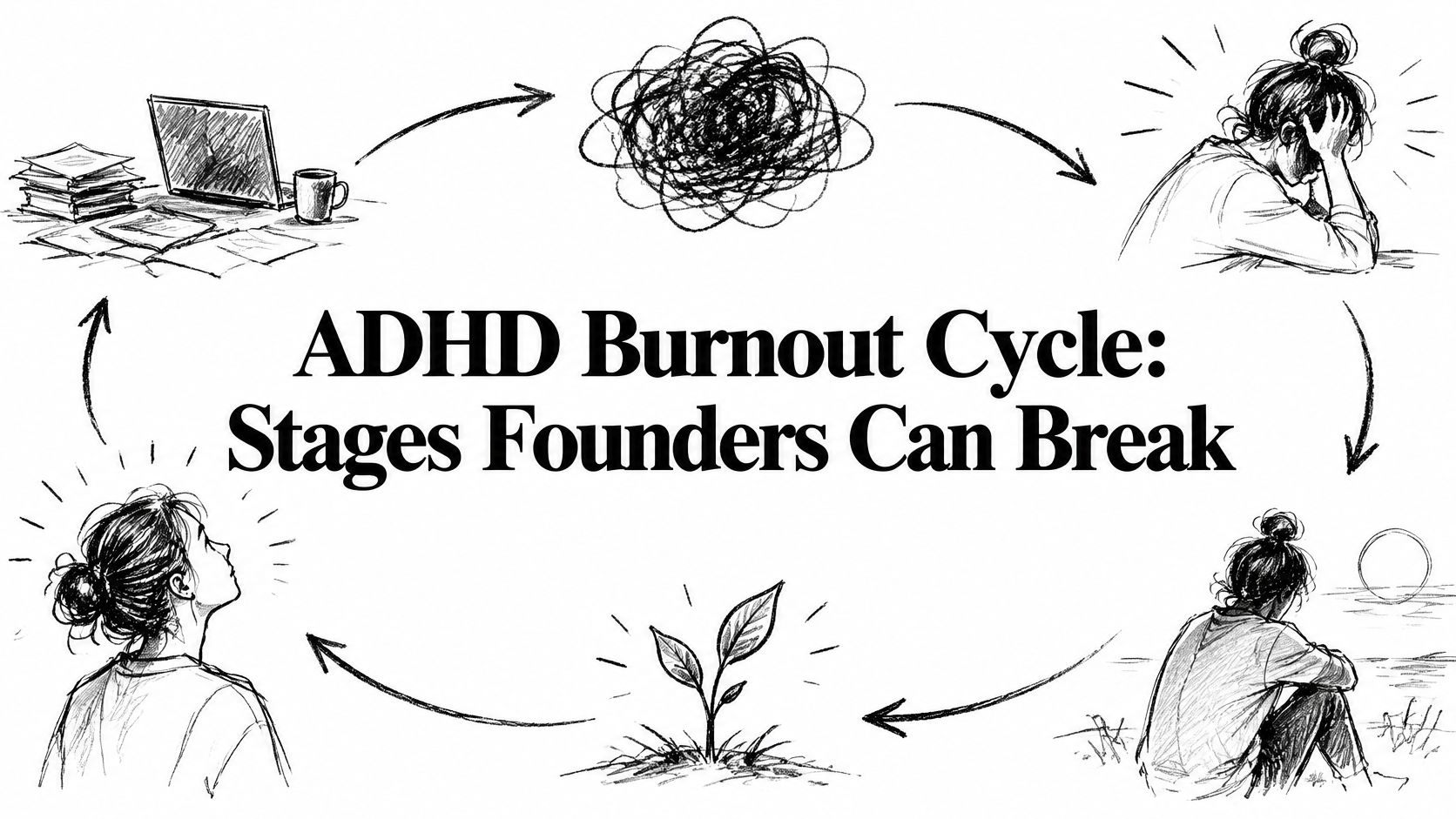
ADHD Burnout Cycle: Stages Founders Can Break
See the ADHD burnout cycle in five stages, separate it from depression, and test founder fixes before the next crash.
10 Creative Problem Solving Techniques for ADHD Founders
Explore 10 creative problem solving techniques for ADHD founders, from Design Thinking to Pre-mortems, with steps, templates, and when to use each.