ADHD Paralysis Symptoms and How to Restart
ADHD paralysis symptoms explained with freeze patterns, likely drivers, and a first move that restarts the stuck task.
Jan Kutschera
The proposal has been finished for nine days.
You know it’s finished because you’ve read it twice. The scope is clean, the pricing is right, and the client asked for it last Monday. All that’s left is the send button on an email you drafted three days ago and never touched again. You opened it this morning, read the first line, closed the tab, and went to check a hosting invoice that could have waited until next year.
Nobody watching you would call that a disorder. They’d call it a coffee break. But you know the difference between choosing not to send something and being unable to, and the second one has been running your calendar for years.
Table of Contents
- The Send Button That Will Not Move
- ADHD Paralysis Symptoms Mapped to a First Move
- Why the Brain Stalls on Important Work
- When the Freeze Is Not ADHD
- Founder Moments That Trigger a Full Stop
- Scallolds That Restart a Stuck Task
- Decide Whether to Structure or Get Assessed
The Send Button That Will Not Move
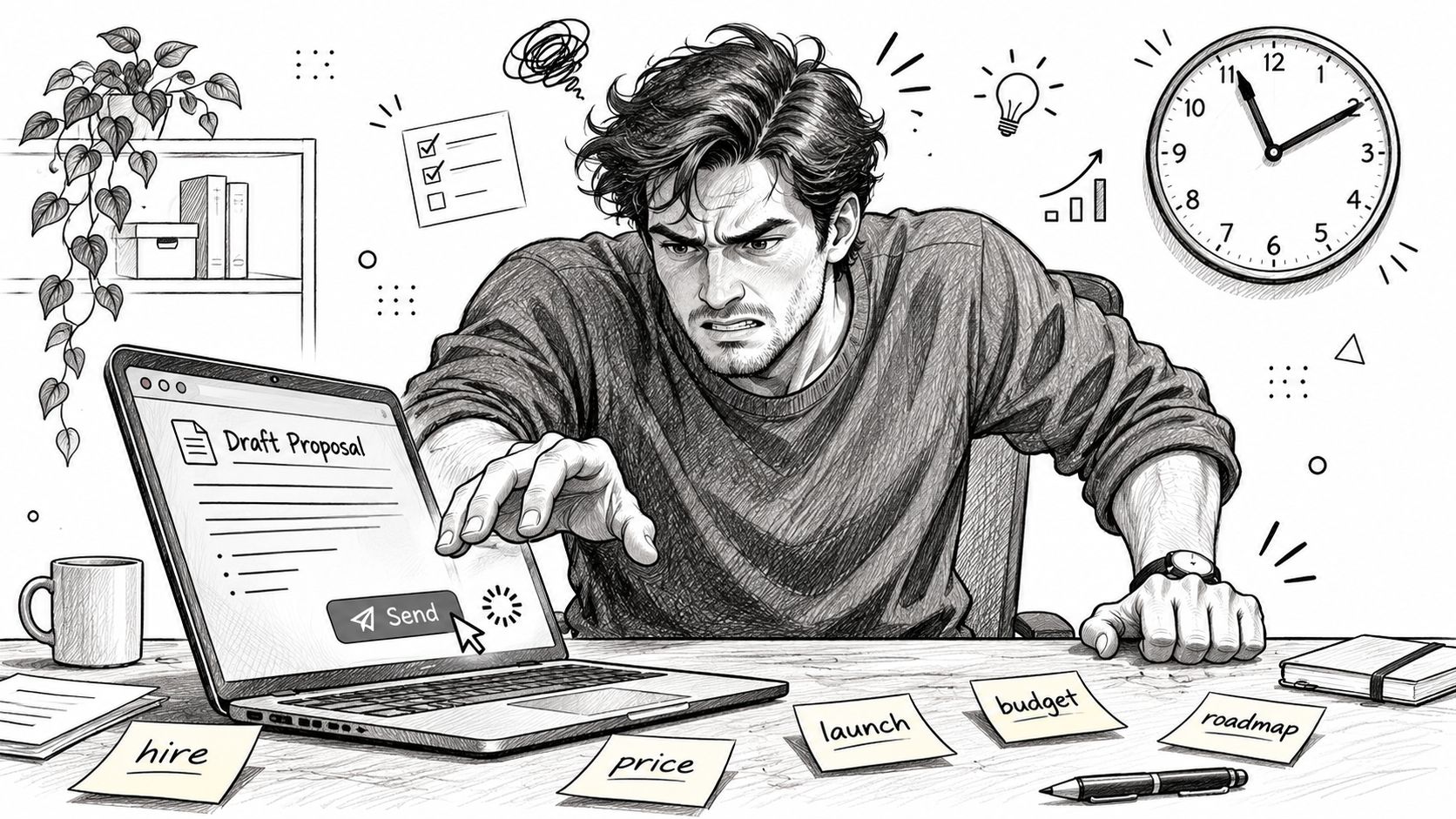
The proposal is ready, the email is open, and the cursor is parked beside Send. You know what to do. Still, the hand does not move. That gap between knowing and starting is often what people mean by ADHD paralysis symptoms.
The phrase is informal. It describes difficulty initiating, organizing, sustaining, or switching a task you want to do. Your thoughts may race, decisions may pile up, or your mind may feel iced over. The outward result can look identical, while the point of failure differs.
A browser can have forty tabs open and none of them registering a click. Everything is there, but the system is not responding. That is different from laziness, which implies a choice, and from low motivation, which does not explain why someone can care a lot and still be unable to begin.
The pattern can be uneven. A deadline catches fire, and suddenly you produce a burst of work. When the urgency disappears, an ambiguous, slow-paying, or emotionally loaded task can bring the stall back. A sprint does not prove that the system is working smoothly; it may only show that urgency temporarily got it moving.
Input matters, too. Too many open tabs and interruptions can make it harder to hold the task in view. Reducing tab-switching may help, as the advice to stop losing hours to tab-switching suggests. It is one practical adjustment, not a diagnosis or a complete explanation.
A freeze is not automatically ADHD. Depression, anxiety, burnout, sleep debt, medication timing, or cognitive disengagement can also affect your ability to act. The useful question is not merely whether you feel stuck, but what is driving the stall and whether the pattern persists across situations.
Clinically, ADHD involves symptoms that are present often for at least six months, show up in at least two settings such as work and home, and impair functioning. One stuck afternoon is common; by itself, it is not a diagnosis.
ADHD Paralysis Symptoms Mapped to a First Move
Find your row. That’s the whole instruction. Six patterns cover most of what shows up in a founder’s week, and each one has a different first move.
| Pattern | Everyday sign | Likely snag | First move |
|---|---|---|---|
| Cannot start a known task | You’ve read the brief three times and the file is still blank | Activation | Two-minute ugly first action, sent or saved |
| Loses the steps mid-task | You reread the brief and restart from paragraph one | Working memory | Three-step checklist written outside your head |
| Cannot ignore pings | Tab hopping until the task vanishes off the screen | Inhibition | Phone in another room for one block |
| Stuck on a preferred activity | You can’t switch out of design work into invoicing or follow-up | Set-shifting | A timed two-minute transition ritual |
| Decision pile-up | Hiring, pricing, and next-quarter strategy all open at once | Too many open decisions | Write one decision down, park the rest |
| Emotionally loaded task | Shame or dread shows up before the file even opens | Emotion regulation | Name the feeling, then set a five-minute timer |
Look at how unalike those rows are. One person understands the task perfectly and can’t start it. Another starts fine and loses the thread by paragraph three. A third is only stuck because six decisions are open at the same time and none of them has an owner. The same word, paralysis, covers all three, and the fix that rescues one does nothing for the others.
Most of these rows also look like ordinary procrastination from the outside, which is exactly why so many capable people spend years assuming they’re just undisciplined. Avoidance and inattention cause far more lost weeks than any dramatic freeze does, and they’re far less photogenic.
The thirty-second self-sort
Do this now, on paper or in a note you’ll see tomorrow.
- Circle one row only. The one that happened this week. Not the one that sounds most like you in general.
- Ignore the other five. You can’t run six corrections at once, and trying is the same overload that created the stall.
- Shrink the task. Not a practice task. The actual proposal, the actual price, the actual offer letter, cut down to the smallest version that still counts.
- Run that row’s first move once. Two minutes. Today. Ugly is allowed.
The step people skip is shrinking the task. “Write the strategy doc” is not a task, it’s a category. “Write the three-sentence summary of what we will not do next quarter” is a task, and it takes eleven minutes.
Treat the table as a matching tool, not a verdict. A blocked afternoon is ordinary. The pattern matters when it keeps returning and keeps blocking work that has a consequence attached to it.
If you cannot find your row, that’s information too. A freeze that doesn’t match any specific pattern, and comes with a flat mood or collapsed energy across your whole life, points somewhere other than task initiation.
Why the Brain Stalls on Important Work
The stall stops being a personality trait and becomes a wiring report. Executive function is the set of mental controls that let you start, hold steps in mind, block distractions, and switch gears. A 2024 peer-reviewed review found that approximately 89% of young people with ADHD show a deficit in at least one executive-function component, and the review’s domain breakdown explains why no two freezes feel identical.
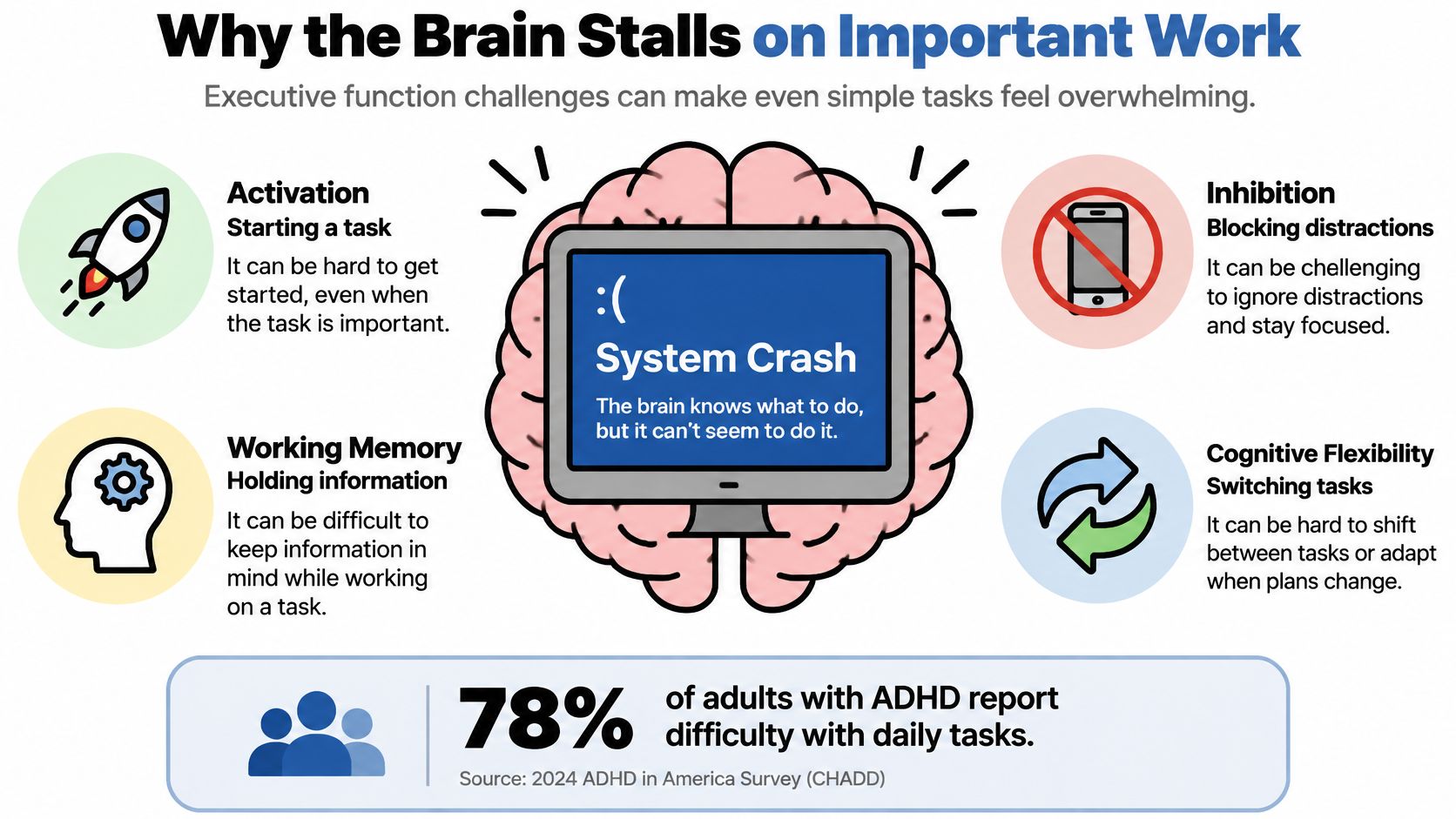
The affected domains are anything but uniform. Working-memory impairment was reported in roughly 75 to 85% of youth with ADHD, inhibitory-control impairment in 21 to 46%, and set-shifting impairment in 10 to 38%. Those ranges are the whole argument in one line. One colleague can’t hold the steps. Another can hold every step and can’t suppress the ping. A third suppresses everything and still can’t leave the interesting tab.
| Domain | Reported share | What it blocks |
|---|---|---|
| Any executive-function component | about 89% | at least one deficit |
| Working memory | 75-85% | holding task steps in mind |
| Inhibitory control | 21-46% | suppressing pings and tab-switching |
| Set-shifting | 10-38% | leaving a preferred activity for admin |
Read those figures the way they’re meant. They don’t say every person with ADHD has every deficit. They say ADHD usually arrives as a variable profile of weaknesses, and that initiation gets especially unreliable when the work is ambiguous, the reward is delayed, the effort is heavy, or the emotion around it is loaded.
Here’s a short walkthrough worth watching before you go further.
The practical consequence is that a stall is a maintenance failure, not a moral one. ADHD isn’t a superpower and it isn’t a curse. It’s a different operating system, and it crashes when it isn’t maintained.
What that means in practice: the crash happens at predictable places, under predictable conditions, and those conditions can be engineered around. Character has nothing to do with it.
Go back to the row you circled. That row tells you which domain to design around. If it’s activation, you need a smaller entry point. If it’s working memory, you need an external holder for steps. If it’s inhibition, you need the competing cue physically removed. The executive-function strategies that map to each domain are worth reading next, because the fix is domain-specific and generic advice isn’t.
When the Freeze Is Not ADHD
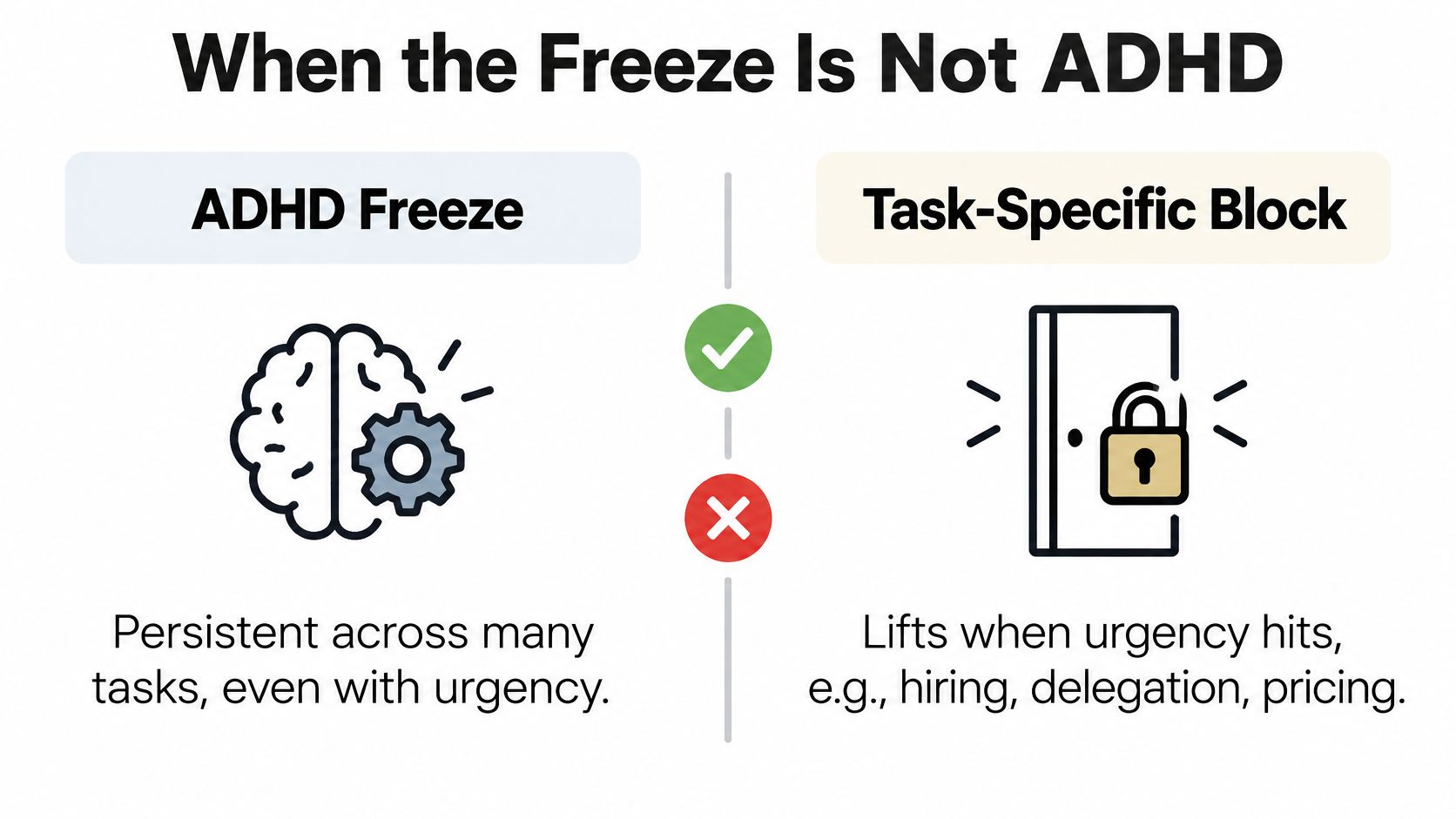
The first split worth making is scope. A stall that only shows up on ambiguous, high-stakes work, and lifts the moment urgency arrives, is a very different animal from a stall that’s present in every part of your life, including things you enjoy. The first one is the classic founder pattern on hiring, delegation, pricing, or strategy. The second one needs a wider look.
Run the check before you self-label anything. Each row asks what you notice and what to verify before concluding.
| What you notice | More like | Check before you self-label |
|---|---|---|
| Stall only on ambiguous high-stakes work; urgency restores output | ADHD executive stall | Six months, two settings, occupational impairment |
| Pleasure and energy down across ordinary life | Depression | Anhedonia, sleep, appetite, hopelessness |
| Dread, body alarm, avoidance of a threat | Anxiety | Panic, catastrophic loops, physical arousal |
| Shutdown after prolonged masking or sensory load | Autistic burnout | Need for recovery rather than another deadline |
| Freeze mainly after short nights | Sleep debt | Hours slept this week versus hard days |
| Worse at dose peak or wear-off | Medication timing | Log dose time against the stall |
| Mind blank, slow, daydreamy rather than distractible | Cognitive disengagement | Overlap with ADHD; not the same as inattention |
Depression dulls pleasure and energy across the board, not only on the difficult email. It’s the drive itself that’s gone, not the ability to launch a task you still want to do. Anxiety arrives with a body: alarm, dread, avoidance of something your nervous system is treating as a threat. Autistic burnout follows prolonged masking and sensory overload, and it responds to recovery, not to another sprint or a sharper deadline. When a freeze arrives after months of running hot rather than out of nowhere, the ADHD burnout cycle is the pattern to check before you touch your calendar. Sleep debt can imitate a freeze after three short nights even when the task is simple and clear.
Medication timing deserves its own line. Attention can sharpen at one point in the dose curve and initiation can get worse at wear-off, so a two-column log, dose time against freeze time, does more for your next appointment than a month of vague memory.
Then there’s the pattern that gets missed because it doesn’t look like distraction at all. In 2025 a study of 690 university students in Iran found that 25.15% met criteria for combined ADHD and cognitive disengagement syndrome. Among participants already diagnosed with ADHD, 41.3% also met criteria for cognitive disengagement syndrome, a condition associated with impaired executive functioning and a blank, slow, daydreamy feel rather than a busy, distractible one, per the PubMed-indexed study.
That matters because a person who is miles away doesn’t match the stereotype, and adult ADHD overlaps heavily with emotional dysregulation and other conditions. Treating every freeze as ADHD can delay the right assessment, which is the point this overview of the informal term keeps returning to.
If the pattern holds across tasks and settings rather than one hard category of work, stop shopping for productivity hacks. A clinical question needs a clinical answer.
Founder Moments That Trigger a Full Stop
Four scenes, because recognition beats description. In each one the missing piece isn’t willpower. It’s a single external object.
The hiring tab. Twelve candidates, strong shortlist, and no named owner of the decision, because the moment you name an owner it could be the wrong name. So you reread resumes, compare two of them, and let the calendar save you by scheduling another interview round. Missing object: one decider, one date, written at the top of the file.
The pricing document. The number is knowable. You’ve done the margin math twice. But typing it converts an opinion into a verdict, so the file stays in draft while smaller busywork gets finished to a high standard. Missing object: a written price and the date it takes effect.
The strategy afternoon. Three hours blocked, laptop open, goal enormous, and “done” undefined. Every twenty minutes you switch to a different slide, which feels like progress and is avoidance in a decent suit. Missing object: one sentence defining what exists at 5 p.m. that didn’t exist at 1 p.m.
The handoff that never leaves your head. Someone else could own the onboarding sequence. Writing the brief feels harder than doing it badly at midnight, so you keep doing it badly at midnight. Missing object: a note with owner, input required, and deadline.
Each of those got rescued at some point by the same thing. The Sunday night surge. The deadline that pulls three days of output out of you in four hours and makes you think, see, I can work when I have to.
Urgency borrows stimulation. It doesn’t install a start. The surge that unsticks you tonight teaches your nervous system that panic is the only fuel that works.
That’s why panic productivity is such a bad witness. It proves capacity and hides the missing infrastructure, and it keeps proving it until the pattern hardens into a system. The team learns to wait for a crisis. Offers go out late. Ownership stays fuzzy because naming an owner is the exact decision that stalls.
The cost shows up in the business, not the mood journal. Slower hiring, prices that never get tested, handoffs that don’t exist so you become the handoff, and a team that has organised itself around waiting for the fire alarm. ADHD symptoms have been linked with faster and more severe burnout too, which is what happens when the alarm stops working.
Every one of those four scenes has the same shape. A decision that should have left your head stayed in it, and a stall filled the space where a structure should have been.
Scallolds That Restart a Stuck Task
Nothing here is a personality overhaul. This is a routine you run on the task you already circled, and it works because each move removes a specific operating failure rather than asking you to want it more.
Start with an honest limit. Medication can sharpen focus and attention while leaving planning, prioritization, initiation, and follow-through thin, because the higher-level executive functions adult life demands respond less reliably to the dose. Cognitive-behavioral work and organizational skills training are what compensate, according to reporting on the forthcoming U.S. adult-ADHD guidelines. Which means “concentrate harder” is the wrong instruction for a sequencing problem.
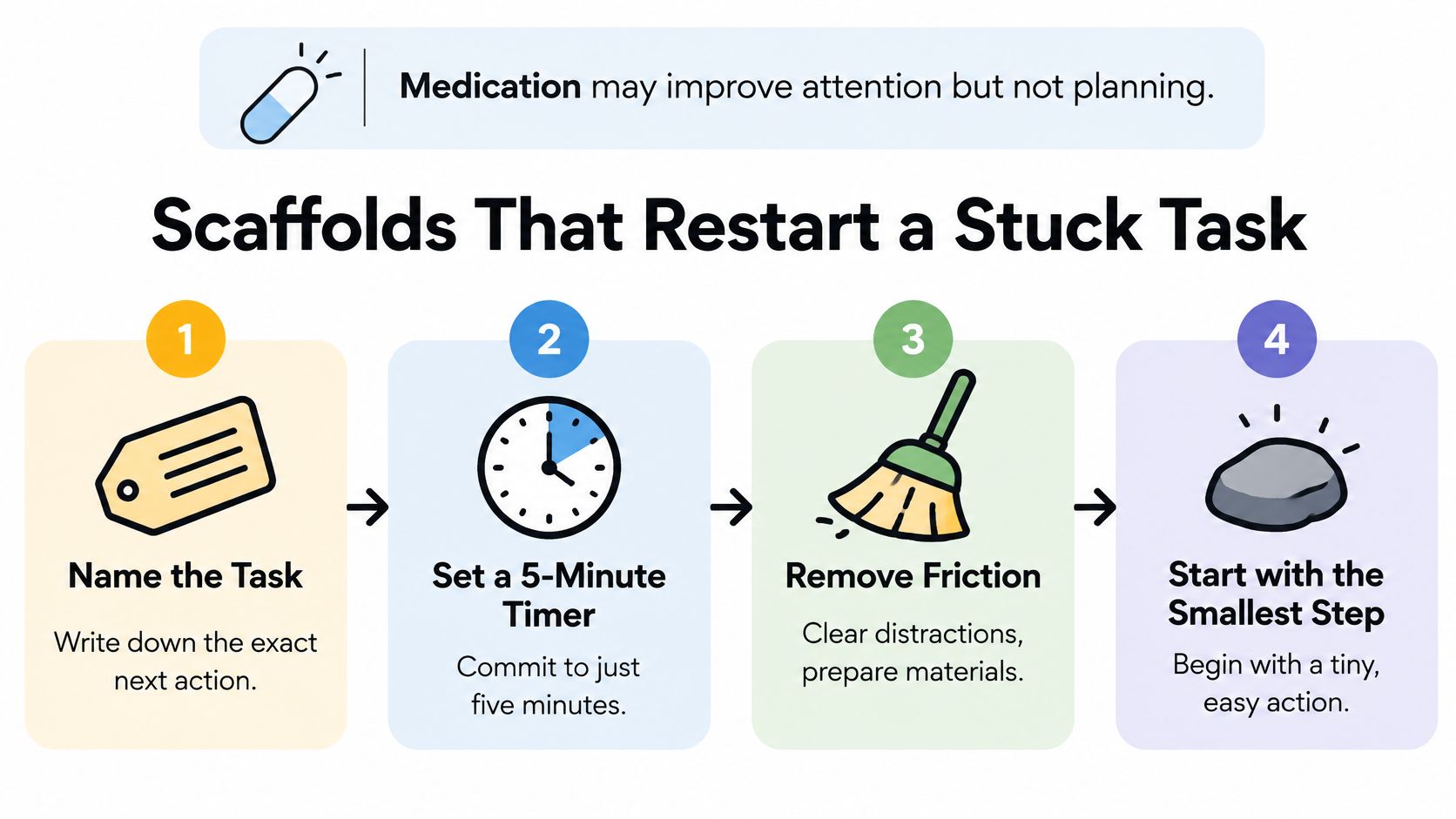
Run the seven moves in order.
- Name the single output and the done line, in one sentence. “Send the revised proposal to Dana before 4 p.m., priced at the higher tier.” Vague work cannot be started because there’s nothing to start.
- Move every other open decision to a parking list. One choice in your head at a time. The rest live somewhere you’ll look tomorrow, not somewhere you’ll ruminate tonight.
- Write the next three physical steps where they stay visible. Physical means physical. “Open the pricing tab, change row 12, screenshot it into the email.” This is the external memory that replaces the working-memory load.
- Set a five-minute timer and allow the ugly version. Permission to write badly is not lowering standards. It’s the only entry point that exists for work with a delayed reward.
- Remove the competing cue before you sit down. Phone in another room, one window open, notifications off. Inhibition isn’t a fair fight against a device designed by thousands of engineers.
- If the task sits outside your genius zone, draft a handoff instead of doing it in crisis. Owner, input, deadline. Delegation is a structure, and structures are cheaper than another midnight.
- After the block, log which failure caused it. Unclear ownership, too many decisions, no definition of done, context switching, or a missing handoff. Five categories, one line each, so next week’s design gets better.
That log is the part people skip and the part that compounds. It converts a vague sense of being broken into a list of design faults you can fix.
Two sentences on the trap. Crisis stimulation that unsticks you today trains panic as your only fuel, and ADHD symptoms have been associated with burnout that arrives faster and lands harder. Skills and structure aren’t a soft add-on to treatment. They’re the part that makes a good day repeatable.
For the sensory and scheduling side of the same routine, these time management and sensory regulation tips from Be Your Best Self & Thrive Counseling, PLLC are a useful companion, because a start you can only pull off in a silent room isn’t a system.
One rule if you remember nothing else: steps 1 through 4 take eleven minutes and you run them today, on the real task. Not a practice task. Not Monday.
If task initiation is your specific failure and you want the deeper behavioural work on it, the task initiation strategies that hold up under deadline go further than a timer. And if the stall keeps landing on the same decision type, the problem is the decision, not the timer.
Decide Whether to Structure or Get Assessed
Two plain tests, and they’re worth applying rather than flatteringly.
Keep self-structuring for another week if the stall is limited to ambiguous or delayed-reward work, your pleasure and energy are otherwise intact, sleep and medication timing don’t explain the pattern, and a five-minute start plus a written done line produces movement. That’s not denial. That’s a system that needs tuning.
Arrange a professional assessment if the inability to begin or sequence important work keeps returning, has been present often across many months, shows up in more than one part of your life, and costs you work. The clinical picture behind that threshold, where inattention is the strongest correlate of ADHD-related procrastination and the evidence still can’t prove causation, is set out in this systematic review of 11 studies and 2,788 participants. Mood symptoms, panic, dissociation, or a global collapse in energy are reasons to seek evaluation sooner, whatever the timeline.
When you go, bring evidence rather than self-blame. Take the symptom row you circled, your dose timings, your sleep pattern, and two or three examples of what the stall cost you. A clinician can work with that. Nobody can work with “I’m just bad at admin.”
If you’re weighing a decision that keeps stalling and you want a structured way to reason through it, this framework for comparing feasibility and business potential from Find Startup Idea turns an open-ended dread into a checklist with an endpoint. An occasional delayed start is ordinary adult life. Impairment that follows you across settings is the signal to stop self-diagnosing and get a clinician or a structured skills coach involved.
I was diagnosed with ADHD at 51, after four agencies and enough deadlines to notice that my systems worked for reasons I couldn’t explain. That diagnosis is why the Starter Kit and Brain Map exist: a personal blueprint of where your executive load breaks, which decisions should leave your head permanently, and the external structures that make starting repeatable instead of heroic. If the send button has been winning for years, visit Jan Kutschera and start with the map.
Jan Kutschera
German founder, diagnosed with ADHD at 51. Built 4 agencies, now building systems for neurodivergent entrepreneurs. German engineering for the ADHD brain.
Connect on LinkedInRelated Articles
Hold Me Accountable: A Practical ADHD Founder Guide
Hold me accountable without surveillance or shame: a step-by-step ADHD founder playbook for partners, cadences, reminders and reliable follow-through.
ADHD Project Management: Systems That Work with Your Brain
ADHD project management that works with your brain, not against it: external structure, visible tasks, smarter delegation and follow-through that lasts.
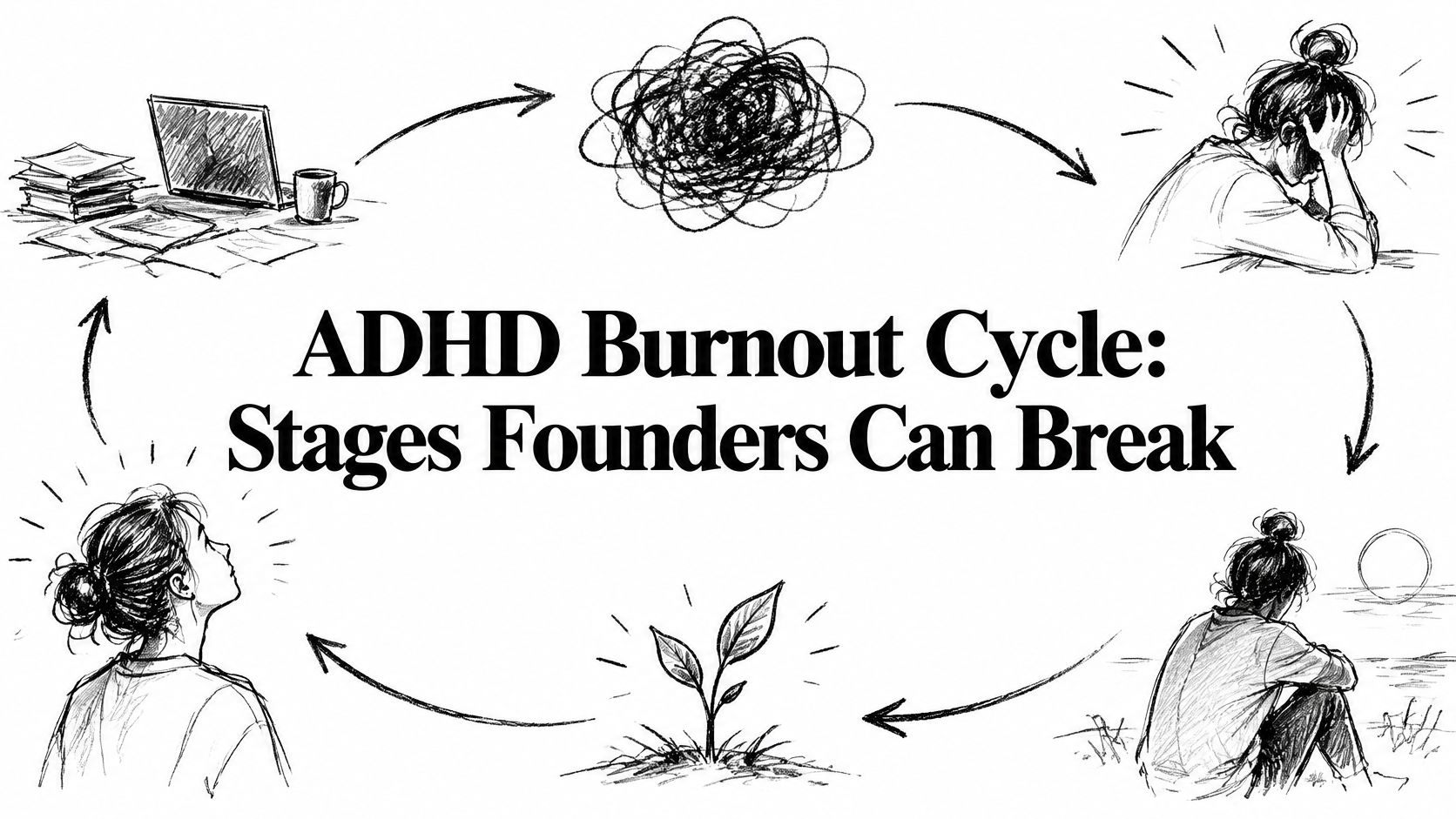
ADHD Burnout Cycle: Stages Founders Can Break
See the ADHD burnout cycle in five stages, separate it from depression, and test founder fixes before the next crash.