Task Initiation Strategies for ADHD Founders
Practical task initiation strategies to help ADHD founders start work faster, overcome procrastination, and build momentum in 2026.
Jan Kutschera
You’ve opened the proposal, checked Slack, remembered an invoice, and somehow ended up rearranging your Notion dashboard. The proposal is still blank. You know what to write, the client matters, and you’re annoyed enough with yourself to power a small industrial estate.
That’s the moment to stop asking for more discipline. Useful task initiation strategies change what happens between deciding and doing, without requiring you to become a different person first.
Table of Contents
- Why Starting Is the Whole Game for ADHD Founders
- If-Then Triggers That Fire Before Resistance Kicks In
- The 10-Minute Minimum Viable Start
- Engineered Reward Loops That Replace Adrenaline
- Environment and Schedule Tweaks That Lower the Cost of Starting
- Strategic Delegation as an Initiation Multiplier
- Troubleshooting When You Still Cannot Start
Why Starting Is the Whole Game for ADHD Founders
Consider a familiar founder afternoon. You can explain the offer, spot the weakness in the positioning, and tell your team exactly what the client needs. Yet opening the document and writing the opening paragraph feels harder than the strategic thinking.
Then the deadline gets close. You finally start, work late, and deliver something good. It’s tempting to conclude that pressure is your preferred working style, rather than an expensive workaround you’d rather not need.
Treat initiation as an engineering problem: inspect the conditions under which work begins, then change those conditions.

Separate the work from the start
A project can be commercially sound and still have a terrible entry point. “Develop the acquisition strategy” describes a responsibility, not something your hands can do.
Look at the difference:
- Project outcome: Produce a proposal the client can approve.
- Start condition: The relevant brief is visible and messages are closed.
- First action: Paste the client’s stated problem into the proposal draft.
These aren’t interchangeable. A beautiful project plan won’t help much if you still have to invent the opening move every time you sit down.
For an early-stage business, Pazi’s steps before your first sale can sit alongside this work as a planning resource. Keep business sequencing separate from initiation design: deciding what matters and making it startable are different jobs.
Practical rule: Design the trigger before you design the task.
Audit your abandoned projects and false starts without turning the exercise into a character assessment. Where did you stall: before opening the file, when choosing an approach, or when facing a decision you couldn’t make alone?
That distinction matters. You don’t fix a missing decision with a timer, and you don’t fix an invisible starting point with another motivational podcast.
If-Then Triggers That Fire Before Resistance Kicks In
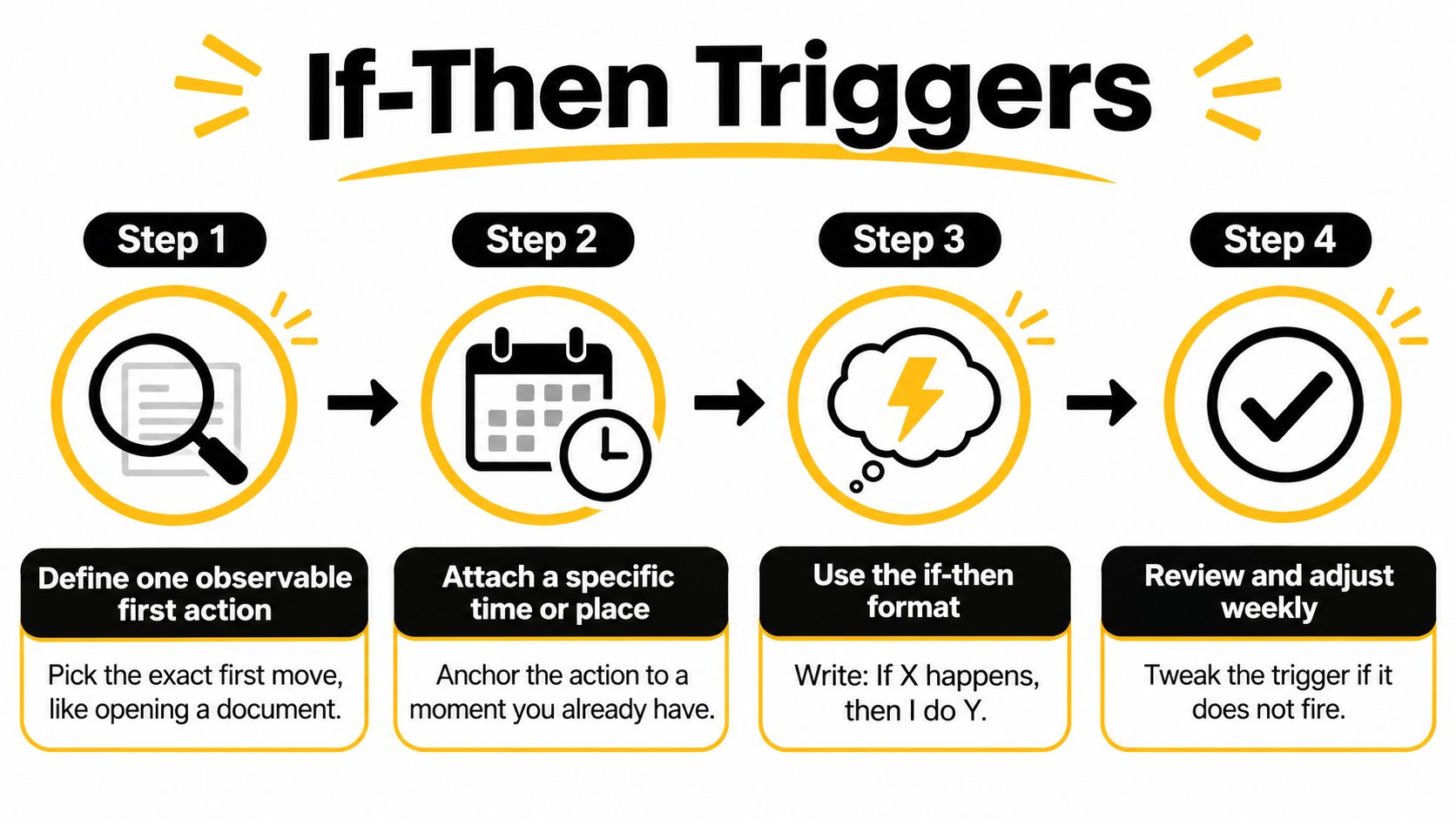
“Work on strategy” leaves you with another decision to make at the exact moment you’re trying to begin. An implementation intention specifies the situation and the response beforehand.
The practical version is deliberately literal:
If it is 09:00 and my laptop opens, then I will start a 10-minute document skeleton before checking messages.
That’s a proposed operating rule, not a promise that you’ll suddenly enjoy writing strategy documents.
Build a trigger you can actually encounter
- Define an observable action. Choose something visible, such as opening the project brief and writing three bullet points. “Make progress” doesn’t qualify.
- Specify the situation. Write an if-then rule tied to an identifiable event, not a mood.
- Attach a stable cue and time. Use a workday moment you can protect. If your mornings vary, choose a more dependable transition.
- Remove competing choices beforehand. Close the inbox and prepare the document before the cue arrives.
The ADHD-specific evidence is encouraging but bounded: across two studies involving 50 children, implementation intentions improved goal-directed response inhibition compared with goal intentions alone, with a pooled medium effect size of d = 0.48, p = 0.04, as reported in the implementation-intention research. That isn’t a trial of agency founders completing proposals, so don’t translate it into a promised business result.
The useful mechanism is specificity: make the intended response accessible when the situation occurs, rather than trying to increase motivation generally.
For practice, draft separate plans for writing, administration, and a difficult conversation. An administration plan might start when you finish your scheduled planning session; a conversation plan might start when you open the relevant client record.
Avoid “when I feel ready.” Also avoid cues that happen constantly, such as “when I check my phone.” A trigger needs a recognizable boundary, not a permanent background hum.
If your laptop is already open before your chosen time, rewrite the cue. The system should describe your actual day, not the imaginary one where nobody sends you anything.
The 10-Minute Minimum Viable Start
“Write the investor update” contains drafting, financial checks, judgment, and the possibility of discovering something uncomfortable. No wonder opening it can feel like agreeing to an entire afternoon.
A minimum viable start makes a smaller agreement. The recommended ramp is 5–10 minutes: prepare the materials, begin with a low-friction action, and record the start rather than waiting to count the finished outcome.
Make the first attempt produce an artifact
For an investor update, the start could be:
- Prepare: Open the previous update and the current reporting folder before the scheduled work.
- Begin: Paste the existing template into a fresh document.
- Add substance: Write rough bullets under progress, risks, and decisions needed.
- Reach the boundary: When the short timer ends, choose whether to continue.
- Leave evidence: Record what changed and leave the next unfinished action visible.
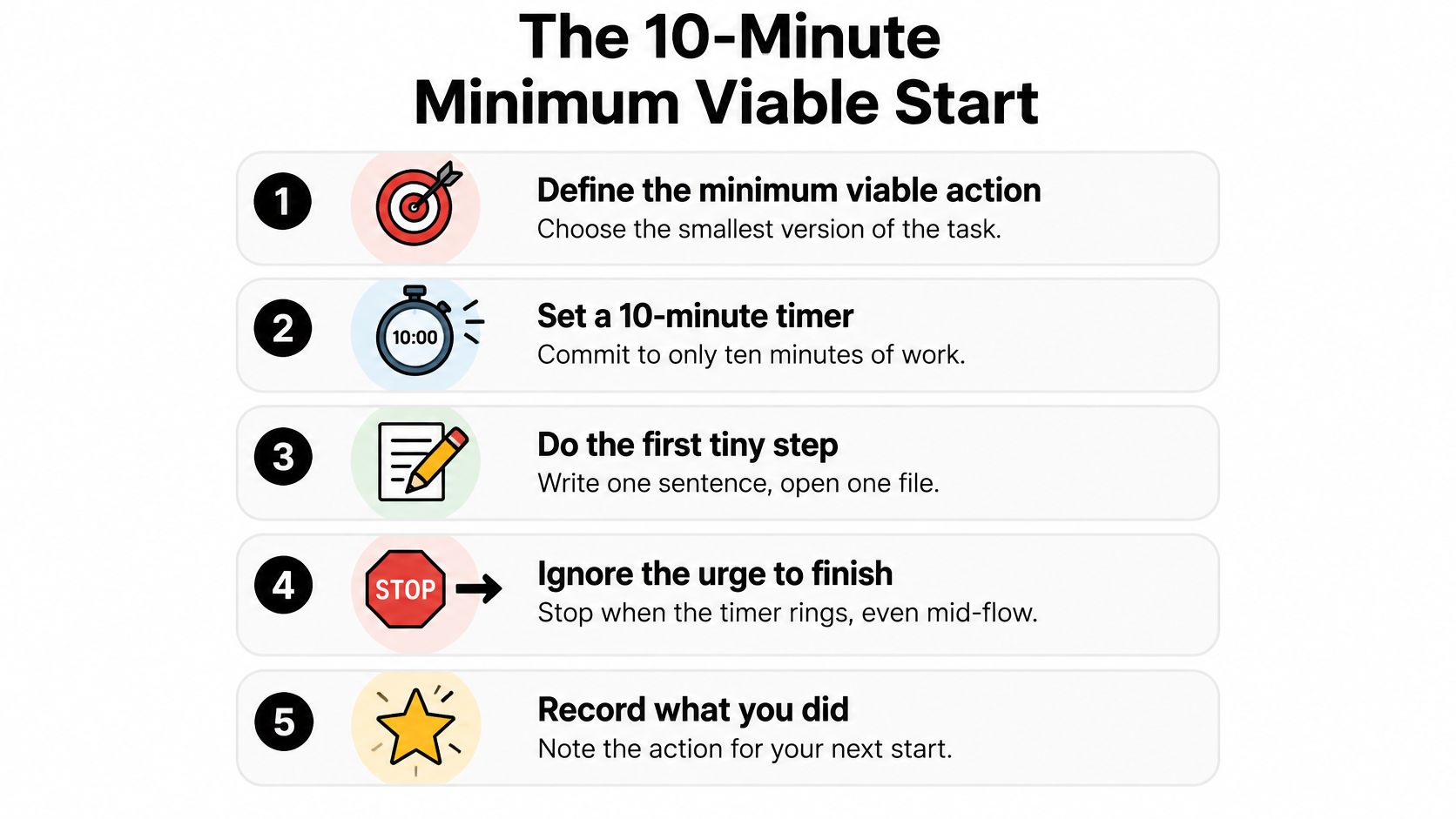
Treat the stop instruction as permission, not punishment. You can stop at the boundary without having failed; you can also continue deliberately if you have capacity. Don’t turn “just start” into “surprise, you’re committed until midnight.”
A 2020 cognitive-functional intervention study reported improvements in initiation, planning, organization, and monitoring, with gains maintained after treatment ended. The participant group was small, and that intervention isn’t proof that a timer alone produces the same results.
Count a start when the deliverable changes, not when you’ve finished preparing to prepare.
That distinction keeps the ritual honest. Opening Notion, selecting an icon, and renaming a database may feel productive, but the investor update still needs words.
Use a plain document, a kitchen timer, or your existing task manager. Don’t build an automation suite before attempting the task it’s supposed to support.
If the smallest version still feels impossible, shrink the uncertainty rather than merely shrinking the duration. “Identify the missing financial input” may be a better start than “draft the financial commentary.”
Engineered Reward Loops That Replace Adrenaline
A deadline rescue has an obvious payoff: the uncomfortable thing is finally over. Designing a calmer reward loop means making ordinary progress worth noticing before you reach crisis mode.
This is an operating experiment, not a claim that you can precisely control your neurochemistry with coffee and a checkbox. Choose rewards you enjoy, then test whether they help you return to the work.
Reward the behavior you want repeated
Use a simple relationship: the agreed action earns the agreed reward. Don’t make the reward depend on an immaculate result when the behavior you’re practicing is beginning.
| Work event | Possible reward | Guardrail |
|---|---|---|
| Draft skeleton exists | Make a slow coffee | Return with the next action already written |
| Difficult handoff sent | Walk with a favorite podcast | Choose the episode before leaving |
| Focus session completed | Check in with a body-double partner | Share the artifact, not a productivity performance |
| Meaningful milestone reached | Protect an enjoyable nonwork activity | Don’t cancel it merely because more work exists |
A reward ladder can distinguish between starting, completing a useful work block, and shipping a deliverable. Keep the smallest reward easy to access; reserve more involved activities for natural stopping points.
The trade-off is interruption. A podcast walk may fit after drafting, but starting an absorbing video halfway through financial reconciliation is a questionable gift to your future self.
Don’t reward the avoidance ritual
If you spend the preparation period selecting music, browsing coffee equipment, and finding the perfect background video, you’ve built a leisure session with a document nearby. Pleasant surroundings are fine, but check whether the promised action happened.
For a related operating approach, consider the ADHD reward system for business momentum. Judge any suggestion by the same practical test: can you use the reward without making the return harder?
Close your if-then plan with a reward you’ve chosen beforehand. Keep basic needs outside the bargain: food, rest, and necessary breaks aren’t prizes you must earn by being productive.
Environment and Schedule Tweaks That Lower the Cost of Starting
Your desk doesn’t need to resemble a minimalist architecture magazine. It needs to make the intended action easier to reach than the alternatives.
Before a client walkthrough, for example, pre-stage the Loom recording tab and the relevant page. Leave a short speaking outline beside it, so “record the walkthrough” doesn’t begin with hunting through browser history.

Audit the next workday
- Workspace: Put the required file in view, close unrelated tabs, and move your phone if you keep reaching for it. Keep necessary reference material available.
- Calendar: Protect an opening work block before reactive work where feasible. Batch meetings later if clients and colleagues can accommodate it, rather than imposing a schedule your business can’t support.
- Physical readiness: Check whether you need water, food, movement, daylight, or rest before asking yourself to concentrate. Treat these as readiness checks, not medical treatment.
For recurring publishing work, use Social Media Scheduler’s resource to build a weekly content schedule, then assign a visible opening action to each session. A calendar entry labeled “content” still leaves the hard choice unresolved.
Setup test: Could you begin without searching, choosing, or asking someone where the materials are?
The aim isn’t a sterile workspace or a rigid morning ceremony. It’s fewer avoidable negotiations when you arrive.
For a broader approach, explore ADHD and routines while keeping exceptions explicit. If a client emergency displaces your start, name the replacement window rather than treating the entire day as lost.
Choose the changes that remove your actual friction. A phone in another room won’t solve a missing brief.
Strategic Delegation as an Initiation Multiplier
You might complete the task faster than you can explain it. That’s relevant for an unusual emergency, but it’s a poor default policy for recurring work.
Delegation can remove an initiation burden, not merely transfer execution. The founder no longer has to notice the task, reconstruct its context, and summon the energy to begin it every cycle.
Founder Task Audit by Initiation Cost
These ratings are diagnostic examples, not measured scores. Replace them with your own experience.
| Task Type | Initiation Cost | Founder Action | Handoff To |
|---|---|---|---|
| Recurring reporting | High when inputs are scattered | Specify exceptions requiring review | Operations lead |
| Routine client scheduling | Low effort, repeated interruption | Set availability boundaries | Coordinator |
| Positioning decision | High ambiguity | Retain the decision, request a challenge | Advisor |
| Document formatting | High relative to founder interest | Supply acceptance criteria | Delivery specialist |
Don’t delegate a vague cloud of discomfort. Transfer context, authority, and an observable finish line.
Copy-paste handoff brief
- Context: Why this matters and who needs the output.
- Current state: What exists, where it lives, and what’s missing.
- Decision needed: What you may decide and what needs escalation.
- Deadline: Agreed delivery point and any genuine dependencies.
- Definition of done: The artifact, quality checks, and delivery location.
For an operations lead, try: “Please own the recurring client report from input collection through delivery. Flag missing information and unusual results; send me only the exceptions requiring my judgment.”
For an advisor: “I’m stuck between these approaches. Challenge my assumptions and identify what evidence would change the decision; I’ll retain responsibility for the choice.”
Keep accountability without reclaiming the task
A clean handoff still needs review. If you rewrite everything without explanation, your colleague never learns the standard and you remain the hidden production department.
Use the guide to delegating tasks effectively to develop the handoff process. ContextFlow is another planning resource where you can find routines for busy professionals; use a routine to prepare handoffs consistently, not to supervise every keystroke.
Delegate work someone else can own. For work only you can decide, ask for preparation or challenge instead of pretending you’ve transferred responsibility.
Troubleshooting When You Still Cannot Start
A failed start doesn’t prove you need more pressure. It gives you a specific event to inspect.
Follow this decision tree in order. Once you identify a plausible bottleneck, test its fix before redesigning your entire working life.
Route the failure to the right intervention
Unclear next action
Can you describe the next physical or digital action? Could someone watching tell whether you’d done it?
If not, replace the project label with a verb and an object: “open the contract and highlight the disputed clause.” Don’t demand execution while you’re still deciding what execution means.
Excessive task size
Are you expecting the opening session to resolve the entire deliverable? Does starting feel like consenting to an indefinite workday?
If yes, narrow the commitment to a bounded artifact. Draft the decision question rather than the complete strategy.
Distracting environment
What did you touch immediately before leaving the task? Was that interruption necessary for the work?
Remove that specific escape route for the next attempt. Don’t conduct a ceremonial office overhaul when the immediate problem is an open inbox.
Low physiological readiness
Are you depleted, hungry, uncomfortable, or struggling to stay awake? Would you reasonably expect a colleague in the same condition to perform well?
Address the immediate need and reassess. Persistent or substantial difficulty warrants discussion with an appropriate clinician, not increasingly elaborate productivity rituals.
Missing accountability
Does anyone know what you’re attempting? Have you agreed to show an artifact, or only announced that you’ll “work on it”?
Arrange a concrete check-in with a colleague or body-double partner. Show the changed document, decision note, or sent handoff rather than reporting how hard you tried.
Install the system over a week
Treat this as a proposed rollout, not a performance challenge. Move a stage if your workload demands it.
- Day one, environment audit: Identify the most common escape route and remove it.
- Day two, trigger writing: Write your if-then plans around dependable workday events.
- Day three, minimum viable starts: Test the short-start approach on a stalled deliverable.
- Day four, reward setup: Choose a bounded reward and its return condition.
- Day five, delegation audit: Transfer a recurring responsibility with clear authority.
- Day six, bottleneck diagnosis: Inspect a missed start using the decision tree.
- Day seven, review: Keep what helped and revise what didn’t.
Copy-paste operating templates
Paste these into Notion, Obsidian, or a plain text file. Resist turning them into another database renovation.
If-then planner
- Situation: If [observable cue] occurs at [chosen time or transition]…
- Response: Then I will [visible opening action].
- Preparation: Beforehand, I will remove [competing choice].
- Boundary: My agreed stopping point is [artifact or timer].
- Reward: After the action, I will [bounded reward].
Delegation brief
- Context and current state: [Purpose, materials, missing inputs.]
- Authority and escalation: [Decisions the owner can make.]
- Delivery agreement: [Deadline and definition of done.]
Weekly review
- Evidence: What started, and what changed?
- Failure point: Where did I stall?
- Adjustment: What will I change before the next attempt?
- Support: Who needs to help?
After a month of consistent use, don’t demand a transformed personality. Look for clearer evidence about which cues work, which responsibilities need another owner, and which problems require support beyond workflow design.
For harder cases, consider applying to the Founder Circle rather than privately adding more rules. Bring a concrete stuck task and your attempted fixes.
Through his Starter Kit, application-only Founder Circle, and hands-on advisory, Jan Kutschera helps ADHD founders build operating systems around initiation, rewards, and delegation. Visit to choose the support that fits, and bring the task you keep reopening without starting.
Jan Kutschera
German founder, diagnosed with ADHD at 51. Built 4 agencies, now building systems for neurodivergent entrepreneurs. German engineering for the ADHD brain.
Connect on LinkedInRelated Articles

Executive Function Explained: The Brain's Air Traffic Crew
Executive function explained without jargon: the three core skills, why ADHD makes them state-dependent, and the external scaffolds that replace willpower.
Time Management for Entrepreneurs Without the Panic
Time management for entrepreneurs with ADHD: a weekly split, capacity calendar, batching, and delegation specs that replace panic productivity.
How to Run Effective Meetings for ADHD Founders
How to run effective meetings with timeboxes, roles, agendas, and follow-up built for neurodivergent founders who want decisions, not more calls.