Define Accountability Partner: Unlock ADHD Success: Smart
Define accountability partner for ADHD founders. Bypass executive deficits, engineer dopamine loops, and achieve sustainable success. No more burnout!
Jan Kutschera
You have six browser tabs open, Slack is pinging, your team needs decisions, and the one task that would move the business forward is still sitting there untouched. Then the deadline gets close enough to trigger panic. You sprint, pull it off, feel briefly superhuman, and crash right after.
A lot of ADHD founders mistake that cycle for ambition. It isn’t. It’s a fragile operating system that only boots under threat.
That’s why people start searching to define accountability partner and usually get a soft, forgettable answer like “a supportive friend who checks in on you.” Nice idea. Weak system. If your brain ignores internal intentions and casual reminders, encouragement alone won’t carry the load. You need structure that can hold when motivation disappears.
Table of Contents
- Your Brain Isn’t Broken Your System Is
- The Human External Hard Drive Your Definition of an Accountability Partner
- Engineering Dopamine The Science of Accountability for ADHD Founders
- How to Find and Set Up Your Accountability Partnership
- Beyond Check-Ins The Partner as a Strategic Asset
- When Your Accountability System Breaks Down
Your Brain Isn’t Broken Your System Is
The usual story goes like this. You’re capable, creative, fast in a crisis, and somehow still inconsistent on the work that matters most. You can build campaigns, close deals, lead teams, and improvise under pressure. But routine execution keeps slipping through your hands.
That gap makes a lot of founders blame character. Lazy. Undisciplined. Too distracted. Not serious enough.
That diagnosis is wrong.
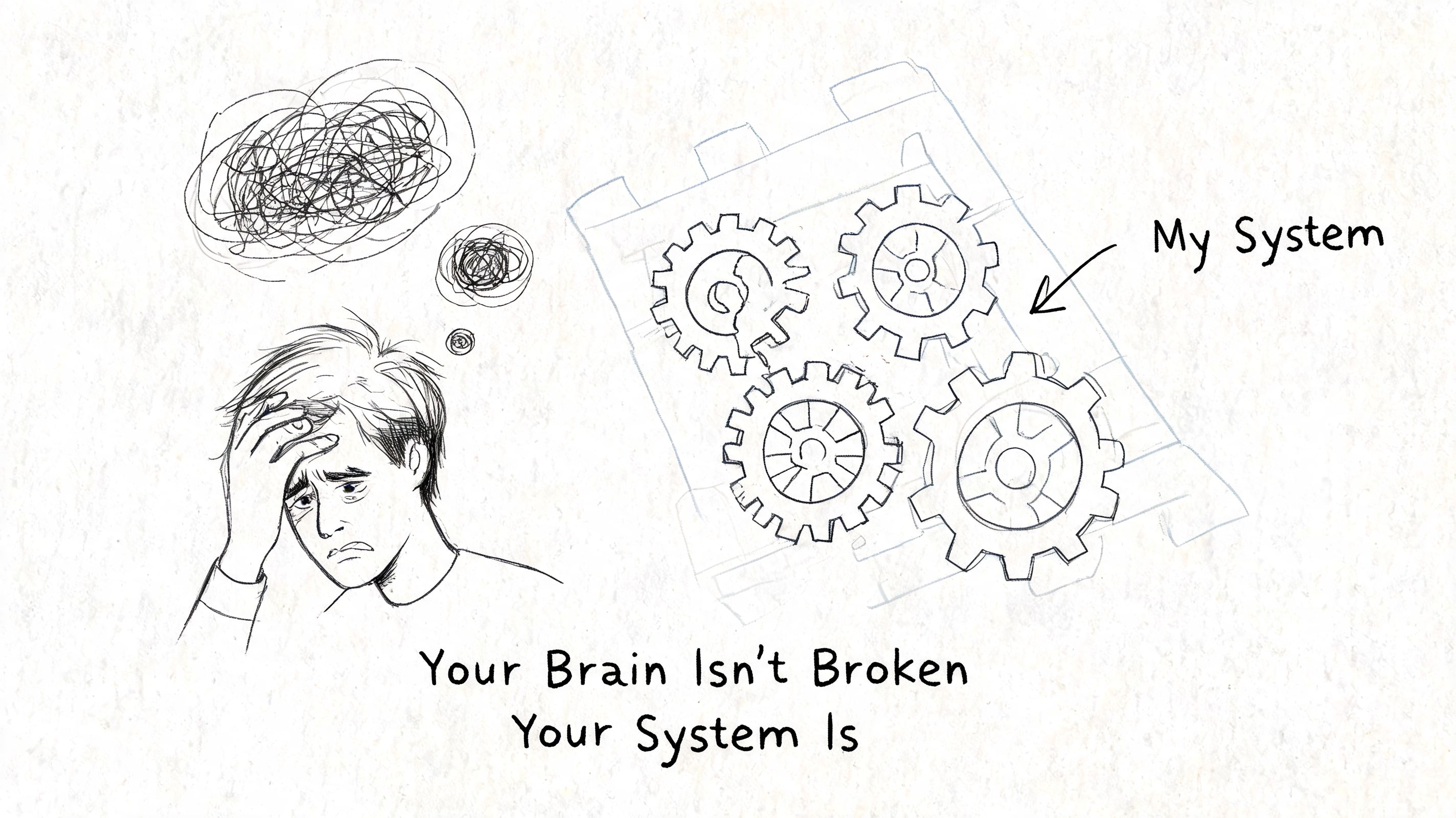
Most advice about accountability assumes the problem is motivation. For ADHD founders, the problem is often self-regulation under low stimulation. Existing content typically defines accountability partners as trusted peers, but that model often fails when the brain filters out social nudges that don’t come with structure. One verified summary notes that 70 to 80% of adults with ADHD struggle with self-regulation despite social support, and that a 2023 Journal of Attention Disorders study found structured tech-mediated accountability boosted completion rates by 45% versus peer check-ins alone (background summary on accountability partner limitations).
That tracks with what many founders already know from experience. A friend saying “How’s it going?” doesn’t change behavior if the task still feels foggy, distant, or emotionally flat.
Generic accountability fails because it is too soft
Casual accountability breaks in predictable ways:
- It relies on memory: You forget the goal existed until the check-in arrives.
- It depends on mood: If both people feel tired, the meeting turns into mutual absolution.
- It lacks friction: Nothing happens when you miss the target, so the brain learns the commitment was optional.
Practical rule: If the system only works when you feel motivated, you do not have a system. You have a lucky streak.
Founders dealing with burnout often confuse this pattern with a focus problem when it’s really an architecture problem. If that’s where you are, this piece on addressing burnout and ADHD focus issues is useful because it names the emotional side of the loop without pretending a mindset tweak will solve it.
The better frame is cognitive architecture
An accountability partner isn’t a cheerleader. For an ADHD founder, the right partner is part of Cognitive Architecture. That means an external structure designed to hold planning, follow-through, sequencing, and review when your internal system drops them.
Think less “supportive friend.” Think load-bearing beam.
Once you define accountability partner this way, the standard advice starts looking flimsy. Good intentions aren’t enough. You need a setup that catches dropped commitments before they become expensive.
The Human External Hard Drive Your Definition of an Accountability Partner
The cleanest way to define accountability partner is this: a structured collaborator who helps enforce commitment to SMART goals through regular, bidirectional check-ins. Not inspiration. Not mentoring. Not therapy. Enforcement.
That matters because ADHD founders often have brilliant strategy and unreliable recall. Your mind generates ideas at speed, then loses the thread between intention and execution. An accountability partner acts like a human external hard drive for executive function. They help store commitments outside your head, pull them back into view at the right time, and force review before drift turns into avoidance.
A verified summary from WGU describes accountability partners as structured collaborators using regular two-way check-ins, noting that two-way partnerships yield 65% higher follow-through on tasks compared to solo efforts, and that a scheduled cadence can reduce procrastination by as much as 42% through immediate feedback loops (structured accountability overview from WGU).
What the role actually does
A strong accountability partner handles a few specific jobs well:
- They make goals concrete. “Grow the agency” becomes “send five proposals, review pipeline Friday, and hand off onboarding checklist.”
- They create recurrence. You’re not deciding every week whether to check in. The cadence already exists.
- They close open loops. If you said you’d do something, they bring it back into the room.
- They mirror reality. They don’t accept vague progress language like “I was thinking about it.”
The best accountability partners reduce ambiguity, not anxiety.
That last point is huge. A lot of founders avoid systems because they fear rigidity. But most ADHD chaos doesn’t come from too much structure. It comes from the wrong kind of structure. Bureaucracy kills momentum. Clean external commitments create it.
Accountability partner versus coach versus mentor
Here’s where founders get confused. They hire a coach when they need execution pressure. They ask a mentor for strategic advice when what they really need is recurring compliance. Different tools, different jobs.
| Attribute | Accountability Partner | Business Coach | Mentor |
|---|---|---|---|
| Primary role | Mutual follow-through and commitment tracking | Paid guidance, performance support, perspective | Experience-based advice and career wisdom |
| Power dynamic | Peer to peer | Professional to client | Senior to junior, usually informal |
| Focus | What you said you would do this week | How to improve, decide, or perform | What to avoid, where to grow |
| Cadence | Usually recurring and operational | Scheduled sessions, often strategic | Irregular, relationship-driven |
| Cost | Often free or reciprocal | Paid | Often unpaid |
| Best use case | Task completion, consistency, anti-drift | Decision quality, leadership growth | Pattern recognition, longer-term judgment |
| Bad substitute for | Deep expertise or therapy | Day-to-day enforcement | Weekly execution pressure |
A founder can use all three. But if you’re trying to define accountability partner in practical terms, the role is simple: someone with permission to inspect your commitments and refuse your excuses.
What it should feel like
Not warm and fuzzy. Not punitive either.
It should feel like this:
- clear before the call
- slightly uncomfortable during the review
- lighter after the conversation
- easier to start work the next day
If your current setup gives you emotional relief without behavioral correction, it’s probably friendship, not accountability.
Engineering Dopamine The Science of Accountability for ADHD Founders
ADHD founders often don’t have a knowledge problem. They have a timing and activation problem. You know what to do. You might even know exactly how to do it. The issue is getting your brain to engage before urgency floods the system.
That’s where structured accountability stops being a productivity trick and becomes Dopamine Engineering.
The strongest argument for that comes from a widely cited ASTD finding. People had a 95% chance of completing a goal when they had a specific accountability appointment with a person they’d committed to, compared with 10% for having an idea and 65% for verbally committing without a scheduled check-in (ASTD accountability data summary).
That gap tells you something important. The magic isn’t the goal. The magic is the appointment.
Why appointments work better than intentions
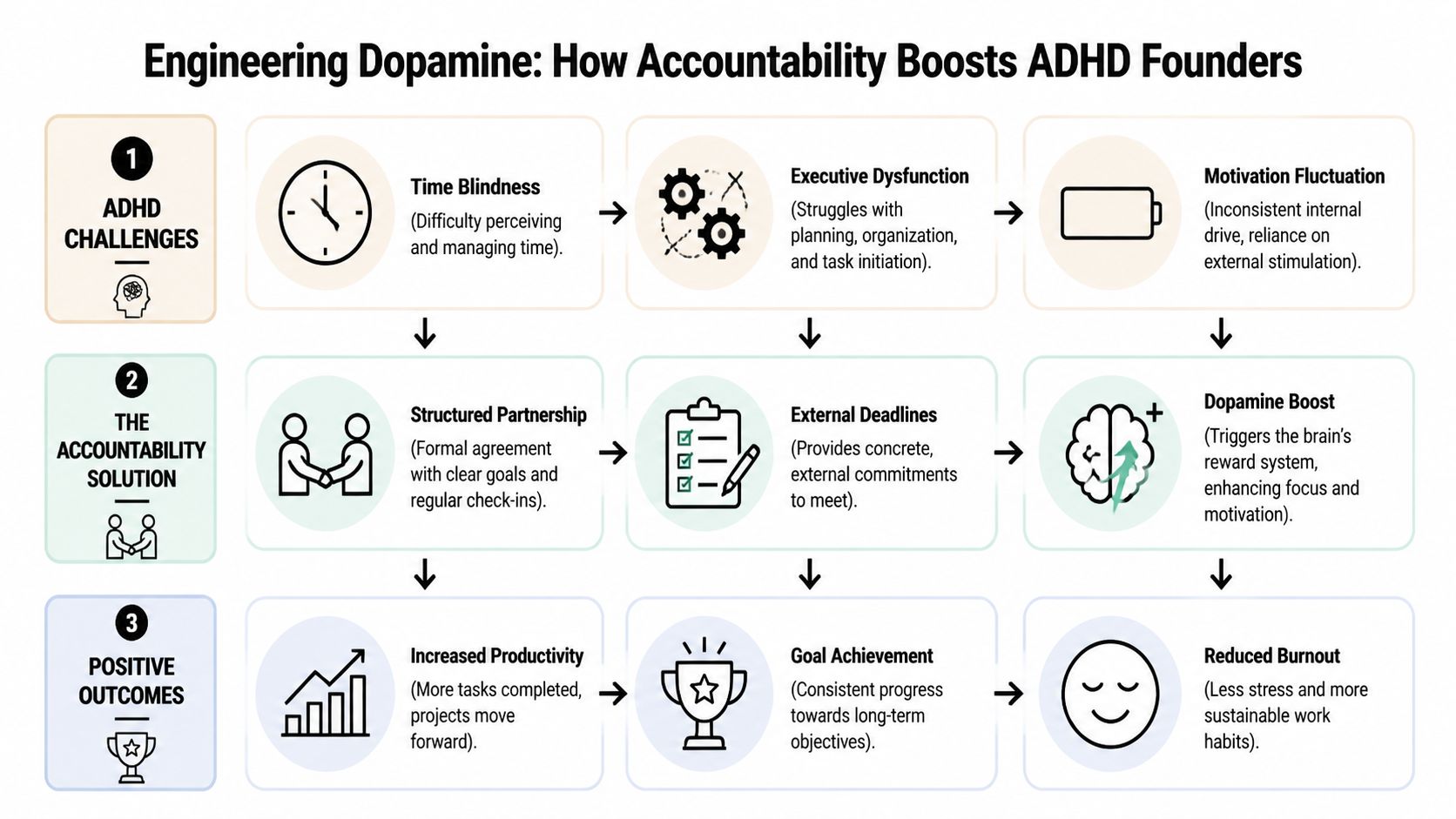
An intention lives in your head. An appointment lives on your calendar, in another person’s expectations, and in time. That difference is everything for a neurodivergent founder.
Appointments do three things your brain struggles to do alone:
- They create an external clock. Time blindness loses power when another person is waiting.
- They create immediate consequence. Missing a goal no longer disappears into private fog.
- They create reward prediction. Reporting progress gives the brain a near-term payoff, not just some distant business result.
If you want a broader primer on how ADHD affects attention, behavior, and daily function, DeTalks’ guide on ADHD gives useful context without reducing it to stereotypes.
Scheduled accountability works because it shifts motivation from “I should” to “I report.”
That is a much better fuel source than panic.
Here’s a useful companion read on ADHD dopamine in business if you want to go deeper into how reward loops shape execution.
What this changes in an ADHD founder brain
ADHD productivity often runs on adrenaline. Deadline near. Stakes high. Body awake. Brain online.
That method can build a business for a while. It can also wreck your nervous system.
A structured accountability relationship gives you a different loop:
- Micro-commitment
- Visible progress
- Social acknowledgment
- Repeat
That’s much steadier than “ignore, avoid, panic, sprint, collapse.”
A short video can make this easier to grasp in real time.
For founders, this changes the emotional texture of work. You stop needing every task to become dramatic before you can touch it. You build enough external pull that important work can start while it is still boring, unclear, or only partially rewarding.
That’s the whole point. Sustainable momentum beats heroic recovery.
How to Find and Set Up Your Accountability Partnership
Finding the right partner matters more than finding one quickly. The wrong person will either let you off the hook, create weird emotional friction, or turn every meeting into a vague conversation about how busy everyone is.
The best structure I’ve seen is simple, written, and repetitive. That approach lines up with Dr. Gail Matthews’ landmark study at Dominican University, where people who wrote down their goals, shared them, and sent weekly progress reports to a friend were 76% successful, compared with 43% for people who only thought about their goals (goal writing and weekly reporting data).
Written goals plus weekly reporting is not administrative fluff. It is the mechanism.
Who to choose and who to avoid
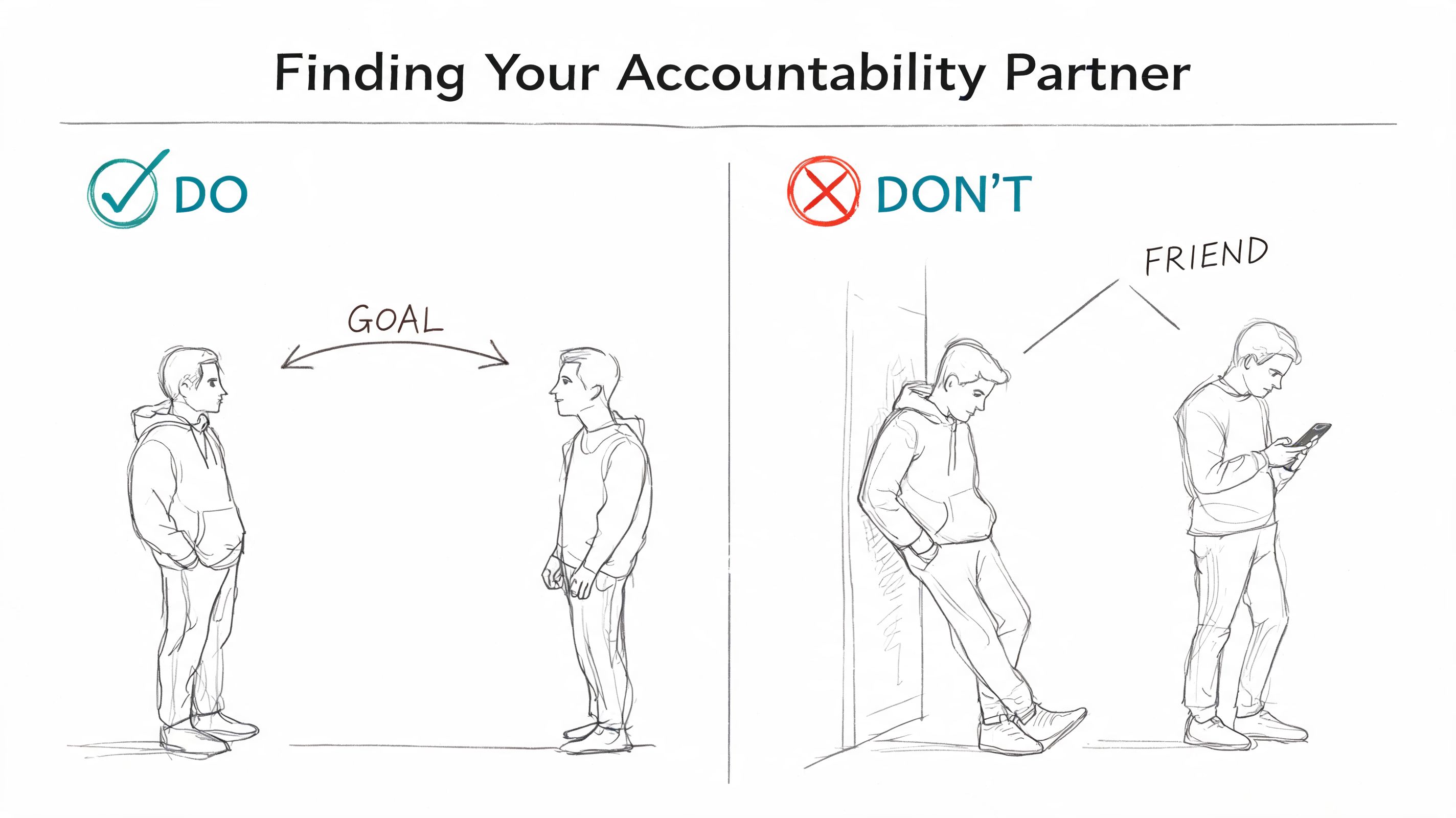
Choose someone who can tolerate clarity. Avoid someone who wants to protect your feelings more than your commitments.
Good candidates usually look like this:
- Reliable under routine: They show up on time, answer messages, and don’t disappear when life gets noisy.
- Emotionally steady: They can be direct without turning every miss into a moral judgment.
- Close enough to care, far enough to stay objective: A best friend can work, but often the relationship is too padded.
- Working on something meaningful themselves: Mutual effort matters. Purely one-sided accountability tends to decay.
Poor candidates tend to have one of these patterns:
- they love brainstorming but hate follow-through
- they confuse empathy with excuse-making
- they compete with you instead of tracking you
- they overcomplicate the tools before the habit exists
If you’re building this inside a community format, this piece on successful mastermind launches is useful because it shows how recurring group structures can create consistency when designed well.
A simple partnership agreement that actually works
Do not “just wing it.” ADHD brains are excellent at improvising and terrible at preserving clean agreements over time.
Use a one-page setup. Google Docs, Notion, or a shared Apple Note all work. If you need help creating visible time cues between check-ins, a tool stack with recurring alarms helps. This guide on using a multiple timer app fits nicely alongside a written accountability rhythm.
Here’s the template.
Partnership Agreement
Purpose
We help each other complete priority commitments and catch drift early.Primary goals
Each person tracks three active outcomes only.Weekly check-in
Same day, same time, same channel every week.Written report before meeting
Sent in advance. Include committed tasks, completed tasks, blocked tasks, and next actions.Channels
One for weekly review, one for quick nudges. Example: Notion plus Slack or WhatsApp.Rules of engagement
Be direct. No shaming. No rescuing. No vague language.If a commitment is missed
Identify whether the failure came from planning, sequencing, avoidance, or overload.Review window
Reassess the partnership after a trial period.
The weekly format that works
Keep the meeting short enough that you won’t avoid it, but structured enough that it can’t drift.
A reliable format:
- Report first: Each person sends a written update before the call.
- Review facts: What got done, what slipped, what is now blocked.
- Name the failure point: Wrong task, wrong estimate, missing dependency, emotional avoidance.
- Set next commitments: Specific, observable, calendar-attached.
- End with one risk: What could break this week’s plan?
If you only talk during the meeting and write nothing down, you’re trusting an ADHD brain to preserve detail across time. That’s fantasy.
Tools that help without becoming the job
You do not need an elaborate software stack. You need a visible one.
Useful combinations:
- Notion + Slack: Shared goals in Notion, quick check-ins in Slack
- Google Docs + Calendar: Minimal friction, easy for founders who hate dashboards
- Trello + WhatsApp voice notes: Good when tasks move through obvious stages
- Focusmate alongside partner check-ins: Helpful if task initiation is your main bottleneck
What doesn’t work is building a gorgeous system nobody wants to maintain. If updating the setup feels like a side project, strip it down.
Beyond Check-Ins The Partner as a Strategic Asset
A weak accountability setup asks, “Did you finish the task?”
A strong one asks, “Why was that task on your plate in the first place?”
That’s the shift from productivity hack to strategic asset.
A verified summary from Indeed states that accountability partnerships centered on peer-to-peer counsel boost productivity by 76% in knowledge work. It also notes that for neurodivergent leaders, this structure supports Dopamine Engineering, where celebrating micro-wins in check-ins creates sustained reward loops and reduces panic-driven work patterns by 55% according to behavioral data from goal-tracking apps (peer-to-peer accountability in knowledge work).
Cognitive architecture in real business life
For an ADHD founder, the partner isn’t just tracking output. They are helping maintain operating conditions.
That includes questions like:
- Are you committing to too many projects at once?
- Are your deadlines attached to actual calendar blocks?
- Are you taking on tasks your team could own?
- Are you confusing urgency with importance again?
In this process, accountability becomes part of Cognitive Architecture. The partner helps catch distortions before they become expensive. Not after the missed launch. Before the week collapses.
The highest-value accountability question is often not “Did you do it?” It’s “Was this yours to do?”
That question protects focus. It also protects margin.
The partner who protects your genius zone
Founders with ADHD are especially vulnerable to drift into low-value work because novelty, immediacy, and visibility all pull attention hard. You can spend half a day fixing copy, reorganizing a dashboard, or tweaking design details while the actual growth bottleneck sits untouched.
A good accountability partner becomes a line of defense against that drift.
They should challenge:
- founder work that belongs to operations
- emotionally easy tasks that replaced difficult ones
- reactive decisions made just to get a dopamine hit
- “busy” weeks with no strategic movement
That connects directly to delegation. If you want to tighten that muscle, this guide on how to delegate tasks effectively is a practical complement because delegation and accountability should reinforce each other.
The best partnerships also create a clean review habit around wins. Not celebration for the sake of positivity. Celebration as a control system. When you name a concrete win, your brain gets evidence that structured effort pays off before the final outcome lands.
That’s how you replace crisis-fueled momentum with steadier traction. The partner isn’t there to make you feel supported. They’re there to help your business stop depending on your last-minute nervous system.
When Your Accountability System Breaks Down
Most accountability partnerships don’t fail because the idea is bad. They fail because the mechanics get sloppy.
The first failure mode is ghosting. One person starts rescheduling, replying late, or vanishing when they’ve had a bad week. The fix is to define what happens after a missed check-in. Use a backup async report. If that also fails, pause the partnership instead of pretending it still exists.
The second is therapy creep. The meeting turns into processing emotions, venting about clients, or narrating stress. Some context is useful. Too much context becomes escape. Tighten the agenda, put the updates in writing before the call, and use a visible timer.
The most common failure modes
A few more show up often:
- Mismatched commitment levels: One person is building seriously, the other is dabbling. Fix it by ending the match early, not by lowering standards.
- No consequences: Missed goals generate discussion but no change. Add a rule that every miss must produce a system adjustment.
- Overloaded plans: Both people agree to unrealistic weeks because optimism feels good in the meeting. Cap active commitments.
- Excessive softness: The partner is kind but useless. Replace vague encouragement with direct review of facts.
When accountability stops changing behavior, don’t ask whether the people are broken. Ask which part of the design stopped carrying weight.
The fix is usually mechanical
If the system feels fuzzy, make it more visible.
If the meetings feel heavy, make them shorter.
If commitments keep slipping, make them smaller and more specific.
If avoidance keeps hiding inside complexity, force everything into plain language. “Work on sales” is not a commitment. “Send proposal draft to three leads by Thursday” is.
The same principle applies across all of it. Don’t moralize the breakdown. Engineer the next version.
A working accountability system should reduce chaos, not add another layer of guilt. When it’s built well, it gives an ADHD founder something rare and valuable. A way to stay ambitious without needing constant crisis to stay in motion.
If that pattern sounds familiar, Jan Kutschera’s work at ADHD Founder is built for exactly this problem. He helps founders with ADHD replace burnout-driven hustle with engineered systems that fit how their brains operate, so execution becomes more reliable, delegation gets cleaner, and growth stops depending on panic.
Jan Kutschera
German founder, diagnosed with ADHD at 51. Built 4 agencies, now building systems for neurodivergent entrepreneurs. German engineering for the ADHD brain.
Connect on LinkedInRelated Articles

Visual Reminders for ADHD: Engineer Your Focus
Founders, ditch burnout! Learn to build high-impact visual reminders for ADHD. Go from panic productivity to an engineered operating system for success.
Planner Color Coding for the ADHD Brain
Ditch generic planner color coding. Learn an ADHD-friendly system for founders that boosts focus and dopamine without the overwhelm. Step-by-step guide.
ADHD-Friendly: Build A Multiple Timer App System
Beat panic productivity. Use a multiple timer app for an ADHD-friendly system. Covers setup, workflows, and real-world use.