How to Handle Setbacks for ADHD Founders
Learn how to handle setbacks with an ADHD-friendly framework. Practical triage, recovery steps, and momentum systems built for neurodivergent founders.
Jan Kutschera
You open Slack and see the message you’ve been avoiding. The client has gone quiet after the proposal. The revenue dashboard looks wrong. A campaign missed its launch window, and three people are waiting for you to explain why. You know the sensible response: gather the facts, make a plan, and communicate clearly.
Instead, you open another tab, reread the same message, check your inbox, and feel your brain lock up.
Most setback advice starts with motivation. Be resilient. Reframe the failure. Try again. That advice assumes the person receiving it still has reliable access to prioritization, working memory, emotional regulation, and motivation. An ADHD founder in the middle of a setback may have access to none of those on demand.
I learned this the expensive way. After founding agencies and building a career around urgency, I was diagnosed with ADHD at 51. The diagnosis didn’t explain away my failures. It explained why my operating system kept depending on panic, novelty, and heroic last-minute effort. Handling setbacks became less about becoming tougher and more about building structures that still work when my brain is overloaded.
Table of Contents
- Why Setbacks Hit ADHD Founders Differently
- The First 72 Hours of Setback Triage
- Making Sense of What Just Happened
- Two Techniques That Actually Regulate the Brain
- Rebuilding Momentum With Cognitive Architecture and Dopamine Engineering
- Turning Personal Recovery Into Team Handoffs
- Prevention Routines That Make the Next Setback Survivable
Why Setbacks Hit ADHD Founders Differently
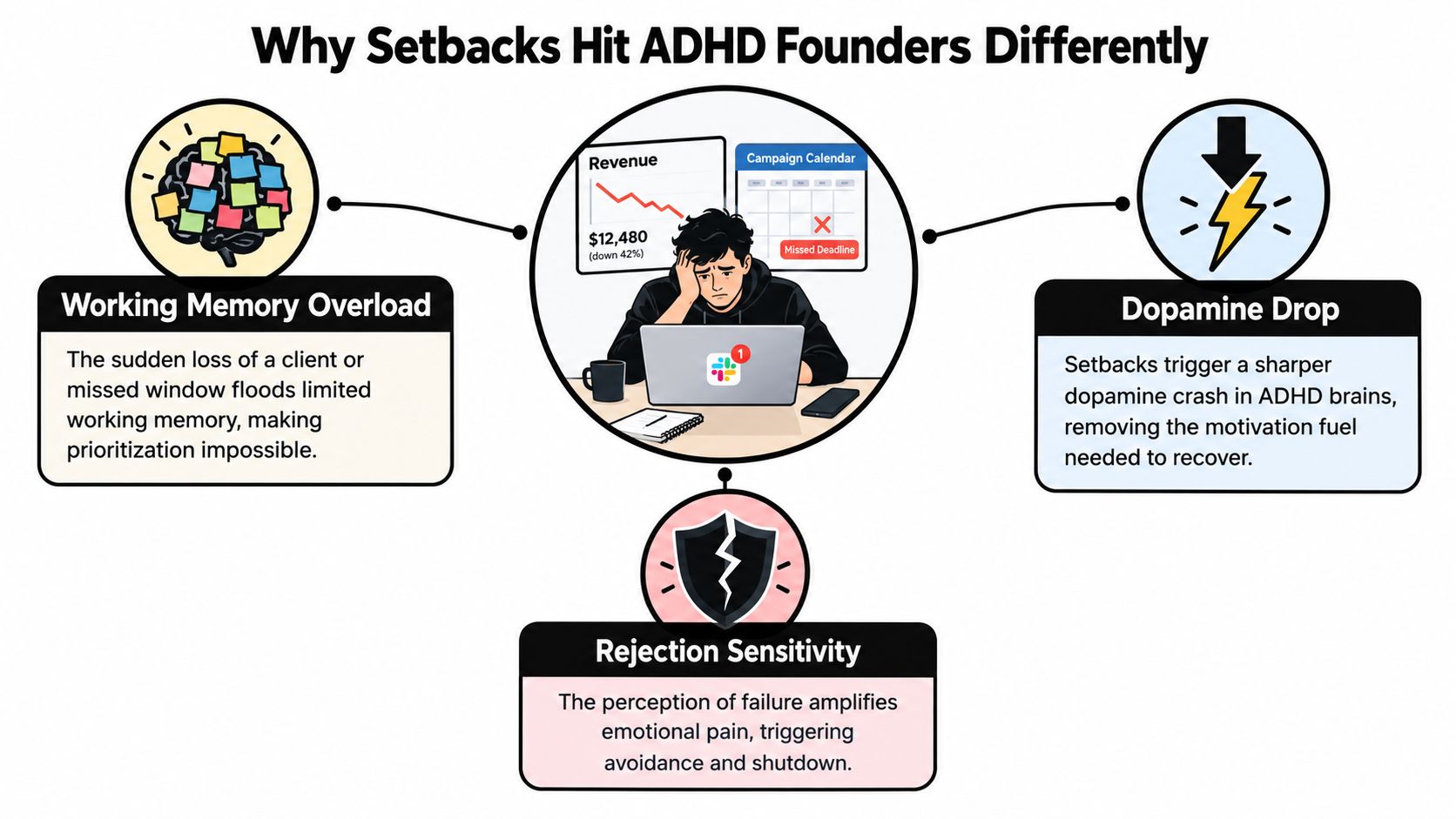
A lost client isn’t only a commercial event. For an ADHD founder, it can become a cognitive traffic jam. The mind tries to calculate the cash impact, rewrite the sales forecast, interpret the client’s silence, remember unfinished work, answer the team, and decide whether the entire business model is broken. Those tasks compete for the same limited working memory.
Then the reward signal disappears. The project that once felt urgent and interesting now feels contaminated by disappointment. The founder may understand exactly what needs doing and still be unable to begin. From the outside, that looks like laziness or avoidance. Internally, it feels like trying to steer a vehicle after the controls have stopped responding.
Rejection sensitivity adds another layer. A neutral client message can feel like a verdict on your competence. A missed deadline becomes evidence that you’re unreliable. The emotional interpretation arrives before the operational facts, so a straightforward business problem becomes a threat to identity.
The gap between advice and capacity
A 2025 workplace study of 106 adults with ADHD found that 79.3% said ADHD negatively affected work performance, while only 58.5% used workplace adjustments. Among those using adjustments, 87.1% reported reduced stress and anxiety and 80.6% reported improved productivity, according to the University of New Hampshire study.
Those findings don’t prove that one adjustment works for every founder. They do expose the flaw in “try harder” advice. If the environment increases task switching, noise, ambiguity, and working-memory demands, extra effort may only intensify the failure pattern.
A useful resource on managing emotional dysregulation with ADHD can help you understand the emotional surge without treating it as a character defect. For a founder-specific perspective, ADHD emotional dysregulation is also worth keeping close to your recovery notes.
The practical conclusion is blunt: the first response to a setback shouldn’t be a motivational speech. It should be a recovery protocol that lowers cognitive demand, externalizes information, and prevents emotional urgency from making permanent decisions.
The First 72 Hours of Setback Triage
The first seventy-two hours aren’t for solving your entire business. They’re for stopping a temporary shock from becoming a strategic disaster. Your job is to reduce the number of things your brain must hold, decide, and remember.
Shrink the cognitive surface
Close unrelated tabs. Turn off nonessential notifications. Move the setback into one note, document, or project board. Give it a plain name such as “Client pause, facts and actions.”
Write only:
- What happened
- What is at risk
- What must happen next
- Who needs information
- What can wait
Don’t start with a retrospective. Don’t draft a furious client email. Capture the situation before your brain turns uncertainty into a story.
Externalize every consequence
Create a short consequence list and assign a named owner to each item. A refund gets an owner. Client communication gets an owner. A technical fix gets an owner. Legal review gets an owner.
The owner doesn’t have to be you. In fact, transferring ownership is often the point. The ADHD workplace study found that people using adjustments reported lower stress and better productivity, which supports a broader operational lesson: changing the conditions around the work can matter more than demanding more effort from the same overloaded person.
Delay irreversible decisions
Give yourself a twenty-four-hour moratorium on firing someone, closing a product line, sending an accusatory message, taking on expensive debt, or publicly announcing a pivot. A delay isn’t avoidance when it has a defined review time and a written purpose.
Use the pause to separate facts from interpretations. “The client hasn’t replied” is a fact. “The client thinks we’re incompetent” is an interpretation. Both may feel real, but they don’t deserve equal authority.
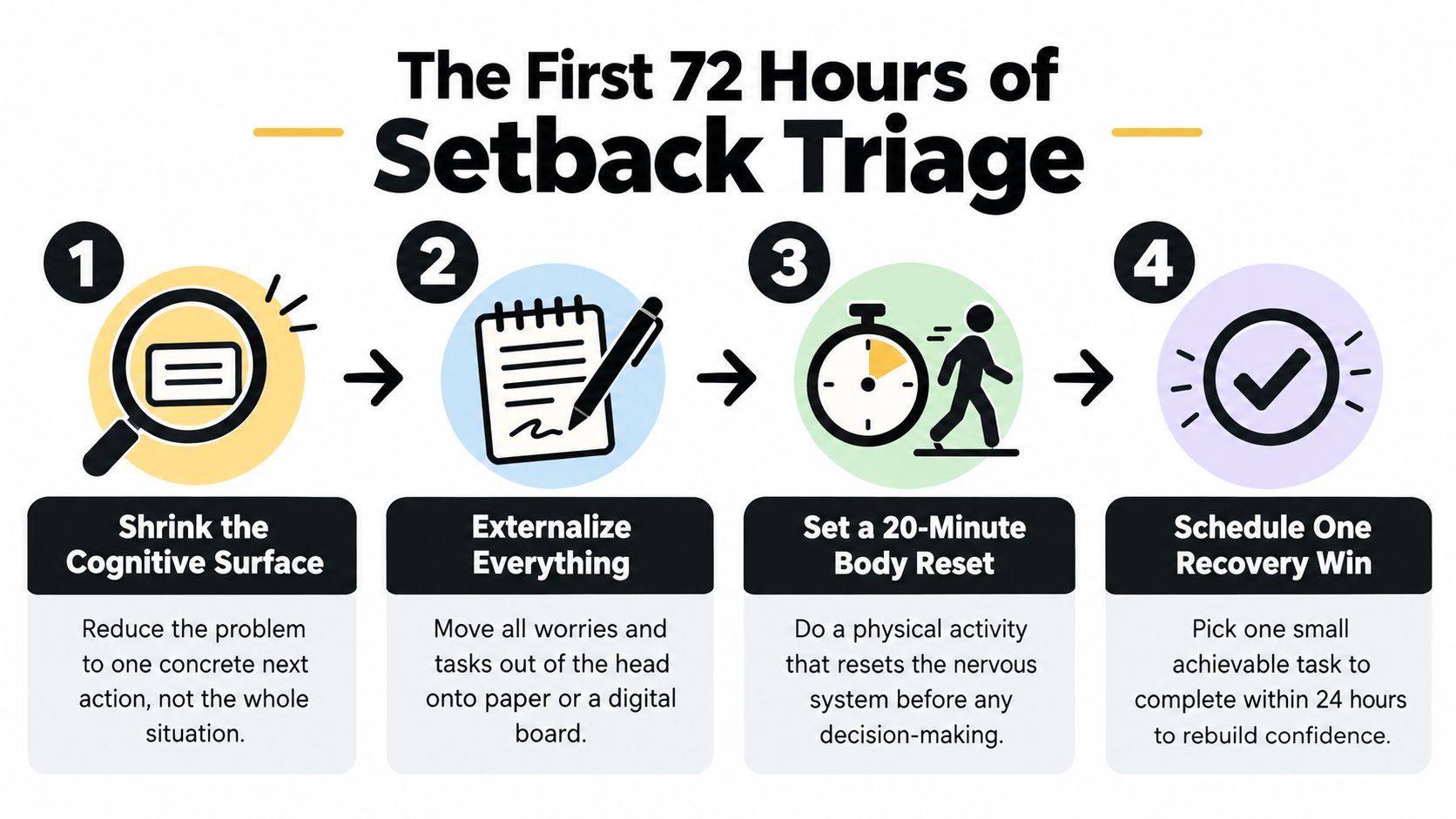
Pin this checklist beside your desk:
- Reduce the surface: Close tabs, silence alerts, and define the single problem you’re handling.
- Write the facts: Record the timeline, exposure, open questions, and immediate obligations.
- Assign consequences: Put a named owner beside every downstream task.
- Protect the decision window: Avoid irreversible moves until your body and information are steadier.
- Choose one recovery action: Complete one small task that restores evidence of control.
The aim isn’t to feel calm before acting. The aim is to make useful action possible while you still feel unsettled.
Making Sense of What Just Happened
Recovery doesn’t come from forcing a positive interpretation onto a painful event. It comes from processing what happened accurately enough to change future behavior.
A 2023 scoping review examined 32 longitudinal studies of post-traumatic growth and found that growth can appear as early as six months after a traumatic event. The review cited a meta-analysis in which 55.6% of people experienced moderate-to-high post-traumatic growth within six months, while also emphasizing that growth depends on social support, relationships, structural conditions, and time, not adversity alone. The scoping review also noted that only 17 of the identified studies measured growth at multiple time points, so an immediate feeling of insight isn’t proof of durable recovery.
That distinction matters for founders. You can feel wiser on Friday and repeat the same failure on Monday. A lesson becomes credible only when it changes decisions, routines, or safeguards over time.
The thirty-minute post-mortem
Run this reflection after the immediate consequences are contained. Set a timer and write without trying to sound impressive.
- Build the timeline: What happened first, and what happened immediately before the failure?
- Separate control from shock: Which decisions belonged to you, and which conditions were external?
- Name broken assumptions: What did you believe would happen that didn’t?
- Install a system change: What structure would make the same error harder to repeat?
- Choose a review date: When will you check whether the change is still operating?
Take a missed client deadline. The timeline might show that the client expanded the scope, delivery depended on one person, and the founder accepted the additions without renegotiating the date. The failure isn’t just “I was disorganized.”
The system changes are concrete: add a written change-order rule, create a second reviewer for critical deliverables, and require a scope conversation before accepting new work. The founder’s insight matters only if those controls appear in the next project.
Practical rule: Don’t ask, “What did this teach me?” Ask, “What will I do differently when the same pressure appears?”
Support belongs in this process too. A trusted advisor, peer, therapist, or experienced operator can challenge the self-blame that distorts the review. The right person won’t just reassure you. They’ll help distinguish a bad decision from an impossible situation, then help you build a better surrounding system.
Two Techniques That Actually Regulate the Brain
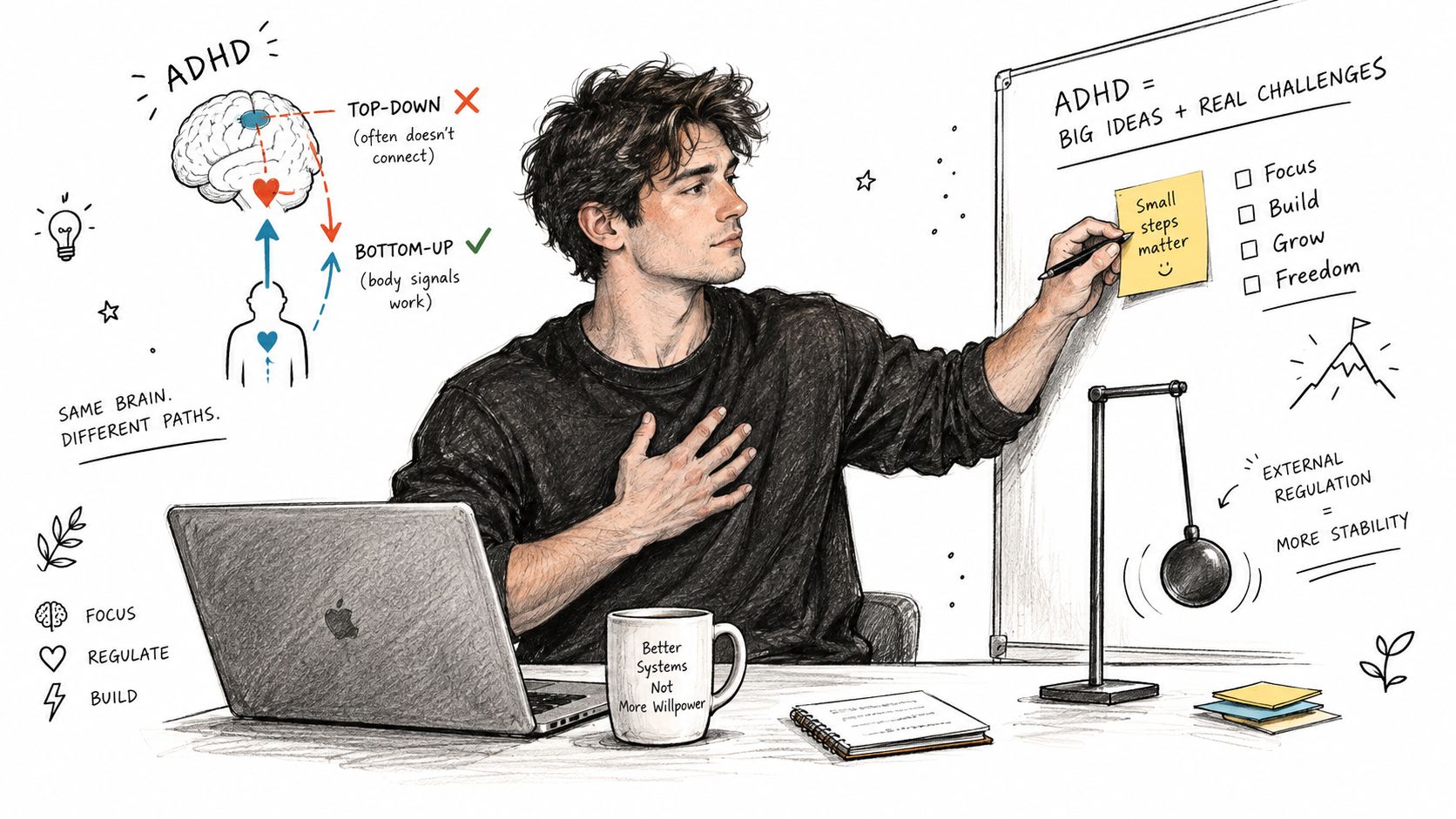
“Calm down” is not a technique. It’s an instruction delivered to the part of the brain currently struggling to regulate itself. Use interventions that reduce arousal first, then ask cognition to do its job.
Start with a ninety-second physical reset
You don’t need a perfect meditation posture. Stand up and put both feet on the floor. Breathe in gently, then make the exhale longer than the inhale for several cycles. Run cold water over your wrists, name five things you can see, four things you can feel, three sounds you can hear, two smells, and one physical sensation that has changed.
The sequence interrupts the freeze loop by giving your body simple, concrete inputs. It doesn’t solve the client problem. It creates enough distance to stop the nervous system from treating every thought as an emergency.
Keep the script visible:
“My body is reacting to a setback. I don’t need to solve the whole business right now. I need to lower the intensity, identify the next safe action, and wait before deciding.”
A short walk works too. So does stretching, climbing stairs, or stepping outside. The method matters less than the transition from mental spiraling to physical orientation.
Turn the thought loop into three columns
Open Apple Notes, Notion, or a paper notebook and record a voice memo. Speak quickly. Don’t edit. Say everything your mind is trying to process, then convert it into three headings:
| Facts | Feelings | Next actions |
|---|---|---|
| Client paused the fourth email | I feel exposed and angry | Reply by Tuesday |
| Delivery missed the agreed window | My chest feels tight | Ask the project lead for the timeline |
| Scope changed twice | I want to disappear | Review the change-order rule |
“I ruined everything” belongs in the feelings column, not the facts column. That doesn’t make the feeling unimportant. It stops the feeling from masquerading as a business diagnosis.
If food, stimulants, or energy crashes amplify the loop, review your working pattern with the practical guidance in Caffeine and Carbs. The point isn’t diet perfection. Stable inputs make it easier to interpret the event instead of reacting to every bodily fluctuation as evidence of failure.
Rebuilding Momentum With Cognitive Architecture and Dopamine Engineering
Motivation rarely returns because you demanded it. It returns when the next action becomes believable, visible, and rewarding enough to start.
Jan Kutsches’ Cognitive Architecture means moving decisions out of your head and into a repeatable structure. Dopamine Engineering means designing small completion loops that restore engagement without relying on panic. Together, they produce a Monday reset that doesn’t ask an overloaded founder to invent a new life before breakfast.
Build a default week
Choose one weekly priority. Not five. Put it at the top of a page or inside your task manager. Then divide the work into three fixed blocks, such as delivery, growth, and leadership. Give each block a clear boundary and a defined outcome.
Add a shutdown ritual. Review unfinished items, assign each a next action, place it on a calendar or board, and close the workspace. Open loops keep asking for attention after the working day ends. A shutdown ritual tells your brain where the work lives.
Dopamine Engineering works best when the wins are small enough to finish. Ship one client deliverable. Send one important proposal. Complete one focused work sprint, then take a defined reward such as a walk, coffee, or music. The reward should close the loop, not become another way to avoid the work.
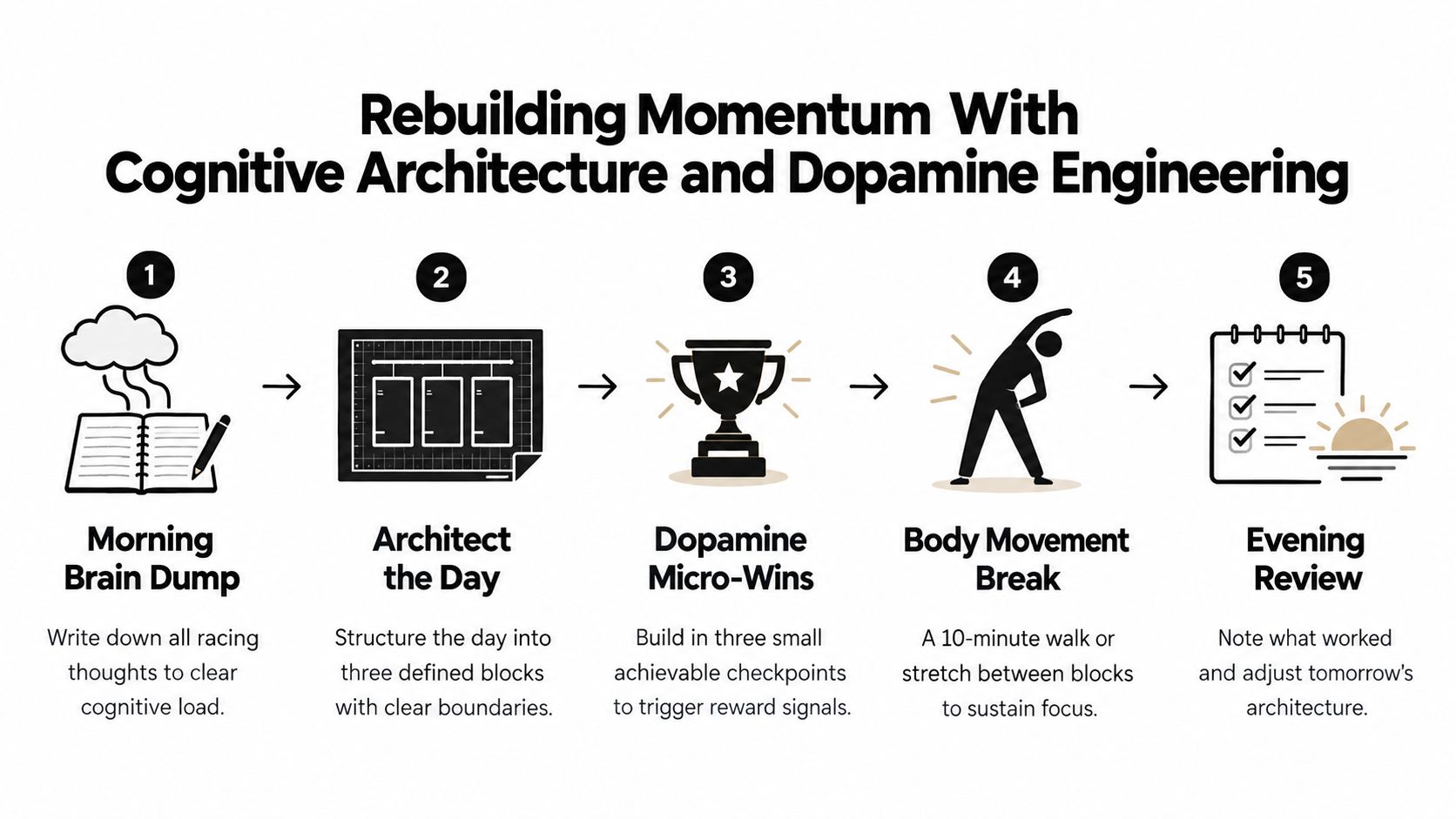
This isn’t hustle culture with better branding. Hustle culture uses escalating urgency. Engineered momentum uses predictable boundaries, visible progress, and repeatable rewards.
Fill in this Sunday template:
- One priority: The outcome that matters most this week
- Three blocks: The fixed periods reserved for the priority
- First visible win: The smallest finished action that proves movement
- Reward: The activity that follows completion
- Shutdown cue: The time and action that closes the workday
- Recovery buffer: The space reserved for unexpected demands
Use this video as a visual prompt for turning ADHD-friendly strategies into a practical routine:
The system should feel almost boring. Boring is useful when your previous operating system depended on crisis.
Turning Personal Recovery Into Team Handoffs
A setback that exists only in the founder’s memory will return as a team problem. Strategic Delegation turns private recovery into shared operating capacity.
Start with a one-page handoff. Every item needs five fields:
- Decision: What needs to be decided or delivered?
- Owner: Who has authority to move it forward?
- Deadline: When is the decision or output due?
- Definition of done: What will count as complete?
- Escalation rule: What should trigger a return to the founder?
The escalation rule protects both sides. Without it, team members either interrupt constantly or wait too long while a small issue becomes expensive.
Use this delegation script:
“I’m keeping the strategy, narrative, and client relationship because those sit in my highest-value zone. I’m delegating reporting, vendor coordination, and production tracking. You own the outcome, not just the task. Bring me exceptions that meet this escalation rule, and bring the finished report by the agreed deadline.”
That language is clearer than “Can you help with this?” Help creates ambiguity. Ownership creates a decision path. The guide to delegating tasks effectively can help you turn this conversation into a repeatable management habit.
When someone contributed to the setback
Don’t use the post-mortem as a disguised prosecution. Name the observable behavior, explain the consequence, and agree on the system change.
“The vendor update arrived after the review window. That left us without time to correct the campaign assets. I want us to agree on an earlier checkpoint and a clear escalation message if the update slips again.”
Then ask what blocked the person. You may discover unclear authority, an unrealistic deadline, missing information, or a skill gap. Accountability doesn’t require humiliation. It requires a reliable response when the same condition appears again.
In a campaign failure, the founder may retain positioning and the client relationship while delegating reporting and coordination to people who can manage recurring detail. That’s not abdication. It’s a deliberate match between responsibility and cognitive strength.
Prevention Routines That Make the Next Setback Survivable
Resilience is not optimism. It is the set of protections that keep one bad event from taking down the rest of the company.
A longitudinal study of previously failed entrepreneurs found that 52% of their subsequent businesses survived to age seven, compared with 67% of businesses founded by novices, a 15-percentage-point gap, according to the study of entrepreneurial re-entry and survival. Experience can produce learning, but it can also carry depleted resources, damaged confidence, weaker networks, and familiar strategic habits.
That evidence argues for operational resilience: cash protection, decision review, delegation, and risk controls. Persistence without safeguards is repetition wearing a brave face.
A thirty-day prevention rhythm
Use Bio-Optimization as infrastructure, not self-care decoration.
- Sleep floor: Set a consistent lights-out cue and a morning light cue. Protect the conditions that make clear decisions possible.
- Fuel stability: Build reliable meals and hydration into the workday so you aren’t making high-stakes choices while physically depleted.
- Movement: Reserve a daily block for walking, stretching, or training. Treat it as a meeting with your nervous system.
- Friday review: Check missed commitments, delayed decisions, client friction, cash exposure, and overloaded people before they become emergencies.
- Buffer design: Leave space between delivery promises and actual capacity. A schedule with no margin converts ordinary variance into a crisis.
- Monthly audit: Verify that the safeguards installed after the last setback still operate when nobody is watching.
Founders in demanding environments may also benefit from reading about burnout risks for MENA founders, particularly when cultural expectations, funding pressure, and leadership isolation make exhaustion harder to name.
Run this self-audit once a month:
- Which recent miss repeated an older pattern?
- What decision still lives only in my head?
- Where does one person remain a single point of failure?
- Which commitment has no buffer?
- What physical or relational stressor am I treating as a motivation problem?
- Which system change has stopped operating, and why?
A setback becomes useful only when execution changes afterward. If the same handoff, deadline, health compromise, or communication failure keeps returning, you haven’t integrated the lesson yet. You’ve remembered it.
Jan Kutschera offers practical systems built around Cognitive Architecture, Dopamine Engineering, Strategic Delegation, and Bio-Optimization for founders who are tired of relying on panic to perform. If you want to replace reactive recovery with an operating system designed for ADHD, visit Jan Kutschera and explore the tools, advisory options, and founder support available.
Jan Kutschera
German founder, diagnosed with ADHD at 51. Built 4 agencies, now building systems for neurodivergent entrepreneurs. German engineering for the ADHD brain.
Connect on LinkedInRelated Articles

Accountability Partner App: 10 Picks for ADHD Founders
Compare 10 accountability partner apps for ADHD founders: how each works, setup workflows, privacy and pricing trade-offs, and which fits your needs.
ADHD Burnout Cycle: Stages Founders Can Break
See the ADHD burnout cycle in five stages, separate it from depression, and test founder fixes before the next crash.

Best ADHD Planner for Adults: A 2026 Guide
Find the best ADHD planner for adults with a quick-pick table, a founder card you can copy, dopamine rewards, and a 14-day test.