How Do I Increase My Attention Span for ADHD
How do I increase my attention span with ADHD? Match the stall, run a 90-minute block, quiet the room, and score real client work.
Jan Kutschera
A longer attention span isn’t a personality upgrade you gain with a brain-training app. If you’re an ADHD founder asking, “How do I increase my attention span?”, start with the work you’re failing to finish, not the drill you might get better at.
Your job isn’t to become someone who can stare at anything indefinitely. It’s to deliver useful work without needing an angry client to supply the ignition.
Table of Contents
- Pick the Attention Lever That Matches the Stall
- How to Run One Focus Block Today
- Engineer the Room Before You Trust Willpower
- Dopamine Rewards That Do Not Need a Fire Drill
- Protect Sleep and Hand Off the Risky Work
- Score the Week and Fix the Stall
Pick the Attention Lever That Matches the Stall
The proposal is half-written. Slack is glowing. The afternoon has disappeared, yet you’ve somehow reorganized the project board. Again.
Calling this poor attention doesn’t tell you what to change. You might be exhausted, interrupted, uncertain about the next step, or avoiding a decision hidden inside the writing task. Those failures need different fixes.
Diagnose before you install anything
For a practical baseline, spend five workdays logging each stall: when it happened, what you were trying to produce, and what pulled you away. Keep it on paper or in Apple Notes. Don’t build an attention-tracking dashboard that requires its own onboarding.
Look for the recurring pattern rather than the most embarrassing incident. Then choose one lever and test it for ten workdays before adding another. These are experiment settings, not clinical thresholds.
Use this map to separate the likely causes.
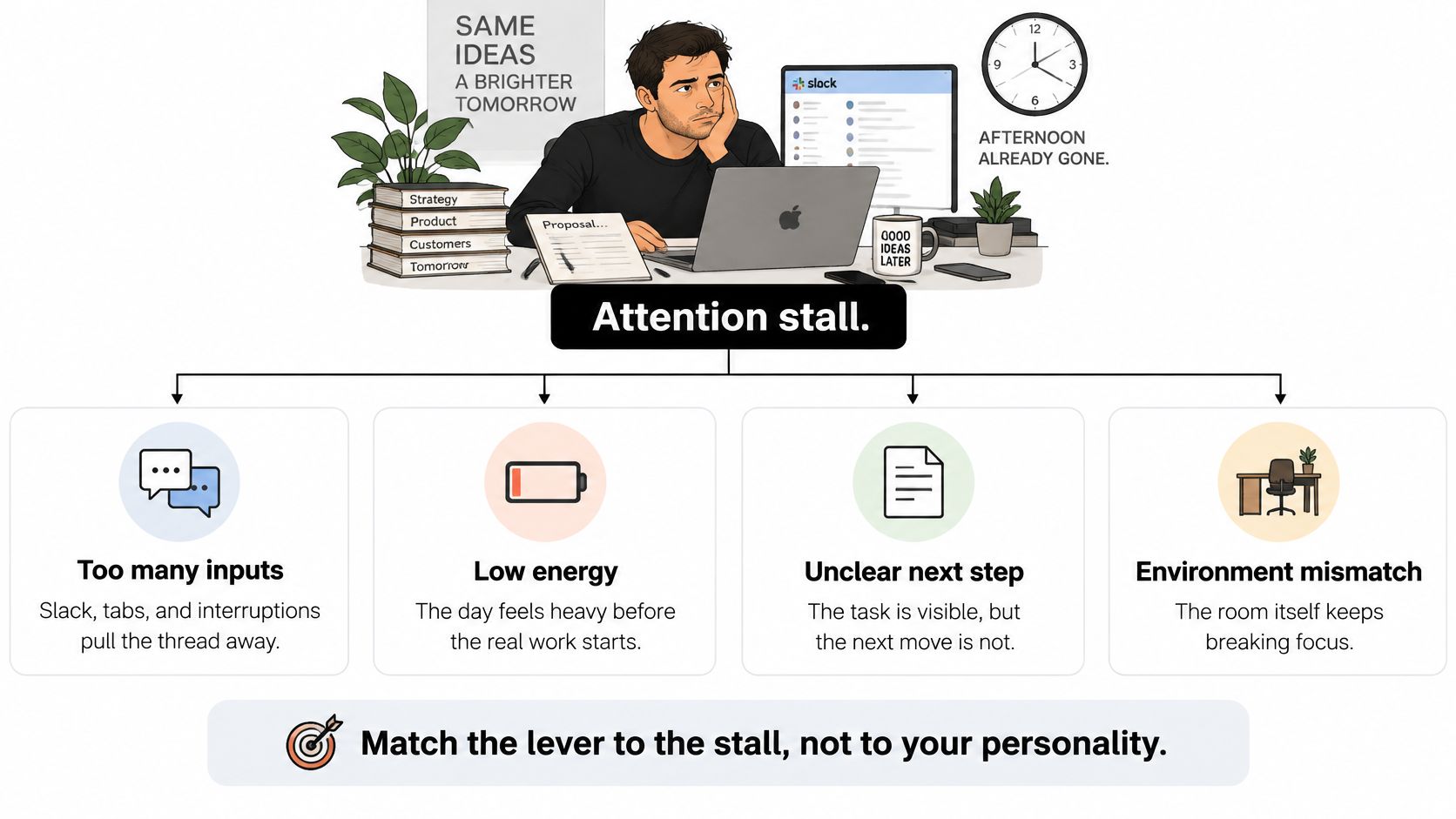
Which attention lever to run first
| Stall you notice | First lever | Proof it worked |
|---|---|---|
| Blank page, task never starts | Two-minute ugly start plus one written next action | Task opened and first artifact exists within your ten-minute starter window |
| Pings pull you off within your opening half-hour | Notification blackout and a batched inbox window | Uninterrupted block completed |
| Hard work collapses after lunch or a late night | Fixed wake window and hard work before noon | Fewer errors on the morning task |
| A new focus app becomes the work | Ban new tools for the ten-day experiment and score delivery | Client artifact shipped, not app streaks |
| Meetings eat the day and nothing is decided | Agenda, time-box, and a delegated follow-up owner | Decisions leave the room with an owner |
If you start readily but drift partway through, shorten the chunk and keep only the working document visible. That’s a different problem from never opening the file.
Judge transfer, not entertainment
A 2025 systematic review of 26 reviews on digital ADHD interventions found possible benefits for inattention or executive function, but generally low or critically low evidence quality, inconsistent outcomes, and insufficient safety reporting. That’s not a reason to dismiss every tool. It’s a reason to demand proof outside the tool.
A higher game score doesn’t approve a proposal, clarify a hiring decision, or get a client their deliverable. Keep an app only if using it helps those outcomes.
The same boundary applies to supplements. Pep Tea’s guide to herbs and nutrients for mental clarity is an optional resource for exploring that category, not evidence that a product will resolve your operating problem; discuss supplements and possible medication interactions with a clinician or pharmacist.
Selection rule: Pick the smallest change that addresses the failure you actually logged.
Circle one row. Take that lever into your next work block, rather than installing the entire productivity internet.
How to Run One Focus Block Today
Choose a client-facing artifact you can point to afterward: a proposal paragraph, a hiring scorecard, or a decision memo. Not business development. Not strategy. Those are departments disguised as tasks.
Here’s the basic sequence to keep beside your desk.
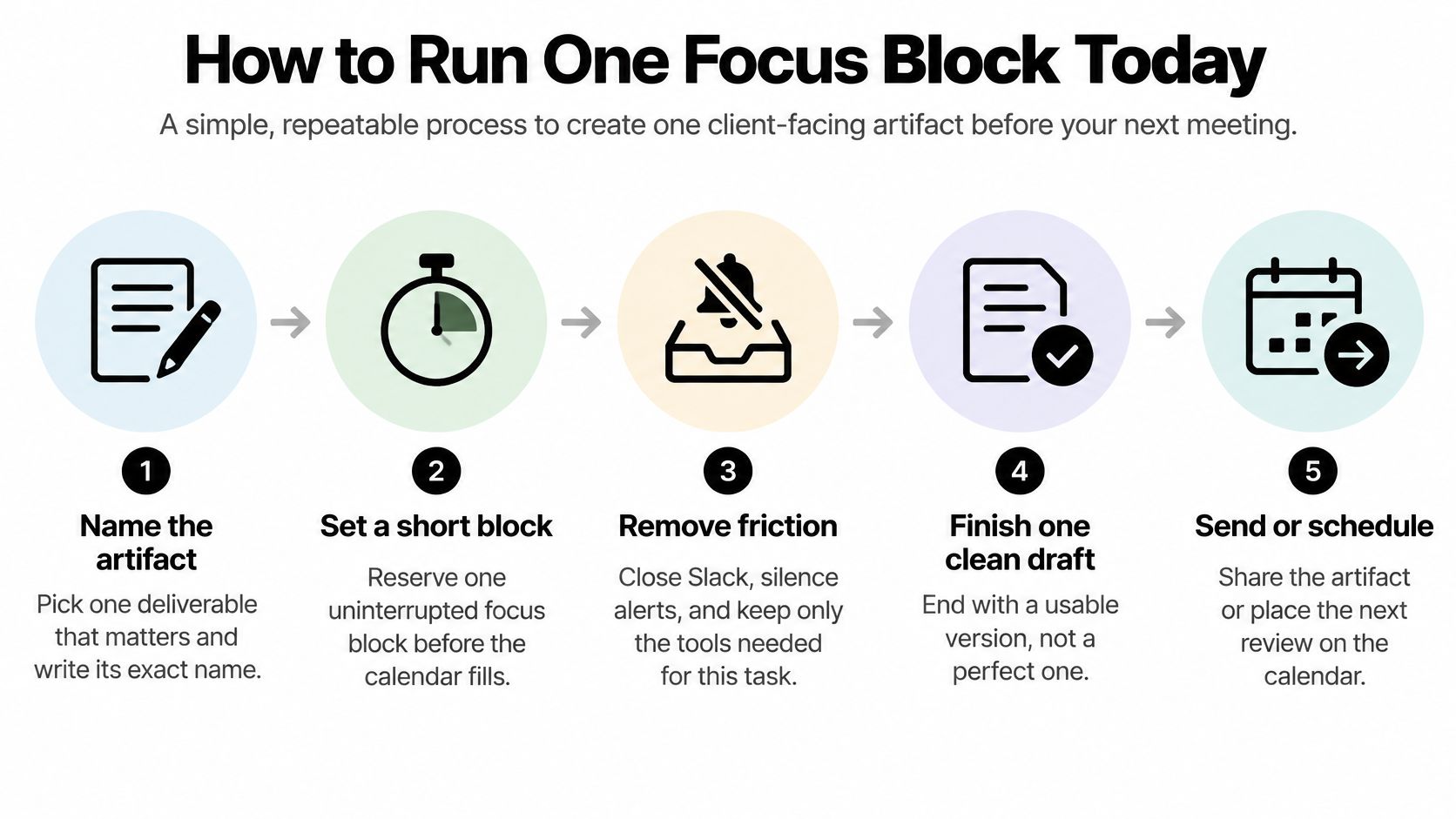
Run the block, not your whole company
Use the timings below as a starter protocol. Adjust them through observation, not because you found a more impressive timer.
-
Name the artifact in a sentence. Write: Draft the scope paragraph for Morgan’s website proposal. Put everything else on a later list so you don’t have to keep remembering it.
-
Shrink it to fit a 25-minute appointment. If the task includes research, pricing, writing, and approval, you’ve scheduled a project. Choose the scope paragraph and leave the commercial terms alone.
-
Open the working file and remove competing inputs. Close chat, mail, and unrelated tabs. Keep a necessary reference beside the draft, but don’t leave the browser buffet open.
-
Start the timer and write an intentionally rough first line. Something like: We will rebuild the checkout flow so customers can complete their purchase. You can improve language that exists; you can’t edit your intentions.
-
When you drift, label it briefly and return. Write supplier email worry or check campaign results on the later list. Don’t negotiate with the distraction or research why you’re distracted.
-
At the bell, leave a restart instruction. Write the next physical action, such as replace assumptions with client requirements, then stand up for a two-minute break. For this experiment, stop at the bell rather than borrowing from the next appointment.
-
Continue only if the same artifact remains the job. An optional second 25-minute chunk gives you a bounded session rather than an afternoon-long siege. After a short night, skip the extension.
-
Log the result without a speech. Record done, stuck, or abandoned, plus the next action. Shame isn’t useful metadata.
A short appointment gives you an attainable finish line. A heroic afternoon of deep work gives you plenty of room to postpone starting. If you’ve been avoiding the document altogether, use a ten-minute starter appointment instead.
The timer isn’t the treatment
A randomized trial of CBT for adults with ADHD found improvements in attention-related functioning through structured treatment, with greater initial improvements when CBT and medication were combined than with CBT alone. A kitchen timer isn’t CBT, but external planning and distraction control are more useful foundations than demanding additional willpower.
Treatment decisions belong with a qualified clinician. For the work routine, use the ADHD Pomodoro guide to adapt the structure, and compare Tecton Ketones™’ strategies for sustained concentration against the practical question of whether they help you complete the artifact. You don’t need a product purchase to run this experiment.
Use this demonstration as a companion to the written routine.
Keep one log line per block throughout your experiment:
| Date | Artifact | Chunks finished | Result | Next physical action |
|---|---|---|---|---|
| Tomorrow | Morgan’s scope paragraph | Record at finish | Done, stuck, or abandoned | Replace assumptions with client requirements |
Schedule tomorrow’s morning blocks before opening space for the inbox. Otherwise, you’ll spend your freshest attention answering other people’s agendas.
Engineer the Room Before You Trust Willpower
Your workspace is part of your attention system. If Slack, Outlook, your phone, and your smartwatch can all interrupt you, you’ve given everyone a doorbell inside your head.
In Unily’s 2024 Digital Noise Impact Report, covered by People Management, 77% of 500 UK employees said workplace-tool notifications distracted them, while 31% experienced them every 15 minutes. That’s a concrete reason to change notification defaults, not another reason to blame yourself.
The contrast isn’t stylish versus messy. It’s a workspace with competing invitations versus one arranged for a specific job.
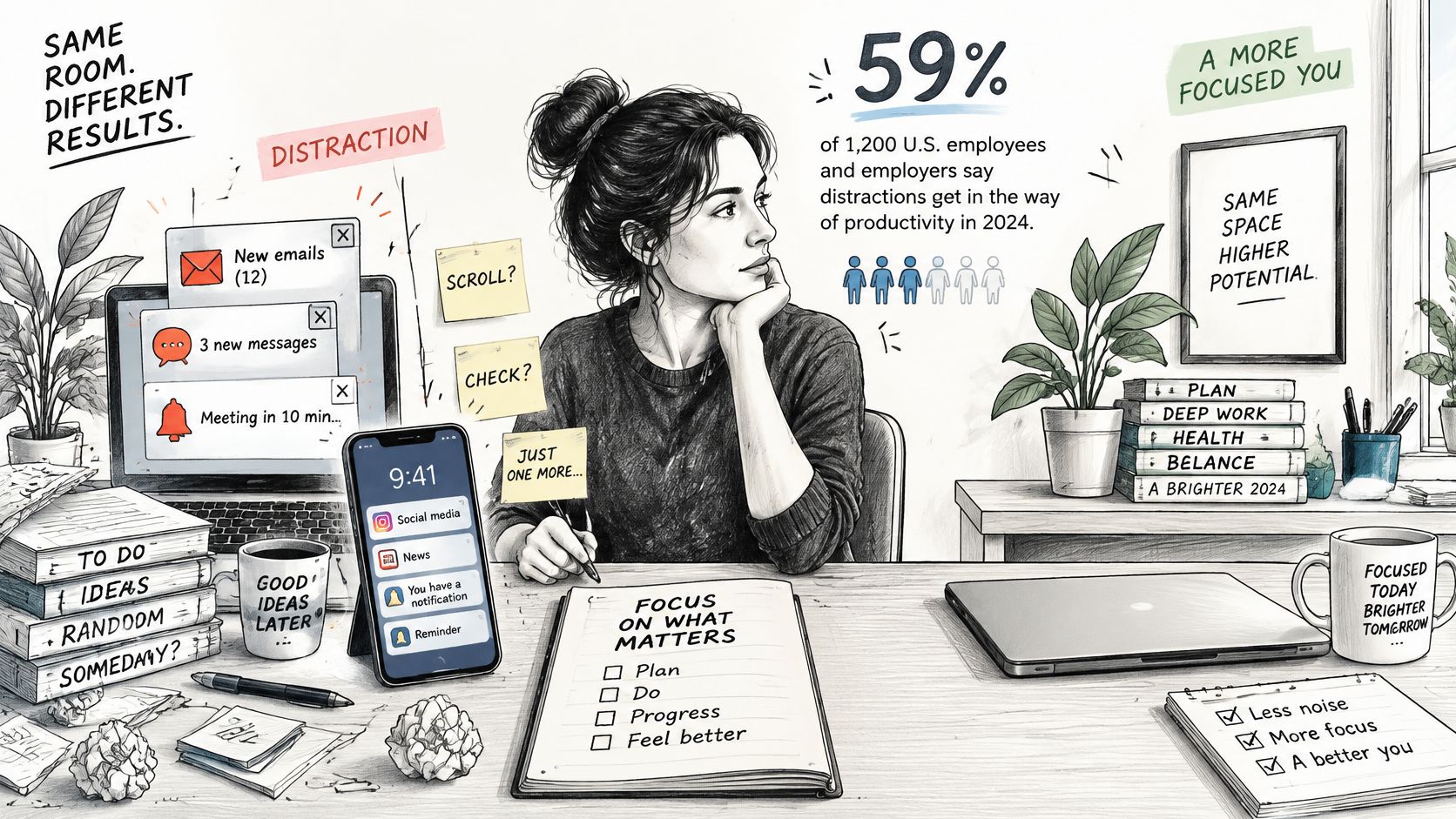
Make interruption inconvenient
Charge your phone outside the room. Face down beside your keyboard is still beside your keyboard. If you need authentication, complete it before starting, then put the device away.
Give deep work its own Chrome or Firefox profile without social logins. Open the task file directly rather than entering through a homepage full of suggestions. Put the artifact’s name on a paper card so checking the assignment doesn’t require visiting Notion and discovering the rest of your life.
Batch Slack and email into late-morning and late-afternoon windows as a trial. The trade-off is slower routine replies. Tell your team when you’ll respond so they don’t have to guess whether you’re concentrating, unavailable, or furious.
A notification setting isn’t a communication agreement. Your team needs both.
Use headphones as a visible closed-door signal, including at home. Agree on what merits an interruption with the people sharing the space; don’t assume they’ll infer your new policy from expensive ear cups.
Define urgent before someone needs you
Try a team rule: anything that can wait until the next inbox window goes into the agreed channel. An urgent issue gets a phone call.
Define urgent with examples. A live checkout outage qualifies. A preference about next month’s slide deck doesn’t. Assign backup coverage when customers or operations need a faster response than your focus schedule allows.
In an open-plan office, book a booth or work before the room fills. Noise-canceling headphones won’t stop a colleague from standing beside your monitor. Physical separation can be the simpler intervention.
Tonight’s room reset
- Move the charger. Choose a phone parking spot outside arm’s reach and preferably outside the room.
- Clear the screen. Close yesterday’s tabs and leave tomorrow’s working file ready.
- Set communication windows. Put them on the calendar and explain the urgent route.
- Prepare the paper cue. Write the deliverable and its next action.
- Reserve the space. Book the booth, clear the desk, or agree on a quiet period at home.
Don’t buy a standing desk to solve a Slack-permissions problem. Start with the inputs you can remove.
Dopamine Rewards That Do Not Need a Fire Drill
Say a founder ignores a client proposal until the client asks whether they should find another agency. Suddenly, the founder can focus beautifully. The draft gets written, the deck gets polished, and dinner gets canceled.
The founder concludes that pressure works. Next time, they wait for the threat before starting.
That’s an expensive operating model. The team absorbs the uncertainty, the client supplies the urgency, and the founder spends the following day recovering from their own rescue mission.
Replace the rescue with an ordinary finish
Keep the proposal, but change the sequence. Before starting, choose a small reward that comes after the work appointment: listen to a song, step outside, or message a peer with the specific thing completed.
The reward needs an edge. A song ends; a social feed doesn’t. A short walk returns you to the desk; opening YouTube to find something inspiring can become a separate career.
For a trial, choose a three-minute reward in advance. Treat it as a deliberate transition, not a claim about how quickly you can replenish a neurotransmitter. Dopamine is useful context, but you aren’t managing a laboratory assay between Zoom calls.
Try body doubling for an avoided task. Invite a peer to a silent co-working appointment, state what each person will produce, and report the result at the end. Camera optional, chat closed, no spontaneous strategy discussion.
Build interest into the assignment itself. Put the genuine client’s name in the document title, constrain the draft to a short list of recommendations, or mark completed chunks on paper. Make progress visible without introducing another app that needs feeding.
Keep novelty in its proper place
A new notebook can be enjoyable. Migrating the company into a new project-management tool before finishing the proposal is avoidance with procurement authority.
Reserve tool exploration for a completed review period, not the moment the work becomes uncomfortable. If you want more ways to arrange this, use the ADHD reward-system guide for business momentum to build a menu you can stop using when the break ends.
Keep these rules for the week when everything gets scrappy:
- Reward returning. Notice when you come back after drifting instead of treating an imperfect session as worthless.
- Protect the opening. Don’t begin in the inbox and surrender task selection to whoever wrote most recently.
- Reduce repeated avoidance. When the same task keeps getting postponed, cut its scope or transfer it to someone equipped to finish it.
Late-night sprints plus energy drinks aren’t a sustainable reward plan. They also make it difficult to tell whether your new work routine helped or whether you pushed harder.
Before Monday, write a reward menu on an index card. Include something physical, something enjoyable, and a social acknowledgment, all with a clear stopping point. Pick from it before the block, when you’re still capable of choosing something other than scrolling.
Protect Sleep and Hand Off the Risky Work
Sleep belongs in business risk management, not on a wellness poster beside the emergency exit. Before trying to extend your attention, check when your judgment and execution become unreliable.
Look for clusters: errors after late-night work, snappy messages following early calls, or abandoned handoffs after travel. Note sleepiness and any consistent difficulties around medication wearing off, then discuss medication-related patterns with your prescriber. These observations are useful signals, not a diagnosis.
A study of ADHD, sleep, and attention in college students links ADHD with shorter sleep and greater daytime sleepiness, and reports associations between longer sleep latency and poorer selective attention, and between shorter sleep time and weaker inhibitory control. The population isn’t a founder cohort, but the findings support checking sleep rather than assuming every focus failure reflects weak discipline.
Change the risk exposure
Use these safeguards as operating choices, not promises of a universal sleep routine.
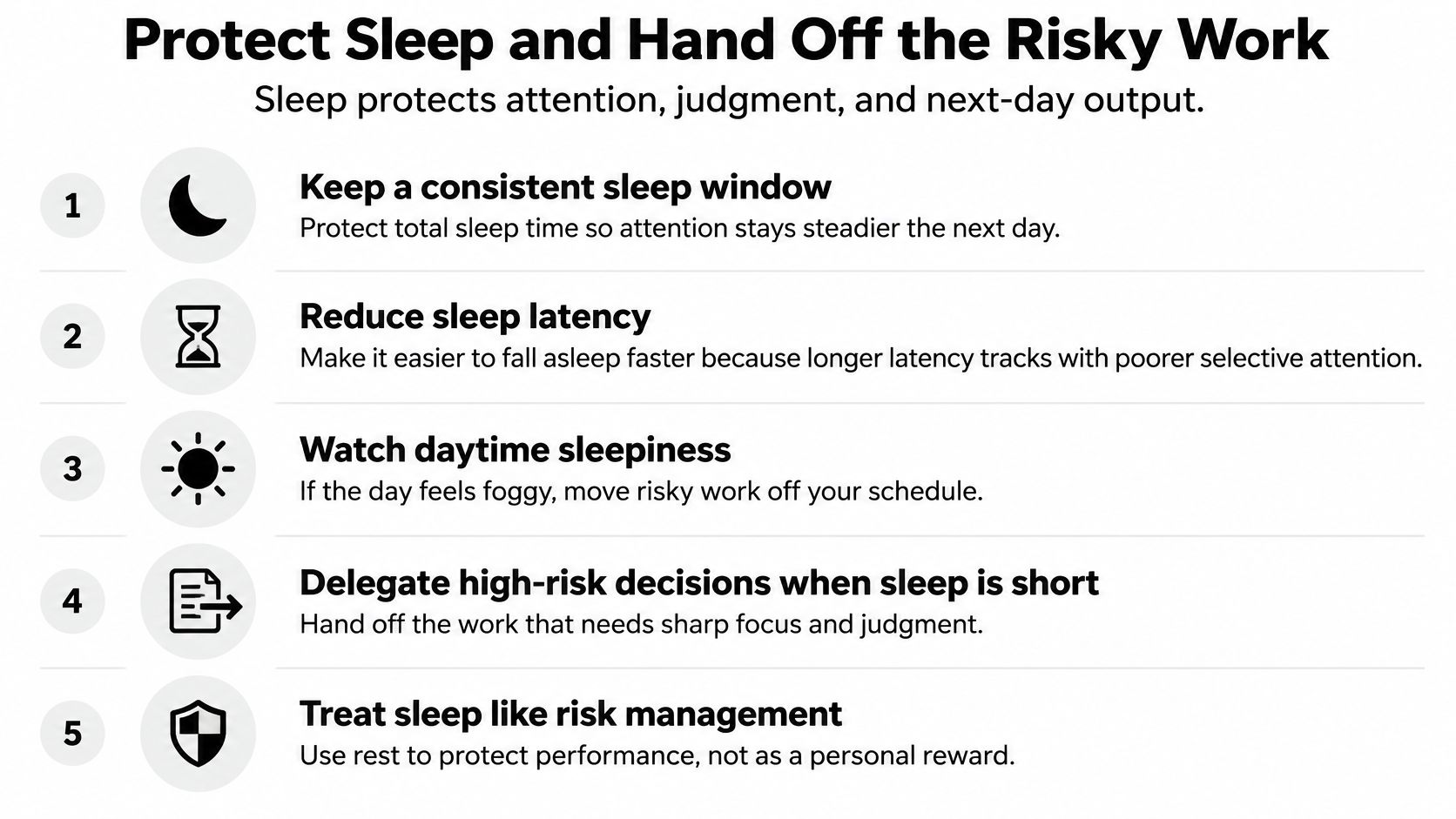
Choose a wake window you can sustain and protect it across ordinary workdays and weekends. Schedule demanding work in your first reliably clear hours, which may not match someone else’s productivity newsletter. Move routine approvals and administration into your less capable period.
After a short night, don’t make consequential pricing, hiring, or client-conflict decisions alone. Ask a rested colleague to review the reasoning, or defer the decision when the cost of waiting is lower than the cost of a mistake.
Risk control: Being awake enough to answer a message isn’t the same as being ready to negotiate a contract.
For evening setup ideas, Sleep All Nite’s guide to light exposure and bedtime routines can help you identify practical changes to test. If you’re staying up because nighttime feels like your only personal territory, address that pattern with the ADHD revenge bedtime procrastination guide rather than adding another bedtime alarm you’ll resent.
Between work chunks, walk or stretch. Make movement a reset you can repeat, not an ambitious fitness project attached to an already difficult workday.
Delegate the recurring drain
Founders often keep the interesting mess and accidentally keep all the administrative shrapnel around it. Separate work that needs your judgment from work that merely needs a reliable owner.
- Keep your distinctive contribution. Retain the creative direction, commercial judgment, or client conversation where your involvement changes the result.
- Transfer recurring coordination. Give status chasing, calendar defense, inbox triage, and first-draft research to a capable person or a clear procedure.
- Specify the handoff. State the outcome, deadline, and acceptance criteria, plus when the owner should escalate.
For example, ask an assistant to prepare a comparison of shortlisted vendors using agreed criteria and flag missing answers before the selection meeting. Don’t send research vendors and assume you’ve delegated the decision process.
A clinician owns medication and therapy decisions. Your operating safeguards still need to work when treatment hasn’t changed. Mark one recurring task class you’ll stop doing personally this month, and name its next owner.
Score the Week and Fix the Stall
Keep a ten-workday scorecard with only the operating marks below. These are your experiment’s measures, not a standardized attention assessment.
| Mark | What counts |
|---|---|
| Blocks scheduled | Protected appointments attached to named artifacts |
| Blocks finished | Sessions completed with an honest result logged |
| Client artifacts shipped | Usable work delivered to its intended recipient |
| Handoffs returned clean | Delegated work accepted without preventable clarification or rework |
Ignore hours you felt focused and points earned inside an app. A completed block with no useful output might reveal an oversized task or a missing decision. An unfinished block that produced a usable deliverable deserves a closer look, not automatic condemnation.
Keep your expectations calibrated
A 2016 selective meta-analysis of attention training examined 15 studies containing 113 effect sizes, finding an average training effect of Hedges’ g = 0.25 and transfer to non-trained attention tasks of g = 0.24. Those are modest average effects, not evidence that attention is fixed and not a promise of dramatic transformation.
Use practice as part of an operating system. Judge it through cleaner writing, more decisive meetings, and work that reaches the person waiting for it.
Ten-day stalls and the single fix
| What the scorecard shows | Likely flaw | Single change |
|---|---|---|
| Blocks scheduled but never started | Artifact still a project | Cut to a ten-minute ugly start |
| Blocks die before minute ten | Phone or chat still in reach | Leave the device in another room |
| Streak, then a total crash | Reward turned back into urgency | Restore a three-minute planned reward |
| Only afternoons fail | Possible sleep debt or timing mismatch | Move hard work to the first clear hours |
| More tools, same delivery | Novelty replaced the work | Ban new apps until the review |
| Handoffs return unfinished | Vague delegation | Rewrite outcome, deadline, and done |
Treat the likely-flaw column as a hypothesis. Early failure doesn’t prove your phone caused it, and afternoon difficulty doesn’t diagnose sleep debt. Choose the plausible explanation, change the matching condition, and observe what happens.
Make the next test smaller
Say a solo founder schedules hiring work but repeatedly never starts. In a hypothetical trial, they replace build hiring system with draft a one-page interview scorecard and move the appointment ahead of routine calls.
The useful result isn’t that the founder enjoyed the appointment. It’s that an interviewer received a usable scorecard and could run the conversation without asking what to assess. Keep the change if that result becomes more reliable.
Don’t respond to a messy week by replacing the whole routine. Change one lever, keep the scorecard, and review at the end of the experiment. Otherwise, you won’t know whether task size, timing, communication settings, or sheer deadline pressure made the difference.
Book tomorrow’s first block tonight. Write the artifact’s exact name where you’ll see it before opening anything else. You don’t need to feel like a focused person before doing a clearly defined piece of work.
Jan Kutschera offers a Starter Kit, an application-only Founder Circle, and hands-on advisory for ADHD founders who want external structure, sustainable rewards, and cleaner delegation. Visit Jan Kutschera if you’re ready to replace crisis-powered concentration with an operating system you can use on an ordinary Tuesday.
Jan Kutschera
German founder, diagnosed with ADHD at 51. Built 4 agencies, now building systems for neurodivergent entrepreneurs. German engineering for the ADHD brain.
Connect on LinkedInRelated Articles
Operating System in Business: A Founder Guide
Learn what an operating system in business is, the five layers that carry execution, and how founders adapt it to their working style.
How to Improve Team Communication for ADHD Founders
Learn how to improve team communication with async rules, handoff templates, delegation scripts and feedback loops built for ADHD-led teams.
10 Exercise Accountability App Picks for ADHD Founders
Compare 10 exercise accountability app options for ADHD founders, with pricing notes, pros, cons, setup templates, and honest limits for each tool.