Operating System in Business: A Founder Guide
Learn what an operating system in business is, the five layers that carry execution, and how founders adapt it to their working style.
Jan Kutschera
It’s 9:40 p.m. and you’re still the person who knows where the client brief lives. Slack has three versions of the same promise. The producer is waiting on a decision you made in a call nobody wrote down. Tomorrow’s standup will rebuild the week from memory, again. The work isn’t hard. The company only runs when your head is online.
An operating system in business is the shared structure that finishes work when you leave the room. It isn’t a personality upgrade, and it isn’t a diagnosis you have to announce. It’s the roles, rhythms, handoffs, and feedback everyone can see.
Table of Contents
- What an Operating System in Business Holds
- How Core Structures Move Work to Done
- Standardize the Costly Work and Keep the Rest Loose
- Why Healthier Operating Systems Show Up in Results
- Match the System to Your Working Style
- Build the System in Stages and Install One Workflow
What an Operating System in Business Holds
Think of your phone. The camera app doesn’t schedule memory or permissions. The operating system does, or the app stalls. Campaigns stall the same way. Strategy is the app. An operating system in business schedules the decisions and handoffs so the app can ship.
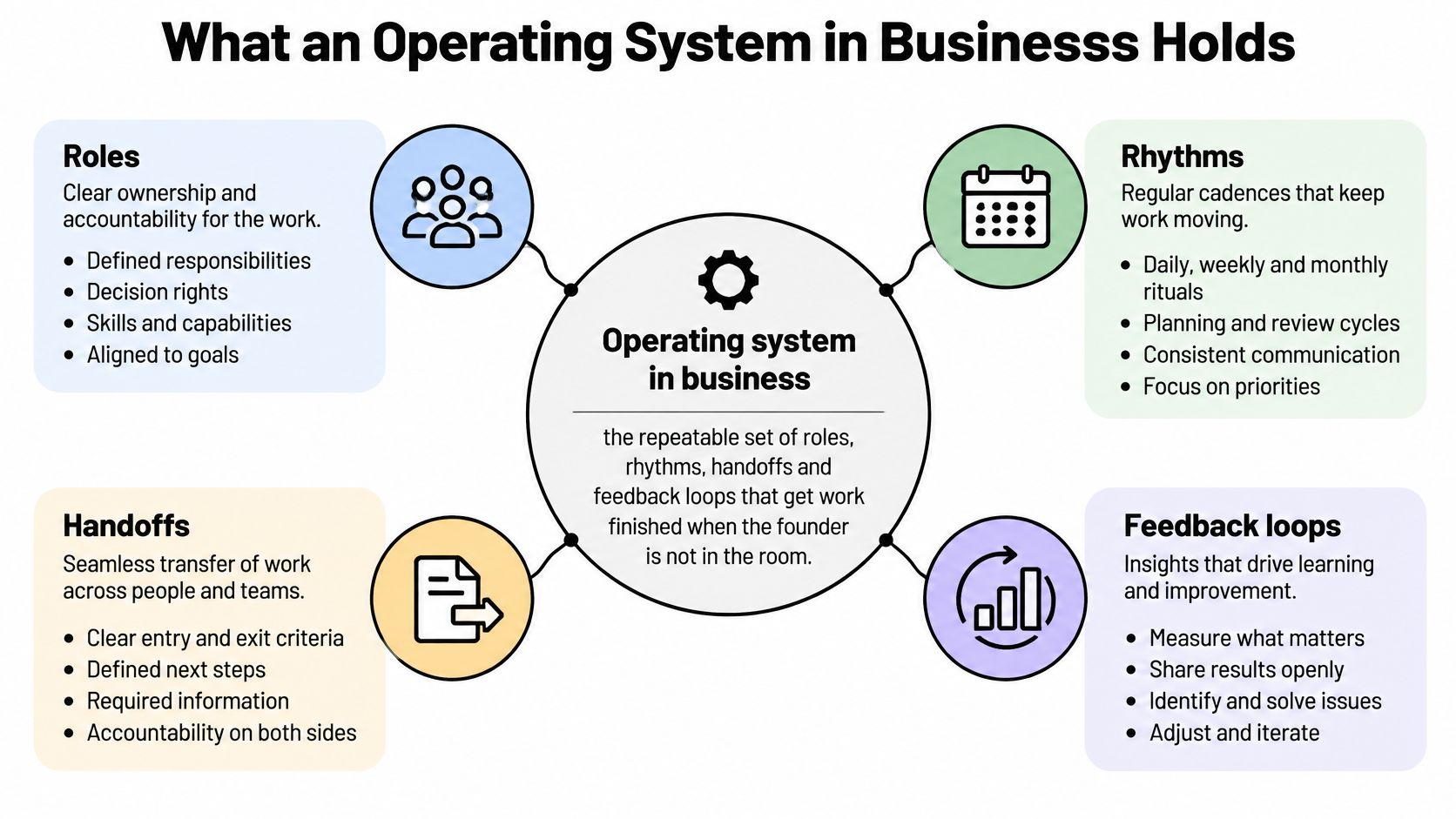
Five layers cover that job. You don’t install all five this month. You find the one that currently exists only in your head.
| Layer | What it holds | If it is missing | First artifact |
|---|---|---|---|
| Strategy alignment | Shared priorities and decision rights | Teams optimize their own corner | One-page priority list with who decides |
| Execution rhythm | Weekly planning, reviews and escalation | Urgency replaces planning | A fixed weekly agenda with an exception slot |
| Workflow standards | Default path, owner, handoff and service level | People reconstruct the process each time | A one-page checklist for one recurring workflow |
| Visual control | Owner, next action, due date and status | Work vanishes between meetings | One board every commitment lives on |
| Feedback | Cycle time, rework, queue age and defects | The same bottleneck stays invisible | A before-and-after metric on that one workflow |
The test for each missing layer
Strategy alignment fails when two leads can both say a project is “the priority” and mean different jobs. The test is simple. Can a new hire name this month’s three bets and who can kill one?
Execution rhythm fails when Monday is a status recital and Friday is a rescue. The test is whether the week has a standing agenda, including a slot for exceptions, before the fire starts.
Workflow standards fail when onboarding a client means interviewing you. The test is a default path someone else can run without a tour of your inbox.
Visual control fails when “I’ll remember” is the database. The test is one board where every live commitment has an owner, a next action, a date, and a status.
Feedback fails when the same delay surprises you every month. The test is one number, cycle time or rework, taken before you change anything and again after.
Practical rule: Circle the single layer that lives only in your head. That layer is the first install, not a company redesign.
Shared structure also makes room for high-impact changes for more productive teams without asking anyone to work from heroics. The phone still needs you for taste and calls. It shouldn’t need you to remember which app is allowed to run.
How Core Structures Move Work to Done
Say a six-person agency just won a brand sprint. Last quarter the brief lived in the founder’s notes app. Qualification happened on a call, the producer guessed the scope, and the designer learned the due date from a forwarded email at 6 p.m. This time the call ends differently.
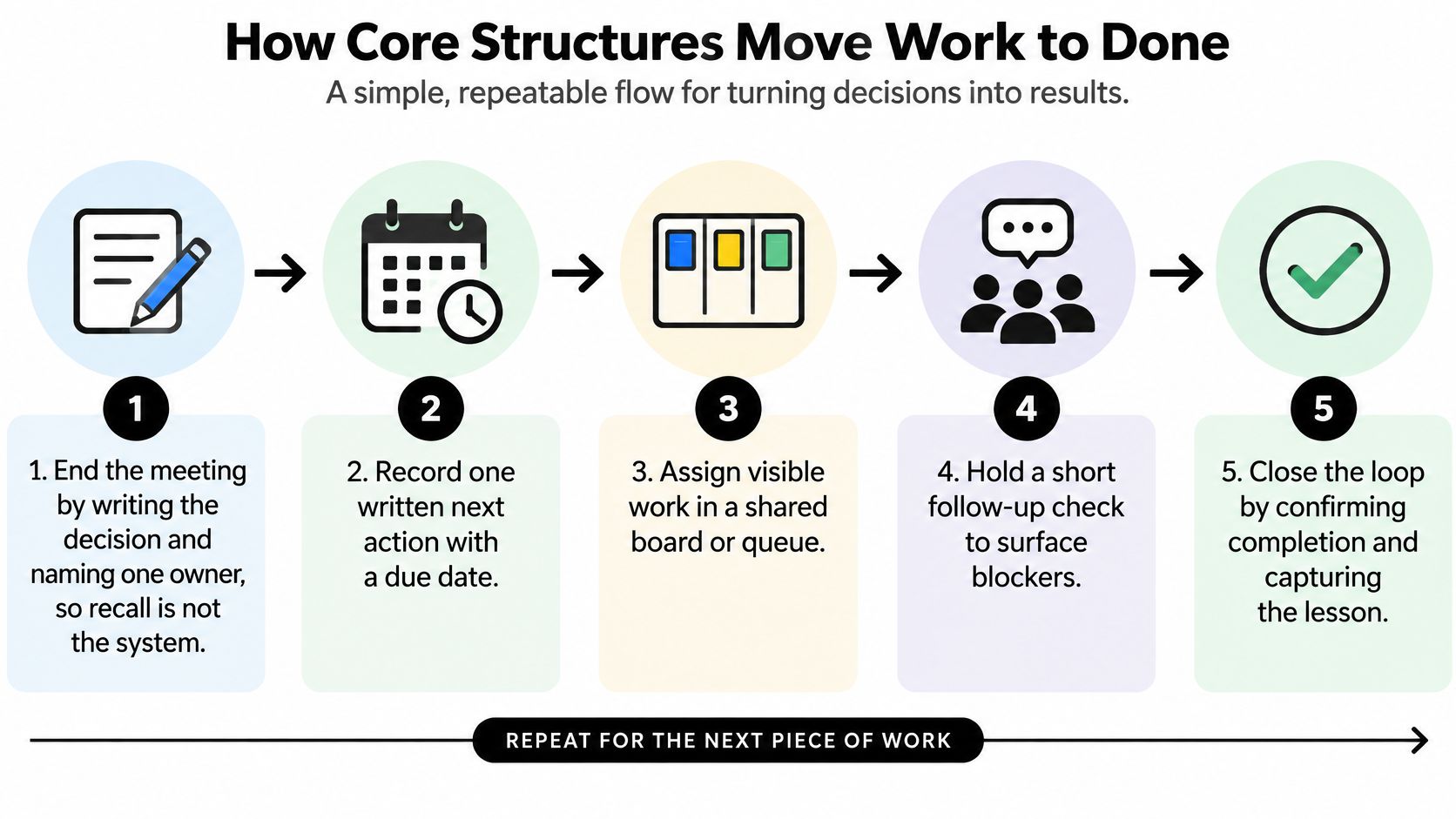
The founder writes, on the shared board, “Qualified. Owner is Maya. Next action is a one-page brief by Thursday noon.” Maya doesn’t ping anyone to reconstruct the call. The chain is five moves you can run on any job that repeats.
- Write the decision and name one owner. Recall is a bad filing cabinet. A sentence in the notes, plus a name, is the system.
- Record one written next action in the shared place. Not in a chat scroll that dies by lunch. One verb, one object, one location.
- Attach the handoff artifact. A brief, a checklist, or an approval state. The next person shouldn’t have to interview the founder to start.
- Set a visible due date and a plain escalation rule. If Thursday slips, Maya posts in the exception channel by noon, not at 5:59.
- On the weekly rhythm, review exceptions and aging work. Not every task. Aging items and broken promises are the agenda.
Routine choices stop eating the room’s attention. People stop rebuilding “what happens next” from scratch, so variation drops and the queue shows up on the board instead of in someone’s stomach. That’s also why a clean handoff is easier to delegate without the work bouncing back. The owner already has the artifact.
Where the chain stops
This chain is for recurring work. A novel positioning bet still needs a human in the room. Don’t run a strategy argument through the invoicing states.
The weekly review is where you set checkpoints for strategy delivery on the few bets that matter, then leave the rest of the board alone. If every card gets a speech, the rhythm becomes another meeting.
A short walkthrough of a working cadence helps when the moves still feel abstract.
The test of a working chain is blunt. A colleague can say what happens next without asking you. If they can’t, the operating system in business is still a private monologue.
Standardize the Costly Work and Keep the Rest Loose
Standards get a bad reputation in creative shops. People hear “process” and picture a script for the idea. A 2009 empirical study of 85 large firms found that business-process standardization had a strong, statistically significant positive effect on both process performance and flexibility. The rigid-company fear doesn’t match that result.
The mechanism is quieter than a rulebook. A default path cuts the variation in routine handoffs. People spend less effort reconstructing what happens next, so capacity comes back. Exceptions get a name instead of hiding inside someone’s improvisation. Flexibility goes up because the weird work is allowed to be weird, on purpose.
A controlled layer, not a bureaucracy
For one recurring workflow, write five things and stop. Entry criteria. One owner. A handoff artifact. A service-level target. An exception rule. Then watch cycle time, rework, queue age, and defects. Change one constraint, compare before and after, and leave the rest alone. That’s an instrument, not a pile of tips. If you want a tighter pass on a messy flow, these process optimization techniques keep the experiment to a single change.
| Work | Treatment | Default artifact | Metric to watch |
|---|---|---|---|
| Lead qualification | Standardize | Entry checklist and owner | Queue age |
| Proposal production | Standardize | Template plus approval state | Cycle time |
| Client onboarding | Standardize | Handoff checklist | Rework rate |
| Creative review | Standardize the path, not the idea | Review states and due dates | Defect or revision count |
| Invoicing | Standardize | Trigger, owner and service level | Days to invoice |
| Weekly planning | Standardize | Agenda and exception list | Missed commitments |
| Strategy and positioning | Protect discretion | Decision note only | Quality of the bet, not cycle time |
| Novel creative work | Protect the method | Brief and outcome, not a script | Client outcome |
Client onboarding is the usual leak. A signed contract sits in email while kickoff waits on a vibe. Teams that streamline onboarding from signature to kickoff treat that gap as a checklist with an owner, not as hospitality.
A novel pitch should not be forced through the invoicing checklist. Standardize what repeats and what is expensive to get wrong. Leave the method free where the work is new.
Why Healthier Operating Systems Show Up in Results
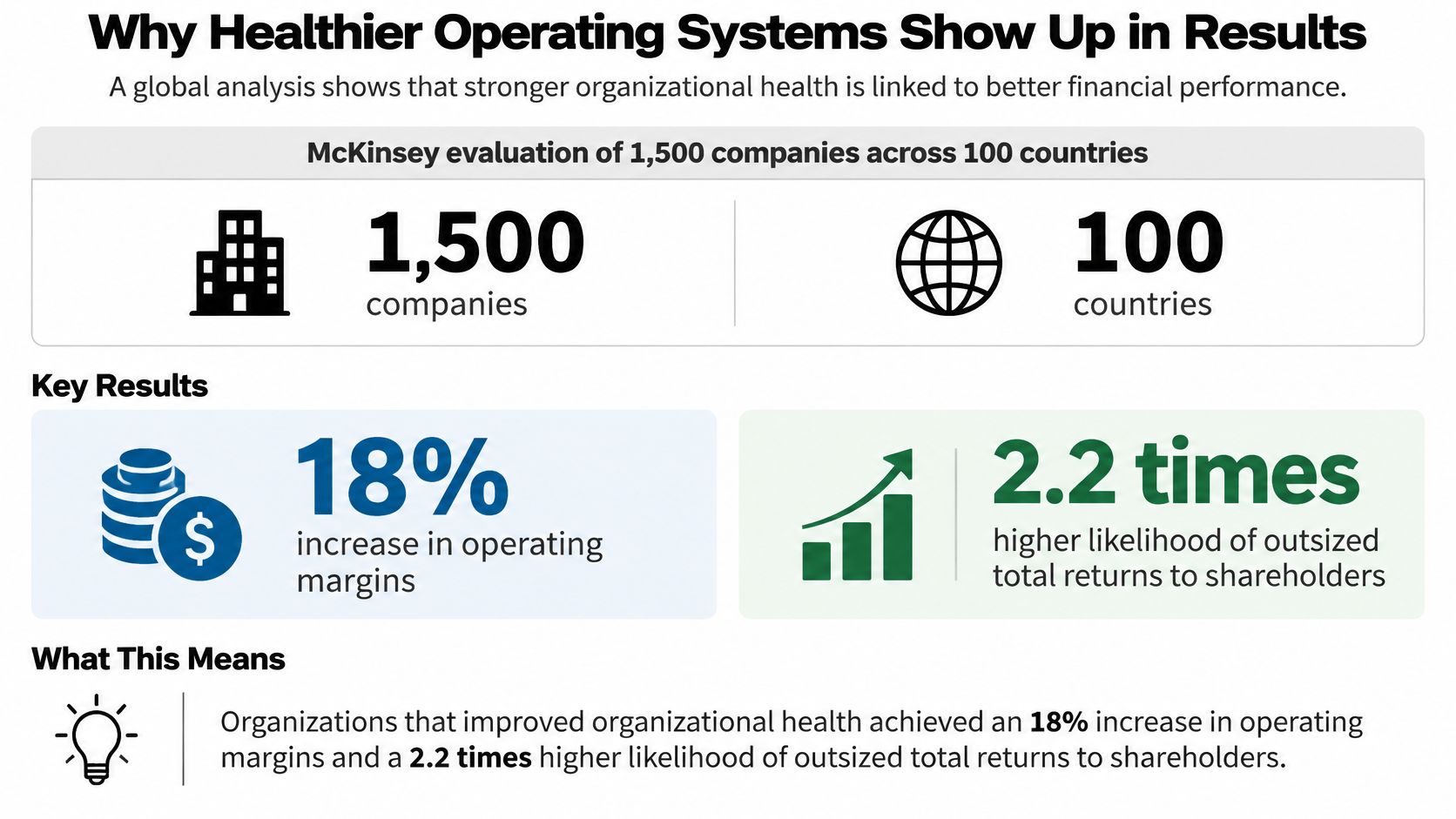
A company can add people and still leave every difficult decision with its founder. Shared structure changes the pattern: work has clearer ownership, and routine questions do not have to wait for one person to remember what happens next.
An evaluation of 1,500 companies across 100 countries found that organizations improving their organizational health achieved an 18% increase in EBITDA after one year, and McKinsey’s Organizational Health Index research found that healthy organizations were three times more likely to outperform unhealthy ones. McKinsey describes organizational health as aligning around a common strategy, translating it into the working environment, and executing consistently over time.
Leaders are also making process and operating-model improvements a priority. In 2024, 9 out of 10 organisations said they would prioritise working with business processes over the following three years, according to Implement Consulting Group’s benchmark study. In 2025, 79% of 1,242 business leaders across 52 countries said they were working to improve their operating models for greater speed, cost efficiency and resilience, according to HLB. In 2024, 97% of surveyed process professionals identified process management as a priority, while 86% prioritised continuous improvement, according to APQC’s survey. The BearingPoint and BPM&O Process Management and Analytics Study found that 42% of surveyed companies rated process management as very important, up from 35% in 2021.
| Finding | Figure | Who was studied | Year |
|---|---|---|---|
| EBITDA after improving organizational health | 18% increase in one year | 1,500 companies in 100 countries | McKinsey evaluation |
| Chance of outperforming | 3 times unhealthy peers | Organizational Health Index research | McKinsey |
| Leaders prioritizing business processes | 9 in 10 organisations | Implement Consulting Group benchmark | 2024 |
| Leaders improving operating models | 79% | 1,242 leaders in 52 countries | 2025 |
| Process management as a priority | 97% | Surveyed process professionals | 2024 |
| Continuous improvement as a priority | 86% | Surveyed process professionals | 2024 |
| Process management rated very important | 42%, up from 35% in 2021 | BearingPoint and BPM&O study | 2024 |
What the numbers do and don’t say
These findings support treating organizational health and process improvement as management priorities. They do not show that a checklist alone raises EBITDA, or promise the same result for every company. An evaluation across 1,500 companies is not a forecast for a six-person studio.
In practice, shared structure gives every team member a common way to understand responsibilities, make decisions, coordinate work, track progress, and raise a problem. The founder does not have to carry those instructions in personal memory, and nobody needs to disclose a diagnosis to benefit from reliable defaults. Structure makes routine work easier to pick up and continue, while leaving room for judgment where the work calls for it.
Match the System to Your Working Style
Some founders don’t lose the brief. They lose the gap between “I’ll do it” and the moment the tab is gone. That’s a sequencing problem, not a character flaw. The fix is cognitive offloading. Move remembering and ordering out of fragile working memory and into parts of the system that stay on the screen.
A 2024 systematic review of ADHD in employment treats external structure as a workplace support, and it reads like a menu, not a prescription. Quiet or private workspaces. Flexible hours. Breaks during long meetings. Delegation of tedious tasks. Assistive tools such as checklists, electronic planners, calendars, alarms, templates, and reminder systems. Nobody in that menu has to match your exact week.
Make the commitment visible
Every commitment still needs one owner, one written next action, one due date, and one place where status lives. Meetings end with the decision written down. External prompts cut the chance a task vanishes between intention and doing. Templates cut the tax of starting.
Split the calendar into deep-work blocks and coordination windows. Shorten the meetings that demand a long stretch of attention. Send low-value repetition to a person or an automation, the invoice trigger, the reminder, the status nudge. Keep autonomy over the goal and the creative method. Ambition stays. Follow-through becomes something a board can show.
Score the fit, then run a two-week test
Don’t adopt the whole menu because an article listed it. Pick supports and watch signals you can count.
- Missed deadlines: How many dates slipped versus how many were on the board.
- Reopened tasks: Work marked done that came back because the handoff was thin.
- Meeting-to-delivery latency: Hours from “we decided” to the first real artifact.
- Context-switch frequency: How often a deep block gets cut by a ping you could have batched.
Test two supports for two weeks. A private block from 9 to 11, plus an alarm that fires when a card has no next action. Keep the one that moves a signal. Drop the one that only feels virtuous.
Routines stick when they’re built for the way attention works, which is the point of treating ADHD and routines as design, not as discipline theater. Same supports don’t fit every founder. The review describes a range. You individualize, you measure, you keep what the numbers tolerate.
Build the System in Stages and Install One Workflow
A founder remembers the client’s approval, the team remembers three different versions of it, and the work stalls while everyone asks what happens next. A shared operating system replaces that memory test with a clear sequence the whole team can follow.
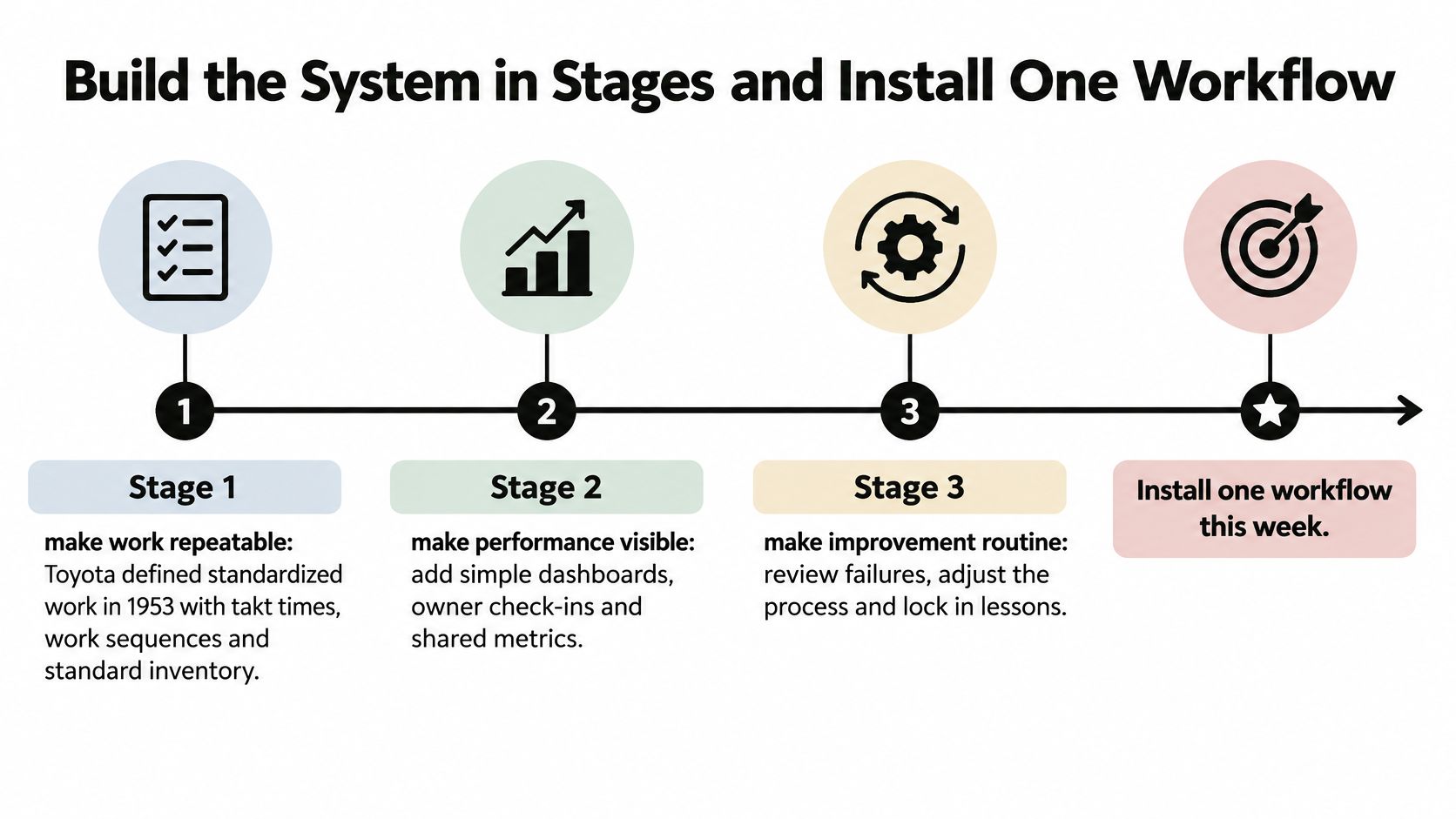
Build the system in three stages: standardize one repeatable job, make handoffs explicit, then track feedback with simple metrics. Start small enough that the team can use it during a busy week.
Stage 1, make work repeatable. Choose a recurring job and write down its sequence, owner, and expected amount of work in progress. A proposal process, for example, might move from qualification to draft to review, with one person responsible for each step.
Stage 2, coordinate handoffs and information. Give the next person a shared artifact that shows what is ready, what is missing, and who owns the next move. That could be a project card or a brief with a clear approval field. The goal is to make the handoff visible without relying on a tap on the shoulder.
Stage 3, track feedback. Record cycle time or rework for the workflow. A simple board can show whether work is moving and where it returns for revision. Add tools only when they make that information easier to see; a new network or app cannot fix unclear steps.
This week, one workflow
- Pick one high-frequency workflow. Choose qualification, proposals, onboarding, reviews, invoicing, or the weekly plan.
- Set a baseline. Write down its cycle time or rework before changing the steps.
- Install the missing layer. Often, a one-page checklist with an owner and due date is enough.
- Make the supports available to everyone. Use written decision rights, meeting summaries, explicit ownership, asynchronous handoffs, visible deadlines, and a predictable escalation rule.
Shared supports also protect privacy. Gallup research found that 37% of employed neurodivergent people do not share their condition with coworkers because they fear stigma. The same research reports that 46% avoid requesting accommodations during hiring because they worry about being labeled difficult or high-maintenance, and 52% do not know whether their employer offers accommodations.
A company-wide operating requirement is something everyone can use. A private accommodation remains optional and personal. Managers can make a deadline visible to the whole team without asking why someone needs to see it. Disclosure is not the doorway to reliable work.
The finish line is modest: one workflow, one owner, visible status, and a before-and-after number. Reliability comes from explicit steps the team can see, not from a founder remembering every detail.
Jan Kutschera helps founders build external operating systems around how attention works, including shared decision rights, handoffs, and rhythms a whole team can run. His advisory and Starter Kit are designed for founders whose companies still depend on them remembering every brief. Visit Jan Kutschera and start with one workflow instead of another heroic week.
Jan Kutschera
German founder, diagnosed with ADHD at 51. Built 4 agencies, now building systems for neurodivergent entrepreneurs. German engineering for the ADHD brain.
Connect on LinkedInRelated Articles
How Do I Increase My Attention Span for ADHD
How do I increase my attention span with ADHD? Match the stall, run a 90-minute block, quiet the room, and score real client work.
How to Improve Team Communication for ADHD Founders
Learn how to improve team communication with async rules, handoff templates, delegation scripts and feedback loops built for ADHD-led teams.

10 Exercise Accountability App Picks for ADHD Founders
Compare 10 exercise accountability app options for ADHD founders, with pricing notes, pros, cons, setup templates, and honest limits for each tool.