How to Improve Team Communication for ADHD Founders
Learn how to improve team communication with async rules, handoff templates, delegation scripts and feedback loops built for ADHD-led teams.
Jan Kutschera
You’ve answered chat all morning, interrupted your own work to explain a client decision, and reminded someone which draft was approved. Then a teammate asks whether the deadline changed. You know it did. You just can’t remember where you said so.
You’ve become the team’s memory. That’s a terrible job description for any founder, especially when you forget, hyperfocus, or switch contexts before finishing the sentence in your head. Learning how to improve team communication starts with replacing that dependency, not becoming more available.
Table of Contents
- Match Each Message to the Right Channel
- Meeting Rhythms That Survive Scattered Attention
- Handoff Templates and Delegation Scripts That Hold
- Feedback Loops and Decision Logs Without Endless Debate
- Information Design for Brains That Forget
- Metrics and Iteration Tied to What Your Team Rewards
- Confirm Your Protocol Before Next Week’s Standup
Match Each Message to the Right Channel
Use synchronous conversation for ambiguity and emotion. Use asynchronous writing for anything that must survive a missed memory. A call can resolve confusion; it can’t serve as the permanent record of what everyone agreed.
Start with the proposed channel rules below. These are operating defaults to test with your team, not universal response-time benchmarks.
Channel rules by message type
| Message type | Channel | Response window | Owner |
|---|---|---|---|
| Decision needing sign-off | Written decision log entry | 24 hours | Decision owner |
| Blocker stopping work | Direct ping, then a 15-minute call | 2 hours | Assignee |
| Status update | Async thread | End of day | Author |
| Ambiguous request | 15-minute call, then written summary | Same day | Requester |
| Feedback on a draft | Document comments | By the review deadline agreed before handoff | Reviewer |
| Conflict or performance topic | One-to-one conversation | Within 1 working day | Team lead |
Count these windows during agreed working hours. The owner holds the clock: they acknowledge the request, resolve it, or name the next action and when it will happen. A response window isn’t a promise to finish complex work on demand.
Blockers get a shorter window because someone can’t proceed. Draft feedback gets a scheduled deadline because reviewers need uninterrupted reading time. Don’t make every notification a fire alarm and then complain that nobody can concentrate.
Give conversation a durable landing place
For the everyday boundary between inbox and chat, Pebb’s guide to choosing between email and workplace chat is a useful companion to your channel table. Make the rule explicit rather than letting each person invent their own etiquette.
Say colleagues agree on a price during a voice call. Nobody records it, and the following week someone quotes a different price. Everyone remembers a different agreement.
The fix is a written decision entry with a named owner. That owner records the approved price and answers for any subsequent change. This is the practical purpose of ADHD-friendly business systems: remove the need to reconstruct work from recollection.
Channel test: If the message would be lost when the sender boards a flight, it belongs in writing.
Meeting Rhythms That Survive Scattered Attention
A recurring calendar slot gives people a cue they can plan around. A late-afternoon invitation for an immediate discussion gives them a surprise. Founders already manufacture enough surprises through normal business operations.
Use a predictable rhythm, but require an artifact from every ritual. A meeting without written output isn’t finished; the participants have merely stopped talking.
Meeting rhythm for a small team
| Ritual | Cadence | Length | Purpose | Required output |
|---|---|---|---|---|
| Daily written check-in | Every working day | 10 minutes, async | Surface blockers | Blocker list with owners |
| Weekly priorities call | Weekly | 30 minutes | Set the week’s top three outcomes | Priority list in the shared tracker |
| Decision hour | Every 2 weeks | 45 minutes | Close open decisions | Decision log entries with dates |
| Monthly communication review | Monthly | 60 minutes | Review metrics and change one protocol | Single written change note |
Treat these durations as starting timeboxes. The daily check-in isn’t an essay competition: name the blocker, its owner, and the help needed. During the priorities call, use a shared agenda and a visible timer rather than touring everyone’s task list.
Decision hour accepts only items already logged as open, with enough context to decide. The monthly review examines execution problems and produces a protocol change, not a group confession about being busy.
Keep the calendar honest
- Publish the agenda early: Set a proposed minimum of 24 hours before a live meeting so people can process the request.
- Cancel empty invitations: No agenda means no meeting. Send a written update instead.
- Finish with confirmation: Read each decision aloud and paste it into the log before people leave.
If software limits make recurring work awkward, explore project scheduling free plan limits with Tuff before moving your team. Check recurring tasks, shared access, and reminders rather than choosing by the prettiest dashboard.
Use this video as a discussion prompt, then agree on the outputs your own team needs.
Hypothetical trial: A founder replaces a 90-minute unstructured weekly meeting with a 30-minute priorities call. Over the following month, they check whether decisions still drift into the next meeting and whether missed deadlines fall. Shorter isn’t automatically better; usable outcomes are the test.
Handoff Templates and Delegation Scripts That Hold
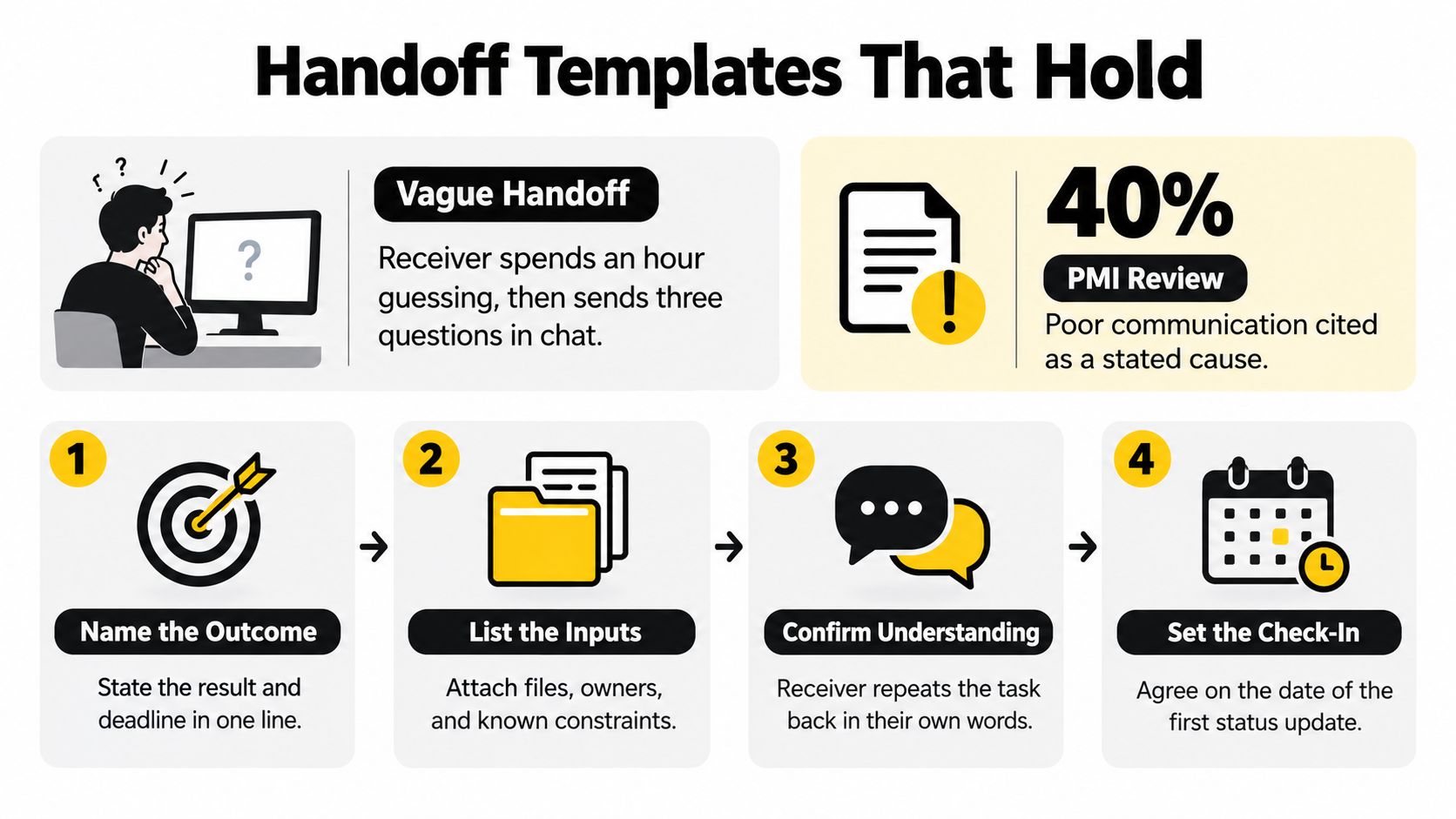
You send a request to tidy up the proposal. The receiver opens the document, guesses what you meant, and eventually sends questions about scope, pricing, and approval. You delegated the typing but kept the thinking hostage.
A Project Management Institute review identified poor communication as a stated cause in 40% of IT project failures. That historical finding makes a practical point: a handoff needs requirements, not just an instruction to start.
Complete the fields before sending
Use this fill-in template in the task itself, whether that’s in Asana, ClickUp, or another shared tracker.
- Owner: Name the person accountable for delivery. Contributors can help, but someone must notice when work stalls.
- Outcome and definition of done: Describe the result and the visible acceptance criteria. For a proposal, that might mean approved scope, checked pricing, and a client-ready PDF.
- Inputs and links: Put the brief, source files, examples, and relevant contacts together. Don’t assign a scavenger hunt through Slack.
- Constraints and dependencies: Record budget limits, approval requirements, and anything another person must supply. Surface the trap before someone steps into it.
- Deadline and check-in: Enter the delivery date, time zone, and an earlier review point. Schedule follow-up instead of improvising reminders.
- Decisions already made: Identify what’s settled and what the receiver can decide independently. Otherwise they may reopen choices or wait for permission they already have.
- Read-back: Ask the receiver to restate the outcome and deadline in their own words. Agreement is easy; demonstrating shared understanding is more useful.
The visual below offers a compact handoff flow for keeping those essentials together.
Transfer authority, not just workload
Use this delegation script aloud, replacing each placeholder with the task details:
I am handing you this. Done means this, by this date. You decide these things. Come back to me on these. What would make you say no?
For responsibilities that pass between shifts, consult shift handover advice from Turn On Work when designing continuity between outgoing and incoming staff. For founder-to-team transfers, this guide to delegating tasks effectively helps clarify what authority travels with the work.
When the receiver says no, investigate the constraint. They may lack capacity, access, or a required decision. Log that information and renegotiate the assignment instead of treating an honest answer as insufficient commitment.
Feedback Loops and Decision Logs Without Endless Debate
Psychological safety doesn’t mean everyone agrees. It means someone can challenge your plan without getting punished, while still being accountable for delivery. High standards and respectful disagreement belong in the same room.
A cluster-randomized hybrid-team trial involving 478 people across 56 teams found that team-regulation practices improved psychological safety and flexible-work social support. That supports installing explicit practices rather than relying on a founder’s assurance that their door is always open.
Give people a defined opportunity to object before asking them to commit.

Put boundaries around debate
Adopt these proposed loops, then adjust their timeboxes to the stakes:
- Written pre-mortem: Before a major commitment, allow 15 minutes for each participant to write three ways the plan could fail. Collect responses before discussion so the founder’s opinion doesn’t become everybody else’s opening position.
- Dissent window: Give a complete proposal 48 working hours for logged objections. The owner then decides, addressing material concerns rather than waiting for unanimous enthusiasm.
- Blameless review: Review a missed deadline within five working days. Examine the failed protocol, such as an unacknowledged dependency or unclear approval route, and assign a repair.
Silence only closes a dissent window when affected people received the proposal and had a realistic opportunity to respond. An unread document isn’t consent. For urgent incidents, use a named incident decision-maker and review the choice afterward.
Record why the decision stands
A decision entry needs the decision, date, owner, alternatives rejected, and reopening condition. That last field prevents a fresh mood from becoming a fresh strategy.
A reopening condition might be a client changing scope or a supplier failing an agreed requirement. The owner can then distinguish new evidence from a recycled preference.
Disagree in the document. Commit in the log.
Leaders must follow the same boundary. If you punish the first objection or reverse the recorded decision without saying so, nobody will trust the protocol, however elegant your Notion template looks.
Information Design for Brains That Forget
Working memory is limited, and time can be difficult to track. Add context-switching, an absorbing task, and important facts buried in an old chat thread, and remembering becomes an unreliable operating method.
Don’t design around the teammate who remembers everything. Design around the person returning from leave, switching clients, or recovering their place after an interruption. Understanding ADHD and working memory helps explain why external cues matter more than another request to pay attention.
Separate access from disclosure
Accessibility means the default system works without exceptional memory or constant availability. People can find responsibilities, deadlines, and current decisions without asking someone to reconstruct them.
Accommodation means an individual receives an adjustment, such as a written summary after every call or advance questions before a review. Offer practical communication preferences without making someone explain a diagnosis to their colleagues. Ask what helps them do the work, not what label justifies the request.
| Information home | Its job | What doesn’t belong there |
|---|---|---|
| Decision log | Preserve approved choices and their rationale | An unfiltered transcript of debate |
| Task tracker | Show responsibility, delivery dates, and current status | Competing versions of company policy |
| One-page onboarding document | Explain how the team works and where to find things | Every historical process detail |
These can be separate views inside the same tool. You don’t need another subscription; you need distinct places with clear purposes.
Format for retrieval
- Lead with the conclusion: Put the requested action or answer in the opening two lines. Add background underneath.
- Keep the brief compact: Aim for a screen-sized summary, with detailed specifications attached. Don’t delete essential requirements to satisfy a layout preference.
- Name files predictably: Use a date-and-topic convention, plus a visible approval status. Retire superseded versions instead of adding another final to the filename.
Run a proposed retrieval test: ask a new hire to find a project’s current price, owner, and deadline in under two minutes. Watch where they hesitate without coaching them.
If they fail, fix the label, navigation, permissions, or duplicate record. A reminder to search harder isn’t information design.
Metrics and Iteration Tied to What Your Team Rewards
Judge communication by missed requirements, rework, and schedule slips, not meeting counts or reply speed. In PMI’s 2013 Pulse of the Profession research, organizations with highly effective communication completed about 80% of projects on time, within budget, and against their original goals, compared with 52% among organizations with minimally effective communication.
That comparison isn’t a forecast for your agency. It’s a reason to evaluate communication through delivery rather than notification activity.
Communication metrics and what they signal
Use these as proposed internal signals, not industry benchmarks.
| Metric | How to measure it | Healthy signal | Red flag |
|---|---|---|---|
| Missed requirements per project | Count items found after review | Falling each month | Same miss repeats |
| Rework tagged in the tracker | Share of tasks tagged rework | Trending down | Rising for two cycles |
| Handoffs returned with questions | Count handoffs bounced back | Falling toward zero | Half or more handoffs bounce |
| Decisions reversed within 30 days | Check decision log dates | Rare | Recurring on the same topics |
| Blocker response time | Compare timestamps to the window | Within the window | Over twice the window |
| Team-reported clarity | Three-question weekly pulse | Rising or stable | Flat or falling |
Distinguish clarification from a failed handoff. A specialist asking a useful technical question isn’t the same as a receiver asking what they’re supposed to deliver. Otherwise, people will stop asking questions to protect the score.
Change the protocol, then observe
My recommended iteration rule is to change a protocol every 30 days at most, then measure it for two more review cycles before judging it. Record what changed and what outcome you expect. Multiple simultaneous repairs make it difficult to tell which helped.
For the clarity pulse, ask whether people understand their priority, know who decides, and know where to escalate a blocker. Keep the wording consistent so you can compare answers.
- Reward useful records: Praise the person who captures the decision and closes the loop, not just whoever replies first.
- Check logging coverage: Compare logged items with completed tasks each month. A lower rework count means little if people stopped recording work.
- Inspect the exceptions: Read failed handoffs and reversed decisions. A tidy average can hide a recurring problem on a major account.
The founder sets the true incentive. If you celebrate midnight rescues while ignoring quiet prevention, expect more midnight rescues.
Confirm Your Protocol Before Next Week’s Standup
Install the channel rules first. They reduce the stream of interruptions that makes every other improvement harder to maintain.
Keep the initial rollout deliberately small:
- Choose the painful message type: Start with whichever causes the most rework, usually decisions or handoffs.
- Publish its rule: Add it to the channel table and pin it where the team works.
- Run a bounded trial: My recommendation is 14 days without adding another protocol.
- Review the matching metric: Inspect returned handoffs, reversals, or blocker response times.
- Expand after review: Keep, revise, or remove the rule before introducing another.
For implementation support, Jan Kutschera’s Starter Kit offers templates and structured review; hands-on advisory is another option for delegation and team structure. You can also run the trial yourself with a shared document and a calendar reminder.
Before you close this article, book the review date. Give the protocol an appointment, not an optimistic intention.
Jan helps founders turn communication habits into workable delegation and team systems through his Starter Kit and hands-on advisory. Visit Jan Kutschera if you want help installing clear handoffs, decision rules, and review routines without making yourself the permanent reminder service.
Jan Kutschera
German founder, diagnosed with ADHD at 51. Built 4 agencies, now building systems for neurodivergent entrepreneurs. German engineering for the ADHD brain.
Connect on LinkedInRelated Articles
Operating System in Business: A Founder Guide
Learn what an operating system in business is, the five layers that carry execution, and how founders adapt it to their working style.

How Do I Increase My Attention Span for ADHD
How do I increase my attention span with ADHD? Match the stall, run a 90-minute block, quiet the room, and score real client work.

10 Exercise Accountability App Picks for ADHD Founders
Compare 10 exercise accountability app options for ADHD founders, with pricing notes, pros, cons, setup templates, and honest limits for each tool.