How to Identify Your Strengths: A Founder's ADHD Playbook
For ADHD founders: Learn how to identify your strengths beyond generic advice. A practical guide to finding your genius zone and building systems to thrive.
Jan Kutschera
You shipped the feature, closed the client, calmed the team, and somehow answered fifteen Slack threads before lunch. From the outside, it looks like strength. From the inside, it often feels like a server running hot with the case off.
That’s the founder version of the ADHD success paradox. You can be effective, admired, even high-output, while still building your company on panic, novelty, and late-stage rescue missions. A lot of smart people call that your “zone of genius.” Sometimes it is. Sometimes it’s just a very polished coping strategy.
If you want to learn how to identify your strengths, skip the self-help fog. Treat it like systems design. Your strengths are not flattering adjectives. They’re recurring capabilities that produce useful output, under recognizable conditions, without requiring your nervous system to catch fire every time.
Table of Contents
- Forget ‘Finding Your Passion’, Let’s Reverse-Engineer Your Brain
- The Evidence Hunt, Becoming a Detective of Your Own Performance
- Mapping Your Genius Zone, When and Where Your Strengths Activate
- From Hypothesis to High-Performance, Validating Strengths with Micro-Experiments
- Your Strategic Delegation Playbook
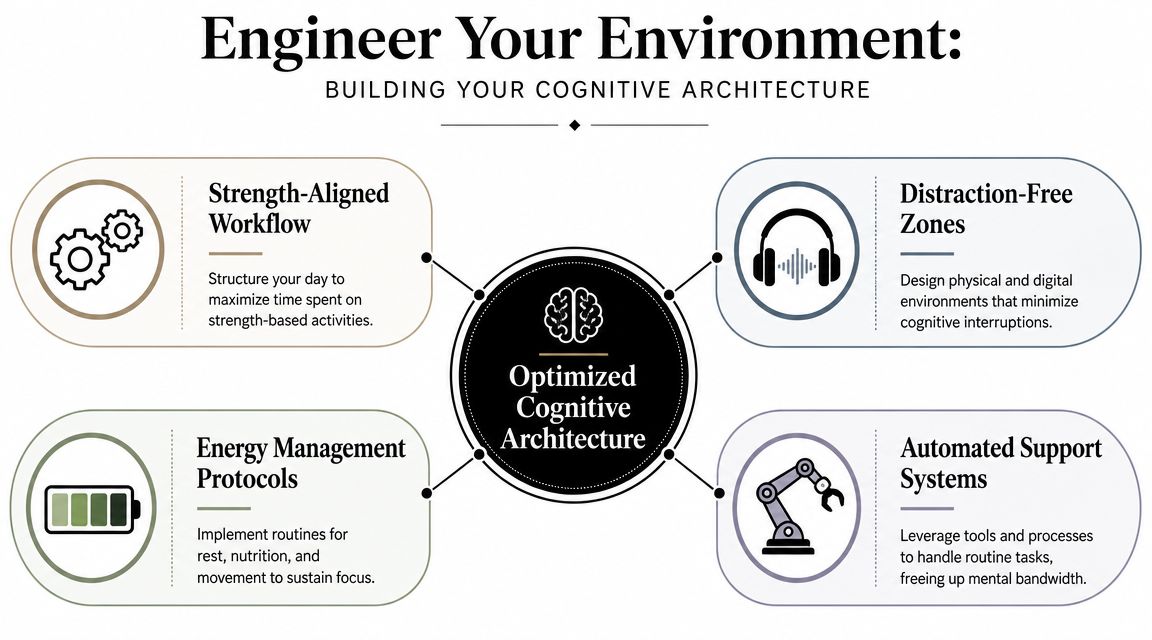
- Engineer Your Environment, Building Your Cognitive Architecture
Forget ‘Finding Your Passion’, Let’s Reverse-Engineer Your Brain
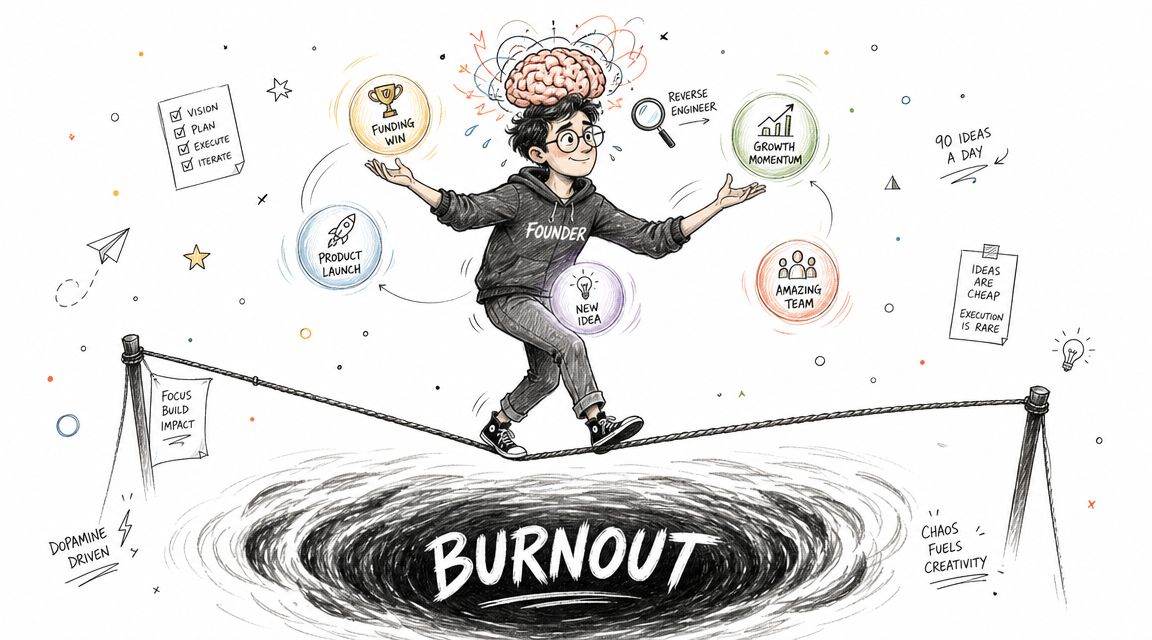
“Follow your passion” is advice that sounds nice and breaks under load. Founders with ADHD usually don’t suffer from lack of passion. They suffer from too many active tabs, too much responsiveness to urgency, and no clean distinction between what feels exciting and what is sustainably strong.
That distinction matters more than most founders realize. One of the most useful diagnostic questions is whether an activity creates durable energy or only adrenaline-fueled momentum, especially for ADHD-affected founders trying to separate strengths from coping strategies, as discussed in this interview on strengths and sustainable energy.
A lot of “strengths” are fake in the same way a brittle script looks reliable right until production traffic hits it. You may be brilliant in crisis. You may write fantastic sales emails at midnight. You may become laser-focused only when the stakes are absurd. That doesn’t automatically mean crisis response, last-minute copy, or deadline roulette are strengths. It may mean your brain is good at manufacturing emergency fuel.
Strengths are operating system components
A real strength has three properties:
- It produces value: people can see the result in decisions, communication, execution, leadership, design, sales, or delivery.
- It repeats: the pattern shows up across projects, not just one heroic week.
- It energizes: you can use it regularly without paying for it with brain fog, resentment, or recovery days.
That last point is where a lot of high-performing founders get fooled. ADHD rewards novelty, challenge, and urgency. Business also rewards those things, at least in short bursts. So founders often confuse “my brain will do this under threat” with “this is how I should build my role.”
Practical rule: If you can only do your “best work” in chaos, that’s not a finished system. It’s an emergency override.
Stop asking identity questions
Don’t ask, “What am I passionate about?” That question is too broad and too easy to romanticize.
Ask better engineering questions instead:
| Question | Why it works |
|---|---|
| Where do I create disproportionate value? | It shifts attention from feelings to outcomes. |
| What work feels easier for me than for the people around me? | Strengths are often obvious to others and invisible to you. |
| Which tasks leave me clearer instead of fried? | Sustainable performance matters more than dramatic effort. |
| Under what conditions does my brain lock in? | Strengths activate in contexts, not in a vacuum. |
Founders don’t need a personality horoscope. They need a working model of their own cognitive architecture. If you know where your brain naturally converts attention into value, you can design your role, team, and calendar around it. If you don’t, you end up using talent to patch structural problems.
The Evidence Hunt, Becoming a Detective of Your Own Performance
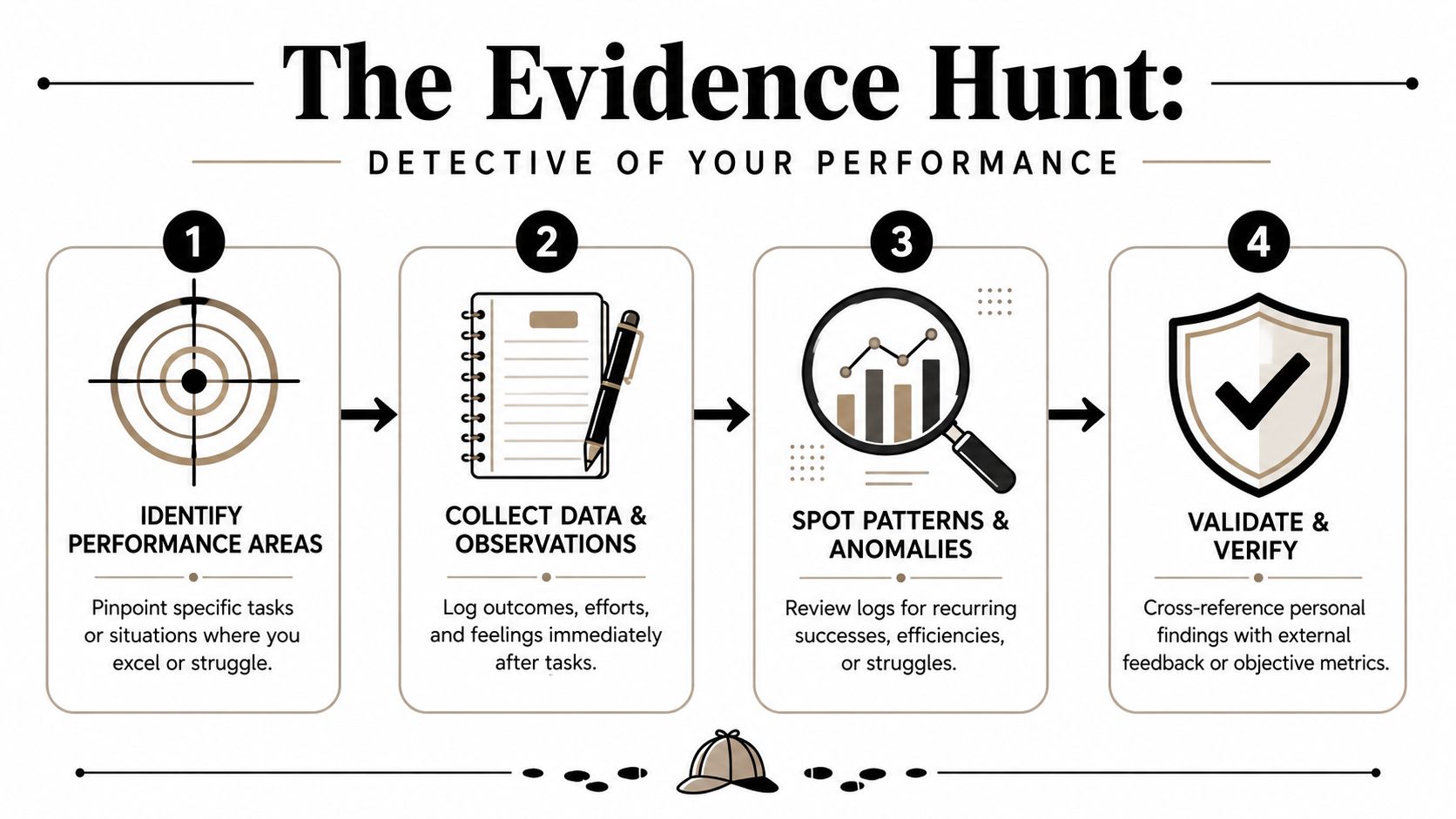
It’s common to try to identify strengths by introspection alone. That’s unreliable. ADHD memory is state-dependent, emotionally biased, and weirdly selective. You’ll remember the missed deadline and forget the dozen times you untangled a messy client problem in one call.
A better method is to hunt for bright spots. 80,000 Hours recommends reviewing your work history, calendar, and feedback to find tasks and contexts that produced unusually good results, then gathering data, reflecting on targeted questions, and using strengths lists to spot patterns. They also point out that strengths are easy to miss because of negativity bias and familiarity.
Start with artifacts, not vibes
Your best raw material is already lying around in your systems.
Look at:
- Calendar history: What kinds of meetings or work blocks consistently led to movement?
- Sent folders and Slack threads: Where do people thank you, defer to you, or ask for help again?
- Project docs and client notes: Which deliverables were easier for you to produce than they “should” have been?
- Performance reviews and testimonials: What language keeps recurring?
If you need a clean template for collecting wins and patterns from past work, these download brag sheet examples are useful because they force you to document concrete contributions instead of vague self-description.
Build a small evidence pack
Don’t overcomplicate this. For one week, run three parallel logs.
-
Calendar audit
At the end of each day, mark each block with one of three labels: energized, neutral, drained. -
Energy log
Write a fast note after meaningful work. Include the task, who was involved, whether the scope was clear, and whether your attention sharpened or scattered. -
Feedback scan
Search old email, Slack, Notion, Asana, or Linear comments for phrases people repeatedly use about you.
A lot of founders should also compare these patterns with mood variability. If your energy and focus swing hard by context, a simple tracking system like these mood charts for adults can help you separate “this task drains me” from “today was cognitively noisy.”
You are not collecting compliments. You are collecting evidence of repeatable contribution.
What counts as a bright spot
A bright spot is not “I worked hard.” It’s a moment where output, ease, and usefulness lined up.
Common bright spots for founders look like this:
- Complexity compression: You took a messy problem and made it legible.
- Pattern recognition: You noticed the root issue before everyone else.
- Trust creation: A tense client or teammate relaxed when you stepped in.
- Narrative framing: You turned scattered facts into a decision.
- Activation: You got a stalled project moving without brute force.
Write down the surrounding conditions too. Time of day matters. Team composition matters. Novelty matters. Constraint level matters. For ADHD brains, context changes performance more than effort does.
By the end of this exercise, you want a dossier, not a diary. A few pages of observed patterns beat an hour of abstract self-analysis.
Mapping Your Genius Zone, When and Where Your Strengths Activate
Raw evidence is useful, but it still isn’t a map. A strength is not just “I’m good at strategy” or “I’m creative.” That’s too blurry to build around. The important question is when the capability turns on.
Context is part of the strength
Founders often say things like, “I’m great with people.” Fine. In what environment?
Are you great in:
- investor conversations where stakes are high and the story is fluid
- client discovery calls where you can diagnose and reframe
- small team workshops where ambiguity needs structure
- hiring interviews where you can read energy and motive
- public presentations where you synthesize and persuade
Those are very different operating conditions.
The same goes for solo work. You may be excellent at generating strategy in a blank document and terrible at updating the roadmap after consensus meetings. That doesn’t mean you’re inconsistent. It means your strength has activation requirements, the same way a high-performance system needs the right input conditions.
Here’s a useful way to annotate your bright spots:
| Variable | Ask yourself |
|---|---|
| Social mode | Was I alone, paired, leading, or collaborating? |
| Pressure level | Did this work better under calm conditions or a hard deadline? |
| Task shape | Was I creating, simplifying, deciding, persuading, or executing? |
| Constraint type | Did I need freedom, or did a tight brief help? |
| Reward signal | Was the work motivating because it was meaningful, novel, visible, or technically elegant? |
If you’re trying to design more repeatable focus, practices for entering ADHD flow state on demand become useful. Flow is not random. It often shows up where your strength, task shape, and stimulation level line up.
Use a real taxonomy so you stop guessing
Labels help when they’re specific. A research-backed option is the VIA model, which organizes strengths into 24 character strengths grouped under 6 virtues: wisdom, courage, humanity, justice, temperance, and transcendence, as outlined by the Positive Psychology Project’s overview of character strengths.
That matters because it gives you a more precise language than “good with people” or “driven.” You can start identifying patterns like:
- curiosity
- perseverance
- leadership
- self-regulation
- social intelligence
Once you have language, delegation gets easier. Team design gets easier. So does self-trust.
A founder who says “I’m bad at operations” usually means something narrower, like “my strengths activate in synthesis and persuasion, not in repetitive coordination.”
A strength map should read more like a user manual than a vision board. It should tell you where your brain is most effective, where it stalls, and which contexts are expensive even when you can technically perform in them.
From Hypothesis to High-Performance, Validating Strengths with Micro-Experiments
A strength claim without testing is just branding. Founders are especially prone to self-mythology because the job rewards storytelling. You can build a whole identity around being “the strategic one” or “the closer” or “the product mind” without ever verifying whether those labels produce reliable output.
A strength needs proof
Gallup’s model is useful because it’s operational. It defines strength as “Talent x Investment = Strength” and recommends mapping top talent themes to daily tasks, routines, and deliberate practice actions to see which abilities reliably convert into performance, as explained in Gallup’s guidance on developing strengths.
That formula solves a common founder mistake. Talent alone isn’t enough. You can have a natural instinct for sales, synthesis, product thinking, or leadership and still fail to turn it into a dependable asset if you haven’t built workflows around it.
Three useful experiment designs
Instead of declaring strengths, run micro-experiments for a week or two.
Experiment type one: task redesign
If you suspect “simplifying complexity” is a strength, choose two messy projects and force yourself to produce a one-page decision memo for each. Then compare how quickly stakeholders align and how your energy feels during the work.
Experiment type two: channel shift
If you think your strength is persuasion, try moving one key discussion from async chat to a live call, or from a rambling meeting to a concise written brief. The question isn’t what feels more comfortable. It’s which channel lets your suspected strength produce a better result.
Experiment type three: role swap
If you’re leading a process-heavy weekly meeting, swap roles with an operator for one cycle. Let them run coordination while you focus on framing decisions, clarifying trade-offs, or unblocking stakeholders. Notice where momentum improves.
Here’s a simple experiment template:
| Part | Example |
|---|---|
| Hypothesis | I’m strongest when I turn ambiguity into a clear plan. |
| Test | For one week, I’ll own project kickoff docs instead of status chasing. |
| Observable output | Better decisions, faster alignment, fewer follow-up clarifications. |
| Energy check | Did this work sharpen attention or drain it? |
| Next move | Keep, refine, delegate, or discard. |
One reason this matters for ADHD founders is that novelty can fake competence. A new task can feel electric because it’s new, not because it fits your wiring. The opposite is also true. A real strength can look boring from the outside because it feels natural to you.
If you want a broader perspective on designing systems around focused work and intelligent tooling, the Superchat productivity blog is worth reading alongside your own experiments.
Field note: If a supposed strength only works when the stakes are absurd, test it again in a calmer context before you trust it.
The strongest signal is simple. When you deliberately deploy a capability in similar work, results hold up and your brain doesn’t revolt.
Your Strategic Delegation Playbook
Once you’ve validated a strength, your next job is not to admire it. Your next job is to reorganize the company around it.
That sounds grandiose, but it’s practical. Founders create bottlenecks when they keep ownership of tasks that prove competence but destroy consistency. Being able to do something is not the same as being the right long-term owner of it.
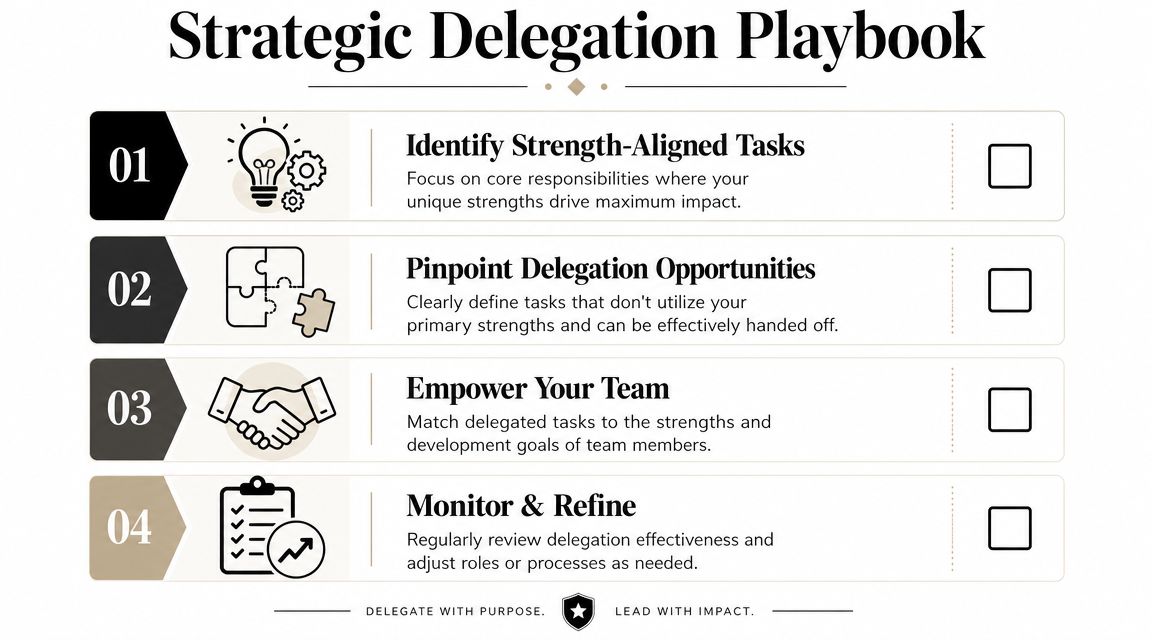
Sort every recurring task into three buckets
Take every task you touch in a normal month and sort it into these categories.
-
Keep and amplify
These tasks clearly align with your validated strengths. You produce high-quality work, the task matters to company leverage, and the work is sustainable. -
Delegate or partner
You can do these tasks, but they cost too much cognitive energy or create drag. Often these belong with an operator, project manager, EA, integrator, or specialist. -
Automate or eliminate
These tasks don’t need your judgment and don’t meaningfully develop anyone else. Remove them, template them, or push them into tooling.
For many founders, this becomes obvious fast. They should keep vision framing, high-stakes sales, product synthesis, recruiting key hires, and stakeholder communication. They should not keep inbox triage, follow-up choreography, recurring coordination, or manual admin, as their unique context knowledge does not justify it.
What delegation gets wrong
Most delegation advice treats delegation as a time-management move. It isn’t. It’s a cognitive architecture move.
Poor delegation sounds like this:
- “Take this off my plate.”
- “Can you own this for now?”
- “I just need help.”
Strong delegation sounds different:
- “You own project coordination. I own scope and decisions.”
- “I create the client narrative. You turn it into a timeline and handoff sequence.”
- “I’m the best person for the first twenty percent. You’re the best person for the repeatable middle.”
That’s where complementarity matters. A founder who is strong in ideation and persuasion often needs a counterpart who is strong in sequencing, follow-through, and operational steadiness. Not because the founder is broken. Because businesses scale through complementary strengths, not heroic sameness.
If delegation is a weak muscle for you, this guide on how to delegate tasks effectively is a practical next step because it focuses on clear ownership and handoff design.
A simple review cadence helps too:
- List friction points from the week.
- Ask whether the friction came from weakness, ambiguity, or lack of process.
- Redesign ownership before you try to “be more disciplined.”
One useful option for founders working on this bigger system is Jan Kutschera’s ADHD Founder framework, which focuses on Cognitive Architecture, Dopamine Engineering, and Strategic Delegation as operating layers rather than motivational advice.
Engineer Your Environment, Building Your Cognitive Architecture
Knowing your strengths is only half the job. The rest is environmental design. If your calendar, workspace, meeting load, and communication norms constantly force you to operate from weak zones, self-knowledge won’t save you.
Build around the brain you have
Founders with ADHD often try to solve a systems problem with self-control. That rarely holds.
If your strength shows up in deep synthesis, you need protected blocks with real interruption barriers. If your strength shows up in live problem solving, stack key conversations when your brain is alert and keep admin away from those windows. If your strength depends on visible momentum, create shorter feedback loops so work doesn’t disappear into abstraction.
That’s Cognitive Architecture. External supports for a brain that shouldn’t be trusted to hold the whole operating system in working memory.
Useful examples include:
- Protected deep-work blocks: not “when I have time,” but named blocks with team norms around interruption.
- Decision templates: one-page structures for proposals, trade-offs, and next actions.
- Capture tools: Apple Notes, Notion, voice memos, or a pocket notebook. Use whatever reduces idea leakage.
- Visible pipelines: Kanban boards, CRM stages, or checklists that show movement without requiring recall.
Make strengths easier to access
Dopamine Engineering matters. You want work to feel engaging because the system is well-designed, not because everything is on fire.
Build feedback loops around the use of strengths:
| If your strength is | Build this cue or reward |
|---|---|
| Synthesis | End work blocks with a visible summary or decision note. |
| Persuasion | Get rapid feedback from real conversations, not delayed abstract metrics. |
| Problem diagnosis | Keep a running log of solved bottlenecks and recurring patterns. |
| Creative generation | Use idea capture systems that make progress tangible fast. |
Physical setup matters too. A founder who sits badly, fidgets through calls, and works in a high-friction environment will feel “mentally off” for reasons that are partly mechanical. If you want a grounded read on workspace design, this piece on how posture affects performance is a useful companion to the cognitive side.
Build a company role that fits your strengths often enough that excellence becomes boring.
That’s the ultimate target. Not occasional brilliance. Repeatable, sustainable contribution.
When you know how to identify your strengths, validate them, delegate around them, and build an environment that supports them, your work stops depending on emergency chemistry. You stop fighting your brain and start using it like a well-tuned machine.
If this article felt uncomfortably familiar, Jan Kutschera helps founders with ADHD turn that chaos into a designed operating system. Through ADHD Founder, he works on Cognitive Architecture, Dopamine Engineering, and Strategic Delegation for leaders who want sustainable performance instead of burnout-powered hustle.
Jan Kutschera
German founder, diagnosed with ADHD at 51. Built 4 agencies, now building systems for neurodivergent entrepreneurs. German engineering for the ADHD brain.
Connect on LinkedInRelated Articles
Dopamine Reward System Addiction Explained for Founders
Dopamine reward system addiction explained: why deadlines feel like drugs, how craving loops form, and how founders can rebuild the loop without burnout.
BIOS Optimization Guide for Founders Who Hate Habits
A bios optimization guide for founders: tune sleep, fuel and movement like firmware, with ADHD-proof systems that survive launch week.
10 ADHD Productivity Tools for Founders: What Works
Ten ADHD productivity tools for founders, with honest limits and tips for choosing systems that support executive function without extra clutter.