How to Improve Team Performance with Engineered Systems
Learn how to improve team performance using engineered operating systems built for neurodivergent leaders — with diagnostics, frameworks, and experiments that
Jan Kutschera
It’s Tuesday, you’ve got a client deliverable due Friday, and you’re the only person who knows what “final version” means. Your designer is waiting on copy you swore you sent. Your account manager is waiting on a decision you don’t remember being asked for. You’re not lazy, your team isn’t incompetent, and another motivational talk won’t fix this. What you have is an engineering problem. Learning how to improve team performance starts there, with systems built for how your brain works instead of systems that demand you become someone else first.
Table of Contents
- Why Most Team Performance Advice Fails Neurodivergent Founders
- The 15-Minute Team Performance Diagnostic
- Engineering Cognitive Architecture and Clean Handoffs
- Dopamine Engineering Instead of Adrenaline Addiction
- Strategic Delegation and a 30-Day Onboarding Protocol
- When More Meetings Make Performance Worse
- Bio-Optimization as a Performance Variable
Why Most Team Performance Advice Fails Neurodivergent Founders
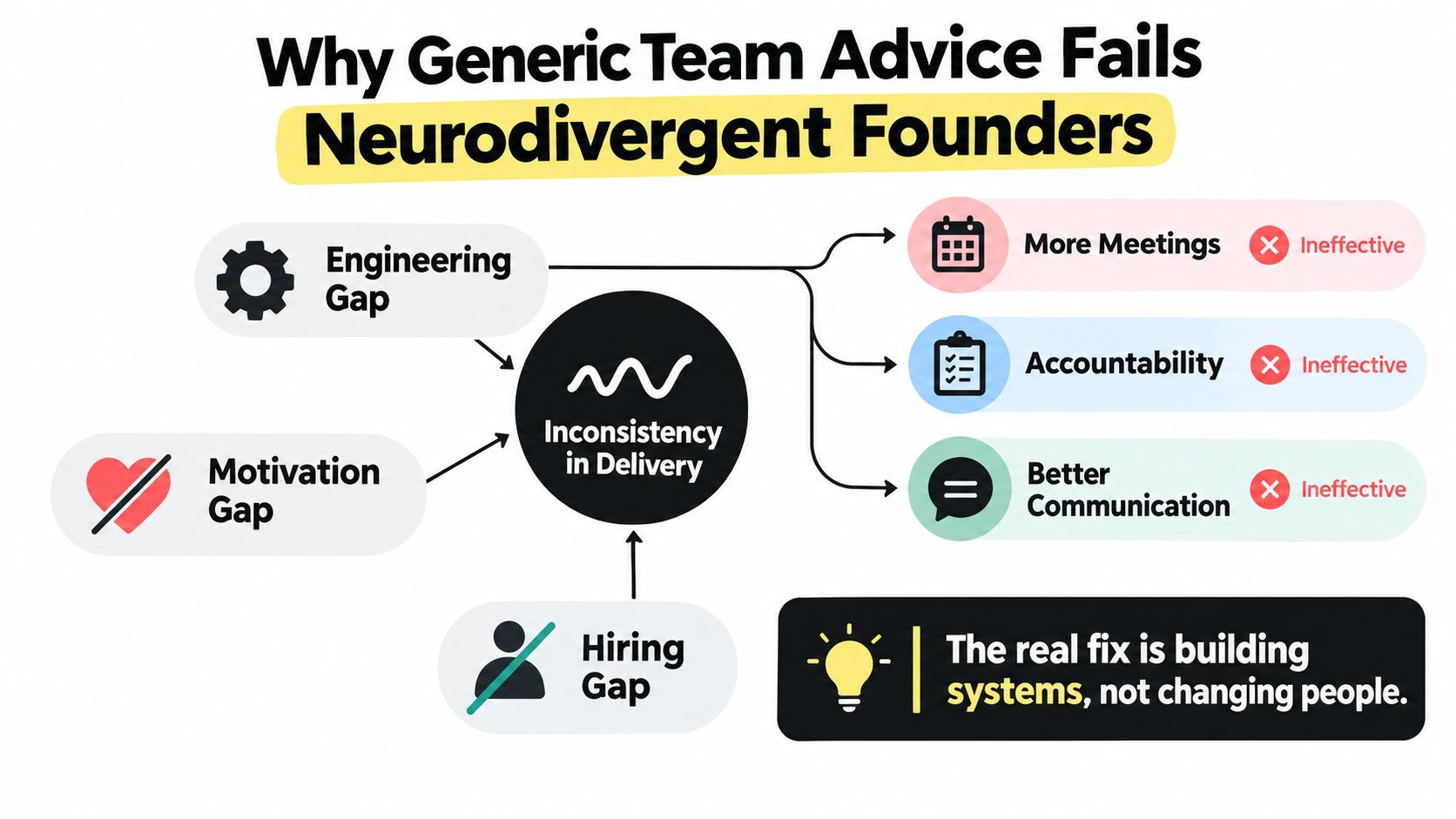
Most management advice assumes the founder has spare executive function lying around. Hold more check ins. Remember who promised what. Follow up consistently. Give timely feedback even on days when your own attention is scattered across fourteen open loops. If you’re wired like me, that’s not a minor stretch. That’s asking you to fix inconsistency by using the exact functions that are already running on fumes.
I rebuilt my agency four times before I stopped blaming motivation. The pattern was always the same. We’d hire well, win interesting work, then watch delivery wobble because decisions lived in my head, handoffs lived in chat threads, and priorities lived nowhere. Hiring better people didn’t solve it. They just waited more politely for clarity that never arrived.
The Evidence Behind the Mismatch
The numbers confirm the friction is real, not imagined. A 2025 survey of 106 employed people with ADHD across 21 industries found that 79.3% believed ADHD negatively affected work performance, while only 58.5% used workplace adjustments, according to the University of New Hampshire survey of employed adults with ADHD. That gap matters. Many people are struggling inside systems that were never redesigned, then getting told to try harder inside them.
That’s why generic fixes collapse. More meetings add context switching. Accountability software adds another dashboard you’ll ignore by week three. A rousing Monday speech adds adrenaline, then Thursday arrives and nothing structural changed.
The real fix is building systems, not changing people.
The Four Levers I Actually Use
I now run everything through four levers. Cognitive Architecture moves memory and sequencing out of your head and into visible structures. Dopamine Engineering replaces crisis fuel with short, repeatable feedback loops. Strategic Delegation designs roles around outcomes so other people can decide without you. Bio-Optimization treats sleep, food, and movement as inputs that directly shape your judgment.
You don’t need all four perfect. You need to know which one is currently breaking delivery. That’s a diagnostic question, not a character question, and it’s exactly where you start tomorrow morning.
The 15-Minute Team Performance Diagnostic
Don’t redesign anything until you’ve scored what’s broken. Pull three artifacts before you sit down. Grab last week’s calendar, your last five handoff documents or task briefs, and notes from your most recent retro or project debrief. You’re looking for evidence, not impressions.
Set a timer. Fifteen minutes is enough because you’re not solving problems yet, you’re naming them. Score each lever from 0 to 10 based on what the documents show, not what you intended.
Team Performance Audit Scorecard
| Lever | Signal Question | Score 0–10 | Dominant Gap |
|---|---|---|---|
| Cognitive Architecture | Can a new person find the current decision, owner, and deadline without asking you? | ||
| Dopamine Engineering | Does the team see visible progress every week without a crisis to create it? | ||
| Strategic Delegation | Can team members make routine decisions inside clear boundaries without approval? | ||
| Bio-Optimization | Are your hardest decisions scheduled when you’re rested, fed, and focused? |
Listen for specific phrases in retros. “I thought you had it” signals broken ownership. “We were waiting” signals a handoff gap. “It all landed at once” signals your reward system only fires under deadline pressure. Write those phrases down verbatim. They’re more honest than any satisfaction survey.
What a Real Audit Surfaces
I ran this with a six person agency where the founder assumed motivation was the issue. His scores told a different story. Delegation scored reasonably well and his energy management was mediocre but workable. Cognitive Architecture scored lowest by far. Three projects had no single written brief. Every approval ran through him because nobody else could see what “done” meant.
He hadn’t hired weak people. He’d built an invisible system.
One useful constraint while you audit is to block your usual escape apps so you finish the scorecard in one sitting. If you need a concrete model for that kind of friction, look at how the app enforces limits and apply the same principle to your audit window. No new tabs, no “quick checks.” Finish the page, circle the lowest lever, and fix that one first.
Engineering Cognitive Architecture and Clean Handoffs
Your working memory is not a project management tool. Treat it that way and delivery improves fast. Cognitive Architecture means every fragile executive function, remembering, sequencing, prioritizing, gets an external home your whole team can see.
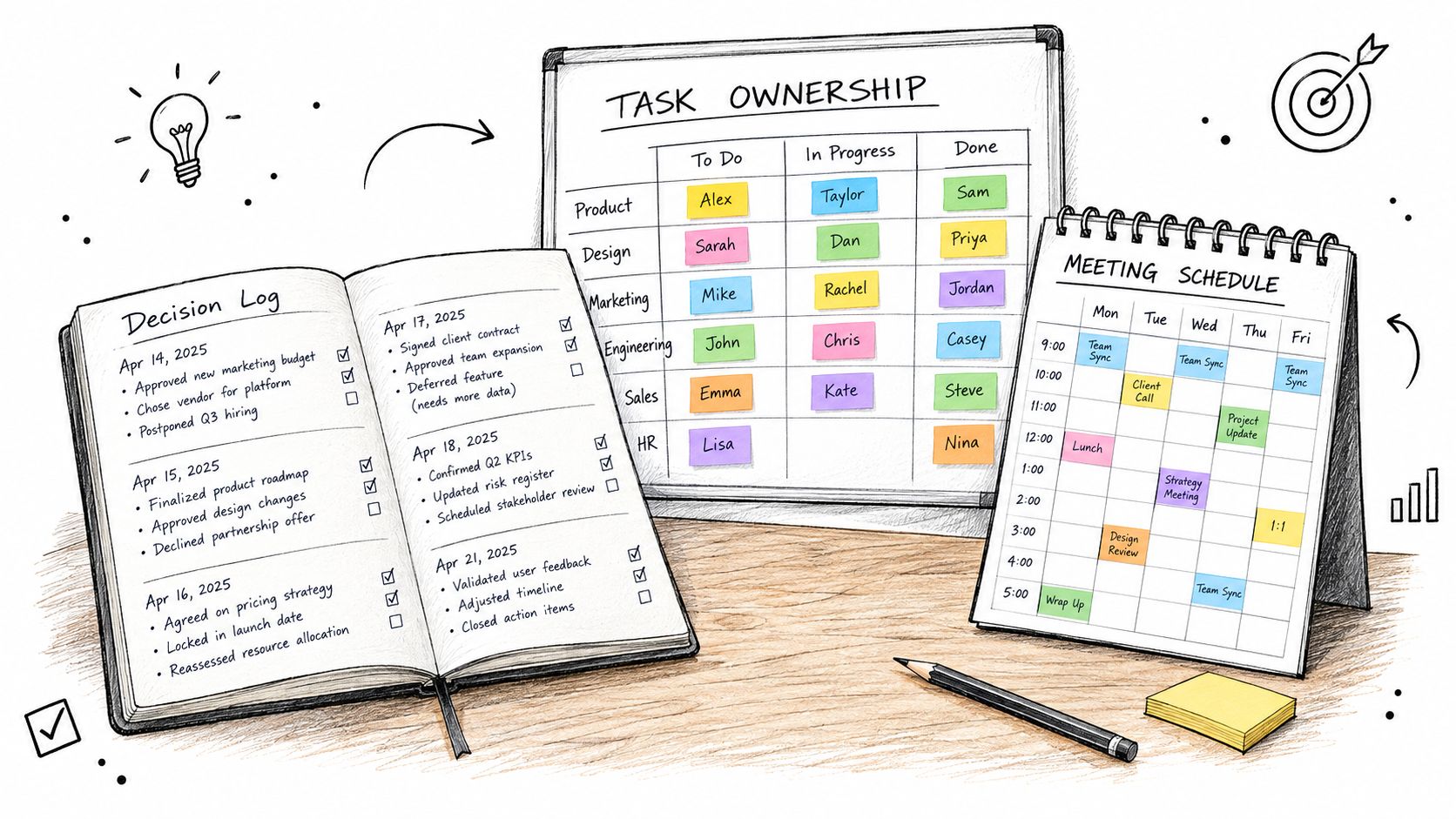
Start with the decision log you’ll see in the sketch below. One document, not five chat threads.
The One Template Library
You need three templates, not thirty.
- Decision log: Date, decision, owner, reason, and what would change it. Written decisions end the “I thought we agreed” loop.
- Task ownership board: One owner per deliverable, visible deadline, and acceptance criteria written in plain language.
- Meeting skeleton: Same agenda structure every time, decisions captured live, open questions assigned before anyone leaves.
Watch how this changes a normal agency handoff. Before, a brief arrived as a voice note, production guessed at format, and QA discovered missing assets on delivery day. After, the brief template requires audience, format, assets, owner, and deadline in one place. Production can’t start until those fields exist. QA checks against the same criteria the client approved. Nobody needs to find you to interpret your own brief.
If writing all that down feels heavy, dictate first drafts and clean them later. Resources that help you boost your team’s communication are worth exploring for exactly this reason. The point isn’t beautiful prose. It’s that the information lives outside your head.
The video below walks through how visible structure changes team behavior in practice, and it’s worth watching before you build your own versions.
Why Structure Creates Safety
These moves do more than organize tasks. Google’s Project Aristotle, a two-year study of more than 180 teams and roughly 250 attributes, identified psychological safety as the strongest differentiator of high-performing teams, with dependability, structure and clarity, meaningful work, and impact as supporting conditions, as documented in Google’s reWork account of Project Aristotle. People speak up earlier when they can point to a written brief instead of challenging your memory. That’s how risks surface while you still have time to fix them.
Post-project reviews belong here too. Keep them focused on learning rather than blame, and capture one change you’ll test next time. If you want a deeper foundation for these structures, study ADHD friendly business systems that externalize executive function and steal the templates that match your current bottleneck. Deploy one on Monday. Don’t wait until the library feels complete.
Dopamine Engineering Instead of Adrenaline Addiction
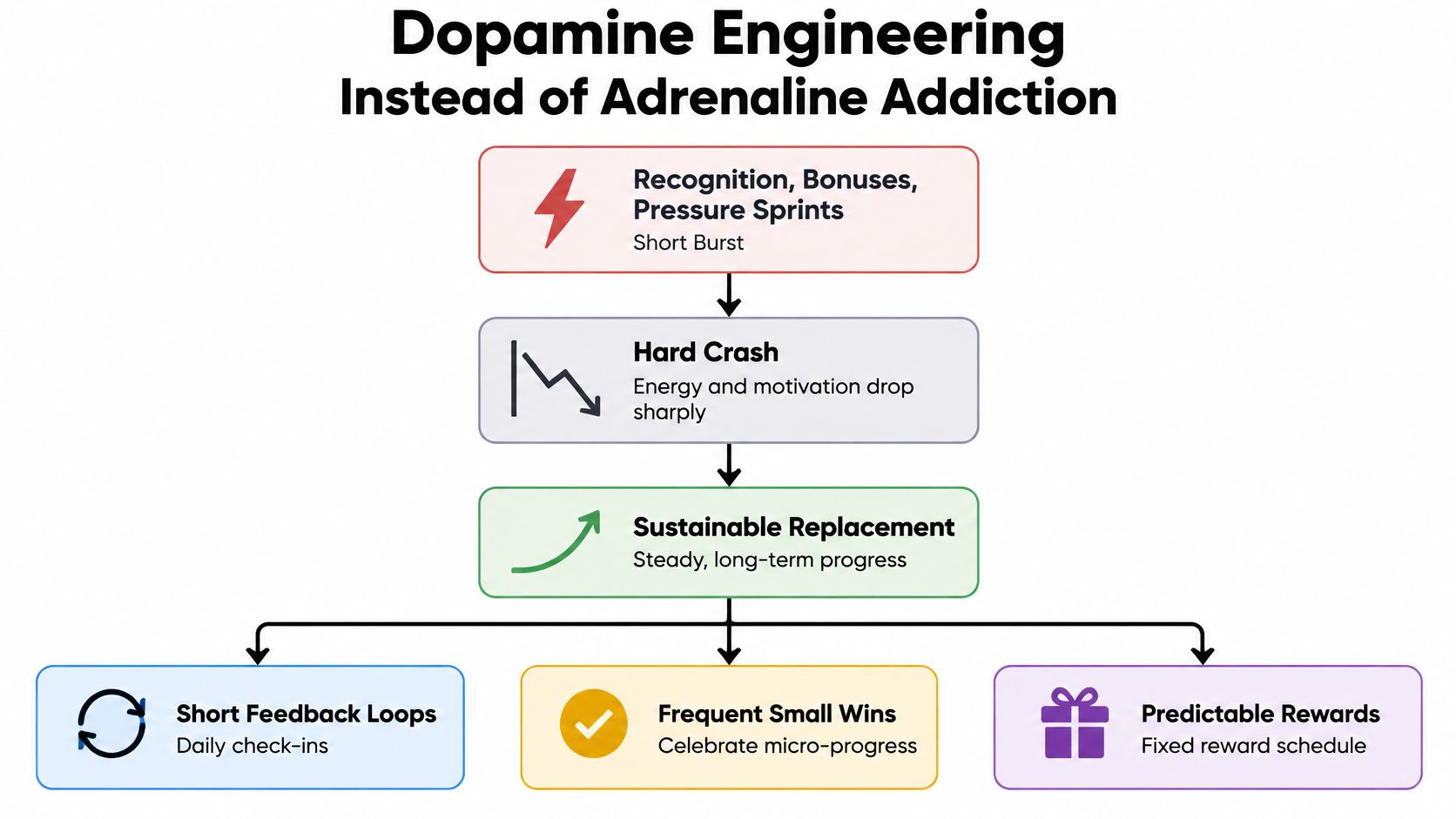
Pressure works. That’s the trap. A looming deadline, an angry client, a dramatic sprint, your brain finally focuses and the team ships. Then everyone crashes, quality dips, and you start needing the next crisis to feel normal again. I’ve run agencies on that fuel. It feels productive right up until it doesn’t.
Traditional management rewards often mimic the same cycle. Big bonuses, public recognition blasts, heroic all nighters. Short burst, hard crash, repeat. For ADHD wiring, that pattern isn’t a motivation strategy. It’s caffeine logic applied to people.
Build Smaller Loops Instead
Dopamine Engineering means designing progress your brain can register, frequently and predictably. Short feedback loops beat grand finales. Visible progress beats private effort. Rewards matched to the work beat generic praise delivered weeks later when nobody remembers what it was for.
Try this weekly experiment template. It’s deliberately boring, which is why it works.
- Pick one shippable item on Monday that the whole team can see.
- Ship it visibly by a fixed time, in a shared channel or board, not in a private update to you.
- Mark the win specifically by naming what changed for the client or the next person in the chain.
No leaderboard. No theatre. One visible completion that proves momentum exists without panic.
Contrarian rule: Motivation is downstream of structure, not the other way around.
Stack that weekly loop into a simple cadence you can run without willpower. Weekly, one shipped and celebrated item per team member. Monthly, a short review of what shipped, what stalled, and which friction point you’ll remove next. Quarterly, retire one ritual that no longer creates visible progress and replace it with a smaller one. You’re not chasing excitement anymore. You’re building a rhythm where steady output feels rewarding enough that you stop manufacturing emergencies to get moving.
Strategic Delegation and a 30-Day Onboarding Protocol
Delegation fails when you hand someone tasks but keep every decision. They move slowly, you get frustrated, you take the work back at midnight, and both of you conclude delegation doesn’t work. I’ve done that dance with talented people. The problem wasn’t trust. The role was never designed.
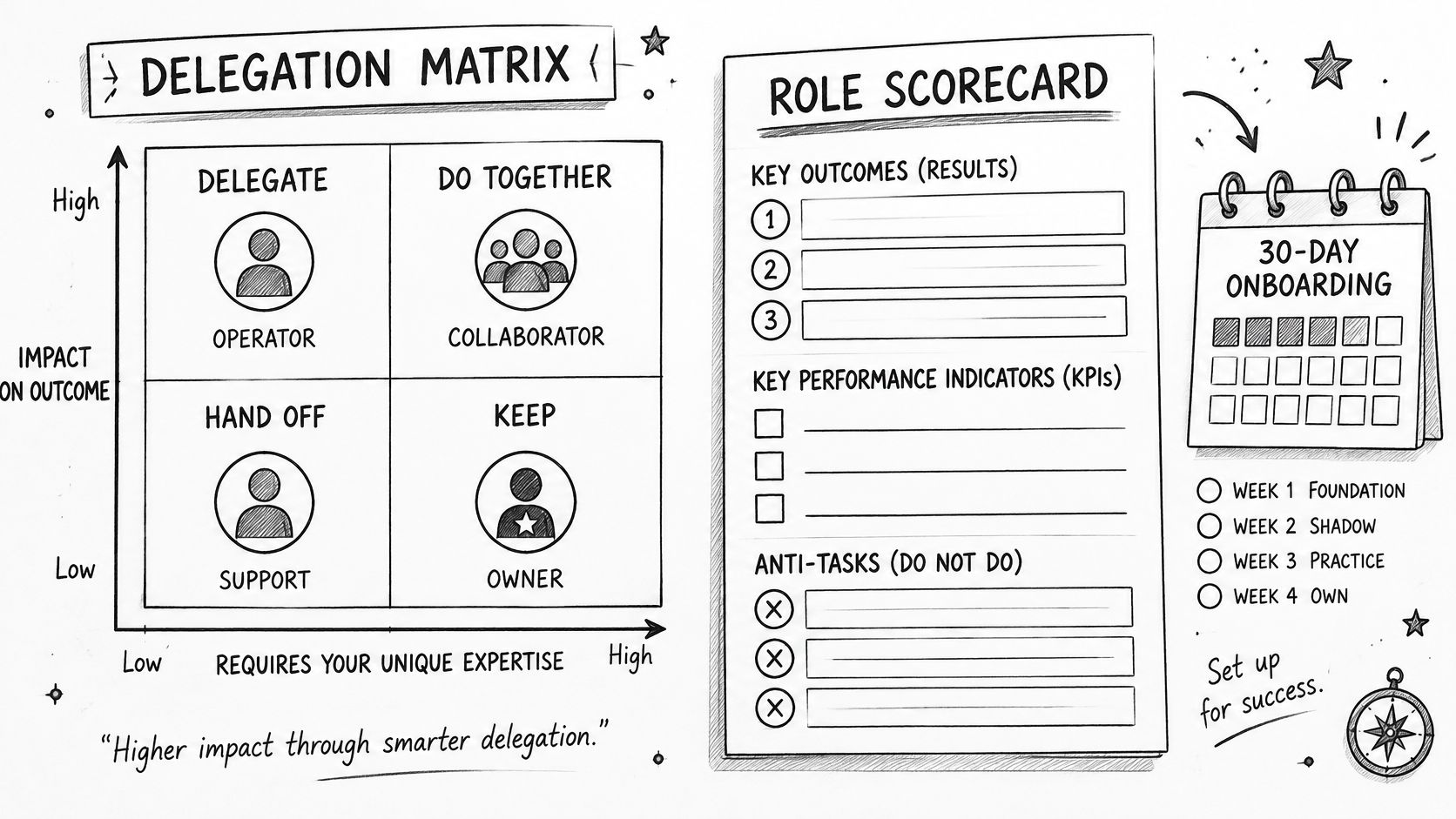
The matrix and scorecard below show the structure I wish I’d used from the first hire.
Write the Role Scorecard First
Every role gets one page before you interview anyone.
- 3 outcomes: Results this person owns, written as finished states, not activities.
- 3 KPIs: Signals you’ll both check to know whether those outcomes are on track.
- 3 anti-tasks: Work this role explicitly does not do, so scope creep has a written enemy.
Then separate two kinds of delegation. Task delegation means “do this step and report back.” Decision delegation means “own this outcome inside these boundaries and tell me what you chose.” Most founders only ever do the first, then wonder why they’re still the bottleneck. Routine client tweaks, scheduling, and standard QA calls should be decisions you delegate outright. Pricing changes, hiring, and strategic positioning stay with you until the scorecard says otherwise. For a fuller walkthrough of that boundary, read how to delegate tasks effectively without losing control and map your current approvals against it.
The 30 Day Protocol
Week one is observation plus one tiny, real deliverable. Not training videos for five days. Your new hire shadows the workflow, reads past decision logs, and ships something small enough to finish.
By day 14, aim for first visible contribution. A client ready asset, a cleaned up process document, a resolved support backlog item. Something the team can point to. Early visibility builds belonging faster than any welcome lunch.
Days 15 to 30 expand decision rights gradually. Review the scorecard together weekly, adjust boundaries in writing, and document every assumption the new hire brings from previous experience. That last step matters more than founders expect. A 2019 meta-analysis of 174 correlations across 35 studies concluded that diverse teams share information more openly when collaboration requires it, and diversity improves performance only when systems convert difference into usable knowledge, according to the meta-analysis of team diversity, communication, and performance. Different experience only helps if your onboarding forces it into shared documents, structured debate, and explicit handoffs. Otherwise you’ve hired diversity and then buried it under your habits.
When More Meetings Make Performance Worse
Coordination is not the same as performance. I learned this after adding a daily stand-up, a weekly planning session, and a Friday review, then watching blocked work stay blocked while everyone got better at sounding busy. The calendar looked disciplined. Delivery didn’t change.
Run every recurring meeting through three tests. If it fails two, cancel it or rebuild it.
Three Tests for Every Session
- Does it unblock work that was stuck before the meeting and moving after it?
- Does it clarify ownership so exactly one person leaves responsible for the next step?
- Does it surface risk early while fixing it is still cheap?
A stand-up that passes these tests is gold. People name blockers, dependencies get assigned, and problems appear while they’re small. A stand-up that fails them is surveillance with better branding. Team members perform progress, hide uncertainty, and save real concerns for private messages you’ll never see.
That distinction isn’t just my opinion. A 2025 study of 199 teams found that contribution conflict had a significant negative indirect effect on team performance, mediated by psychological safety, and the cost of forced participation outweighs the benefit, as reported in the 2025 study of contribution conflict across 199 teams. Forcing everyone to speak, compete for airtime, or defend their contribution in public drains the safety that makes honest reporting possible.
The Calendar Audit Script
Open next week’s calendar and ask one question per meeting. What decision or unblocking will exist after this that doesn’t exist now? If you can’t answer in one sentence, that meeting is a candidate for a written update instead.
Add a private escalation route for anything people won’t say in a group. A short form, a direct message norm, a weekly office hour. Dissent doesn’t need to live in the room to be useful. It needs a safe path to you. Knowing when to stop managing the meeting and start coaching the person is a separate skill, and the distinction between coaching and managing your team will help you spot which mode a stuck team member needs. Cancel one recurring meeting this week using the three tests. You’ll learn more from the silence than from another status round.
Bio-Optimization as a Performance Variable
You are the team’s weather system. When you’ve slept badly for three nights, skipped lunch, and made your hardest decisions at 6 p.m. on fumes, your team doesn’t get your best judgment. They get shorter patience, vaguer briefs, and priorities that change by Thursday. That’s not a wellness observation. That’s an operating cost.
Bio-Optimization means treating a small set of physical inputs as business variables you’ll manage with the same seriousness as cash flow. Not biohacking theatre. Not a supplement cabinet. The basics that most directly shape attention, emotional regulation, and decision quality for an ADHD executive.
Inputs Worth Managing
Sleep regularity matters more than chasing a perfect score. A consistent wake time, morning light soon after waking, and a shutdown routine that doesn’t involve reviewing tomorrow’s problems in bed will do more for your Monday decisions than most productivity apps. You’re protecting the brain you’ll lead with.
Food works the same way. Protein anchored meals at predictable times reduce the afternoon crash where impulsive decisions breed. You don’t need a perfect diet. You need to stop discovering at 4 p.m. that coffee was lunch, then wondering why the team meeting went sideways.
Movement is the third lever, and low friction beats ambitious. Short walks between decision blocks, standing calls, a brief workout you will repeat. The goal is breaking cognitive stagnation and giving restless energy somewhere to go before it turns into scattered messaging across six channels.
Ignore the rest until these three are stable. Cold plunges, elaborate stacks, and trend driven protocols mostly give you a new hobby to hyperfocus on while your sleep stays broken. I’ve been there. Optimization becomes procrastination with better branding.
Tracking minimum: If an input doesn’t change a decision you’ll make this week, stop measuring it.
Three Numbers to Log Weekly
Keep tracking small enough that you’ll still do it in a bad week. Log your average sleep duration, the number of days you ate a real lunch before mid afternoon, and the number of movement breaks you took on workdays. Review them next to one business signal, such as on time delivery or decisions you reversed. Patterns appear quickly, and they’re usually humbling.
Set a clean rule for outside help. A coach helps you design routines, accountability, and environment. A clinician helps with diagnosis, medication, and health concerns. Don’t ask either one to do the other’s job, and don’t use your team as your regulation system. They can support your structure. They can’t be your structure.
Your 90 Day Rollout
Weeks 1 to 2 are audit and quick wins. Run the diagnostic, cancel one failing meeting, install the decision log, and pick your three tracking numbers. Small, visible, done.
Weeks 3 to 6 are structural fixes. Write role scorecards for your most overloaded positions, rebuild your worst handoff with acceptance criteria, and move your hardest decisions into your best energy window. Resistance shows up here, mostly from you, because the old chaos felt faster.
Weeks 7 to 12 are rituals and feedback. The weekly shipped win becomes automatic, onboarding follows the written protocol, and your retro produces one tested change per cycle instead of a complaint list.
Build in off-ramps now, while you’re calm. If energy or capacity drops, shrink the system instead of abandoning it. One template instead of three. One weekly ritual instead of four. A smaller system you’ll keep beats a perfect system you’ll quit by week five.
Choose one metric that proves this is working, matched to your lowest diagnostic score. If handoffs were broken, track work delivered without founder rescue. If delegation was broken, track decisions made without your approval. One number, reviewed weekly, no dashboard sprawl.
Your next quarter checklist fits on one page. Decision log current. Every deliverable has one owner. Every recurring meeting passes the three tests. Every role has a scorecard. Your three bio numbers are logged. Trade panic productivity for compounding output, and you’ll finally know how to improve team performance in a way that survives your worst week, not just your best one.
If you’re done rebuilding the same team problems from scratch every quarter, Jan Kutschera offers a Starter Kit, an application only Founder Circle, and hands-on advisory that turn these four levers into operating systems fitted to your wiring and your current bottleneck. Start with the diagnostic materials, pick your lowest lever, and visit Jan Kutschera to get the templates and support to implement it this month.
Jan Kutschera
German founder, diagnosed with ADHD at 51. Built 4 agencies, now building systems for neurodivergent entrepreneurs. German engineering for the ADHD brain.
Connect on LinkedInRelated Articles
Accountability Partner App: 10 Picks for ADHD Founders
Compare 10 accountability partner apps for ADHD founders: how each works, setup workflows, privacy and pricing trade-offs, and which fits your needs.
ADHD Burnout Cycle: Stages Founders Can Break
See the ADHD burnout cycle in five stages, separate it from depression, and test founder fixes before the next crash.
Best ADHD Planner for Adults: A 2026 Guide
Find the best ADHD planner for adults with a quick-pick table, a founder card you can copy, dopamine rewards, and a 14-day test.