The Time Blindness Test Every Founder Needs
Take a validated time blindness test designed for ADHD founders. Score your results and build engineered systems to replace panic productivity with clarity.
Jan Kutschera
You answer one email before lunch. Then you look up and discover the afternoon has disappeared, your investor follow-up is late, and the meeting you thought was “later” starts in twelve minutes. The workday didn’t feel chaotic while you were inside it. It felt productive, even focused. The problem appeared only when the clock became visible again.
That pattern is familiar to many founders with ADHD, especially those who learned to compensate through urgency, talent, and heroic bursts of effort. A standard time blindness test promises a simple answer, but your business doesn’t run on a single timing skill. You need to know whether you misjudge task duration, lose elapsed time during absorption, struggle with transitions, or make unrealistic commitments several days ahead.
A useful assessment should produce a founder timing profile, not a verdict about your character or a shortcut to diagnosis. Once you know the specific failure, you can build the right external system around it.
Table of Contents
- Why Standard Time Blindness Tests Fail Founders
- Running Your Multi-Dimensional Founder Assessment
- Decoding Your Results and Avoiding Diagnostic Traps
- Engineering Your Cognitive Architecture and Dopamine Loops
- Strategic Delegation and Bio-Optimization for Time Mastery
- Building Your Sustainable Founder Operating System
Why Standard Time Blindness Tests Fail Founders
A founder’s timing problem rarely appears in a laboratory task. It appears when a quick email reply exposes an unresolved process issue, and the afternoon disappears into redesigning the workflow. It appears when a strategy session, sales call, and team handoff all seem manageable until their preparation, transitions, and follow-up collide. It appears in a confident promise to deliver “by the end of the day” without accounting for everything already occupying that day.
Online quizzes reduce these situations to questions about lateness, procrastination, missed deadlines, or losing track of time. Those questions can confirm a frustrating pattern, but they cannot identify the timing demand that fails. They also cannot separate a persistent difficulty from sleep loss, anxiety, medication effects, workload, or coping habits built under pressure.
A useful time blindness test should produce a working profile of your operating weaknesses, not a verdict about your character or a shortcut to diagnosis.
Time is not one mental function
A practical assessment should combine prospective estimation, retrospective estimation, and time reproduction or production. Research reviewing time-perception methods explains why these tasks capture different aspects of timing.
- Prospective estimation asks you to predict how long a task will take before starting it.
- Retrospective estimation asks you to judge the duration afterward, without making timing the focus in advance.
- Reproduction or production asks you to recreate a target interval or stop a timer when the interval feels complete.
Each task maps to a different founder failure. Prospective estimation resembles planning a product launch or assigning work to a team member. Retrospective estimation resembles discovering that a supposedly brief deep-work session consumed much of the day. Reproduction resembles sensing when a meeting, preparation block, or transition window has reached its end.
A browser reaction quiz measures something narrower. It may show inconsistent responses to an unfamiliar stimulus, but it cannot show whether your calendar predictions omit transition costs, whether hyperfocus hides elapsed time, or whether you accept work without checking the full workload.
Practical rule: Use a quiz to identify a question for investigation, not to produce a pass, fail, or ADHD result.
Build a profile instead of chasing a label
Founder timing is often uneven. You may estimate a short client call accurately while missing the preparation, context switching, and follow-up around it. You may perform well when a deadline feels immediate, then struggle with work that requires steady pacing over a longer horizon.
That uneven pattern has direct operating consequences. A binary score points toward generic fixes, such as buying another planner. A profile supports a targeted system: a visible timer for transitions, calendar buffers before external commitments, or a handoff rule that keeps you from becoming the final approval point for every task.
The better question is, “Which temporal demand repeatedly creates expensive mistakes, and what structure can catch it before it reaches my team or customers?” Your answer can shape Cognitive Architecture and Dopamine Engineering around the specific failure, rather than forcing every timing problem into one label.
Running Your Multi-Dimensional Founder Assessment
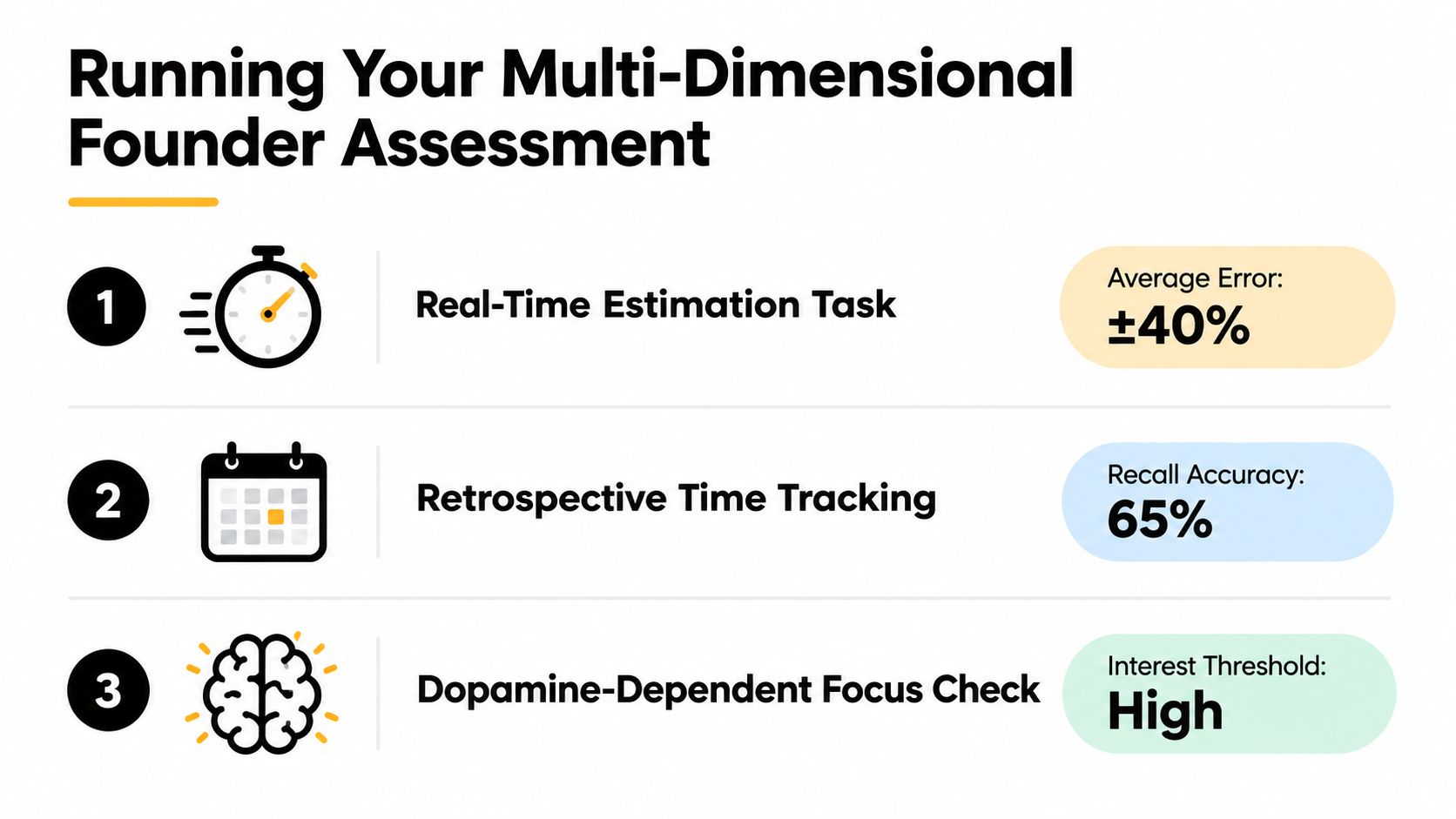
Run the assessment like an operating experiment, not a personality test. Use the same device, workspace, instructions, and general time of day across two sessions on separate days. Counterbalance the interval order, avoid immediate performance feedback, and record conditions that may affect your results. This design follows the reliability guidance in research comparing timing paradigms.
Do not treat an unusually short night as your normal baseline. Log sleep, caffeine, medication timing, mood, interruptions, and whether you counted internally. If you use a sleep or chronotype tool to clarify those background variables, you can compare MEQ MCTQ and actigraphy before interpreting your timing results.
Start with prospective estimation
Choose ordinary founder tasks rather than abstract puzzles. Review a proposal, prepare a hiring brief, reconcile a short set of expenses, or write a decision memo. Before starting, record:
- Predicted duration: How long do you expect the task to take?
- Completion condition: What exactly counts as finished?
- Interruption risk: What is likely to pull you away?
- Actual duration: Record the start and stop time with a neutral timer.
Use a defined, repeatable task where possible. Keep its definition stable across sessions. “Work on strategy” cannot be scored consistently. “Draft the decision section and list unresolved assumptions” gives you a clear endpoint and exposes whether preparation, checking, or follow-up has been omitted.
Calculate signed error by subtracting actual duration from estimated duration. A negative result means you underestimated. Calculate absolute error to measure the size of the miss regardless of direction. An accurate average can hide unstable performance, so record variability across tasks instead of relying on one flattering result.
Add retrospective estimation
Do not announce that you will evaluate time until the task ends. Complete a standardized work block, then estimate its duration. This tests a different failure from prospective planning. You may predict a task reasonably when you deliberately monitor time, then lose track once an interesting problem captures your attention.
Record the details immediately afterward:
- The task you performed.
- Your felt duration.
- The recorded duration.
- Whether you became absorbed.
- Whether an interruption changed your estimate.
The gap between felt and recorded time has direct operating value. If a work block repeatedly feels brief, schedule a transition alarm before the next commitment. If routine administration feels endless, divide it into smaller work units, shorten the feedback loop, or attach a reward to completion.
Use reproduction and production tasks
For reproduction, set a target interval without displaying a running countdown. Start the interval, then stop the timer when it feels complete. For production, begin without a visible duration and stop when you believe the requested interval has passed. Randomize several intervals, such as 7, 12, and 20 seconds, and repeat each enough times to separate a stable bias from an attention lapse. One published method used 30 presentations of each interval, producing 90 trials. As in the methodology review cited earlier, that repetition provides protocol context. Adapt the trial count to your calendar rather than skipping repetition altogether.
Connect the exercise to a founder transition. Estimate when you should stop reviewing a document and prepare for a call, then compare the felt interval with the clock. The point is not a diagnosis. It is to identify whether your internal estimate of “enough time to switch” can support calendar buffers, handoff rules, or a more deliberate Cognitive Architecture.
Repeat the protocol on the second day without giving yourself performance feedback between sessions. Compare results across sleep, mood, and task interest. Your final profile should show direction, magnitude, and variability, then feed the next design choice in your Dopamine Engineering system rather than collapsing into a single time blindness score.
Decoding Your Results and Avoiding Diagnostic Traps
Your first result may contradict your experience. You might feel chronically late while estimating short intervals reasonably well. You might also perform normally on a controlled task and still miss deadlines, lose hours in hyperfocus, or fail to recover after interruptions. Neither outcome invalidates the other.
Subjective time blindness describes how daily life feels and functions. Objective timing tasks measure performance under controlled instructions. Those are related questions, but they aren’t interchangeable. A review of adult ADHD time perception notes that strong self-reported time blindness doesn’t necessarily predict larger objective timing difficulties in every task.
Read the error pattern, not just the average
Use your notes to classify the failure. A simple table can turn vague frustration into an operating decision.
| Pattern | What it may indicate | Useful business support |
|---|---|---|
| Estimates are consistently short | Planning bias or omitted transition work | Add calendar buffers and estimate the full work package |
| Estimates are accurate but highly variable | Attention, context, or strategy instability | Use repeated checkpoints and visible timers |
| Retrospective estimates collapse during interesting work | Absorption makes elapsed time less visible | Add exit alarms and a defined stopping ritual |
| Routine tasks feel much longer than expected | Low engagement or weak reward signal | Reduce friction and pair completion with an immediate reward |
| Calendar predictions fail more than short tasks | Future planning or workload visibility problem | Compare planned versus actual completion across recurring work |
| Timing worsens after interruptions | Recovery cost is being ignored | Create protected focus windows and time-boxed handoffs |
Don’t assume that one poor interval reveals a global deficit. Timing can vary by duration, sensory format, task interest, and context. A short timing task may look stable while the same person struggles to anticipate the length of a complex project or to notice that a meeting has overrun.
Separate impairment from diagnosis
A time blindness test isn’t a diagnostic test, and a poor score isn’t proof of ADHD. Clinical ADHD assessment requires developmental history, persistent symptoms, impairment across settings, and consideration of alternative explanations and co-occurring conditions. Sleep deprivation, anxiety, depression, medication effects, stress, and task strategy can all influence performance.
The reverse error is just as important. Average laboratory performance doesn’t prove that your business is functioning well. A founder can estimate intervals adequately in a quiet test and still lose track of task boundaries in a noisy office, misjudge a sequence of dependencies, or accept too many commitments.
A useful result doesn’t tell you who you are. It tells you where your current system needs a guardrail.
Look for real-world convergence. Compare calendar predictions with actual completion times. Note missed transitions, late handoffs, deadline compression, and tasks that repeatedly require emergency effort. If the controlled task and the business log disagree, investigate the context instead of forcing a single explanation.
The goal is a profile such as, “I plan isolated tasks reasonably, but I underestimate preparation and recovery after interruptions,” or, “I stay accurate when a deadline is immediate, but long-horizon work disappears from working memory.” That description gives you something to engineer.
Engineering Your Cognitive Architecture and Dopamine Loops
Once you know the failure point, stop asking willpower to perform a job better suited to architecture. A calendar that shows appointments but hides transition time won’t solve a transition problem. A task manager full of unlabeled priorities won’t help when the issue is deciding what to do after a high-intensity work block.
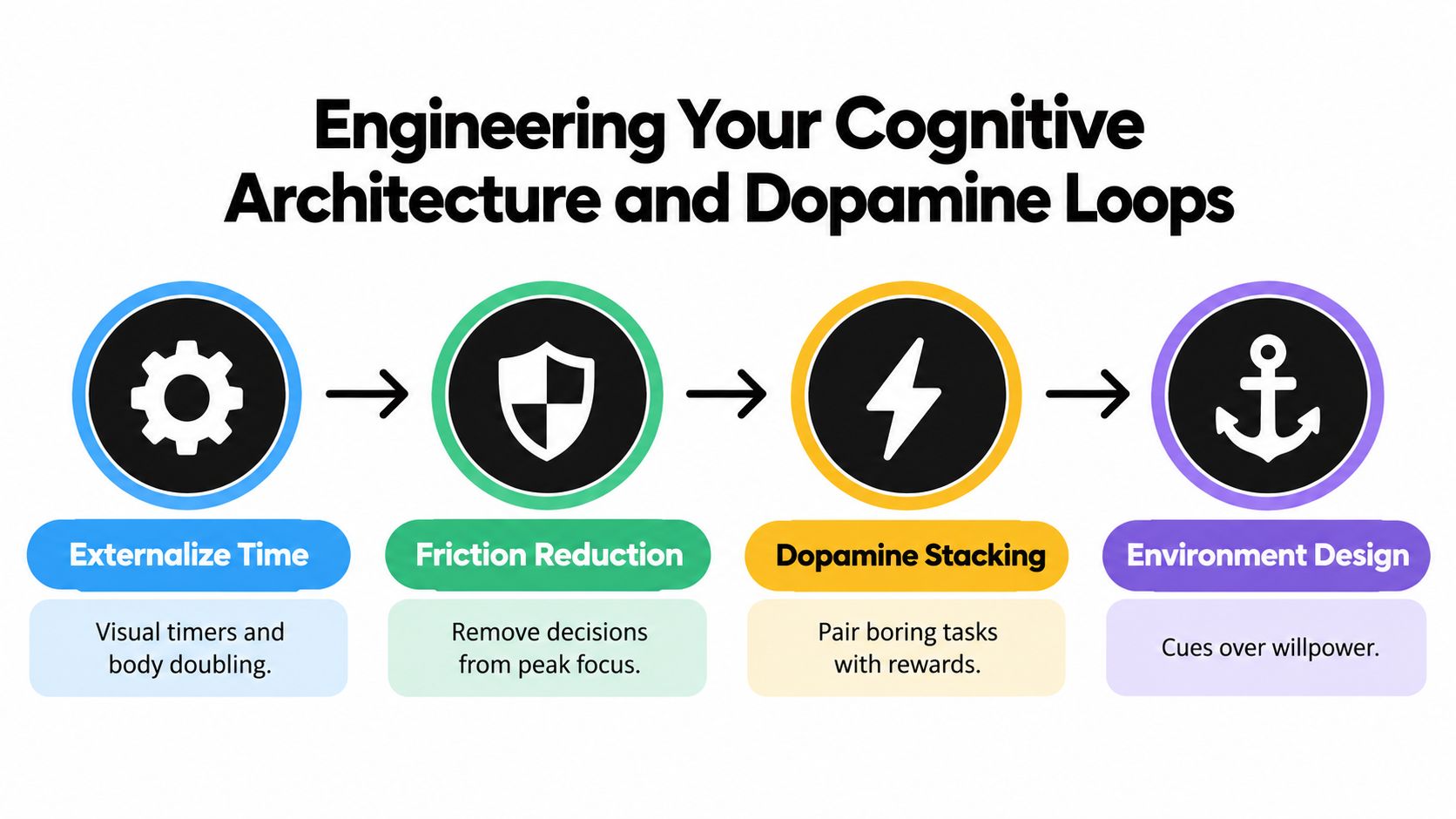
Cognitive Architecture means placing the missing cues outside your head. Dopamine Engineering means making necessary work sufficiently rewarding that you don’t need a crisis to initiate it. Together, they turn an internal timing weakness into a visible operating sequence.
Match the system to the failure
If retrospective estimation fails during hyperfocus, put time where your eyes already go. A physical Time Timer, an analog watch, a full-screen countdown, or a scheduled audio cue can make elapsed time concrete. Set the alarm before beginning, not after you realize the session has run long. Pair it with a stopping script: save the work, write the next action, close the active window, and stand up.
If prospective estimation fails, make planning more empirical. Before accepting a task, check your historical log for a comparable activity. Separate creation, review, coordination, and recovery instead of treating them as one block. A proposal isn’t just writing. It may include gathering inputs, resolving questions, formatting, sending, and responding to the next round.
If transitions fail, use time-boxed handoffs. Five minutes before a meeting, the system should prompt you to capture the current state and identify the next owner. If the handoff depends on memory, it will often happen too late.
Reduce friction before peak focus
Friction reduction protects the part of the day when your attention is most valuable. Prepare meeting links, decision templates, recurring agendas, and next-action fields in advance. Keep a “return later” note visible so an interruption doesn’t force you to reconstruct the entire problem.
Dopamine stacking works best when the reward arrives directly after the avoided task. Pair financial administration with a preferred coffee, a walk, a favorite playlist, or a short conversation with an accountability partner. The reward shouldn’t become a two-hour escape. It should make starting and finishing the task more attractive than waiting for deadline adrenaline.
Watch the embedded walkthrough for a visual example of how these pieces can fit together.
Environment design completes the loop. Put the timer in the room where work happens, block distracting applications during a time-sensitive task, and place the next physical action in view. For a deeper look at reward-based operating systems, explore the dopamine ROI framework. The principle is simple: cues over willpower, visible boundaries over vague intentions, and reliable rewards over panic.
Strategic Delegation and Bio-Optimization for Time Mastery
A planner can’t compensate for a workload that exceeds your available attention. Founders often try to solve every timing failure personally, then blame themselves when the same class of task keeps expanding. The better question is which temporal demands belong in your role at all.
Timing problems can be interval- and context-specific, rather than one global deficit. A controlled timing task may not predict how you handle a long project, a sequence of interruptions, or a calendar packed with handoffs. Research on timing precision and ADHD supports a profile-based approach, which makes repeated calendar predictions, actual completion times, and interruption recovery more useful than a single browser score for founder operations.
Delegate the work that exposes your weak interval
Review your log for tasks that repeatedly expand, disappear, or trigger last-minute effort. Don’t delegate only by job title. Delegate by temporal demand.
- Long-horizon coordination: Assign ownership to someone who naturally tracks dependencies, follow-ups, and dates.
- Rapid context switching: Protect yourself from a role that requires constant movement between sales, operations, hiring, and support.
- Routine completion work: Transfer repetitive tasks that become invisible when your attention is captured elsewhere.
- Deadline monitoring: Give one person authority to surface risk before a commitment becomes urgent.
A good handoff includes the outcome, decision rights, deadline, definition of done, and escalation trigger. If you merely forward a task and remain the hidden approval bottleneck, you haven’t delegated the temporal load. You’ve moved the task while keeping the anxiety.
For practical guidance on ownership, expectations, and follow-through, these MakeAutomation delegation strategies offer a useful complement to founder-specific workload design.
Treat biology as operating infrastructure
Sleep, food, movement, medication timing, caffeine, and mood belong in the assessment log because they can change working memory, sustained attention, and timing strategy. That doesn’t mean you need a perfect wellness routine before you can run a business. It means you shouldn’t interpret a poor timing day without knowing whether your cognitive conditions were unusual.
Protect the conditions that support your known weak point. If interruptions damage your timing, schedule demanding work when your attention is most stable. If low-interest tasks disappear, place them after a meal or movement break that helps you re-engage, then give them a visible endpoint. If your medication or caffeine timing changes your experience, discuss patterns with an appropriate clinician rather than adjusting treatment casually.
For a founder whose main problem is sustained focus, a structured 90-minute focus system may be more useful than another general productivity app. For another founder, the right answer may be shorter work blocks, a stronger operator, or fewer simultaneous commitments.
Bio-optimization isn’t about turning yourself into a machine. It’s about removing avoidable noise so your engineered supports can work consistently.
Building Your Sustainable Founder Operating System
Time perception belongs on the business dashboard because it affects promises, handoffs, hiring capacity, customer trust, and strategic pace. You don’t need to become perfectly punctual or make every estimate accurate. You need a system that exposes uncertainty early enough for you and your team to act.
Use the first month as an operating experiment
Start with one recurring workflow that currently creates expensive friction. Run the assessment across two separate sessions, then keep a lightweight log during normal work. Record the estimate, actual duration, interruptions, transition cost, and final outcome. Don’t collect data indefinitely. Collect enough to see whether the same failure appears in the same context.
Then install one support for each observed failure:
- Planning miss: Require a historical estimate before accepting new work.
- Hyperfocus miss: Use a visible timer and an exit alarm.
- Transition miss: Schedule a handoff ritual before every important commitment.
- Delegation miss: Assign a single owner with explicit decision authority.
- Low-interest miss: Pair the task with a bounded reward and remove setup friction.
Review the system with your team. Ask where work waits for you, where deadlines become visible too late, and which commitments depend on your memory. A sustainable operating system should make those answers easier to find, not require another heroic week from the founder.
If you want practical ideas for boosting planning skills, focus on techniques that produce observable behavior, such as earlier estimates, clearer buffers, and visible next actions. You can also compare timer approaches in this guide to a multiple timer app before choosing the tool your environment can sustain.
Replace panic productivity with compounding reliability
The point of a time blindness test isn’t to prove that your brain is broken. It’s to identify where your current architecture asks too much of memory, attention, or motivation. Build around that point, measure whether the guardrail catches the failure, and revise the system when the work changes.
A founder who can see time, hand off time, and protect time makes better promises. That reliability gives the team room to think, customers confidence in delivery, and the founder enough capacity to pursue growth without manufacturing another emergency.
Jan Kutschera helps ADHD founders replace burnout-driven hustle with engineered operating systems built around Cognitive Architecture, Dopamine Engineering, Strategic Delegation, and Bio-Optimization. If your time blindness test has exposed recurring gaps in planning, transitions, or follow-through, visit Jan Kutschera to explore practical support for building a calmer, more reliable founder system.
Jan Kutschera
German founder, diagnosed with ADHD at 51. Built 4 agencies, now building systems for neurodivergent entrepreneurs. German engineering for the ADHD brain.
Connect on LinkedInRelated Articles

Executive Function Explained: The Brain's Air Traffic Crew
Executive function explained without jargon: the three core skills, why ADHD makes them state-dependent, and the external scaffolds that replace willpower.
Time Management for Entrepreneurs Without the Panic
Time management for entrepreneurs with ADHD: a weekly split, capacity calendar, batching, and delegation specs that replace panic productivity.
How to Run Effective Meetings for ADHD Founders
How to run effective meetings with timeboxes, roles, agendas, and follow-up built for neurodivergent founders who want decisions, not more calls.