How to Avoid Burnout at Work as a Neurodivergent Founder
Learn how to avoid burnout at work with neurodivergent-friendly systems: dopamine engineering, delegation scripts, and routines that replace panic productivity.
Jan Kutschera
You’re three days from launch. The team is waiting for answers, the client has introduced one “small” change that affects everything, and your own task list has become a swamp of half-decisions. You open another tab, pour more coffee, promise yourself you’ll sleep after the deadline, and discover that panic has once again become your most reliable productivity tool.
I know that trap because I built four agencies inside it. I was diagnosed with ADHD at 51, after years of treating urgency as a personality trait and exhaustion as the price of ambition. The useful question isn’t whether you’re disciplined enough to avoid burnout. It’s whether your business depends on a nervous system staying permanently alert.
Table of Contents
- The Panic-Productivity Trap That Burns Out Neurodivergent Founders
- The Neurodivergent Founder Prevention Framework
- Building External Structures That Actually Stick
- Delegation Scripts and Team Handoff Templates
- An Example Day and Week Built on Engineered Systems
- Troubleshooting Burnout Warning Signs Before They Break You
- Recovery Is Possible When You Redesign the System
The Panic-Productivity Trap That Burns Out Neurodivergent Founders
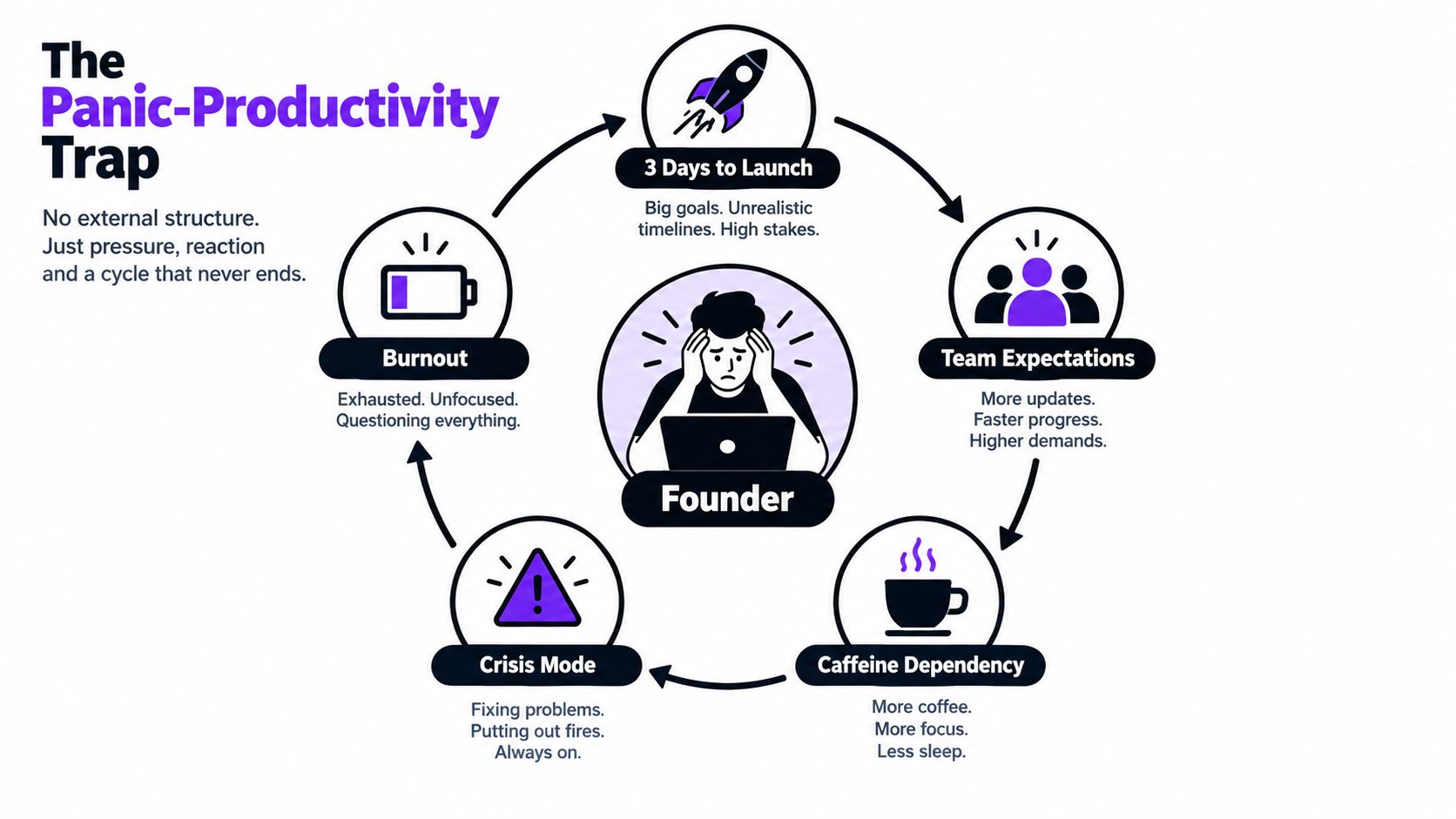
Neurodivergent founders can produce extraordinary work in a crisis. Novelty sharpens attention, a looming deadline creates energy, and everyone’s immediate need supplies the external structure that an ADHD brain may struggle to generate internally. The danger starts when the exception becomes the operating model.
The cycle is predictable. Work stays vague until the deadline feels dangerous, danger creates focus, focus produces a heroic rescue, and the rescue teaches the company that waiting for panic is acceptable. You get praised for saving the launch, while your team learns to bring decisions to you at the last possible moment. Then the next emergency arrives before your body has recovered from the previous one.
Burnout isn’t a character verdict
The World Health Organization’s definition of occupational burnout describes it as a syndrome resulting from chronic workplace stress that hasn’t been successfully managed. Its dimensions are exhaustion, growing mental distance or cynicism toward the job, and reduced professional efficacy. WHO classifies burn-out as an occupational phenomenon, not a medical condition.
That distinction matters. It moves the conversation away from “Why can’t I cope?” and toward “What conditions keep producing this result?” Gallup’s 2024 global workplace report found that 41% of employees experienced a lot of stress during the previous day, and employees in actively disengaged workplaces were nearly 60% more likely to report high stress than employees in engaged workplaces. The pattern points toward management quality, clarity, workload, and team conditions, not just individual resilience.
Practical rule: If your business only works when you’re overstimulated, the business has an infrastructure problem.
Sleep, food, movement, and recovery still matter. They’re not a moral test, though, and they can’t compensate indefinitely for unclear priorities, constant interruptions, excessive demands, or leadership that amplifies ambiguity. If caffeine has become part of your operating system, start by examining the system around it with this guide to caffeine and carbohydrates.
The alternative isn’t becoming less ambitious. It’s replacing emergency fuel with reliable priorities, visible progress, clear ownership, and deliberate recovery. That’s how to avoid burnout at work without pretending your brain will suddenly enjoy repetitive planning or neatly sequenced tasks.
The Neurodivergent Founder Prevention Framework
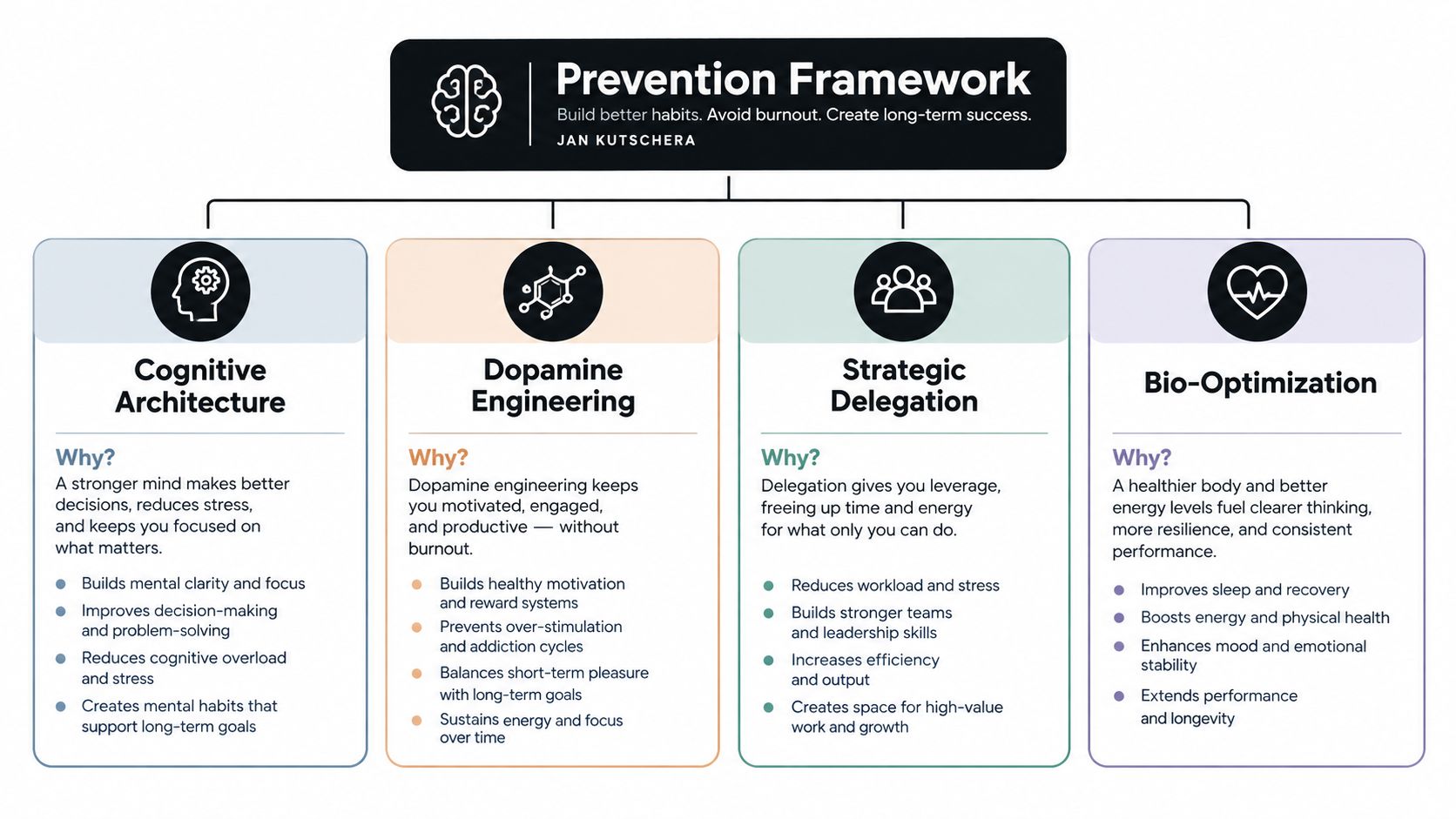
A sustainable founder operating system needs four connected pillars. They solve different failure points, so removing one can leave the others carrying too much weight.
Cognitive Architecture
Externalize anything your brain shouldn’t have to hold. Use a launch checklist, a decision tree for common approvals, a standard client brief, and one visible place for active commitments. The point isn’t bureaucratic neatness. It’s to bypass working-memory demands and reduce the number of decisions you must reconstruct from scattered messages.
A useful decision template contains only what’s needed:
- Decision: What must be decided?
- Owner: Who makes the call?
- Deadline: When does delay become expensive?
- Options: What are the realistic choices?
- Next action: What happens immediately after the decision?
Dopamine Engineering
Adrenaline creates a fast reward, but it charges a high interest rate. Build smaller and more predictable rewards into delivery instead. Break a large project into visible milestones, finish work in short cycles, and make progress tangible through a board, scorecard, or client-facing checkpoint.
Reward the behavior you want repeated. A team that prevents a crisis should receive recognition, not only the person who stays up late fixing one. A founder who delegates a decision cleanly should treat that as a performance win, even when rescuing the task personally would feel more satisfying.
Strategic Delegation
Delegation isn’t removing yourself from everything interesting. It’s deciding where your judgment creates disproportionate value, then designing handoffs so other people can own the rest. Your genius zone might include positioning, creative direction, or high-stakes relationships. It shouldn’t automatically include every approval, reminder, and operational rescue.
Workload design must sit beside delegation. Research on organizational burnout interventions reviewed 2,425 records, assessed 228 full texts, and included 23 studies, with 11 contributing to the meta-analysis. The estimated overall effect was -0.33, while workload-focused and participatory interventions produced stronger effects than schedule-focused changes alone, as detailed in this systematic review of organizational burnout interventions. If the team just receives more delegated work without realistic capacity, you’ve moved the overload rather than solved it. A practical resource on fixing team overload can help you inspect capacity, priorities, and ownership together.
Bio-Optimization
Treat sleep, nutrition, and movement as operating constraints, not optional wellness accessories. Protect the conditions that make judgment possible, especially during launches. A tired founder may still be able to force output, but decision quality, emotional regulation, and patience with other people become more fragile.
These pillars reinforce one another. Cognitive Architecture lowers friction, Dopamine Engineering makes progress rewarding, Strategic Delegation distributes demand, and Bio-Optimization protects the brain doing the work.
This short video offers another way to think about structured founder performance:
Building External Structures That Actually Stick
An external structure earns its place by reducing cognitive load. If a new productivity system requires constant maintenance, elaborate tagging, and perfect daily motivation, it’s probably another task disguised as support.
Start with the moments where your business repeatedly breaks. Build one structure for each failure, then test whether it prevents the same decision from returning to your head.
Build the minimum viable operating rhythm
Use a weekly planning session to identify active priorities, blocked work, capacity risks, and decisions only you can make. Keep the meeting short enough to survive a busy week, and end every item with an owner and next action. A delegation tracker should show the task, owner, expected outcome, due point, current status, and escalation rule.
For meetings, use a fixed template:
- Purpose: Why does this meeting exist?
- Preparation: What must participants bring?
- Decision points: Which issues need a call?
- Actions: Who does what next?
- Parking lot: What doesn’t belong here?
Protect focus time by default. Meetings should earn their place on the calendar, not expand until they consume every open space.
Choose systems by cognitive return
| System | Impact on Executive Function | Implementation Effort | Sustainability |
|---|---|---|---|
| Reusable checklists | Reduces memory and sequencing demands | Low | High when attached to recurring work |
| Weekly planning cadence | Makes priorities and capacity visible | Moderate | High when decisions end in owners |
| Meeting templates | Limits ambiguity and meeting drift | Low | High if the facilitator enforces the format |
| Delegation tracker | Prevents invisible ownership and repeated reminders | Moderate | High when reviewed at a fixed point |
| Complex productivity dashboard | Can centralize information but adds upkeep | High | Variable, especially during overload |
Don’t build the dashboard first. Build the checklist for the task you keep avoiding, the handoff that keeps failing, or the decision that repeatedly wakes you at night. Founders who want a deeper look at making routines usable for an ADHD brain can explore ADHD and routines.
Test for relief, not aesthetics
After using a structure for a short trial, ask three questions: Did it reduce repeated decisions? Did someone else understand what to do without asking you? Did it make the next action visible when your attention was low?
If the answer is no, simplify it. A plain document, a recurring calendar block, or a visible Kanban board may outperform an elegant system that nobody opens. The right structure is the one that still works on a difficult Tuesday.
Delegation Scripts and Team Handoff Templates
Delegation fails when the founder transfers a task but keeps the responsibility trapped in their own head. “Can you take care of this?” leaves the outcome, authority, quality bar, and deadline undefined. The recipient then guesses, delays, or returns with questions, and the founder concludes that delegation doesn’t work.
Use a handoff that makes ownership concrete.
Delegation script: “You own the client onboarding sequence. The outcome is a completed sequence that the client can use without further clarification. Please send the first draft by Thursday. You can decide the format and workflow. Escalate if the client changes scope, the deadline becomes unsafe, or you need a decision outside the agreed budget.”
That script gives the person authority without pretending they have unlimited authority. It also defines the conditions that bring the founder back in.
The handoff template
Copy this into your project tool:
- Outcome: What finished looks like.
- Context: Why the work matters.
- Constraints: Budget, scope, brand, legal, or technical limits.
- Owner: One person accountable for completion.
- Support: People, files, examples, or access available.
- Checkpoint: The earliest useful review point.
- Escalation: The specific conditions that require help.
- Completion signal: Where the final result is recorded.
The checkpoint isn’t an invitation to hover. It’s a planned opportunity to catch a wrong assumption before the deadline makes correction expensive.
Scripts for common breakdowns
When a team member returns an incomplete task, say: “The current version doesn’t meet the agreed outcome. Let’s identify whether the issue is context, capability, capacity, or ownership. I’ll clarify the missing piece, and you’ll take the next revision.”
When you’re tempted to rescue the work, ask: “Am I the only person who can solve this, or am I reacting to discomfort?” If someone else can solve it, send: “Please propose the next step before I offer one. I’ll make the decision if it crosses the escalation rule.”
When a founder owns too many low-value decisions, use an elimination test. Keep work that requires your distinctive judgment. Delegate work with a clear repeatable outcome. Automate work with stable rules. Delete work that exists only because nobody has questioned it.
The guide to delegating tasks effectively is useful when you need to turn that principle into a repeatable process.
An Example Day and Week Built on Engineered Systems
A workable schedule doesn’t assume consistent attention. It places demanding decisions where the founder is most capable, creates visible completion points, and leaves room for interruptions without turning every interruption into a crisis.
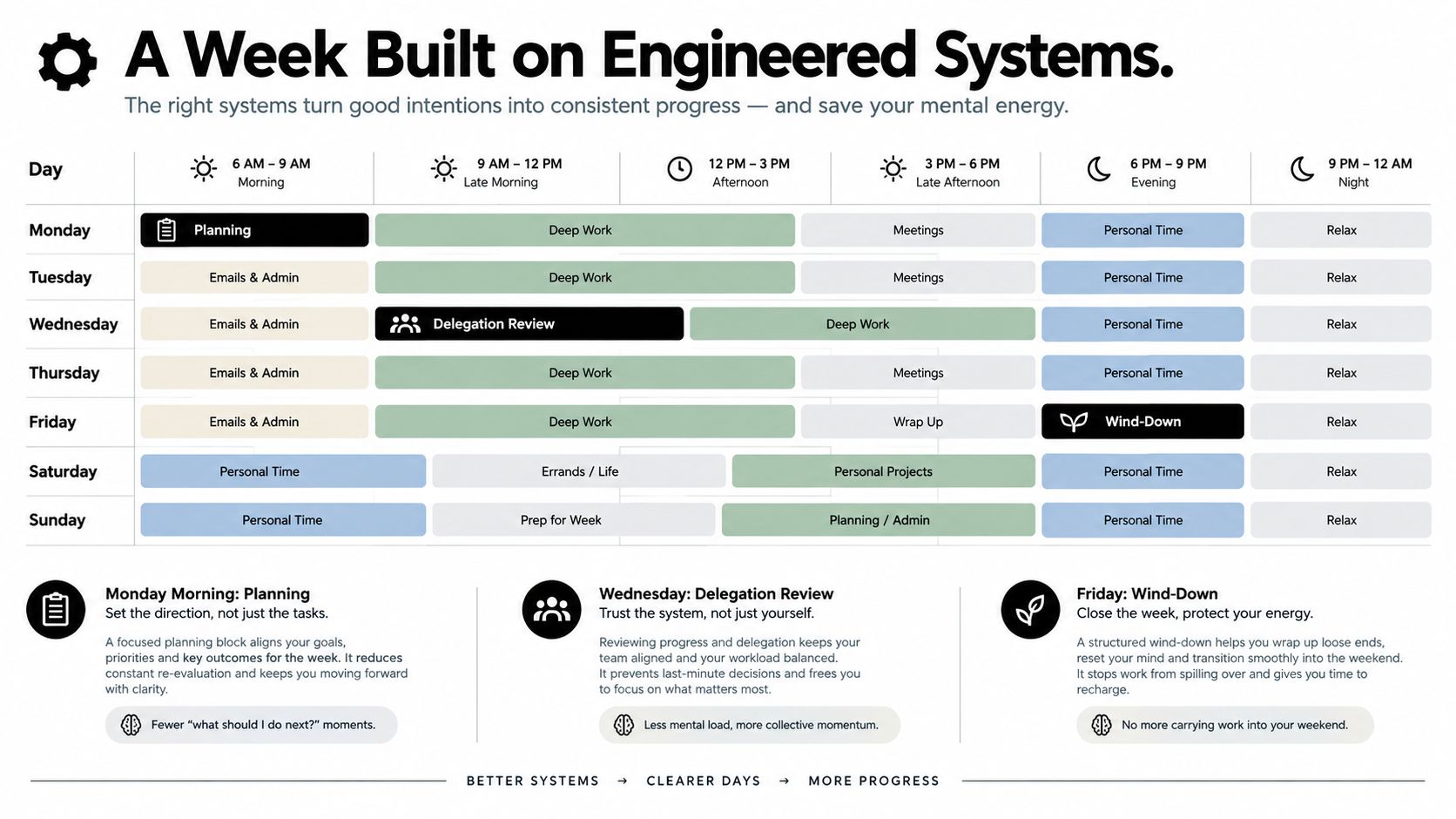
Here’s a model you can adapt rather than imitate.
A day with protected bandwidth
Morning: Start with a brief review of the visible priorities, not an inbox sweep. Choose one meaningful founder-level outcome, confirm the day’s decision points, and work on the highest-value task before opening reactive channels.
Late morning: Hold one defined collaboration window. Group approvals and questions here so the rest of the day doesn’t fracture into tiny response obligations.
Midday: Eat away from the desk and move. This isn’t a reward for finishing work. It’s a planned reset that protects the afternoon’s judgment.
Afternoon: Use a shorter delivery cycle for lower-novelty work, such as reviewing a brief, recording feedback, or checking a project board. Mark completion visibly. The brain gets a clearer reward from finished units than from an endless project that remains “in progress.”
Late afternoon: Run an escalation check. What changed? What needs a decision? What can wait? Record the next actions before leaving the workday.
Evening: Shut down through a repeatable ritual. Close open tabs, capture loose thoughts, and write tomorrow’s first action. Don’t use bedtime as the place where your brain finally processes the company.
A week that absorbs reality
Use Monday for priorities and capacity, Wednesday for a delegation review, and Friday for closing loops and reducing unfinished cognitive residue. Keep one buffer block available for unexpected client or team needs. If the buffer fills repeatedly, treat that as workload data, not evidence that the buffer was a mistake.
The founder’s calendar should show recovery as clearly as revenue work. Sleep windows, meals, movement, and non-work commitments are not decorative appointments. They’re constraints that stop the company from borrowing against the next day.
This rhythm also creates useful feedback. If delivery repeatedly slips before Wednesday, the issue may be scope or ownership. If every Friday becomes a rescue session, the planning cadence isn’t surfacing risk early enough. A system is doing its job when it reveals problems while they’re still affordable to fix.
Troubleshooting Burnout Warning Signs Before They Break You
Burnout rarely arrives with a neat notification. It appears as small changes that founders explain away because the business still needs them. You become unusually irritable, avoid routine tasks, rely on stimulation to begin ordinary work, or feel detached from decisions you used to care about.
The WHO framework identifies exhaustion, cynicism or mental distance, and reduced professional efficacy as the core dimensions of occupational burnout. Use those dimensions as a diagnostic lens, then inspect the work system producing them.
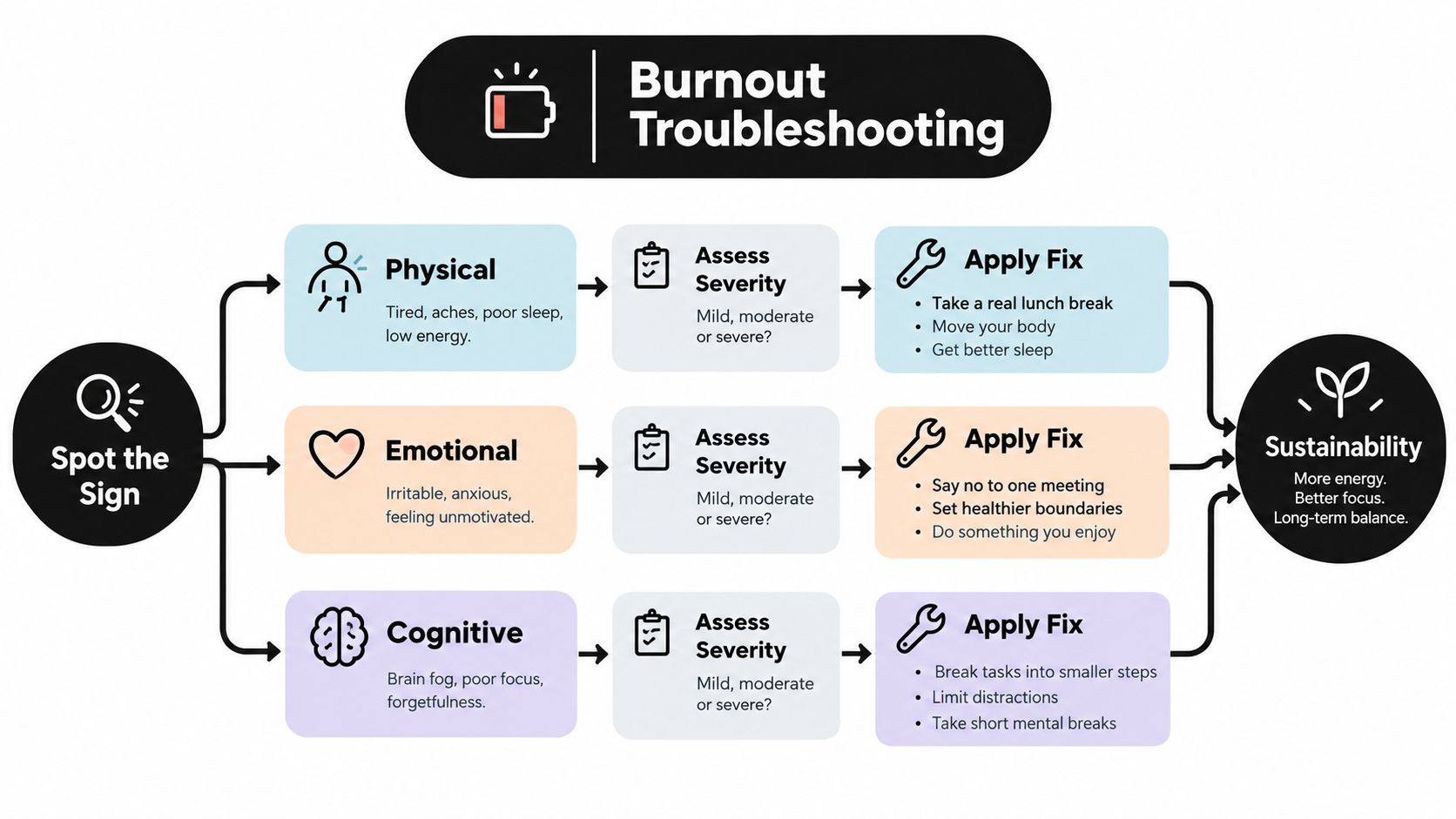
Run the troubleshooting sequence
- Spot the sign. Is the problem physical, emotional, cognitive, or several at once?
- Locate the system failure. Check workload, unclear ownership, meeting expansion, after-hours pressure, sleep disruption, and constant context switching.
- Apply the smallest structural fix. Delete one meeting, pause one commitment, move a decision to its owner, or create a missing checklist.
- Escalate when functioning is impaired. Speak with a qualified healthcare or mental-health professional when symptoms are severe, persistent, or affecting safety and daily life.
A founder who keeps rescuing delegated work may not need a motivation speech. They may need a clearer outcome, stronger capability support, or a different owner. A CEO whose calendar has swallowed meals and movement may need fewer meetings, not a more ambitious morning routine.
Check the organization, not just the individual
The evidence favors participatory changes that alter how work is designed. One newer review included 14 studies, consisting of 9 randomized controlled trials and 5 quasi-experimental studies, with a combined sample of 3,572 participants. Participatory organizational programs produced reductions lasting at least 12 months, while brief workshops showed no sustained benefits beyond three months and digital tools had attrition of about 42%, according to the workplace mental-health review linked earlier.
That doesn’t make personal tools useless. It means a meditation app can’t repair an impossible workload, and a resilience workshop can’t clarify decision rights. Diagnose the demand first.
Recovery Is Possible When You Redesign the System
Prevention and recovery aren’t the same job. Prevention keeps the operating system from overheating. Recovery starts by admitting that the current configuration has already exceeded capacity.
For a founder who has burned out, the first move may be temporary workload reduction, not a better color-coded planner. Remove commitments, reduce stimulation, protect sleep, limit decisions, and identify one meaningful task that can be completed without borrowing energy from tomorrow. The company may need a slower delivery cycle, a clearer interim leader, or an honest conversation with clients about scope.
Replace intensity with reliability
Productive intensity has a beginning, an end, and a defined purpose. It can support a launch or solve a genuine short-term constraint. Impaired functioning looks different: chronic sleep loss, repeated deadline rescues, emotional volatility, inability to delegate, and a growing gap between effort and effective output.
Recovery requires rebuilding trust in ordinary progress. Use visible milestones, short delivery cycles, pre-decided escalation rules, and incentives for preventing crises. Don’t turn recovery into another performance challenge where you expect to feel transformed immediately.
A participatory study cited in the workplace mental-health review reported a 12-month reduction in work-related burnout among hospital staff after workload adjustments and team-support changes, with an effect size of 0.41. The lesson applies beyond hospitals. Sustainable change comes from altering demands and support, then watching what happens over time.
If your experience includes prolonged exhaustion, loss of functioning, or symptoms that extend beyond work, seek qualified professional support. For a broader perspective on autistic and neurodivergent burnout explained, Refresh Psychiatry & Therapy offers context that can help distinguish personal strain from the effects of sustained environmental demands.
Start with an audit today. List every recurring commitment, meeting, decision, and after-hours expectation that keeps the business dependent on emergency-mode performance. Mark each item as delete, redesign, delegate, or protect, then change one high-friction item before adding another self-care habit.
Jan Kutschera helps ADHD founders replace burnout-driven hustle with engineered operating systems built around cognitive architecture, dopamine engineering, strategic delegation, and bio-optimization. Visit Jan Kutschera to explore practical founder systems and choose a starting point for making recovery structurally possible.
Jan Kutschera
German founder, diagnosed with ADHD at 51. Built 4 agencies, now building systems for neurodivergent entrepreneurs. German engineering for the ADHD brain.
Connect on LinkedInRelated Articles
Executive Function Explained: The Brain's Air Traffic Crew
Executive function explained without jargon: the three core skills, why ADHD makes them state-dependent, and the external scaffolds that replace willpower.
Time Management for Entrepreneurs Without the Panic
Time management for entrepreneurs with ADHD: a weekly split, capacity calendar, batching, and delegation specs that replace panic productivity.
How to Run Effective Meetings for ADHD Founders
How to run effective meetings with timeboxes, roles, agendas, and follow-up built for neurodivergent founders who want decisions, not more calls.