How to Overcome Analysis Paralysis: A Founder's Playbook
Learn how to overcome analysis paralysis with proven decision systems built for ADHD founders and high-performing creatives. Stop overthinking, start shipping.
Jan Kutschera
The most popular advice for analysis paralysis is wrong. “Just decide faster” assumes the problem is weak discipline, as if your brain is a lazy intern who needs a stern email. For ADHD founders, the problem is usually too many variables, too much emotional weight, and no external decision architecture.
I know the pattern because I built companies inside it. I spent weeks comparing tools, delayed launches while collecting a fourth opinion, and treated optionality like a business asset while revenue paid the carrying cost in the background. The fix wasn’t more motivation. It was designing a system that made the next decision smaller, visible, and difficult to avoid.
Table of Contents
- Why Smart Founders Get Stuck
- The Four Engines That Replace Overthinking
- Decision Gates That Force a Choice
- Building Your Cognitive Architecture
- Dopamine Engineering for Decision Momentum
- Strategic Delegation and Decision Rights
- Your 14-Day Decision Reset Protocol
Why Smart Founders Get Stuck
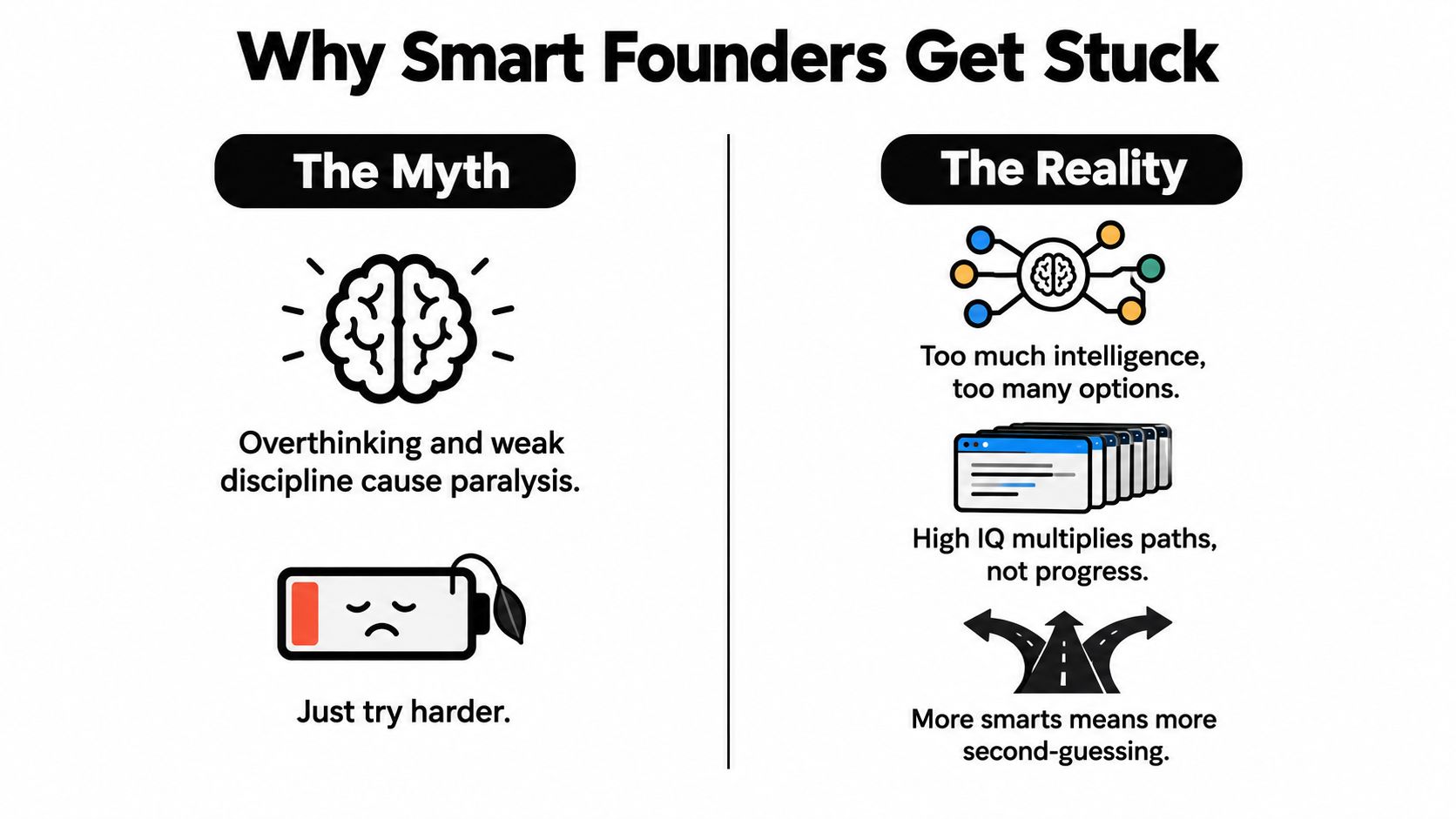
Smart founders don’t get stuck because they lack ideas. They get stuck because they can generate too many plausible paths and see the downside of every one. Intelligence multiplies options. ADHD adds inconsistent access to working memory, prioritization, and emotional regulation. Put those together and a simple vendor choice can become a tribunal.
The evidence doesn’t support the lazy version of choice overload either. A meta-analysis covering 63 conditions from 50 studies and 5,036 participants found that the average choice-overload effect was zero overall, with the outcome depending heavily on context such as task complexity, uncertainty about preferences, and whether people wanted to minimize effort. A later review covering 99 studies and 7,202 participants found those moderators continued to shape whether large assortments created paralysis. The practical lesson is sharp: you don’t solve overload by deleting every option. You solve it by reducing complexity and defining what the decision must accomplish. The choice-overload research reviewed in the Journal of Consumer Research supports that more useful interpretation.
The executive-function trap
The advice industry says, “Trust your gut.” That works beautifully when the decision is familiar, the stakes are contained, and your nervous system isn’t treating uncertainty as a fire alarm. It fails when you have forty browser tabs open, three launches colliding, and a reputation attached to every imperfect choice.
ADHD founders don’t need another pep talk about being decisive. They need the decision moved out of their head and into the environment. A written criterion, a visible timer, a short list, and a named decision owner outperform vague promises to “try harder.”
For a useful distinction between ADHD paralysis and executive dysfunction, see this practical explanation of ADHD paralysis versus executive dysfunction. The distinction matters because the solution isn’t always emotional reassurance. Sometimes it’s a better operating surface.
Practical rule: If a decision keeps returning to your mind, stop asking yourself to remember it better. Build somewhere else for it to live.
Analysis paralysis is a system failure disguised as a personality flaw. You don’t need to become a different person before you can decide. You need rails that narrow the active question, protect your attention, and close the loop after the choice is made.
The Four Engines That Replace Overthinking
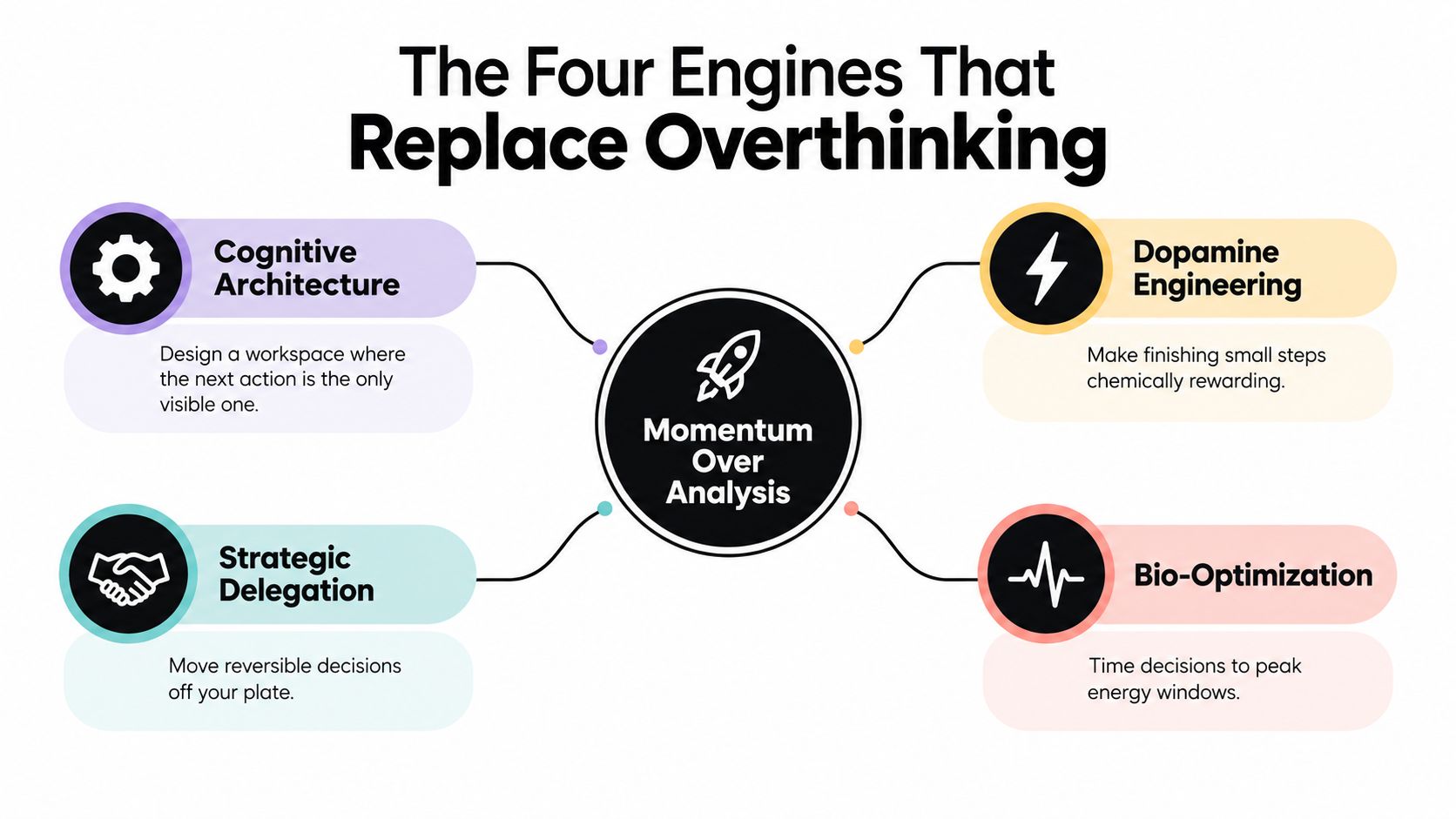
I use four engines to replace fragile willpower: Cognitive Architecture, Dopamine Engineering, Strategic Delegation, and Bio-Optimization. They aren’t productivity flavors you pick from a menu. They are connected parts of one operating system.
Cognitive Architecture
This engine puts the decision where your eyes can find it. One document contains the question, criteria, options, and deadline. Your calendar protects the decision window. Your workspace hides unrelated work. The aim isn’t a prettier dashboard. It’s making the next action more obvious than the distractions competing with it.
A founder choosing a customer relationship management tool shouldn’t have the entire software market visible. They should have a shortlist, a scoring sheet, a decision deadline, and a clear first implementation step.
Dopamine Engineering
Decision completion needs an immediate reward. A future benefit such as higher revenue or a smoother launch is too distant to reliably compete with the stimulation of new research. Attach a small, immediate sensory reward to shipping the decision, not to preparing for it.
That might be a favorite song, a cold drink, or a brief walk outside. The reward is not childish. It’s a signal that tells your brain, “Closing loops produces something good.”
Strategic Delegation
Founders become bottlenecks when every decision arrives with the same priority and authority requirement. Strategic delegation gives each category a clear owner, threshold, and reporting rule.
The operator who can choose a contractor within a defined budget should not wait for the founder to compare every candidate. The founder should reserve attention for decisions involving direction, reputation, or asymmetric risk.
Bio-Optimization
Sleep, food, movement, and stimulant timing affect whether executive function is available when the calendar says it should be. Bio-Optimization isn’t a promise that a morning routine will cure indecision. It’s the less glamorous truth that a depleted brain has fewer resources for sorting options and regulating fear.
The engines compound. Architecture without a reward loop becomes another abandoned system. Delegation without clear rules just moves the bottleneck to your COO. Bio-Optimization without decision rails gives you a well-rested person staring at an unstructured choice.
Your job isn’t to summon heroic focus. Your job is to maintain the machine.
Decision Gates That Force a Choice
A decision gate turns “find the perfect answer” into “clear the agreed bar.” Use the same sequence every time so your brain doesn’t have to invent a process while already overloaded.
- Define the decision. Write the choice in one sentence. “Which CRM should we implement for the agency?” is usable. “How can we improve our operations?” is a fog machine.
- Set a hard time-box. Put the deadline on the calendar before research starts. A reversible choice may deserve two minutes. A high-stakes decision gets a deeper gate.
- Cap the active options at five. Eliminate obvious mismatches before scoring anything. More candidates create more opportunities to reopen settled questions.
- Score against pre-committed criteria. Choose the criteria before you fall in love with an option. Use weights if one factor matters more than another.
- Apply a default rule for ties. Pick the easier implementation, the cheaper test, or the option with the fastest feedback. A coin flip is also valid when the difference is immaterial.
- Log the outcome. Record what you chose, why you chose it, and when you’ll review it. The log stops your future self from reopening the case because today’s anxiety feels like new evidence.
A CRM decision in practice
An ADHD founder has a forty-option CRM shortlist. The first gate defines the decision as, “Choose a CRM the sales team can implement without custom development.” The founder then runs a twenty-minute elimination round and cuts the field to five based on basic fit.
Next, the founder applies a weighted matrix covering adoption, integrations, reporting, and implementation effort. The scores leave two options effectively tied. The pre-committed rule favors the easier rollout, so the founder chooses one rather than launching another research expedition. The entire process fits inside a ninety-minute ship-it block.
The structure matters more than the software. A comparison-shopping experiment found that decision quality dropped sharply when a matrix reached 24 choices with 10 attributes per choice, and quality decreased abruptly as options rose from 12 to 24 or more. Another controlled study found that a sequential tournament structure performed best while keeping the full choice set available. The comparison-shopping research on staged choice architecture points to the same operating rule: evaluate in rounds, not in one giant mental swamp.
For more context on building practical AI decisions for leaders, look for systems that clarify ownership and criteria rather than merely producing more recommendations.
Time pressure can amplify overload when people have no structure. A timer alone isn’t a strategy. A timer plus a shortlist, criteria, and a tie-breaker is a decision gate.
Building Your Cognitive Architecture
A creative director I know had three product launches competing for the same attention. Her old Monday began with email, Slack, open research tabs, and a heroic attempt to remember what mattered. By lunch, she had touched everything and advanced nothing.
She rebuilt the morning around one decision per block. The active project got one document on top, one visible next action, and one timer. Every other launch went into a holding folder with a dated return point. The rebrand direction shipped in two days instead of lingering in review for weeks. The change wasn’t a better personality. It was a workspace that stopped presenting every unfinished thought at once.
Build one decision surface
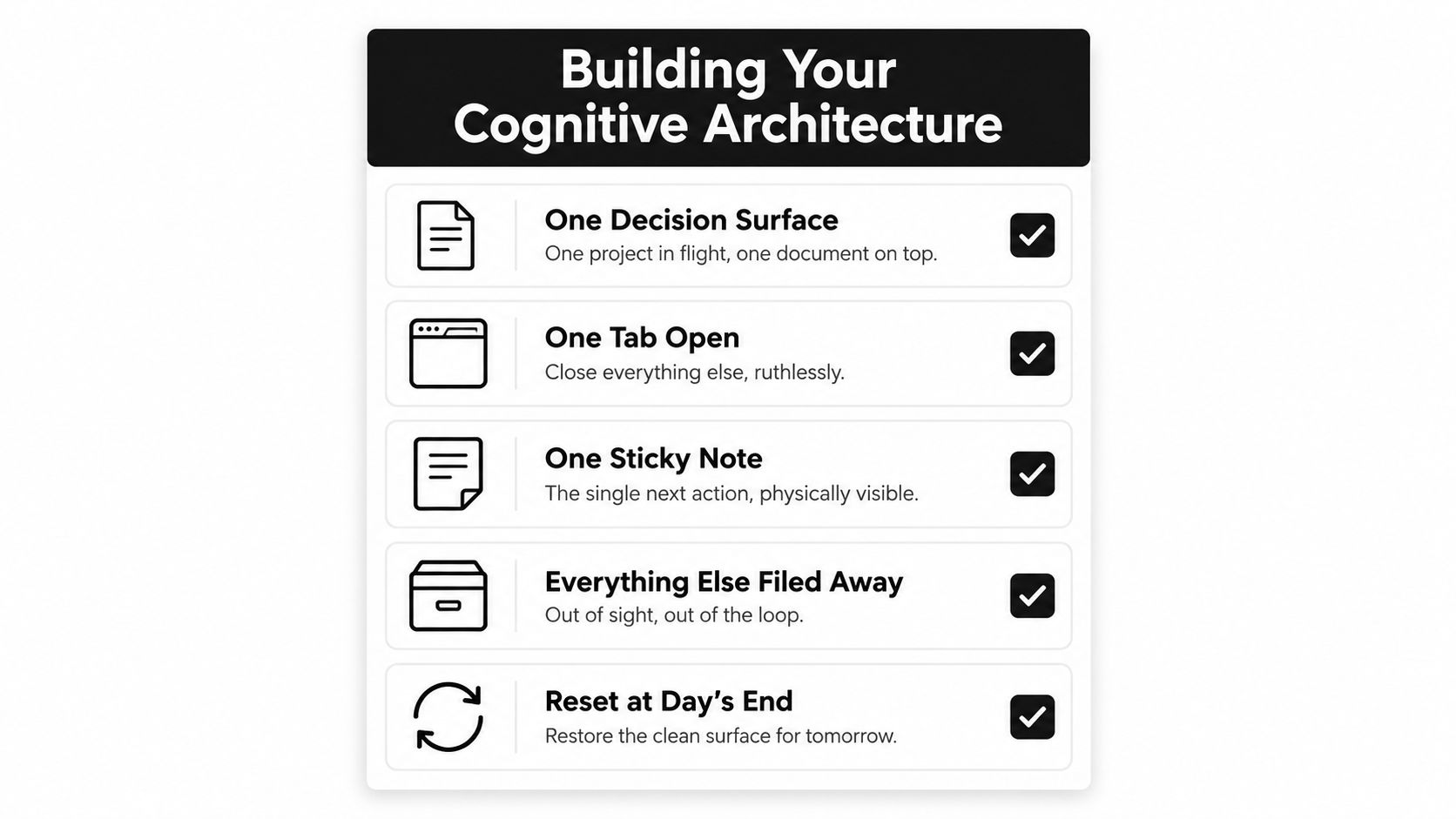
Your decision surface is the smallest physical and digital area that contains everything required for the current choice. Keep the question, options, criteria, timer, and next action together. If you need to search across email, Notion, Slack, and five browser tabs, you’ve already created a scavenger hunt.
Use one monitor for the live decision. If you need a second screen, keep it blank or use it for a distraction blocker. Dual monitors are not automatically more advanced. Sometimes they’re just two cinemas showing different films about your procrastination.
Add friction to distraction
During a decision sprint:
- Put your phone in a timed lockbox.
- Pause Slack.
- Close email.
- Silence notifications.
- Keep the decision document within three clicks on every device.
The point is not permanent isolation. It’s temporary protection while your brain holds a narrow problem. A forty-five-minute sprint with fewer competing signals is more useful than an afternoon spent negotiating with every incoming notification.
Reset the surface
File everything that isn’t tomorrow’s active decision. Leave one sticky note with one verb-led action, such as “score the five CRM finalists” or “send the approved rebrand direction.” Don’t leave a pile of intentions. Leave an obvious starting line.
External structure also helps separate ordinary task friction from genuine executive-function problems. If your workspace repeatedly collapses under competing demands, treat that pattern as operating data, not evidence that you need harsher self-talk.
Dopamine Engineering for Decision Momentum
Checking off “research pricing options” can feel strangely flat because the decision is still open. Your brain knows the loop remains active, so the completed task doesn’t register as a meaningful finish. Reward the choice, not the activity surrounding the choice.
Use this protocol when you feel yourself opening another tab.
- Define the decision in fewer than 20 words. If you can’t write it clearly, you aren’t ready to research.
- Set a 90-second timer. Choose the smallest reversible action that moves the decision forward.
- Commit and ship it. Send the email, publish the test, approve the draft, or book the implementation call.
- Trigger an immediate sensory reward. Play a specific song, drink something cold, stretch, or do a thirty-second victory dance.
- Mark the completion visibly. Add one mark to a paper tally or reward ledger.
The reward should arrive after the decision closes, not after you gather more evidence. Research is not the finish line. Preparing to decide is not the finish line. Opening a spreadsheet is definitely not the finish line, although it has fooled many otherwise competent adults.
Stack small wins deliberately
Front-load your first three decision rewards in the morning, when getting started is often hardest. Keep the rewards brief and predictable so they don’t become a new avoidance activity. A song is useful. A forty-minute video about decision science is research wearing a fake mustache.
Don’t bundle five decisions into one reward. Your brain needs a clear connection between action and consequence. If you make a pricing choice, reward it. If you approve a contractor, reward it separately. The individual closures create momentum.
A founder changing pricing used this sequence to close three micro-decisions in seven minutes. First, she chose the pricing structure. Then she selected the announcement date. Finally, she assigned the update to an operator. Each completed choice received a slightly more enjoyable reward, and the entire pricing loop stopped occupying working memory.
For more on building a reward loop that supports business momentum, use this ADHD reward system for business momentum. The principle is simple: make completion feel immediate enough that your brain doesn’t need a crisis to care.
Strategic Delegation and Decision Rights
Delegation fails when founders delegate tasks but retain every decision. The operator still waits for approval, the founder still carries the uncertainty, and everyone calls it teamwork.
Create a decision-rights matrix that distinguishes authority from notification. The threshold doesn’t need to be perfect. It needs to be visible and revisable.
| Tier | Decision Owner | Threshold | Notification Rule |
|---|---|---|---|
| Tier 1 | Founder | Irreversible, reputation-defining, or above the agreed financial threshold | Founder decides and announces |
| Tier 2 | Founder or accountable lead | Reversible within the operating plan | Decide, then inform affected people |
| Tier 3 | Delegate with founder sign-off | Delegate builds the case and recommends the choice | Founder reviews the recommendation |
| Tier 4 | Operator | Routine, reversible, and inside the written rule | Operator decides and reports in the regular log |
Delegate the rule, not the waiting ticket
An agency owner I worked with moved vendor selection from founder-controlled to Tier 3. The COO had to answer three questions before purchase:
- Does the vendor meet the required operational standard?
- Can the team test the choice without creating a hard-to-reverse commitment?
- What evidence would cause us to change course?
The founder no longer reviewed every vendor from scratch. The COO received a guardrail and a decision right. That is delegation. Forwarding a vendor email with “what do you think?” is merely outsourcing anxiety.
Write the rule once. State the quality bar, the budget boundary, the risk that requires escalation, and the reporting format. Then let the operator work inside it. A good rule reduces interruptions because it answers the questions that would otherwise return to your desk.
Delete decisions that shouldn’t exist
Some decisions survive only because they soothe anxiety. Remove them.
- Vanity metrics: If a number doesn’t change an action, stop reviewing it.
- Premature optimization: Don’t debate a future scale problem before the current version works.
- Preference theater: Don’t ask five people to rank options when one owner has the authority to choose.
- Repeated reassurance: Don’t reopen a decision because the outcome feels uncomfortable.
Founders with ADHD can be especially vulnerable to inconsistent follow-through under cognitive load. A recent meta-analysis linked ADHD symptoms with entrepreneurial behavior while finding that inattention was negatively associated with post-launch outcomes. The implication isn’t “decide faster.” It is “build external rails that protect execution after the decision.” The meta-analysis on ADHD and entrepreneurship makes that distinction important.
Use this delegation playbook for assigning work effectively when a decision keeps bouncing back to you. If the owner, threshold, and escalation rule aren’t clear, the handoff isn’t finished.
Your 14-Day Decision Reset Protocol
A reset works when it produces artifacts, not inspiration. For two weeks, treat decision-making as an operational experiment with a log, a calendar, and visible proof of completion.
Days 1 to 3
Start by auditing every pending decision. Put each one on a single list with the question, owner, deadline, reversibility, and next action. Kill trivial choices. Assign anything below your personal threshold to someone else. Move the remaining decisions into one clean workspace.
Install the Cognitive Architecture scaffold:
- One decision surface for the active choice.
- One visible next action.
- One protected calendar block.
- One holding area for everything that can wait.
- One decision log for completed choices.
Don’t improve the system endlessly. Build the smallest version you can use tomorrow morning.
Days 4 to 10
Run one daily ship-it block capped at 90 minutes. Begin with a morning decision triage. Choose the day’s highest-impact choice, identify the gate it needs, and write the criteria before opening research.
Use the midday block to close the decision. Apply the option cap, score the shortlist, use the tie-breaker, and log the result. Attach a micro-reward immediately after every shipped choice. Hand off anything below the agreed C-tier threshold, including the rule the delegate should use.
End with a short review ritual. Record what closed, what reopened, what distracted you, and whether the reward helped. A visible reward ledger turns vague progress into something your brain can see.
Tools that make work visible can help during this phase. If you’re refining your workspace and want examples of evolving organization systems, browse what’s new in visual workspace design. Don’t mistake a new tool for the operating system. The tool only matters if it makes the next decision easier to see.
Days 11 to 14
Run a decision audit. Compare the intended outcome with what happened, without turning the review into a courtroom drama. Ask:
- Did the decision meet the criteria?
- Did the time-box fit the level of risk?
- Did someone else have the authority to own it?
- Did you reopen it without new evidence?
- Which rule should change for the next cycle?
Then build the next thirty-day decision backlog. Include only decisions that can change an outcome, remove the ones that exist to manage discomfort, and assign an owner to each remaining item.
Copy this template into your workspace:
Decision:
Owner:
Deadline:
Reversible by:
Active options:
Criteria:
Tie-breaker:
Next action:
Reward:
Outcome and review date:
The point isn’t to make every decision fast. It’s to give every decision the right amount of attention. Research on perfectionism, workaholism, neuroticism, and intolerance of uncertainty links those patterns with indecisiveness and delayed correction. That means more analysis can sometimes signal that uncertainty feels unsafe, not that the decision deserves more diligence. Tight scopes, delegation, and explicit error budgets often work better than another spreadsheet. The management research on uncertainty, perfectionism, and indecisiveness supports that more honest diagnosis.
Jan Kutschera helps founders replace burnout-driven hustle with engineered operating systems for ADHD, using cognitive architecture, dopamine engineering, strategic delegation, and bio-optimization to make execution more reliable. If your business keeps depending on panic to move, visit Jan Kutschera and turn your decision process into rails you can use.
Jan Kutschera
German founder, diagnosed with ADHD at 51. Built 4 agencies, now building systems for neurodivergent entrepreneurs. German engineering for the ADHD brain.
Connect on LinkedInRelated Articles

Executive Function Explained: The Brain's Air Traffic Crew
Executive function explained without jargon: the three core skills, why ADHD makes them state-dependent, and the external scaffolds that replace willpower.
Time Management for Entrepreneurs Without the Panic
Time management for entrepreneurs with ADHD: a weekly split, capacity calendar, batching, and delegation specs that replace panic productivity.
How to Run Effective Meetings for ADHD Founders
How to run effective meetings with timeboxes, roles, agendas, and follow-up built for neurodivergent founders who want decisions, not more calls.