
Making a Daily Schedule That Fits an ADHD Brain
Learn making a daily schedule around your ADHD energy peaks, with time blocks, rituals, decision-cutting templates and a plan that survives bad days.
Jan Kutschera
It’s 9:17, you’re on your third coffee, and your calendar already looks like a crime scene. You blocked deep work at 8:00 because that’s what serious people do, except your brain didn’t boot up until 10:40. A client pinged, you answered, and now the one important task is still sitting there, judging you. Making a daily schedule for an ADHD brain isn’t about filling boxes more neatly. It’s about building the bad day into the plan, with a minimum version, a switch signal, and a resume note, so a dropped block doesn’t take the whole day down with it.
Table of Contents
- Map Your Energy Windows Before You Block Anything
- Rituals and Defaults That Cut Daily Decisions
- Three Daily Templates to Copy This Week
- What to Do When the Plan Breaks Mid-Day
- Test Tomorrow’s Schedule Tonight and Review It Weekly
Map Your Energy Windows Before You Block Anything
Most schedules fail at the start of the day. You assign your hardest work to an hour when you’re basically a well dressed houseplant, miss it, feel behind by 9:30, and spend the rest of the day negotiating with guilt. A schedule built on the wrong hours is just a to do list with timestamps.
Start with energy, not tasks. Copy the table below into a note, then treat every time range as a starting estimate, not a law. Your windows will move depending on sleep, medication timing, food, and whether your first meeting involves a human who says “quick question” and means forty minutes.
Five windows to test
| Window | Typical energy pattern | Best use | Keep out |
|---|---|---|---|
| First 90 minutes after waking | Foggy, then suddenly sharp | Light start, review, easy admin | Hardest decision of the day |
| 10:30 to 12:00 | Peak focus for some, unstable for others | Deep work block | Back-to-back calls |
| 13:00 to 14:30 | Post lunch slump, low initiation | Email triage, errands, walk | New complex project |
| 15:00 to 16:30 | Second wind, more social energy | Calls, collaborative work, feedback | Solo work needing silence |
| After 19:00 | Hyperfocus risk, tired but wired | Optional capture, low stakes tidy up | Starting a project with no stopping point |
Read the rows as hypotheses. The first 90 minutes often punish ambition, so use them to warm up rather than prove something. The late morning window is either gold or chaos, which is exactly why you test it instead of copying someone else’s 5:00 routine from the internet.
The post lunch slump is real enough that fighting it is expensive. Put work there that has clear edges and a visible finish, such as clearing an inbox to zero unread or approving invoices. Save the 15:00 to 16:30 second wind for people, because conversation gives you external stimulation when solo focus is fading.
Evenings deserve special suspicion. Hyperfocus after 19:00 feels productive until it steals sleep and tomorrow’s first window with it. If you work then, set a hard stop and a written next step before you start.
Practical rule: Protect your best window like a client meeting. If you wouldn’t move it for a vague internal chat, don’t move it for email either.
Run a two week test
For two weeks, rate your energy from 1 to 5 every two hours. Use a phone alarm, a sticky note, or a simple tally in your notebook, whatever you’ll do when you’re busy. Circle the windows where scores are consistently highest, not the one glorious Tuesday when you felt unstoppable.
Pair those ratings with tools that make time visible when time blindness hits, because an internal sense of “about an hour” is not data. Teachers face the same problem in a different uniform, which is why practical daily planning templates for teachers are useful to steal from. They plan around fixed bells and unpredictable humans, and founders can borrow that realism.
Once you know your peak, making a daily schedule gets simpler. Put the task that needs judgment, writing, or strategy in your highest rated window. Put everything else where it can survive a mediocre brain.
Rituals and Defaults That Cut Daily Decisions
Your morning doesn’t need more motivation. It needs fewer questions. Every open question, what to eat, what to wear, which project first, whether to check Slack, spends energy you’ll want at 11:00. Think of it as a decision budget and pre decide whatever can be pre decided.
A five to ten minute morning start is enough. Drink water, glance at the three priorities you wrote the night before, and look at the first visible action you’ve already picked. Silence phone and chat notifications before the first focus block, and set one default time for checking messages, so you don’t start the day by deciding whether to peek.
This is the unglamorous part of making a daily schedule, and it works because it’s boring.

The ten minute shutdown
End the day with a ten minute shutdown ritual. Capture loose ends in one list, write tomorrow’s first action in plain words, close the tabs, and say your end of day line out loud. It sounds theatrical, but your brain needs a clear off ramp, otherwise it keeps rehearsing unfinished tasks in the shower.
Say a founder spends 25 minutes each morning choosing which project to start, opening documents and closing them again. After writing the first action at 17:30 the night before, that choice drops to two minutes, because the decision was made by yesterday’s calmer self. That’s the logic behind building routines an ADHD brain can actually keep, you move the thinking to when thinking is cheap.
Defaults worth stealing
- Same weekday breakfast: Eat the same thing on workdays and save novelty for weekends.
- Four lunch rotation: Pick four lunches you like and cycle them instead of researching food at 12:45.
- Outfit uniform: Keep a fixed set of work clothes that always match each other.
- Themed days: Put admin on Tuesday and client calls on Thursday, so similar work batches together.
Apply the same thinking to work you delegate. If you’re hiring, deciding in advance which recruiting tasks to automate stops you from reinventing the process with every applicant. Screening, scheduling, and reminders are defaults, judgment calls stay human.
I would set three defaults this week and no more. Pick tomorrow’s first action tonight, fix your message checking time, and choose one themed block. Small, kept defaults beat a beautiful system you abandon by Thursday.
Three Daily Templates to Copy This Week
Copy the column that matches tomorrow’s calendar, then shift the times into your own peak window. Each template opens with a morning review and closes with a ten minute shutdown, so the day keeps the same shape even when the content changes. That sameness is a feature when everything else is on fire.
| Time | Deep-focus day | Meeting-heavy day | Low-energy day |
|---|---|---|---|
| 08:30 to 09:00 | Morning review and first action | Same | Same, cut to 5 minutes |
| 09:00 to 10:30 | Priority one, deep work | Priority one shortened to 45 minutes | Priority one as a 25-minute start |
| 10:30 to 10:45 | Transition buffer | Transition buffer | Water and a short walk |
| 10:45 to 12:00 | Priority two | Meeting block | Email triage |
| 12:00 to 13:00 | Lunch away from desk | Lunch away from desk | Lunch and rest |
| 13:00 to 15:00 | Priority three or project work | Meetings with buffers | Easy admin only |
| 16:30 to 17:00 | Shutdown ritual, 10 minutes | Shutdown ritual, 10 minutes | Shutdown ritual, 10 minutes |
Plan 60 to 70 percent, not 100 percent
Plan no more than about 60 to 70 percent of your usable day, and keep the rest for transitions, interruptions, and underestimation. A meta-analysis of 158 studies in PLOS ONE found time management behavior had a moderate relationship with job performance, with correlations around r = .25, plus moderate associations with wellbeing and a negative relationship with distress. That’s a reason to schedule, not a reason to pack every minute until the calendar squeaks.
Do the math on a sample day. An 8 hour working day with 2 hours of meetings and lunch leaves 6 usable hours. At 60 to 70 percent, you plan 3.6 to 4.2 hours of focused work and hold back 1.8 to 2.4 hours. That holdback isn’t laziness, it’s where reality lives.
A full calendar proves you’re busy. It says nothing about whether the important thing shipped.
Estimate with the rolling median
Estimate each block with the rolling median of similar past tasks, not an optimistic guess. If your last five client brief tasks took 50, 65, 60, 70 and 55 minutes, use 60 minutes, because the middle value ignores your best day fantasy. At the 16:00 log point, record planned duration, actual duration, interruptions, and completion status for each block.
Give every priority a bounded block with a clear done condition, such as “draft sent” rather than “work on proposal”. Put demanding work in your strongest alertness window and shallow admin in lower energy periods. At home, the same capacity logic helps families manage shared chore schedules without one person becoming the unpaid project manager. Visibility beats nagging, at work and at the kitchen sink.
Making a daily schedule this way feels less heroic. It also survives Tuesday.
What to Do When the Plan Breaks Mid-Day
Most scheduling advice assumes tasks have predictable durations and you can assign them to slots. ADHD founders get ambiguous creative work, interruptions, context switching, and fluctuating energy instead. The ADHD task management research summary on Scholar Inbox names difficulty estimating task duration, maintaining temporal awareness, starting tasks, and disengaging from digital media as recurring problems. So the question isn’t how to prioritize, it’s how to build a schedule that stays usable when your estimates are wrong.
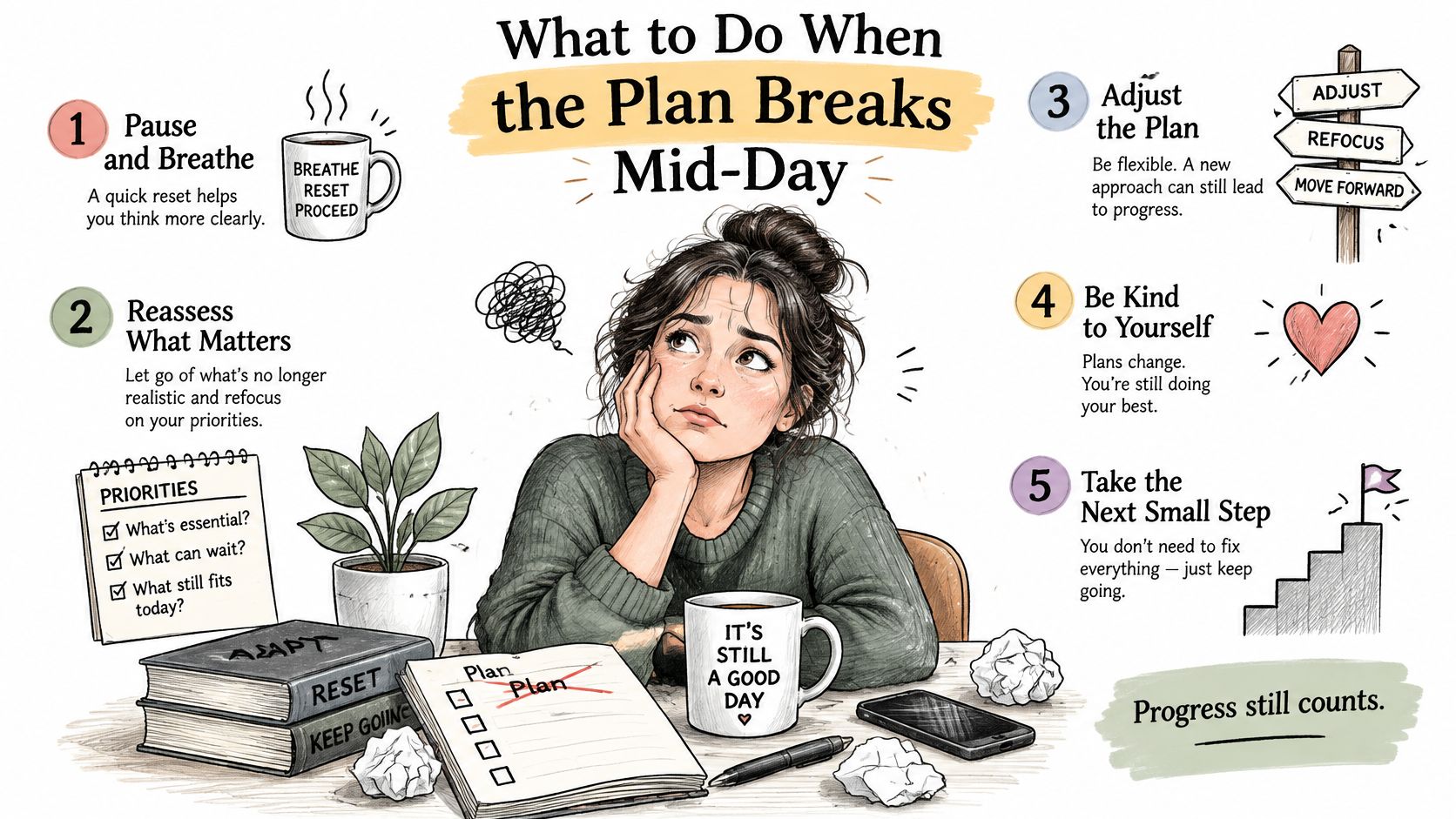
A missed block is not a failure. It’s information for the next estimate, and treating it as a character flaw just makes you avoid looking at the data. This short image sums up the moment most founders know well, the plan lying in pieces while the day keeps moving.
Three operating levels, decided in advance
Build two fallback levels under your ideal day before you need them. When fatigue or distraction cuts your capacity, you switch levels instead of improvising a confession.
| Level | What stays | What gets dropped | Switch when |
|---|---|---|---|
| Ideal day | Three priorities, full blocks and one review | Nothing | Energy feels strong and the morning went to plan |
| Baseline day | One priority, one admin block and one break | Meetings that are not required | Energy feels average or interruptions pile up |
| Minimum viable day | One 25-minute start on the top priority, plus water, food and rest | Everything else | Energy is low or the night was bad |
Name your switch signal in plain language. Two displaced blocks before lunch means baseline. A bad night plus a foggy first window means minimum viable, no debate, no heroic renegotiation at noon.
The minimum viable day still counts. One 25 minute start on the top priority preserves momentum and gives tomorrow a warm entry point. That’s a calmer way of handling setbacks without torching the whole system, because recovery is part of the design, not an apology after it.
Interruption triage and the resume protocol
Decide your emergency criterion before the day starts. A paying client blocked from launching qualifies, a colleague’s curiosity doesn’t. If a request doesn’t meet the criterion, capture it in one inbox and return after the block.
If you do have to switch, run the resume protocol first. Take one minute to write where you stopped, what you decided, and the exact next action. That note turns a twenty minute re entry fog into seconds of reading.
Say a client emergency lands at 11:40, halfway through deep work. You write “stopped at pricing paragraph, next step is add the two tier table”, take the call, then use a 10 minute buffer after it to read the note and restart. Without the note, you’d reopen the document and spend the buffer remembering what past you meant.
This video walks through rebuilding a broken block without starting the day over.
Finally, set a stopping rule for expanding tasks. When a priority runs past its window, stop at the next clean edge, write the resume note, and either move it to tomorrow’s peak window or shrink its done condition. High value work expands to fill panic, so give it a fence.
Measure your schedule by recovery and reliability, not by whether the original plan survived untouched. A plan you can re enter at 14:00 is worth more than a perfect plan you abandon at 10:00. Making a daily schedule that expects breakage isn’t pessimism, it’s engineering.
Test Tomorrow’s Schedule Tonight and Review It Weekly
Tonight, spend 20 minutes setting up tomorrow. Choose three outcome level priorities and write the first visible action for each, not a vague label like “marketing”. “Open the client brief and draft the headline” starts a brain, “marketing” starts an argument.
Write three if then rules for the interruptions most likely to hit. For example, “If the 09:00 focus block begins, then I open the brief and work for 25 minutes before checking messages.” A meta-analysis by Gollwitzer and Sheeran covering 94 independent tests found a medium to large effect on goal attainment of d = .65 for this if then format. You’re pre deciding the trigger, so depleted attention doesn’t have to improvise.
Place the hardest task in the window you rated highest and pick the template that matches tomorrow’s calendar. Rehearse your three rules once, out loud if you can stand it. Then stop planning, because more planning is just procrastination in a blazer.
The Friday numbers
Set a weekly review on a fixed day, such as Friday at 16:00, and bring three numbers. Track planned to actual time error, the percentage of priority blocks started, and the number of blocks displaced by interruptions. If time error stays high for two weeks, shrink the task units, add buffer, or delegate instead of pushing harder.
Our free Morning Blueprint and Weekly Build Filter are a starting point for this setup. If you want guided help, our System Sprint is a live attended session delivered as a booked call with a scheduled start, where you build and test the schedule with guidance. Rescheduling a System Sprint requires at least 24 hours’ notice before the scheduled start.
Run tomorrow’s schedule and log it. One honest week of data beats a month of guessing.
If your schedule keeps collapsing by mid morning, visit Jan Kutschera to grab the free Morning Blueprint and Weekly Build Filter and build tomorrow’s plan tonight. Jan helps ADHD founders replace panic productivity with engineered operating systems, and the System Sprint gives you a live, guided session to build and test yours.
Jan Kutschera
German founder, diagnosed with ADHD at 51. Built 4 agencies, now building systems for neurodivergent entrepreneurs. German engineering for the ADHD brain.
Connect on LinkedInRelated Articles

Best ADHD Planner App for Founders: 10 Ranked Picks
Searching for the best ADHD planner app? We rank 10 founder-tested options on executive-function support, delegation, sync, privacy and pricing.

How to Manage Multiple Projects with ADHD
Learn how to manage multiple projects with ADHD: set boundaries, build external systems, delegate and batch your week without burning out.

ADHD Project Management: Systems That Work with Your Brain
ADHD project management that works with your brain, not against it: external structure, visible tasks, smarter delegation and follow-through that lasts.