8 Organization Tips for ADD: Systems That Actually Stick
8 organization tips for ADD built for founders: external systems, time blocks, delegation, dopamine routines, and quick experiments you can test.
Jan Kutschera
It’s 3:17 p.m. You’ve got three tabs open, a voice memo you never transcribed, and a client reply that’s been waiting since Tuesday. Your calendar says “strategy,” your inbox says “fire,” and your brain has nominated a completely unrelated idea for immediate attention. Naturally, you’re considering reorganizing your entire business before answering the email.
That isn’t a character flaw. It’s a systems problem. A 2020 community study of 774 adults, including 303 adults diagnosed with ADHD, found that the ADHD group scored lower across nearly every measured organizational skill, including managing tasks, materials, time, and information. The study also found that participants with ADHD used organizational strategies, which points to a useful conclusion: structure can be learned and built externally. Read the study on organizational skills and adult ADHD.
These organization tips for ADD are designed as operating systems, not motivational posters. Each one replaces a fragile act of memory or willpower with a visible mechanism. Pick one, run it for seven days without buying new software, and keep what survives contact with your actual workday. For another practical perspective, see how Kohru supports focus.
Table of Contents
- 1. Build an external brain system
- 2. Engineer dopamine into the work
- 3. Use time blocks and environmental cues
- 4. Delegate to complementary strengths
- 5. Batch tasks and bundle the tempting stuff
- 6. Treat sleep, food, and movement as business infrastructure
- 7. Capture first and organize later
- 8. Create supportive accountability
- 8-Point Comparison: Organization Strategies for ADD
- Pick One Tip and Run It for Seven Days
1. Build an external brain system
Your brain is excellent at spotting possibilities. It’s less reliable as a filing cabinet for every promise, idea, decision, and next action. Stop asking it to store the company.
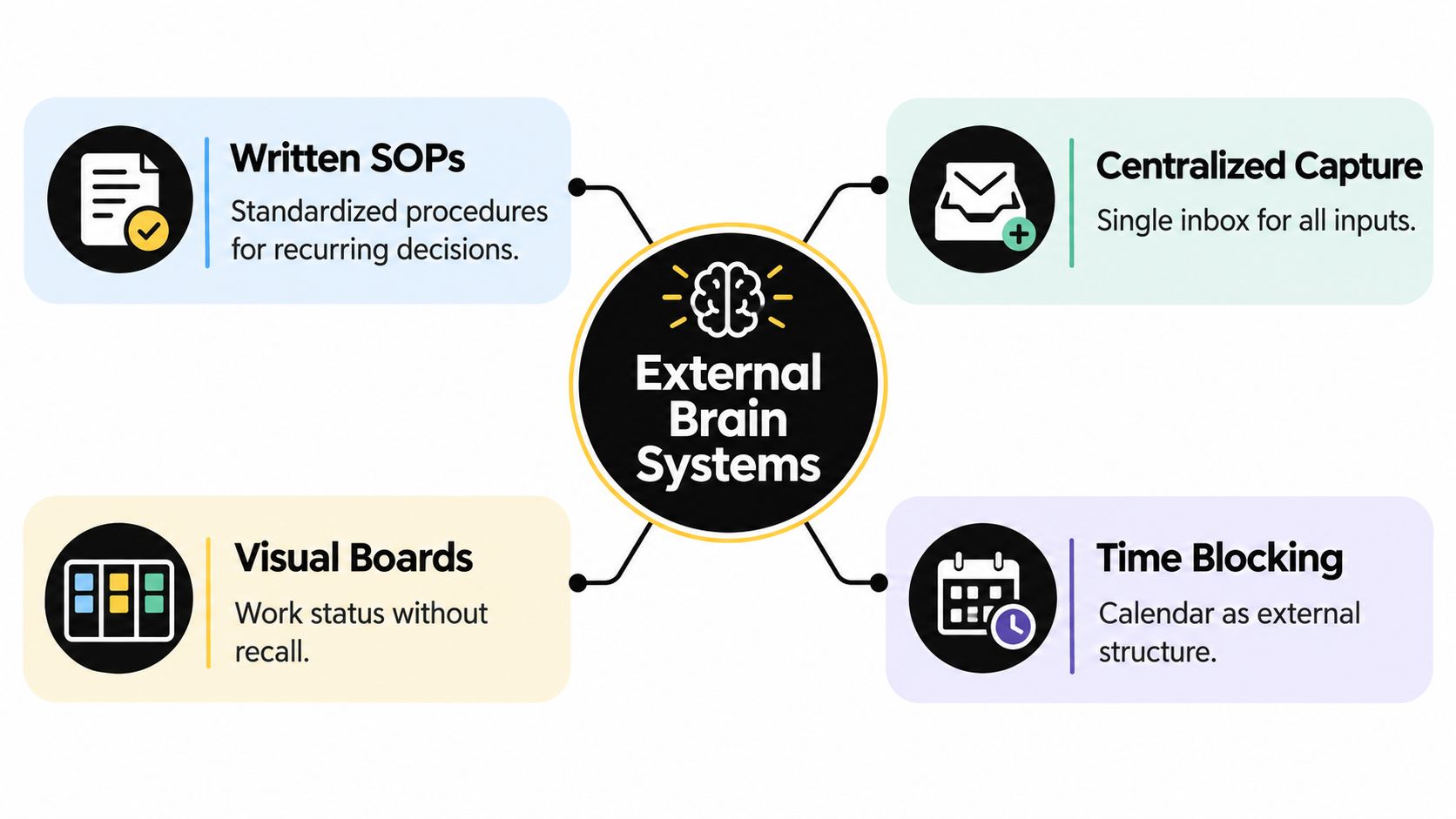
A useful external brain has four parts: centralized capture, visible work, written procedures, and protected time. You can build all four with tools you already have. Use one task board in Asana, Trello, Notion, or a plain document. Put every commitment there instead of scattering it across email flags, Slack messages, sticky notes, and heroic mental vows.
Then make the work visible. A simple board with columns such as Inbox, Next, Waiting, Done gives you a map of the business. Written SOPs handle repeatable work. A calendar protects time for work that requires concentration. Decision rules handle choices you don’t need to reinvent every afternoon.
For example, create a client qualification rule: projects must have a clear decision-maker, a defined business problem, and an agreed next step before they enter your pipeline. Create a hiring scorecard before interviews begin. Create a meeting template with an owner, desired decision, and follow-up action. Your future self will be delighted. Your future self is also a terrible person to rely on.
Practical rule: If a commitment exists only in your head, it isn’t in the company system yet.
Make the system public enough to work
Your team shouldn’t need to ask you what’s happening. Put active priorities on a shared board. Add the owner, deadline, next action, and blocker. When a decision changes, record it where the team can find it. This turns personal memory into an organizational record.
Keep the first version deliberately boring. Don’t build a cathedral of tags, views, automations, and color codes. Start with one capture location and one weekly review. Refine it after you’ve used it, rather than designing a perfect system you avoid.
This diagram shows the basic architecture: four external brain systems for organizing information.
Run the experiment this week: choose one shared task system, move every new commitment into it, and review it at the same time each day. On Friday, count how often someone asked for information that was already available elsewhere.
2. Engineer dopamine into the work
A large project called “improve the business” is motivational wallpaper. Your brain needs a visible finish line, a clear next move, and feedback before the quarterly review arrives wearing a fake mustache.
Dopamine engineering means designing work around shorter achievement cycles. Break a sales objective into daily pipeline actions. Break a product initiative into small releases. Break a client engagement into milestones the team can see and complete. The reward isn’t necessarily money. It might be a progress bar, a five-minute recognition ritual, a completed card moving into Done, or a visible record of wins.
A sales founder might track qualified conversations, proposals sent, and follow-ups completed on a whiteboard. A creative agency might celebrate a finished client phase in its team channel instead of waiting for the final campaign. A product team might mark each shipped improvement and write down what changed. The feedback arrives while the work still matters.
Keep progress concrete
Abstract goals create vague anxiety. Use output markers that answer three questions:
- What counts as complete? Define the observable result, not “work on website.”
- Where will progress appear? Use a board, notebook, spreadsheet, or team channel.
- When will you review it? Put the review on the calendar, not on your hope list.
Keep feedback close to the action. A daily review is more useful than a monthly autopsy when you’re trying to understand why work keeps slipping. Don’t tie every achievement marker to compensation, either. If every completed task becomes a financial negotiation, the system gets noisy fast.
Variable rewards can add interest, but don’t turn the business into a slot machine. Surprise the team with recognition, a better lunch, or first choice of a useful perk. Then return to the actual operating rhythm.
Small visible wins beat one grand promise that stays invisible for six weeks.
Run the experiment this week: choose one recurring business activity, record completion visibly each day, and celebrate the finished cycle before moving to the next one. On Friday, note which progress marker made it easier to start.
3. Use time blocks and environmental cues
An open calendar asks you to make the same decision all day: “What should I do now?” That’s a poor use of executive function. A time block makes the decision once, then lets the clock carry some of the load.
Give each block one job. Reserve a morning window for strategic work, a separate window for meetings, and a defined period for email. Your schedule might include Monday planning, Tuesday sales calls, and a recurring operations block. The exact arrangement should follow your energy, not somebody else’s idealized morning routine.
Put transition space between incompatible modes. A client call and deep writing don’t use the same mental gear, so don’t pretend you can switch between them without friction. Your calendar should also contain recovery space, because a schedule packed edge to edge turns one delayed meeting into a small corporate landslide.
For a more structured approach, use this 90-minute focus system for ADHD founders. You can also compare it with these ADHD time management tips.
Let the room do some work
Environment is part of the system. Keep a quiet place for strategy, a more stimulating setting for routine work, and a defined area for calls if possible. If you work remotely, a pair of headphones, a separate browser profile, or a cleared desk can signal the task before you begin.
Batch similar work together. Put meetings together where practical. Protect your highest-energy hours for the work that needs judgment. Treat calendar blocks as commitments, not decorative suggestions. If an emergency constantly eats your planning time, that’s useful information about your operating model, not proof that planning is pointless.
Run the experiment this week: protect one recurring focus block, silence notifications during it, and work in the same physical or digital environment each time. On Friday, record whether the block produced a finished output, not merely enthusiastic tab activity.
4. Delegate to complementary strengths
Your ADD brain does not need to become average at every business function. It needs an operating system that puts your strongest judgment where it creates the most value, then routes recurring weak spots to people who handle them reliably.
Map the major functions in your business: sales, delivery, finance, hiring, operations, marketing, client relationships, and reporting. For each one, rate your ability and reliability. Mark the work that gets delayed, avoided, or completed only during a crisis. Those tasks are delegation candidates, not character tests.
A creative agency owner might excel at client relationships and ideas but lose track of deliverables. A project manager can own deadlines, status updates, and handoffs while the founder stays close to the client and creative direction. A technical founder may need an operations lead to turn decisions into repeatable processes. If financial reporting makes you procrastinate, hire a fractional finance specialist instead of wrestling spreadsheets into submission.
Use this task delegation guide and the Approved Lux Personal Assistant delegation guide to turn “someone should handle this” into a real transfer of ownership.
Delegate the outcome, not just the chore
Good delegation has four parts:
- Clear ownership: One person owns the result.
- Definition of done: Everyone agrees what finished means.
- Decision boundaries: The owner knows which choices they can make without you.
- Handoff record: The next action, context, and blocker sit somewhere visible.
Delegating a task while keeping every decision creates a bottleneck with extra paperwork. Give the owner enough authority to operate, then review the output on a defined cadence. Your method is not the product. The finished result is.
Run the experiment this week: choose one recurring responsibility you have been carrying badly, write its definition of done, and hand it to one person with clear decision limits. On Friday, judge the handoff quality, speed, and clarity, not whether the person copied your exact method.
5. Batch tasks and bundle the tempting stuff
Context switching charges interest. One minute you’re answering a client question, then checking a payment, then reviewing a proposal, then wondering why you opened a spreadsheet about office chairs. Batching reduces the number of mental gear changes.
Choose your common task categories and give them homes. Email can live in a defined window. Calls can cluster on a particular day. Finance and administration can share a block. Content creation can happen in one focused session rather than appearing as a daily speck of unfinished guilt.
The trick is to remove rival tasks from the batch. During an email block, don’t “quickly” open the project board. During finance time, don’t start rewriting your homepage. Close the tabs. Put the phone away. Your future distractions will survive the wait.
Add stimulation without losing control
Temptation bundling pairs an unpleasant task with a permissible reward. Listen to a favorite podcast while processing expenses. Use a coffee shop for administrative work if the setting helps. Play energetic music during file cleanup. Take walking calls when the conversation doesn’t require a screen.
A timer adds a useful boundary. Give the batch a defined start and end, then stop when the block ends unless you’ve deliberately scheduled more. Urgency can help you start, but endless urgency is how founders accidentally build a business powered by panic.
Use a paper card with three sections: Today’s batch, Not today, Finished. The visual movement matters. You’re not trying to become a serene monk. You’re trying to keep Tuesday’s calls from colonizing every other day.
Run the experiment this week: pick one tedious category, pair it with a favorite form of stimulation, and complete it in one scheduled block. On Friday, compare the number of unfinished fragments with your usual scattered approach.
6. Treat sleep, food, and movement as business infrastructure
Your operating system runs on a body. Ignore that fact and the business eventually sends you an invoice.
Sleep, nutrition, and movement affect the conditions under which you plan, prioritize, regulate emotion, and make decisions. They’re not a reward you earn after the company becomes stable. They’re part of the infrastructure that helps you create stability in the first place.
Start with observation rather than a dramatic lifestyle overhaul. Record your bedtime, wake time, sleep quality, meals, movement, and focus in a notebook. Notice what happens after a poor night, a skipped meal, or a long stretch without movement. The useful question is practical: What conditions make reliable work easier for me?
Build biological defaults
Protect a consistent sleep window that gives you enough rest. Put the bedtime on the calendar if necessary. Keep an easy protein-rich meal available for the afternoon instead of relying on whatever snack is closest to the keyboard. Add movement to existing work through walking meetings, standing calls, or a short walk between demanding blocks.
Your system should reduce decisions. Keep water visible. Put walking shoes near the desk. Prepare food before the busy day begins. Schedule exercise like a client commitment, because you already know how seriously you treat those.
Don’t use this as a reason to chase miracle protocols or diagnose yourself from a productivity slump. If sleep, appetite, mood, or attention problems feel persistent, discuss them with a qualified clinician. Business systems work better when they sit on appropriate health support.
Run the experiment this week: protect one sleep routine, one reliable meal, and one movement appointment each day. On Friday, review which days produced the clearest decisions and strongest follow-through.
7. Capture first and organize later
The moment an idea arrives is the worst time to decide where it belongs. You’re in a meeting, walking between calls, or brushing your teeth, and your brain suddenly offers the solution to a problem from last month. If capture requires sorting, labeling, filing, and choosing a project, the idea may vanish before you find the correct folder.
Use one capture inbox. It can be a notebook, a phone note, a voice memo, a simple document, or one digital inbox. The tool matters less than the rule: capture now, process later.
Keep capture under ten seconds. Write “send revised scope to Maya,” not a paragraph about the emotional history of the proposal. Record the idea, commitment, or concern in plain language. If you’re driving or moving, use a voice memo and process it when you’re stationary.

Give the inbox a processing appointment
An inbox is not a graveyard for good intentions. Schedule a weekly processing block. Open every captured item and use four decisions:
- Do now: Complete it if it’s small and urgent.
- Schedule later: Give it a date or time block.
- Delegate: Send it to the person who owns the outcome.
- Delete: Remove it if it no longer matters.
Turn vague items into physical next actions. “Fix onboarding” becomes “draft the first version of the onboarding checklist.” “Think about pricing” becomes “compare the current three pricing options and list open decisions.” Keep completed notes searchable rather than relying on your memory to recreate context.
This system also solves a common handoff failure. A founder’s private note becomes useful only when it turns into an owner, a next action, and a visible record the team can access.
Run the experiment this week: choose one inbox, capture everything there, and process it during one scheduled weekly block. On Friday, count how many commitments would have disappeared without the capture rule.
8. Create supportive accountability
A deadline that exists only in your head has a suspicious habit of moving. External accountability adds a useful layer of reality, especially when a project feels smaller, easier, or more exciting than it really is.
Choose a person or group that can challenge you without turning the meeting into a shame festival. A founder circle, peer partner, advisor, or team review can work. Share specific commitments: “send the proposal by Thursday” beats “make progress on sales.” Review often enough to preserve momentum, but not so often that accountability becomes another source of noise.
Use accountability for course correction. If you missed the commitment, ask what the system got wrong. Was the next action unclear? Did the task need a time block? Did somebody else own the decision? Did the work require information you didn’t have? Blame creates hiding. Diagnosis creates a better operating system.
For a focused partner arrangement, use this guide to define an accountability partner.
Track what you control
Outcome metrics matter, but process commitments give you something actionable. Track proposals sent, follow-ups completed, handoffs written, or focus blocks protected. Celebrate completion and learning, not theatrical perfection. A useful partner notices patterns you can’t see while you’re busy defending the week.
A team can publish weekly priorities on a shared dashboard and review them together. A founder can send a brief Friday note to a peer with three lines: completed, blocked, next. Keep the format stable. Novelty is charming in a restaurant. It’s less helpful in accountability.
Run the experiment this week: choose one supportive accountability partner, make one specific commitment, and send a Friday update using the same three-line format. On Friday, identify the exact point where the work slowed and change that part of the system.
8-Point Comparison: Organization Strategies for ADD
| Approach | Implementation Complexity 🔄 | Resource Requirements ⚡ | Expected Outcomes ⭐ | Ideal Use Cases 💡 | Key Advantages 📊 |
|---|---|---|---|---|---|
| External Brain Systems (Cognitive Architecture) | 🔄🔄🔄, structured design & maintenance required | ⚡⚡⚡, upfront design, tools, ongoing upkeep | ⭐⭐⭐, consistent reduced cognitive load, scalable operations | Founders scaling ops; teams needing predictable workflows | Offloads working memory; creates repeatable SOPs; clearer delegation |
| Dopamine Engineering (Sustainable Reward Design) | 🔄🔄🔄, intentional design and calibration | ⚡⚡, tracking/feedback systems and rituals | ⭐⭐⭐, sustained motivation with less burnout | Teams prone to crisis-driven work; roles needing frequent feedback | Stable motivation loops; immediate feedback; morale boosts |
| Time Blocking & Environmental Design | 🔄🔄, planning and environment setup | ⚡⚡, calendar discipline, workspace adjustments | ⭐⭐⭐, protected deep work, fewer context switches | Knowledge work requiring focus; teams coordinating schedules | Eliminates “what to do now”; preserves deep focus; predictable rhythm |
| Strategic Delegation to Complementary Teams | 🔄🔄🔄, hiring, mapping, and handoffs needed | ⚡⚡⚡, recruiting/training costs and documentation | ⭐⭐⭐, removes bottlenecks; multiplies founder impact | Founders needing to scale or cover execution gaps | Frees founder energy; places specialists in charge; improves outcomes |
| Task Batching & Temptation Bundling | 🔄, simple scheduling rule changes | ⚡, low-cost, immediate to implement | ⭐⭐, reduces switching cost; boosts completion rates | Admin work, email, calls, routine tasks | Low-effort; quick wins; makes tedious tasks tolerable |
| Bio-Optimization (Sleep, Nutrition, Movement) | 🔄🔄, habit change and monitoring | ⚡⚡, tracking tools, routine shifts | ⭐⭐⭐, stronger baseline executive function over time | High-stakes decision makers; chronically fatigued teams | Improves focus capacity; reduces emotional reactivity; long-term payoff |
| Capture First, Organize Later System | 🔄, one-rule capture then weekly processing | ⚡, one inbox + processing time | ⭐⭐⭐, preserves momentum; prevents lost items | Idea-heavy roles; anyone prone to decision paralysis | Minimizes capture friction; single source of truth; predictable processing |
| Accountability Structures & Public Commitments | 🔄🔄, setting partners/processes and norms | ⚡⚡, meetings, monitoring, peer networks | ⭐⭐⭐, increases follow-through and realistic planning | Founders prone to optimism bias; goal-driven teams | External motivation; early course correction; peer support |
Pick One Tip and Run It for Seven Days
Eight systems are useful. Eight simultaneous changes are a fresh way to create eight new things to forget.
Start with the point of greatest friction. If commitments vanish, begin with capture first. If your calendar is a fog of meetings, begin with time blocking. If you keep rescuing work that other people should own, begin with strategic delegation. If your team repeatedly asks what’s happening, begin with the external brain system and make ownership visible.
The best first system is usually the one that removes the most daily decision-making. You don’t need a new dashboard, a paid app, or a weekend retreat with color-coded index cards. Use a notebook, calendar, shared document, or whiteboard. The system earns its place by making work more reliable, not by looking impressive during setup.
Run a clean seven-day test. Write down the problem in one sentence. Choose one behavior that addresses it. Define the smallest visible measure of success. Then put the behavior on your calendar every day it matters.
For example:
- Problem: Client commitments disappear into meetings.
- System: Capture every commitment in one notebook during the meeting.
- Measure: Number of commitments still unassigned by Friday.
- Review: Process the notebook at a scheduled time each day.
Or:
- Problem: Strategic work gets pushed aside by messages.
- System: Protect one calendar block with notifications off.
- Measure: Whether a defined strategic output is finished.
- Review: Record the result immediately after the block.
Don’t judge the system by how motivated you felt. Judge it by what happened. Did fewer tasks slip? Did a teammate find the information without asking you? Did you make fewer repeated decisions? Did the work move with less drama?
A 2020 study of adults with ADHD found that organizational strategies were a notable exception to the broader pattern of weaker organizational skills, which supports building deliberate external supports rather than treating organization as a fixed personal trait. The full research is available here. Clinical research on adult ADHD cognitive-behavioral therapy has also centered practical skills such as organizing and planning, prioritizing, breaking overwhelming projects into manageable pieces, and structured problem solving. Review the clinical research summary.
By Friday, count how often the original problem occurred. Keep the system if the number moved in the right direction. Adjust one part if it didn’t. Then run the next experiment. That’s how an ADHD-friendly company gets built, one reliable external support at a time.
If you want a fuller framework, adhd-founder.com offers a Starter Kit built around active-project capture, limited weekly priorities, dedicated time blocks, and handoff notes with next actions and blockers. Jan Kutschera also provides advisory support and a curated Founder Circle for founders who want to replace crisis-driven momentum with clearer operating systems.
Jan Kutschera helps founders with ADHD turn scattered commitments, fragile handoffs, and panic productivity into visible, repeatable systems. Explore the practical frameworks and support options at Jan Kutschera and choose one operating change to test this week.
Jan Kutschera
German founder, diagnosed with ADHD at 51. Built 4 agencies, now building systems for neurodivergent entrepreneurs. German engineering for the ADHD brain.
Connect on LinkedInRelated Articles

Accountability Partner App: 10 Picks for ADHD Founders
Compare 10 accountability partner apps for ADHD founders: how each works, setup workflows, privacy and pricing trade-offs, and which fits your needs.
ADHD Burnout Cycle: Stages Founders Can Break
See the ADHD burnout cycle in five stages, separate it from depression, and test founder fixes before the next crash.

Best ADHD Planner for Adults: A 2026 Guide
Find the best ADHD planner for adults with a quick-pick table, a founder card you can copy, dopamine rewards, and a 14-day test.